The restriction that defines the whole subject
A catalyst is defined as much by what it is forbidden to do as by what it does. It accelerates a chemical reaction and emerges from that reaction chemically unchanged, participating in a closed cycle rather than being consumed. What it cannot do is move the position of equilibrium. If a reaction mixture, left alone for long enough, would settle at a particular ratio of products to reactants, then the same mixture with a catalyst present settles at exactly the same ratio. It simply gets there sooner.
The reason is a bookkeeping identity rather than an empirical observation. The equilibrium constant is fixed by the standard Gibbs energy difference between reactants and products,
and that difference is a property of the two end states alone. A catalyst is present in the initial state and present again, unaltered, in the final state. It therefore cancels out of the difference. Any device that genuinely shifted an equilibrium while returning to its original condition would be a perpetual motion machine of the second kind, and could be operated in a loop to extract work from a single heat bath.
This is the restriction from which every practical difficulty in catalysis follows. A catalyst designer cannot make an unfavourable reaction favourable. What a designer can do is change the mechanism: replace a single hard step with a sequence of easier ones, each of which the system can actually perform at the temperature available. The thermodynamics stays fixed; the kinetics is negotiable. Almost all the interesting engineering lives in that gap.
It is worth saying plainly that “the equilibrium is untouched” is a statement about a closed system at a single temperature and pressure. Industrial reactors are not closed. Ammonia is condensed out and recycled; product is swept away by a gas stream. Removing product does shift the achievable conversion, but this is Le Chatelier acting on the process, not the catalyst acting on the equilibrium constant. Conflating the two is one of the more common errors in popular accounts of industrial chemistry.
The barrier, and the two relations that quantify it
Between reactants and products lies a configuration of maximum energy along the reaction path: the transition state. It is not an intermediate that can be isolated. It is a saddle point on the potential energy surface, stable against every displacement except the one that carries it forward or back. The energy required to reach it from the reactant side is the activation energy, and it is what makes a thermodynamically favourable reaction slow.
Arrhenius gave the empirical form. The rate constant depends on temperature as
where the exponential term is, to a good approximation, the fraction of molecular encounters carrying enough energy to clear the barrier, and the pre-exponential factor collects everything about how often encounters happen and how many of them are correctly oriented. The practical consequence of the exponential is severe. At around room temperature, lowering the activation energy by roughly six kilojoules per mole multiplies the rate by about a factor of ten. A catalyst that removes eighty kilojoules per mole from a barrier is not making the reaction somewhat faster; it is making it faster by a factor with thirteen or fourteen digits.
Transition state theory recasts this in thermodynamic language. Treating the activated complex as in quasi-equilibrium with the reactants gives
in which the universal frequency factor sets the timescale, the Gibbs energy of activation sets the barrier, and the transmission coefficient absorbs the failures of the picture — recrossing of the dividing surface, tunnelling, and the fact that the chosen reaction coordinate is rarely perfect. Splitting the activation Gibbs energy into enthalpic and entropic parts is the point of the exercise. It makes explicit that a catalyst can help either by lowering the enthalpic cost of bond reorganisation or by paying the entropic price of bringing partners together and holding them in the right geometry. Enzymes exploit both routes; heterogeneous catalysts lean heavily on the second, because a surface that has already adsorbed both partners has removed most of their translational and rotational freedom before the reaction begins.
An alternative path means a different sequence of bonds
The phrase “the catalyst provides an alternative path” is often left as a metaphor. Physically it means something quite specific: the catalysed reaction proceeds through a different set of chemical species, with different bonds broken and formed in a different order, and the highest barrier along that new sequence is lower than the single barrier of the uncatalysed route.
In heterogeneous catalysis the alternative path begins with adsorption. A molecule approaching a metal surface can chemisorb, forming genuine chemical bonds with surface atoms. In doing so it lends electron density to the metal and borrows some back, and bonds within the molecule weaken. A nitrogen molecule in the gas phase has one of the strongest bonds in chemistry; the same molecule lying on a suitable metal surface has a bond that can be broken with far less help, because the surface is already paying part of the cost by forming metal-nitrogen bonds as the internal bond stretches. The reaction never has to pass through the gas-phase dissociation barrier at all. It takes a different road entirely.
That is the mechanism, and it immediately generates the central tension of the field. The surface has to bind the reactant strongly enough to activate it, and weakly enough to let the product go.
Sabatier’s optimum and its empirical shape
Paul Sabatier stated the principle in 1913 on the basis of empirical observation, at a time when binding energies could not be measured directly and were approximated by proxies such as hydride or chelate formation energies [14]. The statement is deceptively simple: the best catalyst binds the reacting species neither too weakly nor too strongly. Bind too weakly and nothing is activated, because coverage is negligible and the barrier to dissociation stays high. Bind too strongly and the surface fills with species that will not leave, and the sites are lost to the very intermediates they created.
Plotted against binding strength, activity therefore rises, peaks and falls. The resulting shape gave the field its most recognisable graphic, and its acceptance in electrocatalysis dates from the early 1970s [14]. The modern quantitative version rests on two structural facts about transition-metal surfaces. First, activation energies for a given class of elementary step correlate linearly with the reaction energy of that step, so a thermodynamic quantity predicts a kinetic one. Second, the binding energies of related adsorbed species scale with one another, so a great many parameters collapse onto one or two descriptors. Medford and colleagues describe the resulting activity map as a quantitative implementation of the classical Sabatier principle, in which scaling relations determine which bond strengths are the relevant ones and the descriptors, being calculable and measurable, make the theory experimentally testable [10].
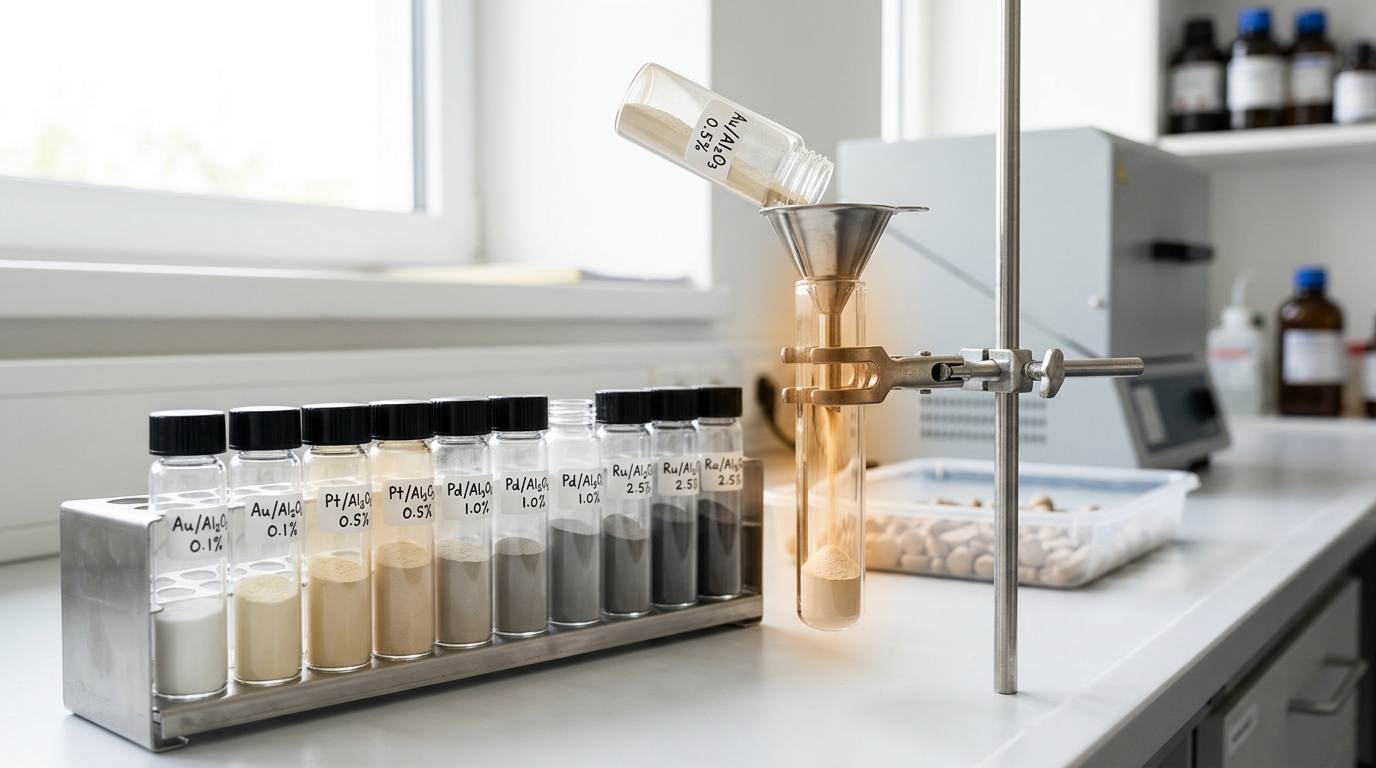
It is worth being careful about what the volcano does and does not establish. Quaino, Juarez, Santos and Schmickler examined volcano plots for hydrogen evolution and found that when oxide-covered metals are excluded from the data set, the evidence for the descending branch largely disappears; they argue that the Sabatier principle “is only one of several factors that determine the rate” and that single-descriptor models understate the role of orbital interactions and multiple adsorption states [15]. Ooka, Huang and Exner reach a compatible conclusion from the theory side, noting that scaling relations make the thermodynamically ideal catalyst unreachable in the first place, that the assumed linear relation between activation energy and reaction free energy sits uneasily beside Marcus theory’s quadratic relation, and that the conventional analysis is carried out at zero overpotential, where no turnover is actually observed [14].
The disagreement here is worth characterising rather than resolving. Nobody disputes that binding strength has an optimum. What is contested is how much of the observed activity variation a single binding descriptor can carry, and whether the descending branch of a given volcano reflects real Sabatier behaviour or an artefact of comparing materials whose surfaces differ in composition under reaction conditions. Both camps agree the answer is reaction-specific, which is itself a limit on how far the framework generalises.
Most of the surface does nothing
The volcano treats a catalyst as though it had one kind of site. It does not. This is not a small correction.
Spencer, Schoonmaker and Somorjai compared iron single crystals as ammonia synthesis catalysts and found that at 798 kelvin and twenty atmospheres of a stoichiometric hydrogen-nitrogen mixture, the relative rates of ammonia formation on the Fe(111), Fe(100) and Fe(110) faces stood at 418 to 25 to 1, with an activation energy on the most active face of 19.4 kilocalories per mole [6]. Three faces of the same pure metal, differing only in how the atoms are arranged at the surface, differ in activity by more than two orders of magnitude.
The effect is sharper still when the comparison is between flat terraces and the atomic steps that interrupt them. Dahl and co-workers combined adsorption experiments with density functional calculations on ruthenium and found that nitrogen dissociation on Ru(0001) is dominated by steps to a degree that is difficult to overstate: the measured adsorption rate at the steps was at least nine orders of magnitude higher than on the terraces at 500 kelvin, corresponding to a calculated activation energy difference of 1.5 electronvolts [5]. Steps typically constitute a small percentage of the atoms on a real surface. On that catalyst, essentially the entire reaction is happening on a small minority of the material, and the overwhelming majority of the surface is inert scenery.
Nørskov and colleagues generalised this into a framework for the active site in metal catalysis, introducing a degree of structure sensitivity to describe how strongly a given reaction depends on which sites are present, and connecting it to Brønsted-Evans-Polanyi relations and volcano curves [7]. The practical implications run in several directions at once. Particle size matters, because the proportion of edge, corner and step atoms changes as particles shrink. Synthesis method matters, because it determines which facets are exposed. And a measured turnover frequency computed by dividing rate by total surface area is a fiction if only a small fraction of that area is active; the true per-site rate may be orders of magnitude higher than reported.
Poisoning is a small-numbers problem
If nearly all the turnover happens on a small minority of sites, then a small quantity of a strongly binding impurity can destroy a disproportionate share of the activity. This is why poisoning is measured in parts per million and sometimes parts per billion rather than in percentages.
Sulfur is the canonical example. In steam methane reforming over nickel, sulfur impurities at parts-per-million levels reduce the working life of commercial catalysts to months or weeks, and much of the research effort goes into bimetallic formulations that tolerate ten to fifty parts per million of hydrogen sulfide rather than being killed by it [17]. The mechanism is exactly what the site picture predicts: sulfur binds to the same low-coordinated metal atoms that activate the reactant, binds far more strongly, and does not leave.

Poisoning is only one of several ways a catalyst dies, and the others operate on different timescales. Thermal sintering coarsens small particles into larger ones, reducing the number of low-coordinated sites without adding any foreign element. Carbon deposition physically buries the surface. Volatile compound formation carries the active metal away in the gas phase. Attrition grinds pellets to dust. The industrial consequence is a spread of working lives that covers seven orders of magnitude in time: fluid catalytic cracking catalyst is regenerated on a timescale of seconds, while promoted iron ammonia catalyst sustains synthesis for seven to ten years under industrial conditions [16].
That durability is engineered rather than intrinsic. Recent operando microscopy and near-ambient-pressure photoelectron spectroscopy on technical multi-promoted ammonia catalysts describe an active structure consisting of a nanodispersion of iron covered by mobile potassium-containing adsorbates, held open by cementitious mineral phases built from oxides of aluminium, silicon and calcium; the promoters contribute simultaneously to structural stability, hierarchical porosity, activity and poisoning resistance [16]. The commercial catalyst is mostly not the catalyst. It is a scaffold whose job is to keep a small amount of active iron dispersed, accessible and alive for a decade.
Enzymes are the extreme case of the same idea
Pauling proposed in 1948 that an enzyme’s active site is complementary not to the substrate but to the transition state, binding the strained, distorted configuration far more tightly than the ground state and thereby lowering the activation barrier [1]. It remains the single most productive idea in mechanistic enzymology, and it makes a falsifiable prediction: stable molecules that mimic the transition state’s geometry and charge should bind extraordinarily tightly. They do, and transition-state analogue inhibitors became a standard route to drug design on the strength of it.
The magnitudes involved are worth stating precisely, because they are routinely rounded off into meaninglessness. Radzicka and Wolfenden measured the spontaneous decarboxylation of orotic acid in neutral aqueous solution at room temperature and found a half-time of 78 million years. Orotidine 5’-phosphate decarboxylase accelerates that reaction by a factor of 10 to the 17th power, and is estimated to bind the altered substrate in the transition state with a dissociation constant of less than 5 times 10 to the minus 24 molar [2]. Their broader survey found that the spontaneous rates of enzyme-susceptible reactions span more than fourteen orders of magnitude, while the corresponding enzymatic second-order rate constants are confined to a range of only about six hundredfold [2]. Enzymes have, in effect, flattened an enormously uneven kinetic landscape onto a narrow band of biologically useful rates. Wolfenden and Snider later described uncatalysed reactions whose half-times approach the age of the Earth, and attributed enzyme proficiency to a high level of synergism among binding elements rather than to any single trick [3].
How that stabilisation is achieved is genuinely contested. Warshel and colleagues argue that the dominant contribution is electrostatic: the active site’s charges and dipoles are held in a preorganised arrangement by the protein fold, so that the transition state’s charge distribution is stabilised without the reorganisation penalty that water must pay, and they insist that relating structure to energetics requires simulation rather than inspection [4]. Competing accounts have emphasised near-attack conformations, dynamical coupling of protein motions to barrier crossing, and ground-state destabilisation. The disagreement is not about whether enzymes stabilise transition states, which is settled, but about how the free energy is partitioned among mechanisms and whether protein dynamics contributes anything beyond conventional transition state theory. It is a live argument in the literature and should not be reported as resolved.
Haber-Bosch as the worked example
Nitrogen fixation is where every element of the preceding argument becomes visible at industrial scale. Atmospheric nitrogen is abundant and almost completely unreactive. The synthesis of ammonia from nitrogen and hydrogen is exothermic and entropically unfavourable, so thermodynamics prefers low temperature and high pressure, while kinetics demands high temperature. That contradiction is the entire process design problem, and only a catalyst makes it soluble.
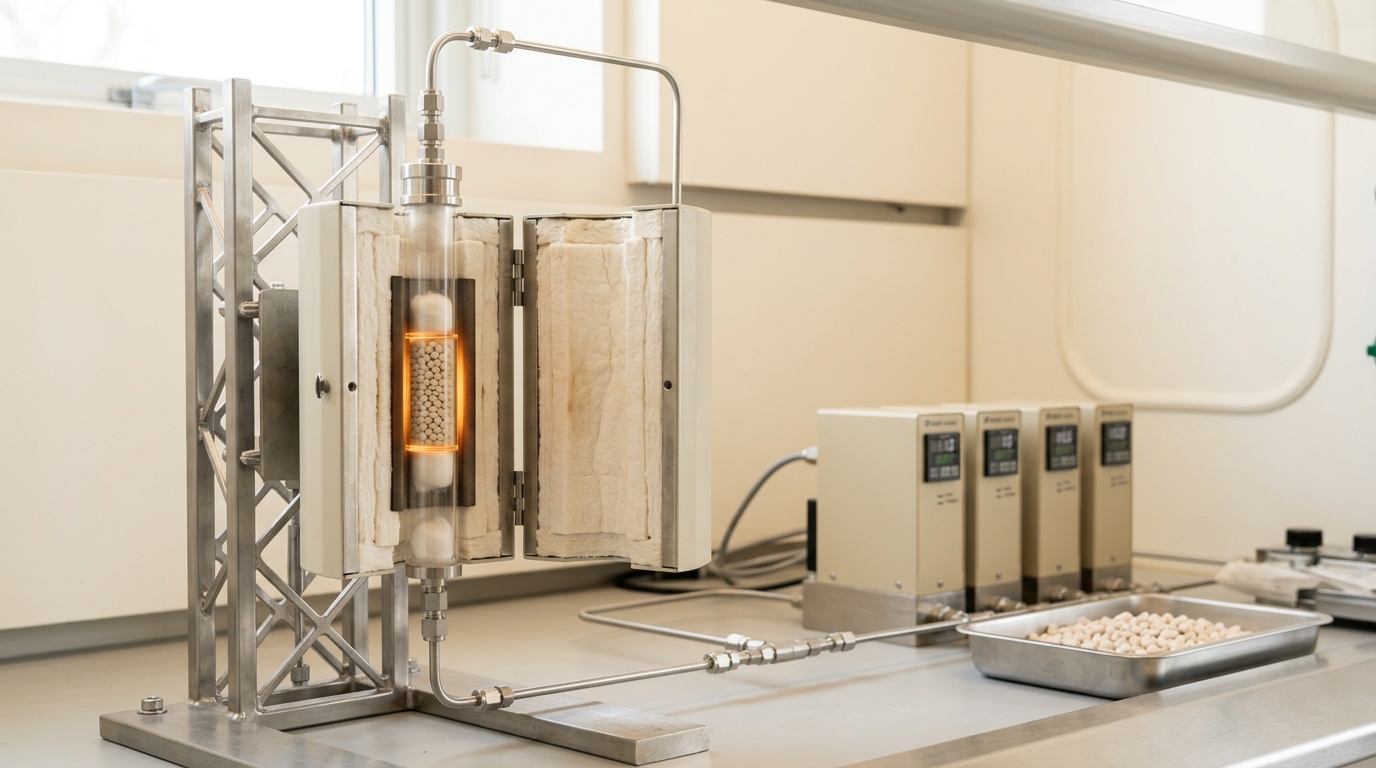
Industrial ammonia synthesis runs over an iron-based catalyst at roughly 400 to 500 degrees Celsius and 150 to 300 bar [20]. The high pressure is thermodynamic compensation for a temperature chosen entirely to make the catalyst work. The rate-limiting step is the dissociative adsorption of nitrogen, which is exactly the step the surface science quantified: it happens overwhelmingly at step and other low-coordinated sites, which is why the structure sensitivity is so severe and why promoters that stabilise the right surface arrangements matter so much [5, 6].
The consequences are not modest. Erisman and colleagues, marking the centenary of Haber’s patent, estimated that roughly 48 per cent of the world’s population in 2008 was fed by food grown with Haber-Bosch nitrogen [18]. The energy footprint is correspondingly large. The International Energy Agency puts global ammonia production at around two per cent of total final energy consumption, or 8.6 exajoules, with direct emissions of 450 megatonnes of carbon dioxide and indirect emissions of around 170 megatonnes per year, and about 70 per cent of the output going to fertiliser [19]. Per tonne of product, the process consumes over 30 gigajoules and emits on the order of 2.16 tonnes of carbon dioxide [20]. Most of that carbon comes from making hydrogen out of natural gas rather than from the synthesis loop itself, which is why decarbonisation efforts target the hydrogen supply first.
Two per cent of world energy for a single catalytic reaction is the clearest available statement of what activation barriers cost when you have to pay for them in a reactor.
Computational design: what actually works, and what does not
The ambition of computational catalysis is to replace trial-and-error screening with calculation. The honest assessment is that it has produced real successes within a bounded domain and that the bounds are set by the accuracy of the underlying energies.
The successes are concrete. Honkala and co-workers computed the rate of ammonia synthesis over ruthenium nanoparticles directly from density functional theory, using the measured particle size distribution to connect the calculation to a real supported catalyst, and obtained a rate within a factor of three to twenty of the measured value [9]. For a quantity that varies over many orders of magnitude across catalysts, agreement inside a factor of twenty with no fitted kinetic parameters is a substantive result. Nørskov and colleagues have argued from this and related work that reactivity trends at transition-metal surfaces are now understood well enough to enable in silico design of heterogeneous catalysts in a few cases, with the qualifier “in a few cases” carrying real weight [8].
The limits are equally concrete, and the field has been unusually candid about them. Medford and colleagues propagated the error in the exchange-correlation functional through a microkinetic model of ammonia synthesis using ensembles of functionals, and found that density functional errors of the order of 0.2 electronvolts translate into uncertainty of one to two orders of magnitude in predicted turnover frequency, while relative rates between catalysts carry roughly one order of magnitude of uncertainty because the energetic errors are correlated and partially cancel [11]. That result deserves to be read in both directions. Error cancellation is why ranking candidate materials works better than it has any right to. The absolute number is why a calculated turnover frequency is not a specification.
Functional choice is not a solved problem either. Kim, Yu, Tian and Medford assessed functionals from the generalised gradient approximation up to the random phase approximation for gas-phase nitrogen species, lattice constants of metals, oxides and metal-organic frameworks, and adsorption energies of nitrogen-containing intermediates, and reported that the choice of functional and van der Waals correction “can have a surprisingly large effect” and that increasing the level of theory does not always improve accuracy for nitrogen compounds [12]. There is no universally correct setting to dial in; the choice has to be justified per system.
Machine learning has changed the throughput of this pipeline without changing its foundation. The Open Catalyst 2020 dataset released 1,281,040 density functional theory relaxations, comprising roughly 264,890,000 single-point evaluations across a wide range of materials, surfaces and adsorbates, specifically to train models that approximate those calculations at a fraction of the cost [13]. This is a genuine capability shift for screening. It is also, unavoidably, a model of a model: a surrogate trained on density functional theory inherits that theory’s systematic errors and adds its own. Faster wrong answers are still wrong answers, and no amount of learned interpolation repairs an inaccurate functional.
What would change this assessment
A prediction, stated with its conditions so it can be checked. Horizon: five years, to mid-2031. I expect descriptor-based and machine-learned screening to keep delivering reliable rankings of candidate materials within well-studied reaction families, while continuing to fail at predicting absolute turnover frequencies to better than an order of magnitude for reactions involving new elements or supports.
Assumptions: that exchange-correlation functional error remains the dominant error term rather than being superseded by a cheap higher-level method; that surrogate models continue to be trained predominantly on density functional theory labels rather than on experimental kinetics; and that no widely adopted method emerges for treating the working surface under reaction conditions, as opposed to the idealised clean surface.
Observable indicators: the number of published catalysts whose discovery is credited to computational screening and which then reach pilot scale; whether uncertainty quantification of the kind Medford’s group introduced becomes routine in screening papers rather than exceptional; and whether reported errors on absolute rates narrow.
Disconfirmation condition: if a group publishes blind, pre-registered predictions of absolute turnover frequencies for a set of previously unmeasured catalysts and lands within a factor of three across a chemically diverse set, the assessment above is wrong and should be discarded.
The tool and the metal
Return to the restriction. A catalyst cannot change what a system is able to become. It changes only which path the system takes and how much work that path costs, and it does so by offering a sequence of bonds that the reactants can make and break at the temperature available.
Everything difficult follows from there. Because the path runs across a surface, binding strength has an optimum and cannot simply be maximised. Because the path runs through particular atomic arrangements, most of the material is spectator and a trace of the wrong impurity is fatal. Because the alternative path is chemistry rather than magic, it can be computed — and because computing it means computing energy differences to a small fraction of an electronvolt, it can be computed only so well. The framework is genuinely predictive about trends and genuinely uncertain about magnitudes, and the field’s willingness to publish that distinction rather than paper over it is the reason its claims can be trusted at all.