One product, four rigs, no free lunch
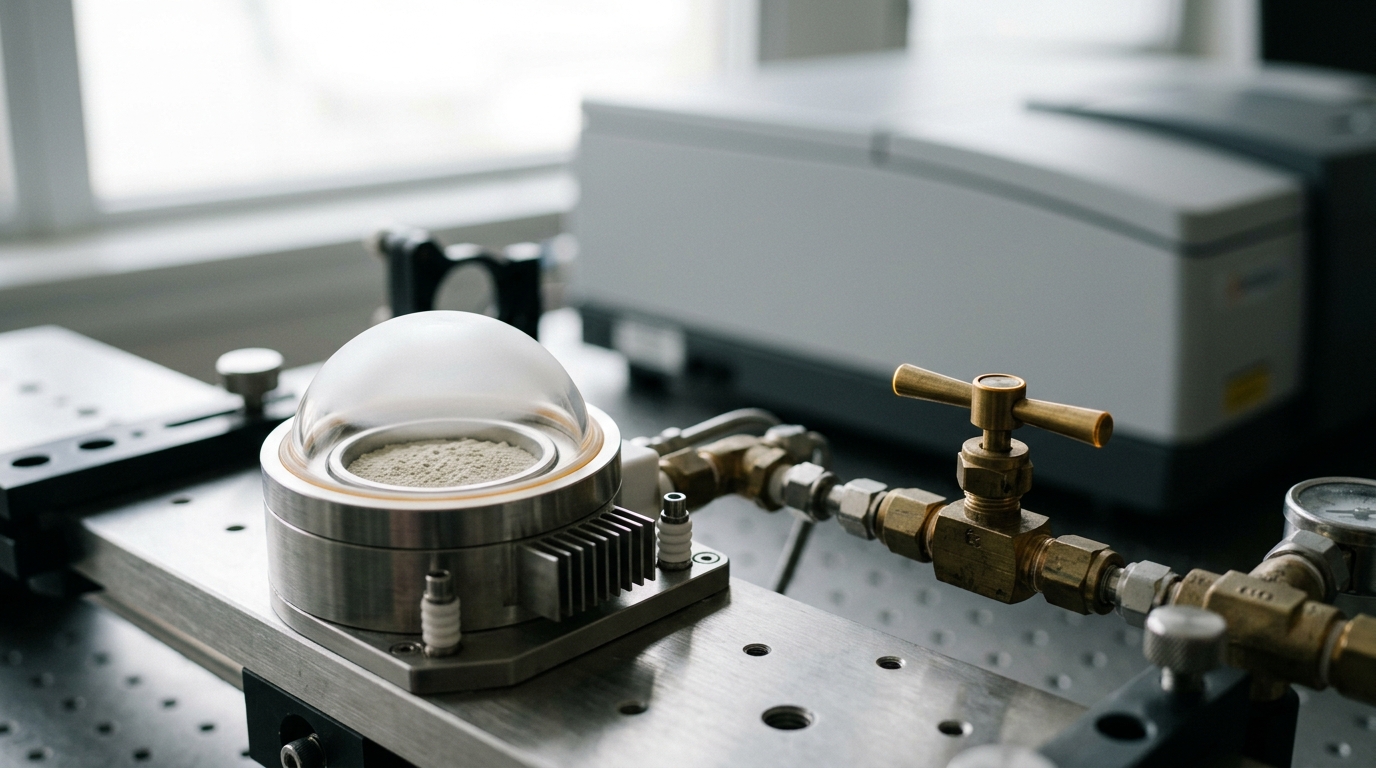
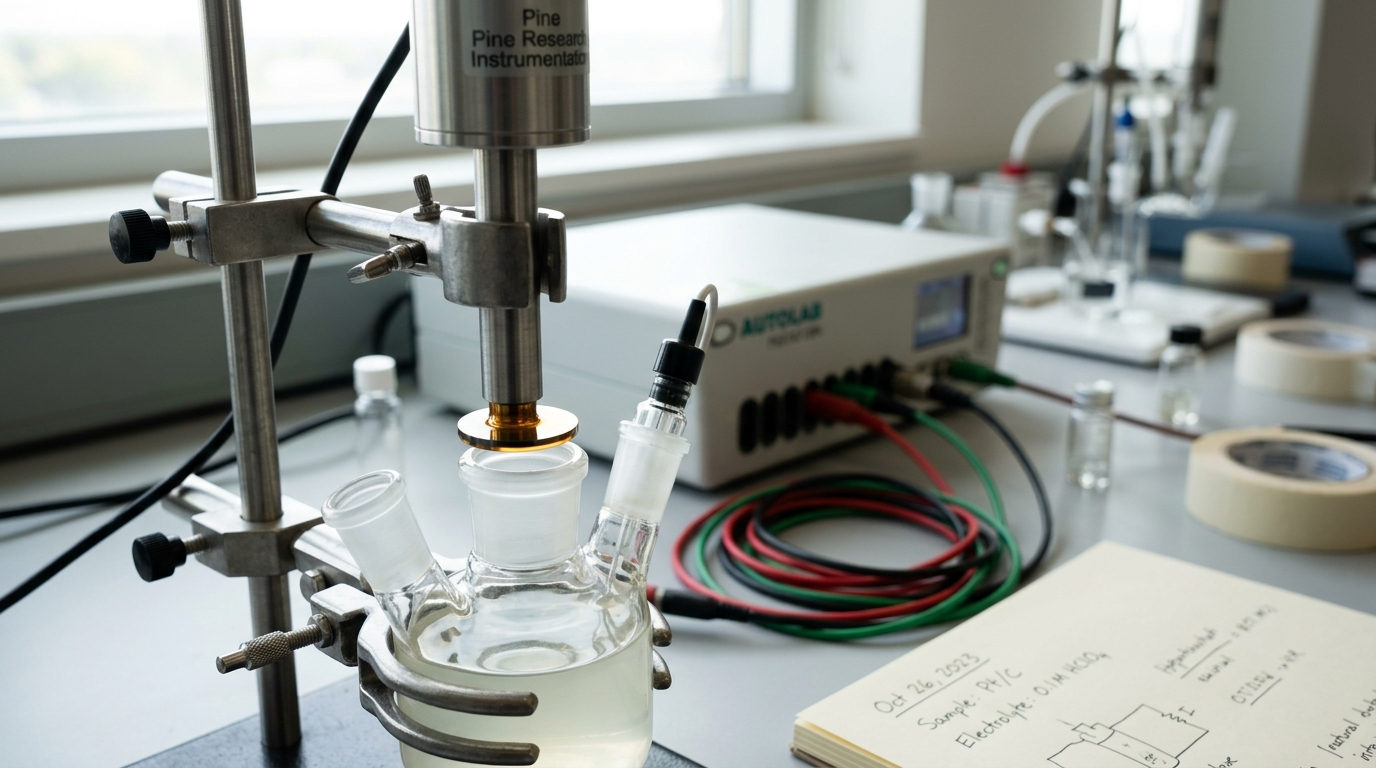
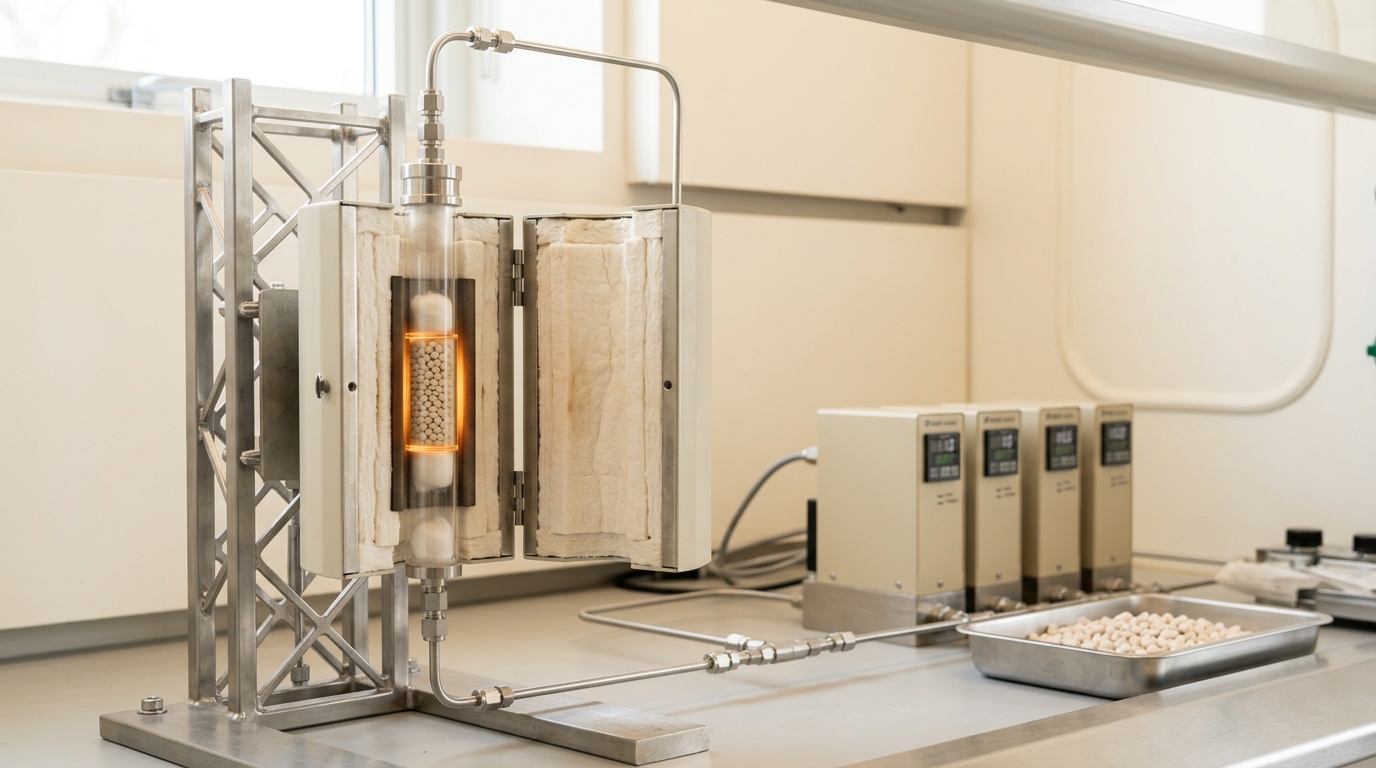
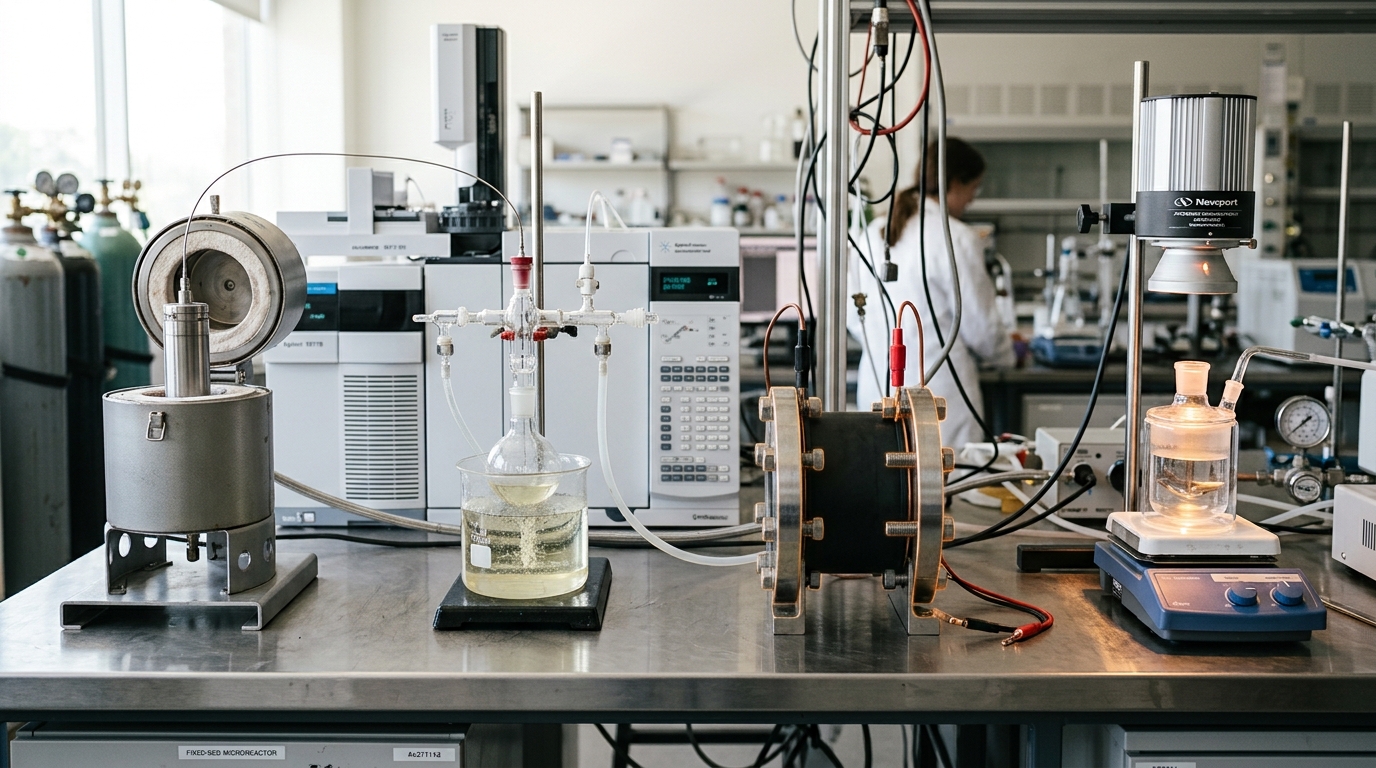
Walk down a pilot-scale catalysis testing bay built to compare routes to the same molecule and you will find, in practice, something like four different rigs standing side by side: a packed bed of solid catalyst pellets under flowing gas and heat; a glass flask of dissolved metal complex under an inert atmosphere; an electrode clamped in a flow cell under applied potential; and a semiconductor slurry under a lamp. Each rig can, in principle, drive the same transformation — most visibly ammonia synthesis from nitrogen and hydrogen, or the reduction of carbon dioxide to a fuel or a feedstock. None of them is a free-standing “better” way to do chemistry. Each converts a different input — heat, a ligand environment, electrical work, or a photon — into the same class of output, and each therefore inherits a different set of constraints on selectivity, rate, and scale.
This article compares four structurally distinct catalytic approaches against each other on dimensions that are actually comparable — reaction pathway, kinetics, selectivity, energy input, and demonstrated scale — using ammonia synthesis and CO2 reduction as the running industrial cases. It does not crown a winner. Where routes are not evaluated under the same conditions, on the same feedstock, at the same scale, ranking them numerically would misrepresent what has actually been measured.
Heterogeneous catalysis: a surface doing chemistry on a flowing gas
The incumbent industrial process for ammonia is the Haber-Bosch synthesis: iron- or ruthenium-based solid catalysts, packed as pellets in a fixed bed, under roughly 150-300 bar and 400-500 degrees Celsius, converting nitrogen and hydrogen gas directly to ammonia. This is heterogeneous catalysis in its purest industrial form — the catalyst is a solid phase, the reactants are a gas phase, and the reaction proceeds at the interface between them. The scale is not a laboratory curiosity: Haber-Bosch ammonia now underwrites roughly half of the nitrogen in food produced worldwide, a dependency that took shape over the twentieth century as the process displaced Chilean nitrate mining and biological nitrogen fixation as the dominant route to reactive nitrogen [1].
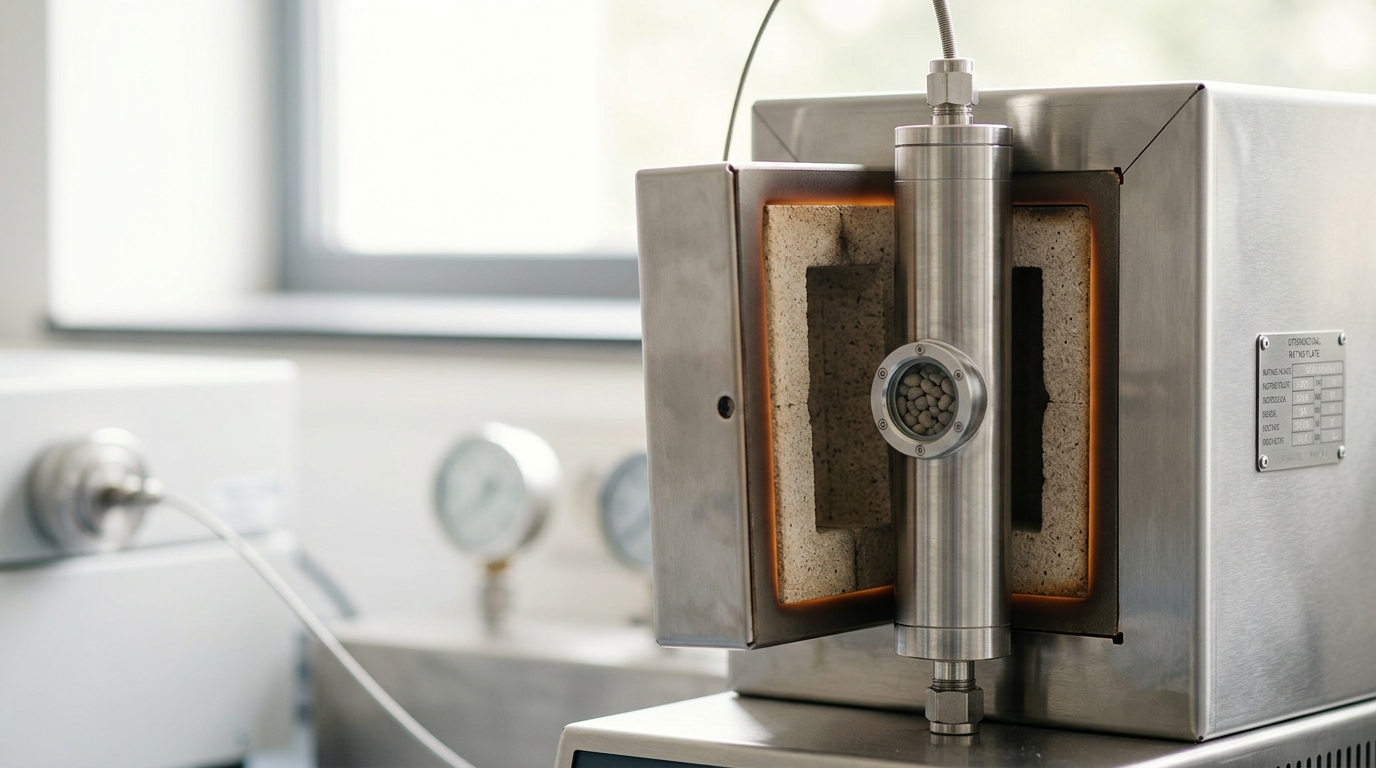
The rate-limiting step on a conventional iron catalyst is dissociative chemisorption of the strong nitrogen-nitrogen triple bond — breaking
A structural feature of heterogeneous catalysis is that the active site is not simply “the catalyst material” — it is a specific atomic arrangement, often a minority of the surface atoms, whose local coordination and electronic structure change under reaction conditions. Reviews of the active-site concept emphasize that a catalyst’s true active center can differ substantially from the catalyst’s nominal bulk composition or its as-synthesized structure, and that this center can restructure dynamically while the reaction runs [6]. That dynamism is precisely why operando measurement — probing the catalyst while it is working, under real pressure, temperature, and flow, rather than before or after the reaction — has become central to the field rather than a peripheral technique. A catalyst characterized only at rest can look identical to two materials that behave completely differently in the reactor.
Homogeneous catalysis: a molecular complex with one well-defined site
Homogeneous catalysis inverts the heterogeneous picture. The catalyst is a discrete molecular complex dissolved in the same phase as the reactants, so — unlike a solid surface, where catalytic sites are heterogeneous by definition and distributed across a material with defects, terraces, and edges — every catalytic center in solution is, in principle, chemically identical. This uniformity is what makes homogeneous catalysis mechanistically tractable: reaction intermediates can often be isolated, characterized by conventional solution spectroscopy, and correlated directly with turnover, in a way that a buried subsurface intermediate on a metal particle typically cannot be.
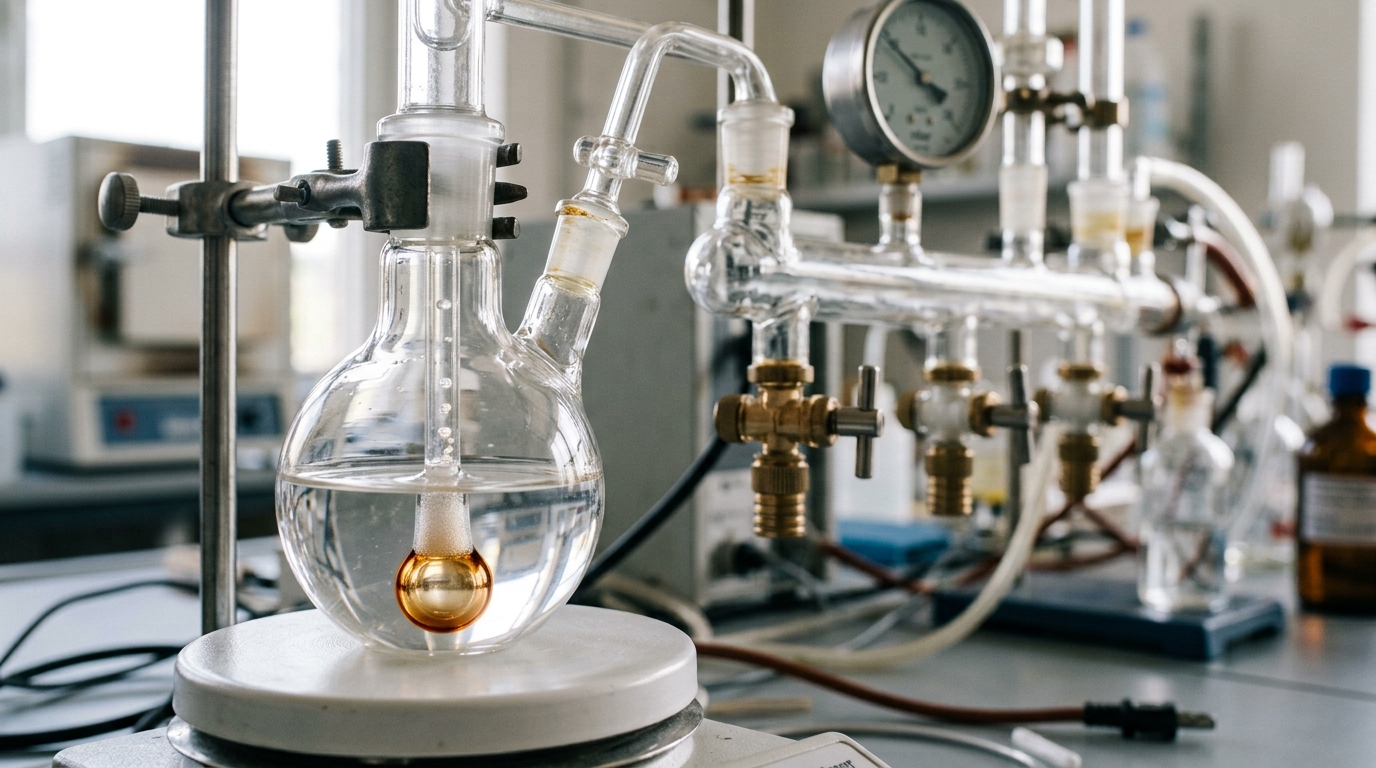
The clearest demonstration in the nitrogen-fixation space is molecular catalysis using well-defined molybdenum complexes bearing pincer-type ligands, which catalytically convert dinitrogen to ammonia in solution under ambient temperature and pressure, using a strong chemical reductant and a proton source rather than heat and pressure to drive the transformation. Using samarium diiodide together with alcohols or water as the reductant and proton source, one such system achieved substantially higher turnover numbers for ammonia formation from molecular nitrogen than earlier molybdenum-catalyzed variants, run at room temperature and roughly atmospheric pressure [3]. That is a striking mechanistic result: catalytic dinitrogen reduction to ammonia without a 400-degree furnace or a 200-bar compressor. It is not, on the same evidence, an industrial ammonia process. The reductant consumed stoichiometrically per catalytic cycle is itself an energy-intensive reagent to manufacture and regenerate, the demonstrated turnover numbers remain far below what continuous industrial operation over months or years would require of a catalyst, and no published account of this chemistry operates at anything resembling Haber-Bosch throughput. The correct reading is that homogeneous molecular catalysis has established a mechanistic proof of concept for ambient-condition nitrogen fixation, not a validated replacement pathway — the two claims are frequently conflated in secondary reporting on this chemistry, and the distinction matters for anyone evaluating it as a decarbonization route rather than as fundamental chemistry.
Electrocatalysis: current density and cell voltage replace furnace and compressor
Electrocatalytic approaches substitute an applied electrical potential for the thermal and pressure driving force of heterogeneous catalysis. In principle, if renewable electricity is cheap and abundant, an electrocatalytic route to ammonia or to reduced carbon products could sidestep both the enormous capital cost of a high-pressure Haber-Bosch train and its associated carbon emissions from hydrogen production via steam methane reforming. In practice, electrocatalytic nitrogen reduction has been unusually vulnerable to a specific measurement failure: reported ammonia yields in many early studies later turned out to originate from trace ammonia contamination in feed gases, the electrolyte, ambient air, or even the researchers’ own breath, rather than from genuine electrochemical nitrogen reduction, because the quantities of ammonia detected were often close to the contamination background.
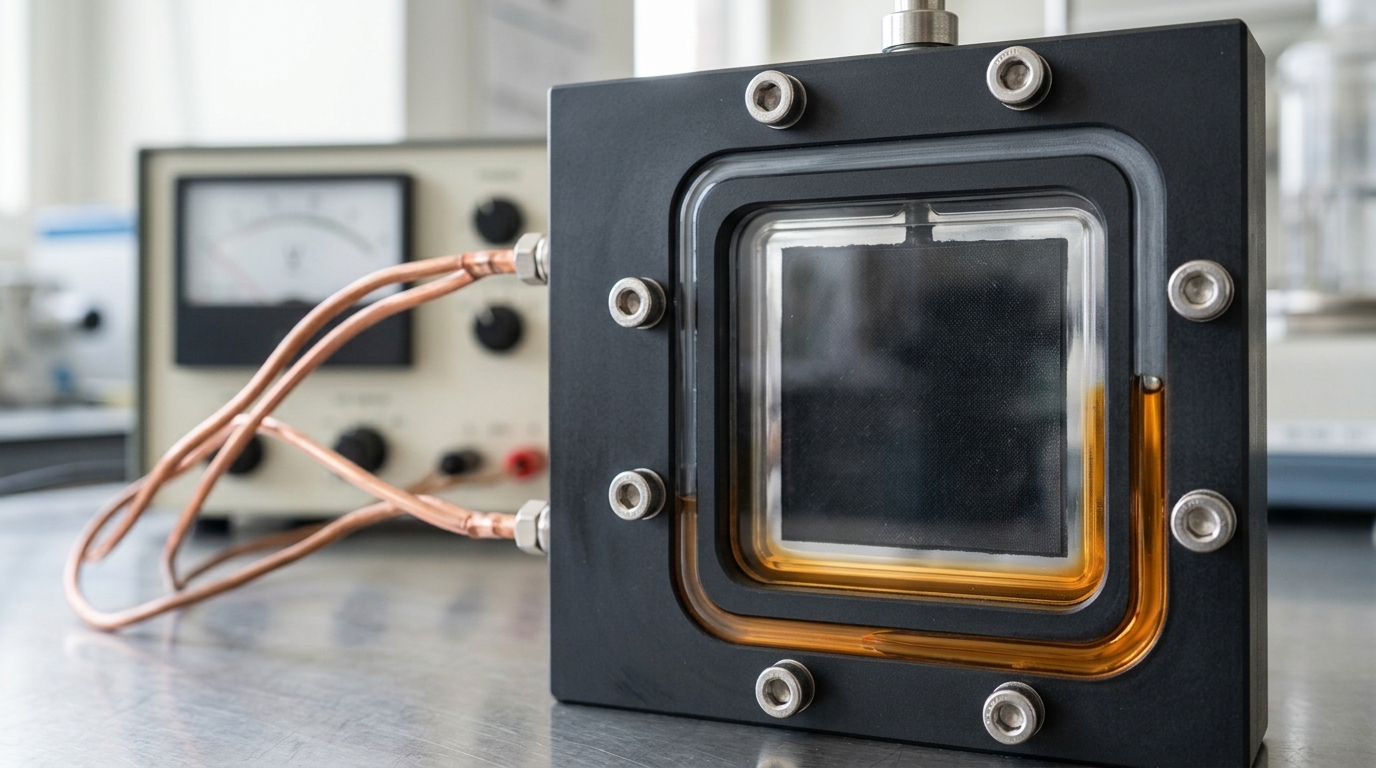
A rigorous protocol addressing this used isotopically labelled nitrogen-15 gas together with quantitative isotope-selective detection, so that any ammonia genuinely produced from the labelled feed gas could be distinguished unambiguously from background contamination carrying the ordinary nitrogen-14 isotope [4]. Applying that protocol to a broad set of previously reported electrocatalytic materials found that most produced ammonia at rates indistinguishable from the contamination background once isotope labelling was applied — a result that reset expectations across the field and made isotope-controlled measurement close to a prerequisite for a credible claim in this specific chemistry. This is a case where methodological rigor, not catalyst discovery, was the binding constraint on the field’s progress: a review of what would actually be required for electrosynthesis to displace petrochemical routes broadly argues that beyond selectivity and activity, credible techno-economic viability additionally requires realistic assessments of electrode stability at industrially relevant current densities, of system-level energy efficiency including separations, and of capital cost at scale — dimensions on which laboratory demonstrations, even methodologically sound ones, are frequently silent [5]. Systematic computational screening approaches, which evaluate candidate electrocatalyst compositions against calculated binding energies of reaction intermediates before committing to experimental synthesis, have meanwhile become a standard tool for narrowing the electrocatalyst search space in adjacent electrochemical reactions such as hydrogen evolution, and the same screening logic has since been extended to CO2 reduction electrocatalysts [8]. Screening narrows candidates; it does not substitute for the isotope-controlled or otherwise rigorously validated experimental measurement that a genuine positive result still requires.
Photocatalysis: the reaction rate is bounded by photon flux
Photocatalysis draws its driving energy directly from absorbed light rather than from heat, an applied potential, or a stoichiometric chemical reductant. A semiconductor particle or film absorbs a photon of sufficient energy, generating an electron-hole pair; if that pair survives long enough to reach the particle’s surface without recombining, the electron and hole can separately drive reduction and oxidation half-reactions — in the CO2 case, reduction of adsorbed CO2 to products such as carbon monoxide, formate, methanol, or methane, paired with water oxidation.
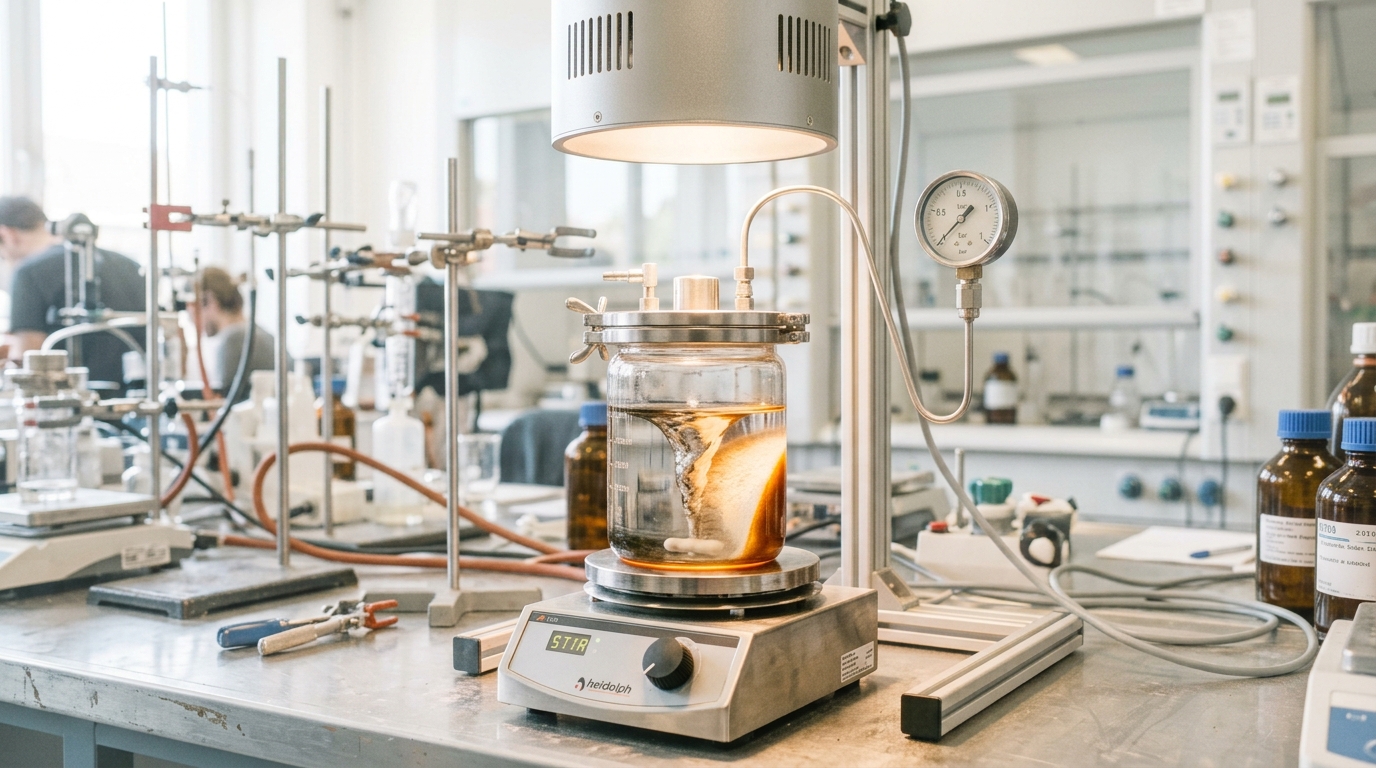
The central engineering problem is selectivity under multi-electron, multi-proton reaction pathways: CO2 photoreduction can proceed through several competing product channels differing by as little as two electrons, and steering the reaction toward one product over another generally requires a cocatalyst — a second, distinct catalytic material deposited on the semiconductor surface specifically to trap one type of charge carrier or to lower the barrier for one particular reaction intermediate. A review of cocatalyst strategies for selective CO2 photoreduction to solar fuels documents that the same base semiconductor can be steered toward markedly different product distributions purely by changing the cocatalyst, underscoring that selectivity in this chemistry is substantially an engineered property of the composite catalyst system rather than an intrinsic property of the light-absorbing semiconductor alone [7]. Photocatalytic CO2 reduction systems reported in the literature still generally show low quantum efficiency and modest absolute rates relative to electrocatalytic or thermal routes, and the review is explicit that low selectivity in the reduction step remains one of the central unresolved challenges in the field rather than a solved problem awaiting only deployment.
Comparing on dimensions that are actually comparable
Selectivity, energy input, and scale do not collapse onto one scoreboard, because each approach reports these quantities under different, non-interchangeable conditions.
On selectivity: heterogeneous Haber-Bosch ammonia synthesis is close to perfectly selective toward ammonia at the process level, because the surface chemistry has been engineered and operated for over a century specifically to suppress side reactions; homogeneous molecular catalysts for the same transformation are also highly selective toward ammonia as the isolated product, because a well-defined molecular coordination sphere limits the accessible reaction pathways by design; electrocatalytic and photocatalytic CO2 reduction, by contrast, routinely produce mixtures of two-electron, six-electron, and eight-electron reduction products competing with the parasitic hydrogen evolution reaction, and the reported selectivity for any one product is frequently sensitive to electrode or cocatalyst composition, applied potential or light intensity, and electrolyte or reaction medium — comparing a headline selectivity number from one electrocatalytic CO2 study to another without matching these conditions is not a like-for-like comparison.
On energy input: comparing Haber-Bosch’s roughly 400-500 degree, 150-300 bar thermal and pressure input against an electrocatalytic cell’s applied voltage and current density, or against a photocatalytic system’s absorbed photon flux, requires converting each to a common energy-per-mole-of-product basis that accounts for the full system — including hydrogen production upstream of a conventional ammonia plant, electricity generation and transmission losses upstream of an electrolytic cell, and the substantially larger illuminated reactor area a photocatalytic system needs to intercept the same total photon flux a compact electrochemical cell delivers as current. Absent a specific published life-cycle or techno-economic analysis performing that conversion for a given electrocatalytic or photocatalytic system, a direct energy comparison against Haber-Bosch is not something the literature currently supports for most laboratory-scale demonstrations, which is exactly the gap the techno-economic assessment above argues the field still needs to close before displacement claims are credible [5].
On scale: only heterogeneous Haber-Bosch catalysis operates at the multi-million-tonne annual global scale that would make it a substitute for, rather than a complement to, existing ammonia production. Homogeneous molecular nitrogen fixation and electrocatalytic ammonia synthesis remain, on published evidence, at laboratory batch or bench-scale continuous operation; photocatalytic CO2 reduction is at a comparable or earlier stage. None of this means the newer approaches will never scale — it means that a fair comparison today is a comparison between one mature industrial process and several early-stage laboratory chemistries, not a comparison between four industrially mature alternatives.
Where analysis ends and scenario begins
It is possible to describe, as an explicit scenario rather than a prediction, a future in which electrocatalytic ammonia synthesis powered by curtailed renewable electricity supplies distributed, small-scale fertilizer production for regions poorly served by centralized Haber-Bosch plants and long nitrogen supply chains. That scenario’s plausibility rests on assumptions that are each independently testable: that electrode stability at industrially relevant current densities over thousands of operating hours can be demonstrated outside isotope-controlled laboratory conditions; that a rigorously validated electrocatalyst selective for nitrogen reduction over the competing hydrogen evolution reaction can be identified, since the 2019 rigorous-protocol survey found most literature candidates failed this bar; and that system-level capital and electricity costs at plausible deployment scale fall below the delivered cost of centrally produced ammonia in the target region. A five-to-fifteen-year horizon is a defensible order of magnitude for such a demonstration to mature from bench to pilot scale, based on comparable electrocatalytic technology development timelines; the scenario should be considered disconfirmed for that horizon if no electrocatalytic nitrogen reduction system passes isotope-controlled validation at greater than bench scale, or achieves competitive current density with demonstrated multi-thousand-hour electrode stability, within it.
A parallel, independent scenario applies to photocatalytic CO2 reduction feeding chemical rather than fuel markets — where required production volumes are smaller and product value is higher, so photocatalysis’s currently modest absolute rates may be a survivable limitation sooner than they would be for bulk fuel production. This is a distinct claim from the ammonia scenario above, resting on different assumptions about market volume rather than about electrode durability, and it should not be read as implying that photocatalysis and electrocatalysis are converging on one shared timeline; they are not evaluated against the same market or the same technical bottleneck.
What the comparison actually establishes
None of the four approaches examined here is simply “catalysis, done differently, arriving at the same place.” Each substitutes a different physical driving force — thermal and pressure energy, a fixed molecular coordination environment, applied electrical potential, or absorbed photon flux — for the others, and each inherits that substitution’s own characteristic failure mode: heterogeneous catalysis must manage a dynamically restructuring, heterogeneous active site under harsh bulk conditions [6]; homogeneous catalysis must manage stoichiometric reagent consumption and catalyst turnover limits even where the mechanism is elegant [3]; electrocatalysis must manage a documented history of contamination-driven false positives that only isotope-controlled measurement reliably excludes [4]; photocatalysis must manage low quantum efficiency and multi-pathway selectivity with no thermal or electrical push to fall back on [7]. The turnover frequency and turnover number metrics used to report activity across all four regimes are themselves standardized quantities — molecules converted per active site per unit time, and total molecules converted per active site over a catalyst’s operating lifetime, respectively — precisely so that results from a packed bed, a stirred flask, an electrode, and an illuminated slurry can at least be expressed on a common footing even when the underlying chemistry and the demonstrated scale cannot yet be fairly ranked against each other [9]. The honest comparison is not which approach wins; it is which constraint — thermal cost, stoichiometric reagent cost, measurement rigor, or photon economy — a given application can least afford to accept.