Catalysis is the quiet infrastructure of the chemical economy. Roughly nine-tenths of manufactured chemical products pass across a catalyst surface at some point in their synthesis, and the formal definition has not changed in decades: a catalyst increases the rate of a reaction without shifting its overall standard Gibbs energy change, and it emerges from the reaction chemically unconsumed [1]. That single sentence hides an enormous amount of engineering, because a catalyst that survives industrial conditions — pressure, temperature, poisoning species, millions of turnovers — is a different problem from a catalyst that merely works once in a beaker.
By 2035, three specific bets about catalysis will either have paid off or will have visibly not. This article states them as falsifiable predictions, not as a roadmap of hoped-for progress: green hydrogen and green ammonia reaching cost parity with fossil-derived routes, machine-learning-guided discovery producing a catalyst that industry actually adopts, and electrochemical nitrogen fixation crossing an efficiency threshold that makes it a serious alternative to Haber-Bosch. Each comes with a horizon, the assumptions it rests on, the indicators worth tracking between now and then, and the specific evidence that would prove it wrong.
What “catalysis” actually has to overcome
A catalyst does its work by opening a lower-energy pathway between reactants and products — typically by binding an intermediate, weakening a bond that would otherwise need more thermal energy to break, and then releasing the product so the surface is free for another cycle. The energetics of that binding step follow a well-established shape: bind too weakly and the reactant never activates; bind too strongly and the product never leaves. Plotted against binding energy, catalytic activity for a given reaction traces an inverted-U — the Sabatier principle — and the best catalysts sit as close as possible to the peak.
Here the activation energy
Two things make industrial catalysis hard in ways a beaker experiment does not reveal. First, selectivity: an industrially useful catalyst often has to suppress a dozen competing pathways to concentrate yield on one product, and the reaction network branches non-linearly with pressure, temperature and surface coverage rather than staying in the clean regime a rate law suggests. Second, degradation: real catalysts foul, sinter, leach and poison over months of continuous operation in ways that a hundred-hour laboratory run does not capture, which is precisely the gap that recent operando measurement programs — running spectroscopy and diffraction on a catalyst while it is actively working, not before or after — are built to close [10].
Fact, vendor claim, analysis, scenario, prediction
Before the specific bets, a note on register, because catalysis discourse blurs these categories more than most technical fields. A fact here means a number attached to a specific study that this article can point to — a Faradaic efficiency reported in a named paper, a cost band published by an agency with methodology attached. A vendor claim is a company’s own performance assertion for its product, reported as a claim and not adopted as fact. Analysis is this article’s own reasoning from established facts. A scenario is one internally consistent way the future could unfold, stated without asserting it is the most likely one. A prediction is this article committing to a specific, checkable outcome, with a stated horizon and a condition that would prove it wrong.
Prediction one: green hydrogen cost parity by 2035
The claim. Electrolytic hydrogen from renewable electricity will not reach broad cost parity with unabated fossil-based hydrogen (from steam methane reforming without carbon capture) at global scale by 2035. Isolated pockets of parity in favorable-electricity-price regions are likely before then; broad parity is not.
Horizon. By December 2035.
Assumptions. This rests on the IEA’s own Net Zero Emissions modeling, which even in its most optimistic 2030 scenario projects renewable-electrolytic hydrogen costs of roughly two to nine U.S. dollars per kilogram, with less than one million tonnes a year reaching sub-two-dollar costs globally — and that pocket concentrated in China, where renewable electricity is unusually cheap [2]. It also assumes the U.S. Department of Energy’s own Hydrogen Shot program — which explicitly targets one dollar per kilogram within a decade of its 2021 launch, i.e., by 2031 — continues to be treated by the department itself as a stretch target rather than a near-certain outcome, which is how the program frames it: an 80 percent cost reduction goal, not a committed delivery date [3] [4]. Unabated fossil hydrogen today runs roughly one to two dollars per kilogram in most regions; closing that gap requires electrolyzer capital costs, renewable electricity prices, and capacity-factor economics to all move favorably at once, not just one of the three.
Observable indicators to track. (1) Global electrolyzer manufacturing capacity, which the IEA reports doubled to 25 gigawatts per year in 2023, with China supplying roughly 60 percent of that capacity [2] — continued doubling roughly every two years would support the parity case; a plateau would argue against it. (2) The spread between DOE’s interim milestone (two dollars per kilogram, originally targeted for 2026) and actual delivered cost at funded demonstration sites. (3) Whether more than five million tonnes a year of hydrogen reach cost-competitiveness with fossil routes by 2030, the IEA’s own NZE-scenario marker [2].
Disconfirmation condition. If, by 2030, delivered green hydrogen costs in at least three major industrial regions (not just China’s cheapest renewable zones) fall to within twenty percent of regional unabated fossil hydrogen cost — verified by published agency data, not vendor announcements — this prediction is wrong and should be retired in favor of an earlier full-parity date. Conversely, if by 2032 the DOE’s own program status reports acknowledge the one-dollar target will not be reached even directionally, that is strong support for this prediction holding through 2035.
Prediction two: an ML-discovered catalyst reaches industrial adoption
The claim. By 2035, at least one catalyst whose composition or active-site structure was identified primarily through machine-learning-guided screening — not primarily through domain-expert intuition refined afterward by ML — will be running in a commercial industrial process at meaningful scale (not a pilot line).
Horizon. By December 2035.
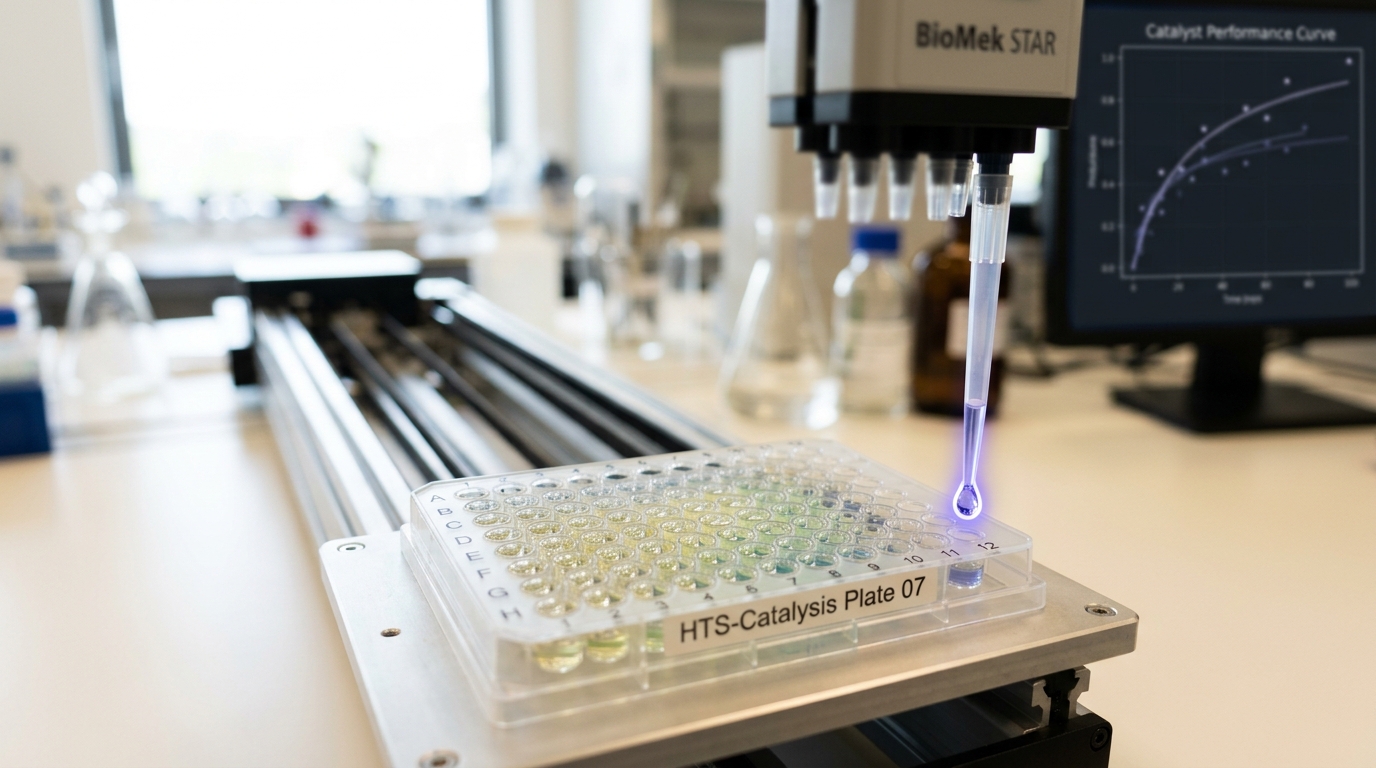
Assumptions. Current published work already demonstrates the mechanism working in the laboratory: a 2023 Nature Communications study used an active-motifs-based machine learning approach to guide discovery of copper-gallium and copper-palladium catalysts for carbon dioxide electroreduction, screening candidates computationally before experimental synthesis [5]. Extrapolative machine-learning methods have also been demonstrated identifying catalyst compositions with elements absent from their training data, applied to reverse water-gas shift chemistry — a genuine test of generalization rather than interpolation within a known family [9]. What has not yet happened, per the same review literature, is many cases of these laboratory-validated candidates actually displacing an incumbent industrial catalyst; the honest state of the field as of 2024 is “only a few case studies resulting in experimentally validated catalyst improvements,” with the harder step — multi-year, multi-plant industrial qualification — still ahead [9]. Newer operando experimental-computational bridging efforts, such as the Open Catalyst Experiments 2024 dataset released to pair real synthesis and testing data with computational screening claims, are explicitly framed as closing that credibility gap rather than reporting it already closed [10].
Observable indicators to track. (1) Whether any chemical or energy company’s public process documentation (not marketing copy) attributes a specific plant catalyst to an ML-first discovery pipeline. (2) The rate at which computational screening papers report matched experimental validation at greater than milligram scale, moving toward kilogram-scale synthesis runs. (3) Whether independent groups reproduce a claimed ML-discovered catalyst’s performance using different synthesis routes — reproduction across labs is the strongest signal a result is real rather than an artifact of one group’s synthesis quirks.
Disconfirmation condition. If, by 2035, the only examples of ML-guided catalysts in industrial use are ones where the ML step merely re-derived a catalyst family already known from prior literature (interpolation dressed as discovery), or if every claimed industrial adoption turns out on inspection to be a pilot-scale demonstration rather than production-scale deployment, this prediction should be treated as falsified — the technology would have proven useful for accelerating known chemistry, not for finding new chemistry that survives contact with a real plant.
Prediction three: electrochemical nitrogen fixation crosses a practical efficiency threshold
The claim. By 2035, no electrochemical direct nitrogen-reduction-to-ammonia process will have crossed the combined efficiency threshold — roughly 90 percent Faradaic efficiency sustained at industrially relevant current densities (above 100 milliamps per square centimeter) for continuous multi-week operation — that would make it a credible on-site replacement for Haber-Bosch at meaningful scale. Continued progress in this direction is likely; full displacement of Haber-Bosch by 2035 is not.
Horizon. By December 2035.
Assumptions. The dinitrogen triple bond is exceptionally strong (around 941 kilojoules per mole) and direct electrochemical nitrogen reduction competes directly with the hydrogen evolution reaction at the same electrode, which is kinetically much faster — the central problem the literature keeps naming as the bottleneck [7]. Reported Faradaic efficiencies for direct nitrogen reduction have climbed meaningfully over the past decade — a 2018 Nature Communications paper reported 56.55 percent Faradaic efficiency for ambient ammonia synthesis by shifting the applied potential [6] — but even recent single-atom catalyst work reports Faradaic efficiencies closer to 20 percent at the current densities needed for industrial relevance, trading efficiency for rate or vice versa rather than achieving both simultaneously. By contrast, a related but chemically distinct route — electrolytic reduction of nitrate (already-oxidized nitrogen, not atmospheric dinitrogen) to ammonia — has demonstrated Faradaic efficiencies approaching 100 percent at current densities above two amps per square centimeter [8]. That distinction matters: nitrate reduction is a genuine near-term route for treating nitrogen-polluted wastewater into ammonia, but it is not atmospheric nitrogen fixation and does not by itself replace Haber-Bosch’s role of pulling nitrogen out of the air.
Observable indicators to track. (1) Whether any peer-reviewed report combines Faradaic efficiency above 90 percent with current density above 100 milliamps per square centimeter for direct N₂ reduction specifically (not nitrate reduction) in the same experiment. (2) Whether reported operating stability extends from the current typical range of hours-to-days toward the multi-week continuous runs that a pilot plant would require. (3) Whether continuous-flow electrosynthesis approaches that co-locate nitrogen reduction with hydrogen oxidation — demonstrated in a 2023 Science paper as a way of avoiding the competing water-splitting side reaction — get picked up by other groups and scale past bench current densities.
Disconfirmation condition. If a peer-reviewed, independently reproduced result reports combined Faradaic efficiency above 90 percent and current density above 100 milliamps per square centimeter sustained for multi-week continuous operation on direct atmospheric nitrogen reduction before 2032, this prediction is falsified early and the 2035 window should be revised toward partial industrial displacement. If, instead, by 2035 the best published combination still trades efficiency for rate — as it consistently has through the reviewed literature — that supports the prediction as stated.
Reading the reaction network, not just the headline number
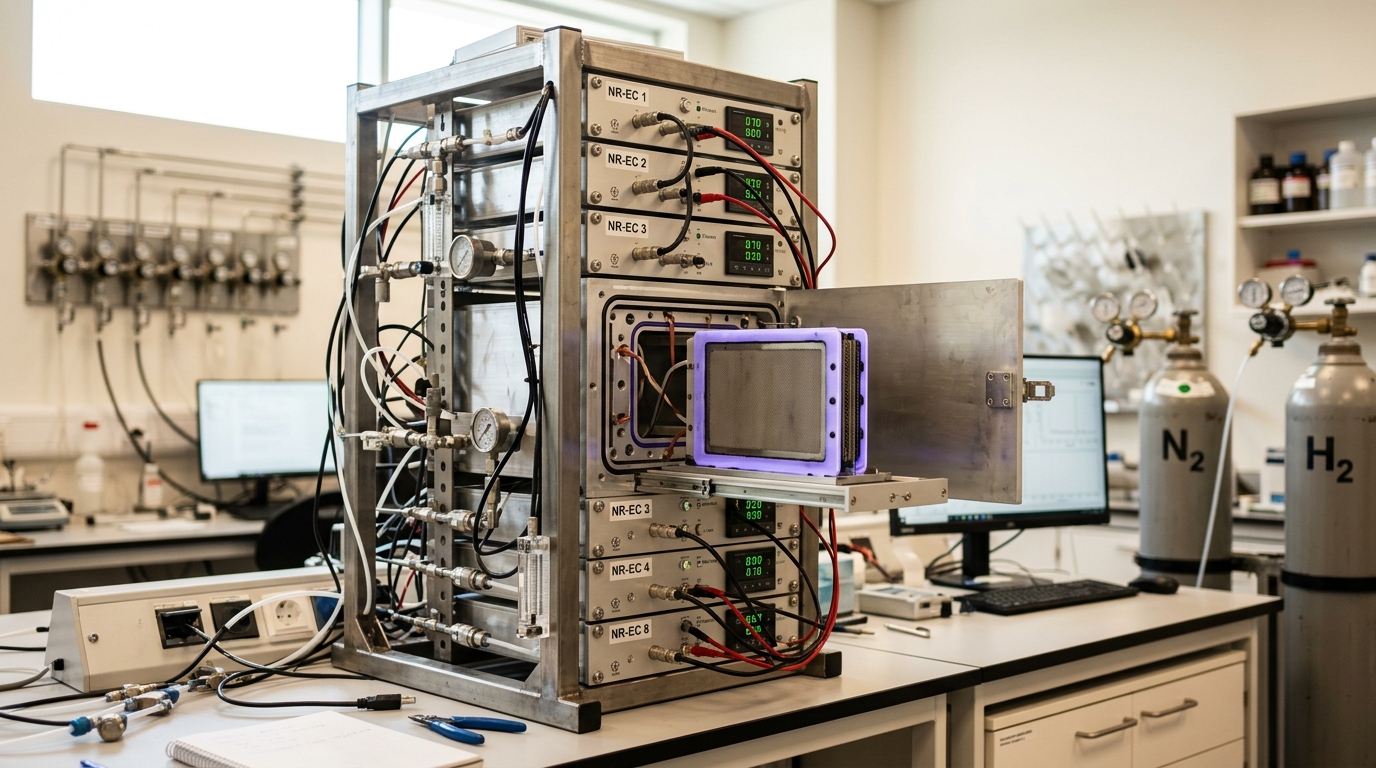
A number like “56 percent Faradaic efficiency” or “90 percent selectivity” means little without the reaction network it was measured against. Most industrially relevant reactions are not single-step transformations but competing pathways sharing intermediates, and a catalyst’s real job is steering flux through one branch of that network while starving the others. Kinetic modeling of these networks typically proceeds through elementary steps — adsorption, surface diffusion, bond activation, desorption — each with its own rate constant, and the observed macroscopic rate is a convolution of whichever step is slowest under the prevailing conditions, the rate-determining step. What makes this genuinely hard in practice is that the rate-determining step is not fixed: it can shift with temperature, pressure, or conversion as a reaction proceeds, so a catalyst optimized against one measured bottleneck can underperform once that bottleneck moves. This is one reason laboratory kinetics measured at low conversion, in a differential reactor designed to isolate a single rate law, often disagree with performance in an integral, plant-scale reactor where conversion is high and multiple steps compete simultaneously for the same active sites.
Surface heterogeneity compounds the problem. A real catalytic surface is not one uniform active site repeated billions of times; it is a distribution of step edges, terraces, kinks, and defect sites, each with a different local binding energy, and industrially relevant activity is often dominated disproportionately by a minority of highly active sites rather than distributed evenly across the surface. Identifying which sites those are — and whether a proposed new catalyst preserves or destroys them during synthesis and activation — is exactly the kind of structural question that benefits from machine-learned structure-activity models trained against large combinatorial datasets, precisely because no human researcher can hold that many site geometries in mind simultaneously while screening candidates by hand [9].
Why operando measurement is the actual rate-limiting step
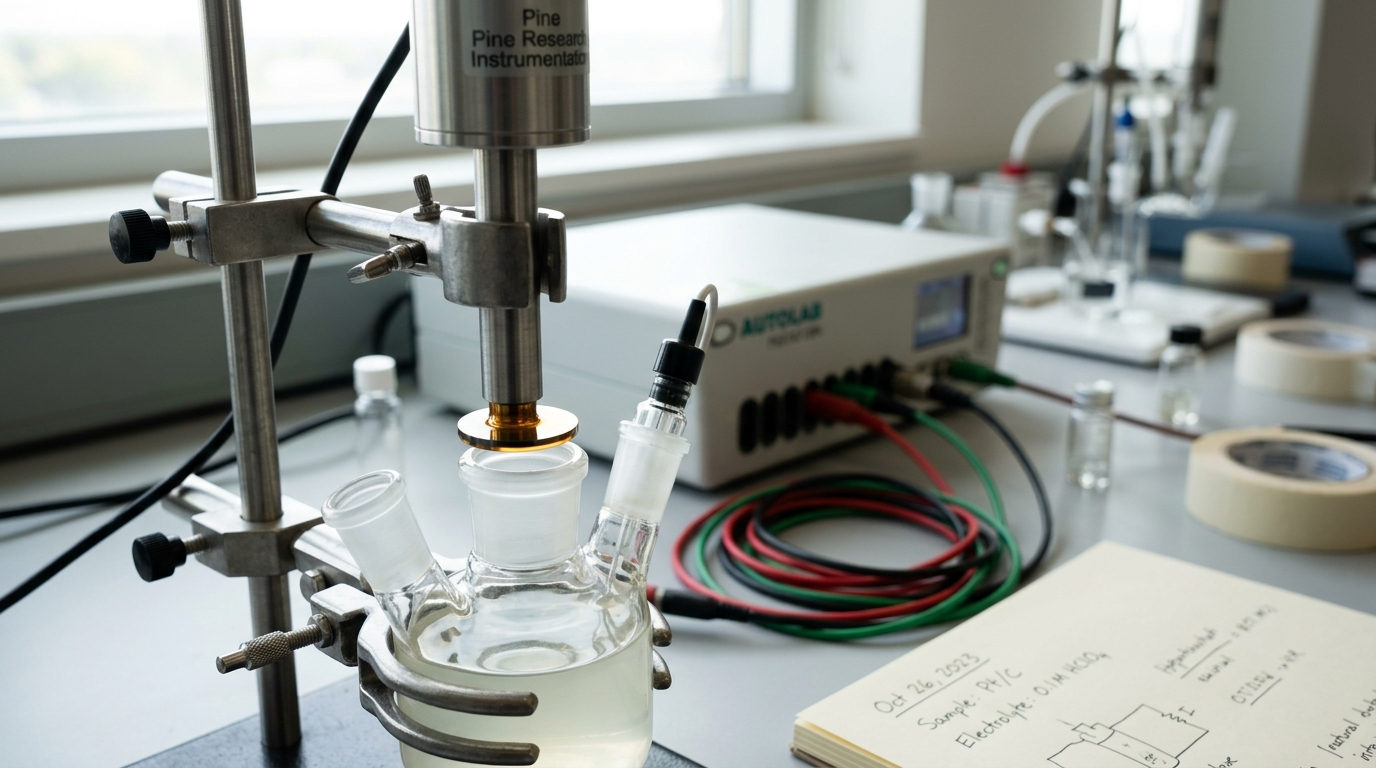
A theme runs under all three predictions: the bottleneck is rarely finding a catalyst that works once, under ideal conditions, in a paper. It is knowing why a catalyst degrades, at what surface site a competing reaction wins, and whether a laboratory result generalizes to plant conditions — questions that require watching a catalyst while it works, not just before and after. This is the argument for operando spectroscopy and diffraction as measurement infrastructure rather than a niche technique: Raman, X-ray absorption, and mass spectrometry performed in situ, on a live cell, under realistic current density and temperature, are what let researchers distinguish a catalyst that is stable from one that merely has not yet been watched long enough to fail [10].
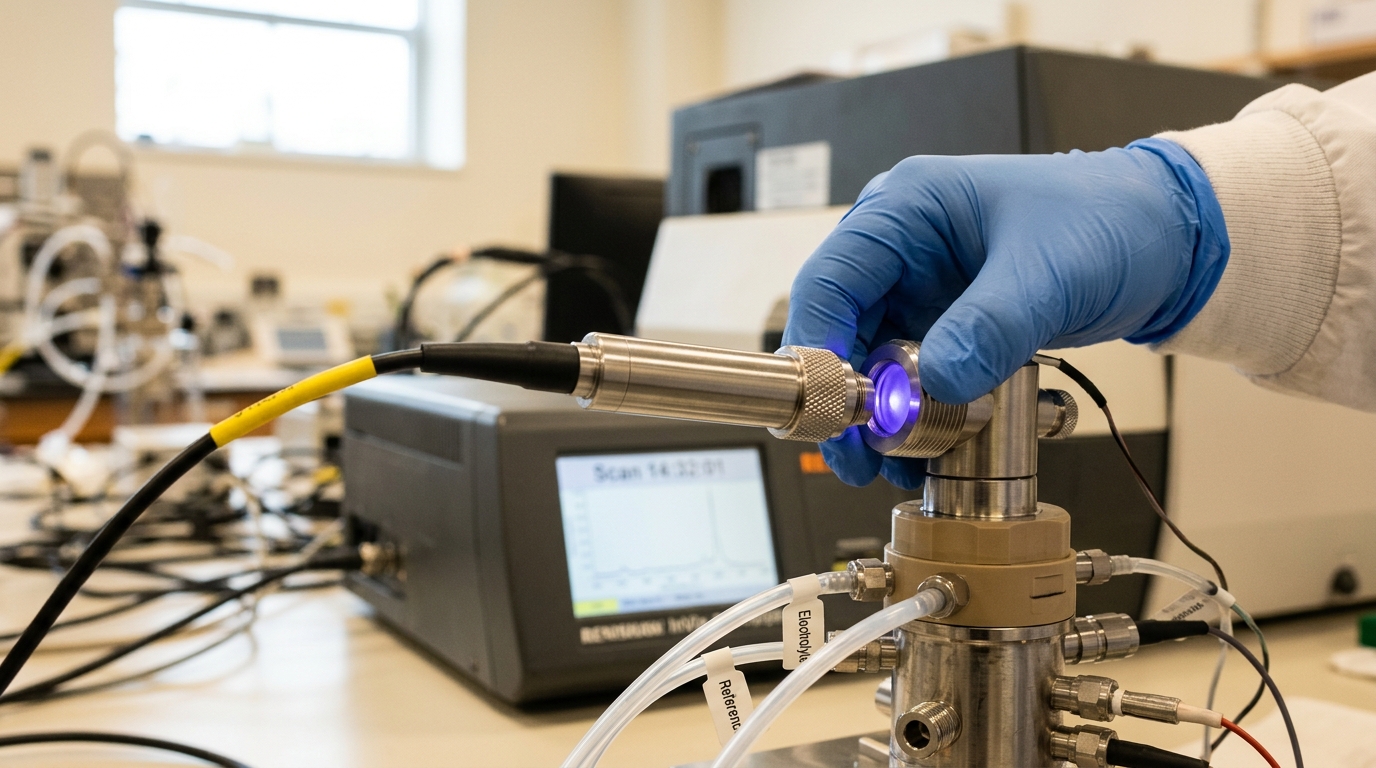
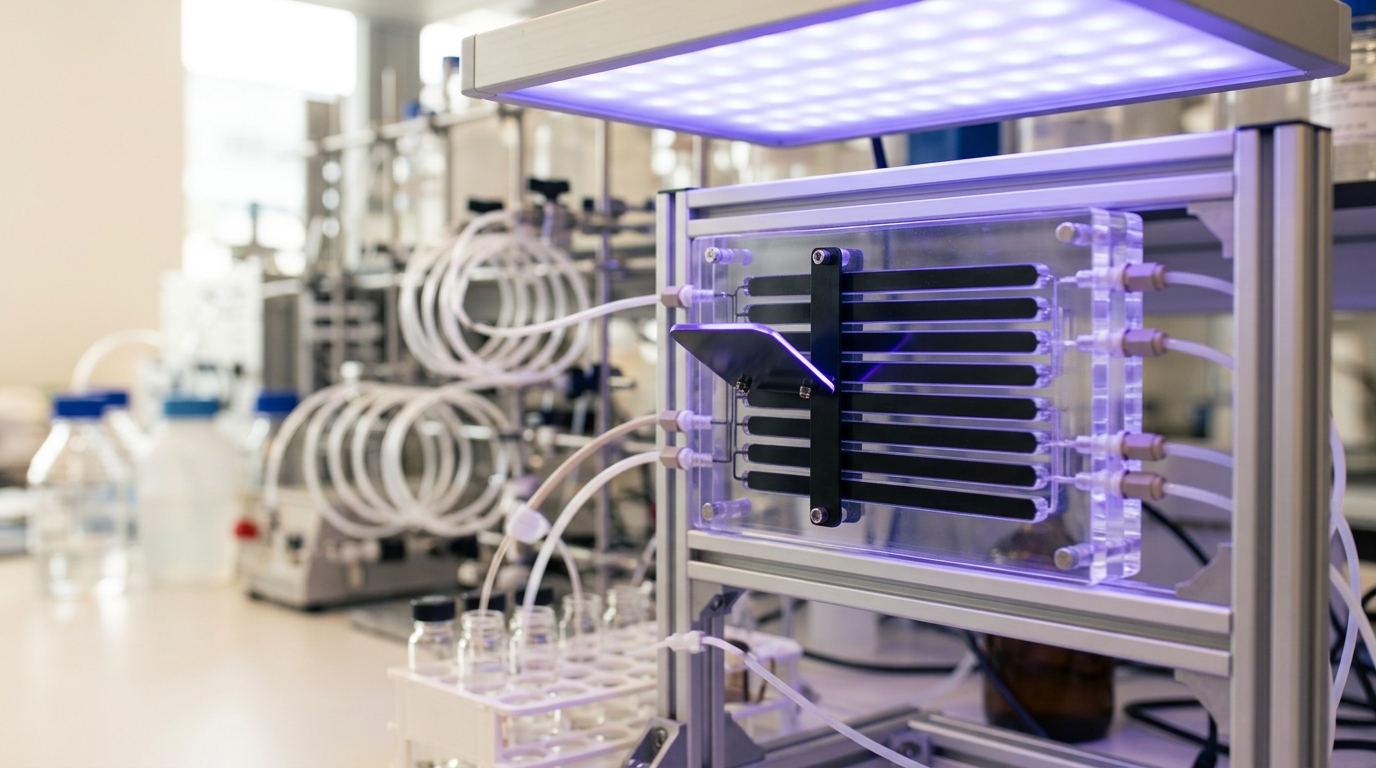
Photocatalysis illustrates the same measurement discipline from a different angle. Because a photocatalytic reaction’s rate depends on photon flux, absorption cross-section, and charge-carrier lifetime simultaneously, apparent quantum yield — the fraction of absorbed photons that produce a useful electron transfer — has to be measured under matched illumination conditions to mean anything comparable across studies. Reports that omit wavelength-resolved flux measurements are not comparable to each other regardless of how large the headline yield number is; this is a methodological point the field itself insists on, not merely an aesthetic one.
What would move each prediction faster than assumed
None of these three predictions are meant to read as pessimistic defaults. Each has a specific lever that, if pulled, would compress the timeline meaningfully. For green hydrogen, the lever is renewable electricity price at the specific sites where electrolyzers are sited, not electrolyzer efficiency improvements alone — the IEA’s own scenario spread is driven more by electricity cost assumptions than by stack technology assumptions [2]. For ML-guided catalyst discovery, the lever is closing the loop between computational screening and automated experimental synthesis at the same institution, cutting the months-long handoff between a predicted candidate and a synthesized, tested sample — exactly what combined experimental-computational datasets are trying to shorten [10]. For nitrogen fixation, the lever is finding an electrode architecture that physically separates the nitrogen-reduction and hydrogen-evolution active sites rather than relying on a single surface to discriminate between the two reactions by binding energy alone — an architectural rather than a purely compositional fix.
What none of this licenses
It is worth being explicit about the inferential limits here, because catalysis reporting routinely overshoots what a single result supports. A Faradaic efficiency measured in a bench cell does not license a claim about plant-scale viability; a computationally screened candidate does not license a claim about industrial adoption until it survives synthesis, testing, and independent reproduction; and a cost projection under one policy scenario does not license a claim about market prices under a different one. Vendor announcements of catalyst performance, in particular, should be read as claims pending independent replication, not as facts — a distinction the peer-reviewed literature itself maintains by requiring reproduction before treating a result as established.
Summary table of the three bets
| Prediction | Horizon | Disconfirmation condition |
|---|---|---|
| Green hydrogen reaches broad cost parity with fossil hydrogen | Not by 2035 | Three major regions reach cost parity within 20% by 2030 |
| ML-discovered catalyst reaches industrial production-scale adoption | Achieved by 2035 is uncertain; genuine cases plausible but rare | Only interpolative “rediscoveries” or pilot-only deployments exist by 2035 |
| Electrochemical N₂ fixation crosses 90% Faradaic efficiency at >100 mA/cm² for weeks | Not by 2035 | Independently reproduced result meets threshold before 2032 |
Each of these is checkable against public literature, not against a company’s roadmap slide. That is the point of stating them this way: by 2035, anyone can look at the same indicators listed here and determine, without ambiguity, which predictions held and which did not — which is a higher bar than most forward-looking chemistry commentary sets for itself, and the bar this article is choosing to be held to.