Culture is an inheritance system, and inheritance systems have a fidelity
A species that teaches its young survives on two channels at once. One is genetic, slow, and blind to what happened to the previous generation. The other is cultural: it copies beliefs, techniques, and habits from brain to brain, and it can update within a single lifetime. Treating the second channel as a real inheritance system, subject to the same kind of formal description as the first, is not a metaphor borrowed from biology — it is the founding move of a specific research program, and it comes with parameters that can be measured rather than merely gestured at. Luigi Luca Cavalli-Sforza and Marcus Feldman built the first rigorous version of that program, modeling cultural traits as transmitted vertically from parent to child, obliquely from a wider set of adults to the young, or horizontally between peers, each channel carrying its own accuracy and its own rate [1]. Robert Boyd and Peter Richerson extended the same formal apparatus to ask why a learner copies one model over another — guided variation, where individuals adjust what they were taught; and biased transmission, where certain content, certain teachers, or simply the majority opinion get copied preferentially [2]. Between them, these two research programs established that cultural transmission has the same three levers any information channel has: a fidelity (how much of the signal survives one hop), a bandwidth (how much signal a channel can carry per unit of time), and a topology (who is connected to whom, and in which direction).
This article treats five kinds of statement separately throughout, because a piece about a system’s future collapses into slogans the moment they blur together. A fact is a number or a finding reported in a named, checkable source. A mechanism is a causal account, supported by evidence, of how a fact comes about. A formal model is a simplified accounting identity used to make assumptions explicit, not a fitted or calibrated forecast. A scenario is one internally consistent way the future could go, presented beside its alternatives. A prediction — used sparingly here — commits to a horizon, names its assumptions, and states in advance what would prove it wrong. The scenarios below use the last two forms exactly as this publication’s other futures-facing pieces do: an owner, an indicator, a falsifier, every time.
The fidelity term is not an abstraction invented for this article. Joseph Henrich and Michael Muthukrishna’s “collective brain” model treats cumulative culture — tools, techniques, and bodies of knowledge too complex for any one mind to invent from scratch — as an emergent property of a population of connected learners, not of individual intelligence. Their synthesis argues that innovation rates scale with two things acting together: how many minds are connected into the transmission network, and how faithfully a skill survives being copied from one mind to the next; a large population with low-fidelity copying loses complex skills just as surely as a small population with high fidelity, because in both cases the accumulated technique cannot survive its own reproduction [4]. This is the mechanism, not merely the analogy, behind describing culture as an inheritance system: a technique that cannot be copied with enough accuracy to preserve its function is, in the relevant sense, no more heritable than a lethal mutation.
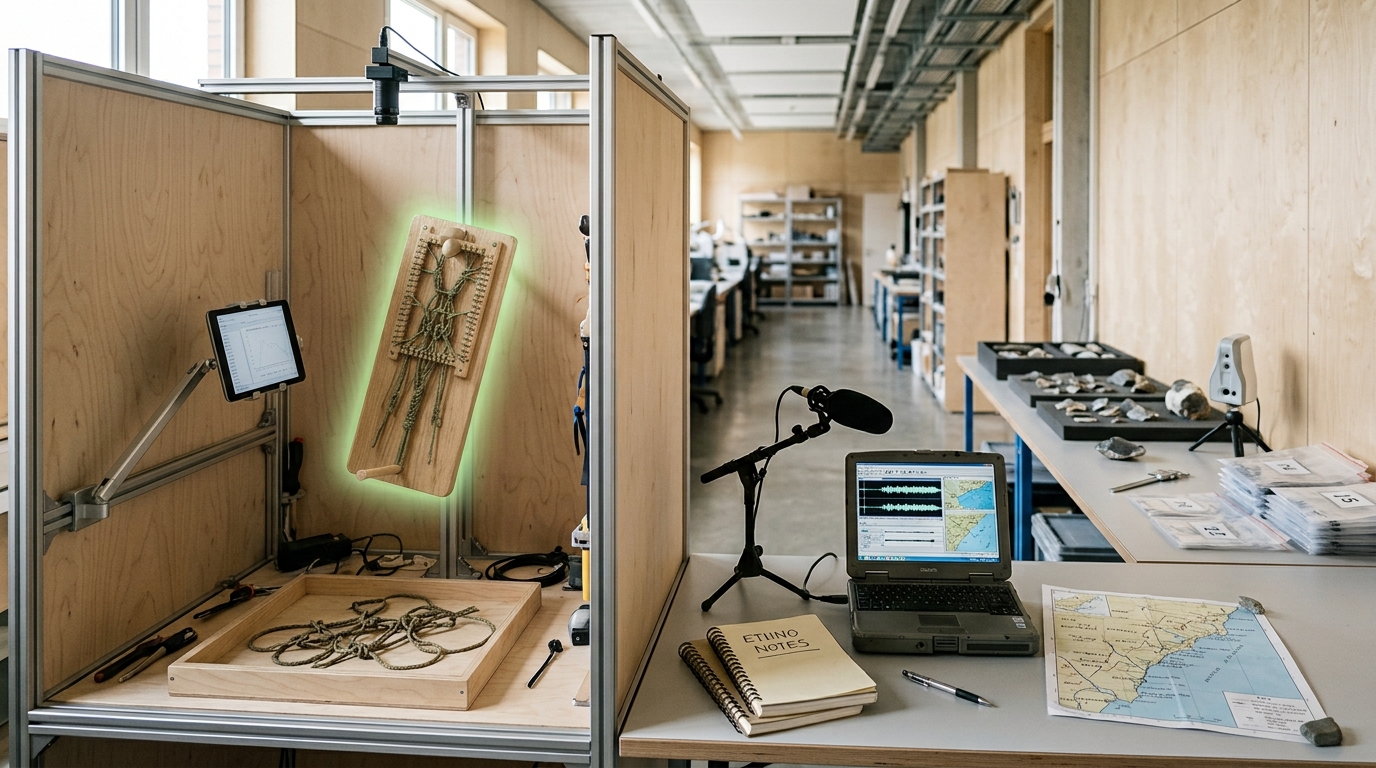
The canonical demonstration of what happens when that fidelity term fails is a documented archaeological case, not a thought experiment. Henrich’s 2004 analysis of Tasmania shows a population of roughly four thousand people, isolated from mainland Australia for about eight thousand years after post-glacial sea-level rise severed the land bridge, progressively losing a set of technologies their own ancestors had possessed: bone tools, cold-weather clothing, hafted composite tools, nets, and fishing spears among them [3]. Henrich’s argument is explicitly evolutionary and explicitly about population size acting on transmission, not about individual intelligence declining: complex skills require a chain of learners large and interconnected enough that at least one imitator, on average, copies a technique with equal or better fidelity than the model who taught it. Shrink that effective population of connected transmitters far enough, and the arithmetic works against any skill whose reproduction depends on getting several linked steps right in sequence — the rarer, more complex variants are the first casualties, exactly as the rarest alleles in a shrinking gene pool are the first lost to drift. This is a lineage argument in the fully technical sense: a cultural technique is a chain of copies, its complexity capped by the worst sustained fidelity anywhere along that chain, and a population bottleneck is a bottleneck on the chain regardless of whether any individual within it lost a step of skill.
The reason this case anchors everything that follows is that it names, in a single well-evidenced episode, the exact failure mode this article will later find recurring at an entirely different scale and in an entirely different substrate: a population of transmitters shrinking below the threshold a body of complex culture needs to survive its own copying, whether that population is a set of human teachers separated by an ocean or a corpus of human-written text being progressively diluted by its own machine-made descendants.
Each technology in the chain bought exactly one parameter, and the record is checkable
If cultural transmission has a fidelity, a bandwidth, and a topology, then a history of communication technology is a history of which of those three parameters got pushed, one jump at a time, and by how much. Read this way, the sequence is not a story about progress in general; it is a series of specific, dated, and — this section insists — independently verifiable magnitude changes. Each one also behaves, in the vocabulary this article uses throughout, as a technology adoption S-curve: a slow uptake, followed by an inflection once a threshold of cost or utility is crossed, followed by saturation, and each winning format then exhibits lock-in — later entrants had to interoperate with the standard the S-curve had already carried to dominance, rather than compete for a blank slate.
Writing is the first jump, and its parameter is not fidelity or bandwidth but persistence: it moves a cultural variant out of any single brain’s mortality and into a durable external medium. It does nothing, on its own, to fix the Tasmania-style failure mode above — a written technique still needs a population of readers to keep it alive as a practiced skill rather than a inert record — but it decouples a lineage’s survival from any one learner’s lifespan or any one population’s continuity, which no purely oral system can do.
Print is the first jump with a hard number attached. The Incunabula Short Title Catalogue, the standing bibliographic census of everything printed in Europe with movable type before 1501, currently lists 30,596 distinct editions [6] — a scale of replicated, identical text that no scriptorium copying by hand had ever approached in a comparable span. The economic historians Eltjo Buringh and Jan Luiten van Zanden, working from manuscript and book survival data across thirteen centuries, find an average annual growth rate in European book production of roughly one percent across their full period, with a marked acceleration beginning after the middle of the fifteenth century that they attribute specifically to falling per-copy prices and rising literacy rather than to any change in demand for the content itself [5]. That is fidelity and bandwidth moving together: each copy became both cheaper to produce and more nearly identical to its exemplar than a scribe’s hand-copy could guarantee, which is precisely the cost-and-fidelity bundle a print run offers that a manuscript tradition cannot.
Telegraphy is the jump in latency, and it is documented at both a continental and an oceanic scale. The United States’ first transcontinental telegraph line reached completion on 26 October 1861, putting San Francisco into direct contact with New York City; the National Park Service’s own account of the competing Pony Express records that its riders had carried mail “more than 1,800 miles in 10 days,” and the Pony Express was formally shut down the same day the telegraph line was finished [8]. Ten days of physical relay collapsed, in one afternoon, to the minutes a telegraph operator needed to key a message through. The transatlantic case is even better instrumented, because an economist has measured what the latency collapse was actually worth. Claudia Steinwender’s analysis of the 1866 transatlantic telegraph cable, built on newly assembled cotton-price and trade-flow data from historical newspapers on both sides of the Atlantic, finds that the average and volatility of the transatlantic price gap fell sharply once the cable connected London and New York directly, and estimates the resulting efficiency gain — from exporters no longer having to forecast a foreign price using information already days old — at the equivalent of eight percent of export value [7]. A latency collapse, in other words, is not merely a communications curiosity; it is measurable as a real change in how well two markets, standing in for two populations of decision-makers, could coordinate on the same information.
Broadcast is the jump in topology, from a chain of relays to a star: one transmitter, arbitrarily many simultaneous receivers, with no intermediate copying generation at all. The clearest documented instance of the resulting one-to-many asymmetry is also one of the most-watched broadcasts in history: coverage of Neil Armstrong’s first steps on the Moon on 20 July 1969 reached, by contemporary estimate, more than a billion people watching or listening at once [9]. No chain-of-custody transmission system — no telegraph relay, no postal network, no line of scribes — could have put the same words in front of the same fraction of the species within the same few seconds; a single transmission event became, briefly, the cultural model for a substantial share of everyone alive.
The internet is the jump that restores many-to-many transmission at the bandwidth broadcast had achieved for one-to-many, and adds something none of the earlier technologies had at scale: a persistent, continuously growing archive of the traffic itself. Almost none of that traffic moves by satellite: US regulatory filings compiled by the industry data provider TeleGeography put satellite’s share of all US international telecommunications capacity at just 0.37 percent, with the remainder carried by the fiber-optic submarine cable network this article’s own figures are drawn from — the physical throat every one of the technologies below still has to pass through the moment a message crosses an ocean [11]. Common Crawl, the open web-crawl archive that has become the standard substrate for large-scale text research, reports that its holdings now exceed 300 billion pages accumulated since 2007, growing by a further three to five billion new pages every month [10]. That is not only a bandwidth number; it is the first time in this history that the transmission medium itself has also become the archive, available for later, repeated re-reading and re-processing — a property about to matter a great deal to the rest of this article.
Language models are a transmission layer built to transform, not copy
Every technology in the previous section, whatever it changed about fidelity, bandwidth, or topology, preserved a single invariant: the thing that arrived at the far end of the channel was recognizably the same signal that entered it, whether relayed by hand, wire, or radio spectrum. A telegraph operator’s key does not paraphrase the message; a printing press does not summarize the manuscript. A large language model breaks that invariant for the first time in this history, and the break is the whole reason it belongs in a different category from everything listed above rather than as one more entry in the same list.
Training a language model is best described, structurally, as an act of ingestion: the same web-scale corpus this article has already cited as an archive — Common Crawl and its many derivatives chief among them [10] — is consumed as statistical material from which the model estimates a probability distribution over sequences of text. Inference, the model’s act of producing a response, is not a lookup against that ingested material; it is a re-emission, a fresh sample drawn from the distribution the training process estimated. Nothing in this pipeline copies a specific prior sentence forward unless the distribution happens to make that sentence overwhelmingly likely in context. Fidelity, for this layer, stops meaning “how close is the copy to the exemplar” — the question Cavalli-Sforza and Feldman’s vertical-transmission models ask of a parent and a child — and starts meaning something closer to “how well does the re-emitted sample preserve the shape, including the rare tails, of the distribution it was drawn from.” Attribution decays as a direct consequence: a re-emitted sentence is a recombination across an enormous, unindexed set of training instances, and nothing in the ordinary inference process retains a pointer back to any one of them. This is Boyd and Richerson’s content bias operating at a scale and an opacity no individual human transmitter’s psychology ever produced — a bias now encoded in billions of trained weights shaped by an objective function and a post-training process, rather than in one teacher’s preferences [2].
The precise, technical version of what can go wrong when this re-emission process becomes its own future input is now a peer-reviewed result, not a speculation. Ilia Shumailov and colleagues, in a 2024 Nature paper, define model collapse as the degenerative process that occurs when generative models — large language models among them, but also variational autoencoders and Gaussian mixture models, so the effect is not specific to text — are trained recursively on data substantially produced by earlier models rather than by the original human-generated distribution. Their finding is stated precisely: “tails of the original content distribution disappear,” and the mechanism has three named, distinct sources of error compounding across generations — statistical approximation error, from the unavoidable information loss of finite resampling at each generation; functional expressivity error, from the limits of what a given model architecture can represent; and functional approximation error, from the limits of the learning procedure itself. The authors show mathematically that variance collapses toward zero and that a formal distance from the original distribution diverges without bound as the recursive process continues. In a concrete language-model experiment using OPT-125m, they measured a perplexity of 34 on WikiText2 for a model trained on the original human data, rising to a substantially degraded score after five generations of training with no original data mixed back in, while retaining as little as ten percent original data across ten generations kept the loss close to the untainted baseline [12]. Stated in this article’s vocabulary: recursive re-ingestion drives the model-mediated fidelity term toward a value measurably lower than human-to-human transmission fidelity, and it does so by disproportionately erasing exactly the rare, complex, tail-end variants that Henrich’s Tasmania case shows are always the first casualties of a shrinking effective transmission population — except here, the population shrinking is not a set of human teachers but the effective diversity of the corpus a model is allowed to learn from.
The supply-side pressure that makes this recursive scenario more than a laboratory curiosity has its own separate, named estimate. Epoch AI’s Pablo Villalobos and colleagues, modeling the growth rate of publicly available human-generated text against the growth rate of dataset sizes used to train frontier models, project that models will be trained on datasets comparable in size to the entire available stock of public human text data sometime between 2026 and 2032, or earlier if models are deliberately overtrained relative to their parameter count [13]. This is Epoch AI’s own forecast, stated with its own horizon, not a settled fact — and it is exactly the condition under which model-generated text stops being a bounded contaminant of the organic corpus and starts being a structurally necessary share of what any subsequent model has to learn from, because the alternative is to stop scaling training data at all.
The recurrence makes explicit which quantities a 2100 forecast is actually a bet on
A useful way to hold fidelity, bandwidth, and the machine-mediated layer in one place is a simple stock-and-flow account of a corpus’s cultural complexity — the accumulated stock of techniques, texts, and transmissible content a population (human, or now human-plus-model) actually carries forward. In its classical form, without any machine term, this recurrence says that next period’s complexity is this period’s complexity that survived transmission, plus whatever genuinely new content was added, minus whatever was lost to forgetting or to a shrinking population of transmitters:
Here
A language model layer changes which quantity absorbs the shock, and this article proposes an honest, explicitly illustrative extension rather than a fitted one — none of the terms below has an agreed measurement procedure, and the point of writing it down is only to make plain which quantities any claim about the year 2100 is actually a claim about:
where

Three scenarios for 2100, each owned to a mechanism and each falsifiable
None of the three scenarios below is this article’s forecast of what culture’s transmission system becomes as a single outcome. Each is a self-contained claim about which term in the recurrence above comes to dominate, stated with its own assumptions, a named observable indicator, and an explicit condition that would disconfirm it — and, as with the historical record in the second section, elements of more than one could hold in different domains of culture at once.
Augmented collective intelligence
The claim. By 2100, transmission-layer improvements — faster search across a shared corpus, machine-assisted synthesis across disciplines, and lower-friction connection between distant specialists — have reversed the long documented decline in research productivity per researcher, raising
Why the baseline this scenario has to reverse is a documented fact. Nicholas Bloom, Charles Jones, John Van Reenen, and Michael Webb, examining research effort against research output across multiple industries, found that the number of researchers required today to sustain Moore’s Law’s historical rate of doubling in computer chip density is more than eighteen times larger than the number required in the early 1970s — direct evidence that, at constant technology mix, each additional unit of research effort has been yielding steadily less new idea output for decades [16]. This is the scenario’s baseline, not a straw man it can dismiss: for it to hold, something about a genuinely new transmission layer has to counteract a decline this well documented and this old.
Assumptions. That machine-mediated synthesis functions as
Indicator. A published re-estimate, using a methodology comparable to Bloom and colleagues’ own research-productivity series, showing the trend reversing — more idea output per researcher, not merely more output per dollar of compute spent — sustained across more than a single measurement period rather than a single favorable year.
Horizon and disconfirmation. Horizon: a checkable interim reading by 2050, with the full claim assessed against the record through 2100. Disconfirmed if research-productivity-per-researcher series comparable to Bloom and colleagues’ remain flat or continue declining through that horizon despite widespread adoption of machine-assisted research tools.
Provenance collapse
The claim. By 2100, a large and rising share of newly circulating cultural content is machine re-emission of prior machine re-emission, with no verifiable link back to a human originator for most of it —
Why this is not a hypothetical. Early, methodologically narrow measurements of silent machine mediation already exist. In a controlled 2023 study, Veniamin Veselovsky, Manoel Horta Ribeiro, and Robert West measured how often paid crowdworkers used a large language model, undisclosed, to complete a single text-summarization task on Amazon Mechanical Turk, and estimated that between 33 and 46 percent of workers did so [15] — a controlled-task measurement, not a web-wide one, but direct evidence that undisclosed machine mediation of “human-labeled” content was already common well before this article was written. A more recent, considerably less certain estimate attempts the web-wide measurement directly: a 2025 preprint by Trivikram Satharasi and S. Sitharama Iyengar, using semantic-similarity analysis of Common Crawl-derived Wikipedia text from 2013 to 2025, reports that 30 to 40 percent of the active web corpus already reads as synthetic by their measure, and that 74.2 percent of newly published webpages contain some AI-generated material [14]. This article treats that second figure with real caution: it comes from a single, not-yet-peer-reviewed preprint using one particular measurement method, not a converged estimate across independent trackers, and its two headline numbers should be read as one team’s reading rather than a settled fact about the web. What is not in dispute is the mechanism driving both figures in the same direction: once the organic supply Epoch AI projects running short between 2026 and 2032 is actually exhausted [13], continued model re-ingestion of machine-generated content stops being an avoidable contaminant and becomes close to unavoidable for any lab still trying to scale training data.
Assumptions. That no cheap, universally adopted technical fix — reliable content provenance tagging, watermarking, or an equivalent — arrives at sufficient scale to keep
Indicator. A rising reading, from the same tracking methodology applied repeatedly over time — since the estimates above use incompatible methods and are not comparable to each other as a single trend line — in the measured share of newly circulating text that a consistent classifier flags as machine-generated or machine-mediated.
Horizon and disconfirmation. Horizon: end of 2040 for an interim checkpoint, full claim assessed through 2100. Disconfirmed if a single consistently applied synthetic-content tracker shows the measured share stabilizing or declining for a sustained multi-year period, or if a provenance-verification standard achieves broad, low-friction adoption across major publishing and social platforms before that share approaches saturation.
Stratified transmission
The claim. By 2100, human-verified transmission channels — credentialed authorship, curated archives, live human instruction, peer-reviewed publication — have not disappeared, but have become a comparatively scarce, higher-cost tier that a shrinking share of cultural transmission actually passes through, while the great bulk of ambient, free cultural content defaults to the lower-fidelity, machine-mediated channel described in the provenance-collapse scenario above. This is presented as the most speculative of the three scenarios, and deliberately anchored more thinly than the other two: it is a structural extrapolation of the fidelity gap this article has already established (
Why the gap has a plausible economic logic even without a direct measurement. The pattern this scenario extrapolates already has a precedent in the print history above: the Incunabula Short Title Catalogue exists precisely because curated, verifiable bibliographic records of exactly what was printed, by whom, and when became valuable enough to sustain a centuries-long cataloguing effort once print made the underlying universe of texts too large to track informally [6]. A world in which
Assumptions. That the cost of verifying human origin does not fall as fast as the volume of machine-mediated content rises, keeping verified channels comparatively expensive; and that enough institutions and individuals continue to value verified provenance highly enough — for legal evidence, scholarship, or simple trust — to sustain a market for it rather than letting it disappear entirely.
Indicator. Growing measured price or access premiums for credentialed, human-verified publication and instruction relative to ambient machine-mediated equivalents, tracked over time by any consistent method, even an imperfect one.
Horizon and disconfirmation. Horizon: end of 2060 for an interim checkpoint, full claim assessed through 2100. Disconfirmed if human-verified and machine-mediated channels converge in price and access rather than diverging, or if a low-cost, broadly trusted verification technology collapses the premium on human-verified content before that horizon.
The species that gave culture a nervous system now has to keep it honest
Every technology in the second section of this article expanded the range of one part of a species-scale inheritance system without changing what that system fundamentally was: a chain of minds, copying from one another, at varying fidelity and varying speed. A language model is the first link in that chain that is not a mind copying from a model but a statistical reconstruction copying from a distribution — and the Tasmania case this article opened with is worth returning to for exactly this reason. What killed those technologies was never a failure of individual intelligence; it was a population of transmitters too sparse to keep a complex lineage’s fidelity above the threshold its own survival required. The model-collapse literature describes, with a precision Henrich’s archaeological case could only infer, the same failure mode operating on a corpus rather than a tribe: a shrinking effective diversity of source material, recursively re-ingested, quietly erasing the rare and complex tails first, exactly where Henrich’s Tasmanian toolmakers lost their most demanding techniques first.
None of this licenses treating what comes next as an inevitability arriving from outside human choice, which is the trap a great deal of writing about this same material falls into by reframing it as a story about a coming discontinuity in intelligence rather than what it actually is: a story about a transmission system’s parameters, and who is deciding how to set them. The recurrence in the fourth section names the free variables plainly —