
A roof you cannot read
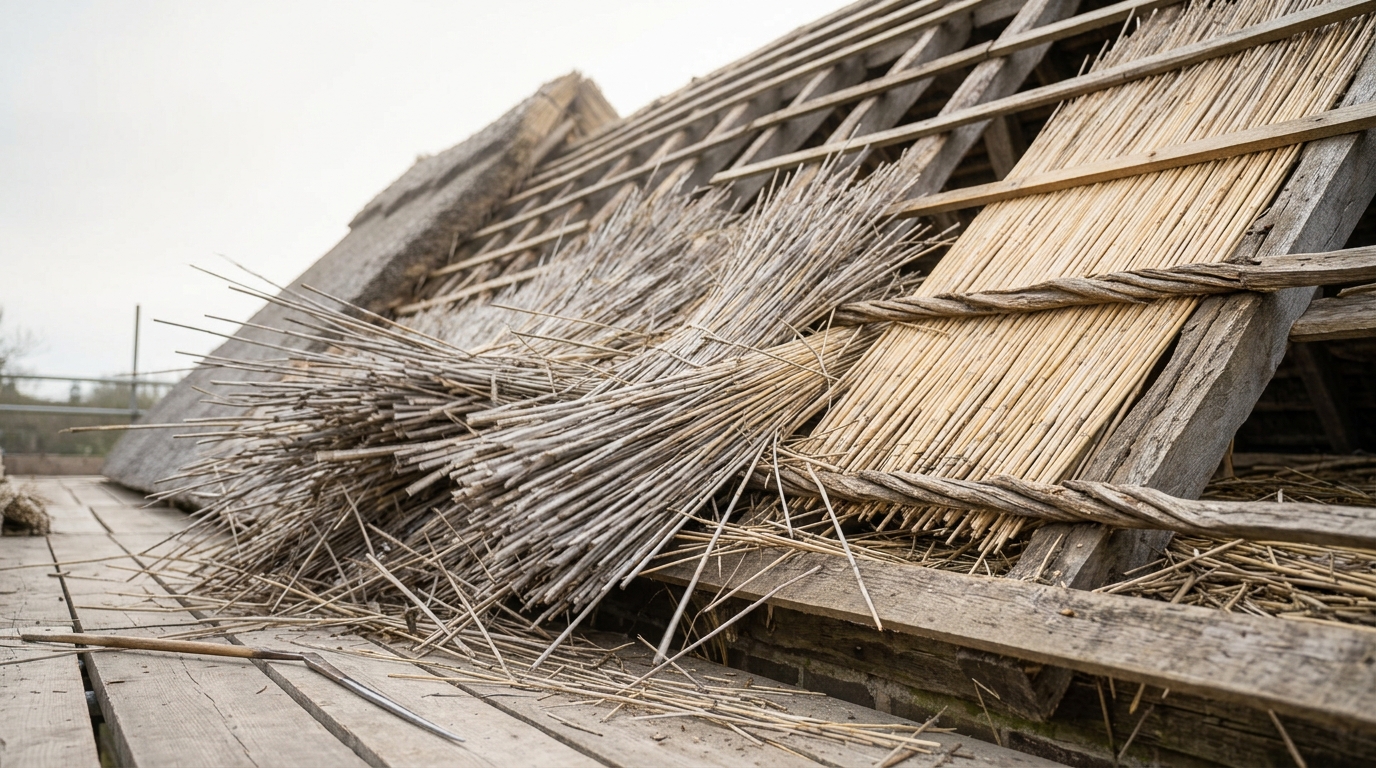
Stand on a scaffold beside a thatched roof that has been stripped back for repair and you can see the whole argument of this article in one frame. On one side, a finished coat: an even, close-dressed surface that gives away nothing. On the other, bare rafters and battens. Between them, the course being worked. Once the new coat closes over the fixings, the pitch at which each yealm was laid, the depth to which each spar was driven, and the force with which the coat was dressed home all become invisible. A section fixed badly looks identical to a section fixed well. The difference appears years later, as water tracking where it should not.
This is not an unusual property of thatch. It is the ordinary condition of skilled making. The information that determines whether an artefact will perform is distributed through a sequence of decisions that the artefact itself does not record. That fact sets the transmission problem this article is about: how does a technique get from one generation of practitioners to the next with enough of itself intact that the next generation can improve on it rather than merely rediscover it?
Two things follow immediately, and they are worth separating before any evidence is introduced. The first is a claim about mechanism: that faithful reproduction, not invention, is usually the binding constraint on accumulated technical capability. The second is a claim about institutions: that apprenticeship, indenture and journeyman travel are not merely labour arrangements that happen to involve training, but engineered solutions to a specific information-transfer failure. The first claim is supported by a substantial experimental literature. The second is historical and interpretive, and I will mark where it stops being evidence and starts being reading.
The ratchet is a fidelity requirement
Cumulative cultural evolution is usually introduced through a ratchet metaphor: improvements are retained, so each generation starts from a higher baseline than the last. The metaphor is durable because it is nearly right, but it has been used loosely enough that Mesoudi and Thornton set out to fix its referent. They argue that debate about cumulative culture is hampered by multiple and often ambiguous definitions, and they separate a set of core criteria — which are necessary and sufficient, and which may be found in non-human species — from a set of extended criteria observed so far only in humans. Their practical recommendation matters for reading any study in this field: different socio-cognitive mechanisms may underlie different criteria, so researchers should be explicit about which component of cumulative culture they are actually testing [1].
The core of the concept is a retention condition. A modification counts as cumulative only if it survives long enough, and in sufficiently recognisable form, to be the thing that the next modification modifies. Tennie, Call and Tomasello frame the contrast with chimpanzee traditions in exactly these terms: chimpanzee cultural variation, on their account, reflects behavioural biases within a species-typical repertoire — a zone of latent solutions — generated by founder effects, individual learning and largely product-oriented copying, whereas human social learning is more oriented toward process, and is reinforced by active teaching, social motivations for conformity and normative sanctions against non-conformity [2].
The distinction between product-oriented and process-oriented copying is the pivot on which the rest of this article turns, so it is worth stating plainly. Product-oriented copying reproduces the outcome: the learner sees a finished thing and works out some way to make a thing like it. Process-oriented copying reproduces the method: the learner acquires the sequence of actions that produced it. For an artefact whose performance is fully legible in its finished form, product copying suffices. For an artefact whose performance depends on decisions the finished form conceals — a thatched coat, a heat-treated blade, an alignment inside a machine — product copying reproduces the appearance and drops the function.

A useful way to make the retention condition inspectable is to write the accumulated complexity after
Here
Imitation, emulation, teaching: what the experiments separate
The mechanisms that could carry a technique across a generational boundary are not interchangeable, and two well-designed experiments have pulled them apart with conflicting emphasis. Presenting both is the honest way to handle this literature.
Morgan and colleagues ran Oldowan stone-knapping skills along transmission chains of adult participants — 184 in total — under five different transmission conditions, and scored the outcome on six measures. Their finding was that transmission improves with teaching, and particularly with language, but not with imitation or emulation. They draw two inferences from this: that low-fidelity social transmission such as imitation or emulation may have contributed to the roughly 700,000-year stasis of the Oldowan technocomplex, and that teaching or proto-language may have been prerequisites for the appearance of Acheulean technology [3].
Zwirner and Thornton reached a more qualified conclusion using a different task. Participants built baskets to carry as much rice as possible from a set of everyday materials, divided into treatment groups with differing opportunities to learn asocially, to imitate, to receive teaching, or to emulate by examining baskets made by earlier chain members. Teaching chains produced more robust baskets. But neither teaching nor imitation proved strictly necessary for cumulative improvement: emulation chains generated equivalent increases in efficacy despite relatively low copying fidelity. Participants also used social information strategically, switching materials when the previous basket in the chain had performed poorly. The authors conclude that cumulative culture does not rest on high-fidelity social learning mechanisms alone, and suggest the roots of human cultural capability lie in the interplay of strategic social learning with other cognitive traits, including the ability to reverse-engineer artefacts through causal reasoning [4].
These are not contradictory results so much as results about different artefacts, and the difference is instructive rather than embarrassing. A basket is highly diagnostic: its weave is visible, its failure mode is immediate, and a learner who examines a poor basket can infer a great deal about why it was poor. A knapped core is far less diagnostic: the productive fracture mechanics are not recoverable from inspecting a flake, and failure is silent. My reading — and this is analysis, not a finding either paper reports — is that the marginal value of teaching over emulation scales with how much of the causal structure the finished artefact hides. Thatch sits at the opaque end of that range, which is why its training times are long.
The transmission chain as a laboratory
The method underlying both studies deserves description in its own right, because it is the field’s principal instrument. Caldwell and Millen built microsocieties in which chains of ten participants worked on a task under a replacement regime: experienced members were progressively removed and replaced by naive newcomers, so that at any moment four people occupied the space, two observing and two working. Staggered start times gave each participant a period of observation followed by a period of doing. Two tasks were used — paper aeroplanes scored on distance flown, and spaghetti towers scored on height. Across replicate chains, performance improved from generation to generation; designs were more similar within chains than between them, and adjacent generations were more similar than distant ones, which is the signature of accumulated modification rather than independent reinvention [5].

Two features of the design are worth naming because they are what makes it a model of the thing rather than a demonstration of it. First, the generations are learner generations, not reproductive ones, which is what allows a whole cultural history to run in an afternoon. Second, nothing in the chain has memory except the participants and the artefacts they leave behind; there is no archive. That second feature is the sharp end. It means the method measures exactly the quantity that matters here — how much of a technique survives a handover — and it is why transmission-chain results are usually reported as degradation curves rather than as scores.
The limitation is equally clear and is acknowledged in the literature: laboratory tasks are chosen to be learnable in minutes, and a task learnable in minutes is by construction one whose causal structure is shallow. Extrapolating from a spaghetti tower to a six-year craft is an inference about kind, not a measurement.
What will not go into words
The strongest evidence that some technical knowledge resists verbal encoding comes not from psychology but from the sociology of science. Collins studied the diffusion of the transversely excited atmospheric-pressure carbon dioxide laser through the research community of the late 1960s. Published accounts existed. They were not sufficient. Collins found that only those with substantial personal contact with someone who had themselves built a working device succeeded in building one, and he records that respondents twice described failed attempts to learn from a person who had all the particulars but had not personally built one [6]. The knowledge that mattered was not withheld; it was not in a form that could be handed over in the absence of the practice that generated it.
The archaeological analogue is Roman concrete, and it is a case where written description survived while the practice did not. Seymour and colleagues identified relict lime clasts as a ubiquitous component of Roman mortars and argued they are the residue of hot mixing — combining quicklime directly with aggregate and water rather than using pre-slaked lime — an exothermic process they associate with temperature rises in the region of 55 to 60 degrees Celsius. They note that the terminology in the surviving Roman texts is itself ambiguous on precisely this point, observing that Vitruvius used different terms for lime preparation in structural as against decorative applications and suggesting his structural term could refer to lime hydrated simultaneously with the other mortar components. Their modern Roman-inspired specimens containing quicklime healed cracks: after thirty days, water flow through half-millimetre cracks ceased entirely, with newly precipitated calcite identified in the healed fractures [7].
Note carefully what this case does and does not show. It does not show that the Romans understood the self-healing mechanism; the paper makes a claim about materials, not about Roman theory. What it shows is that a procedural detail decisive for a technology’s performance was carried in practice, was recorded in text only obliquely and ambiguously, and required instrumented analysis two millennia later to recover. The written record preserved the vocabulary of the craft and lost its procedure. That is the failure mode this article is about, observed at scale.
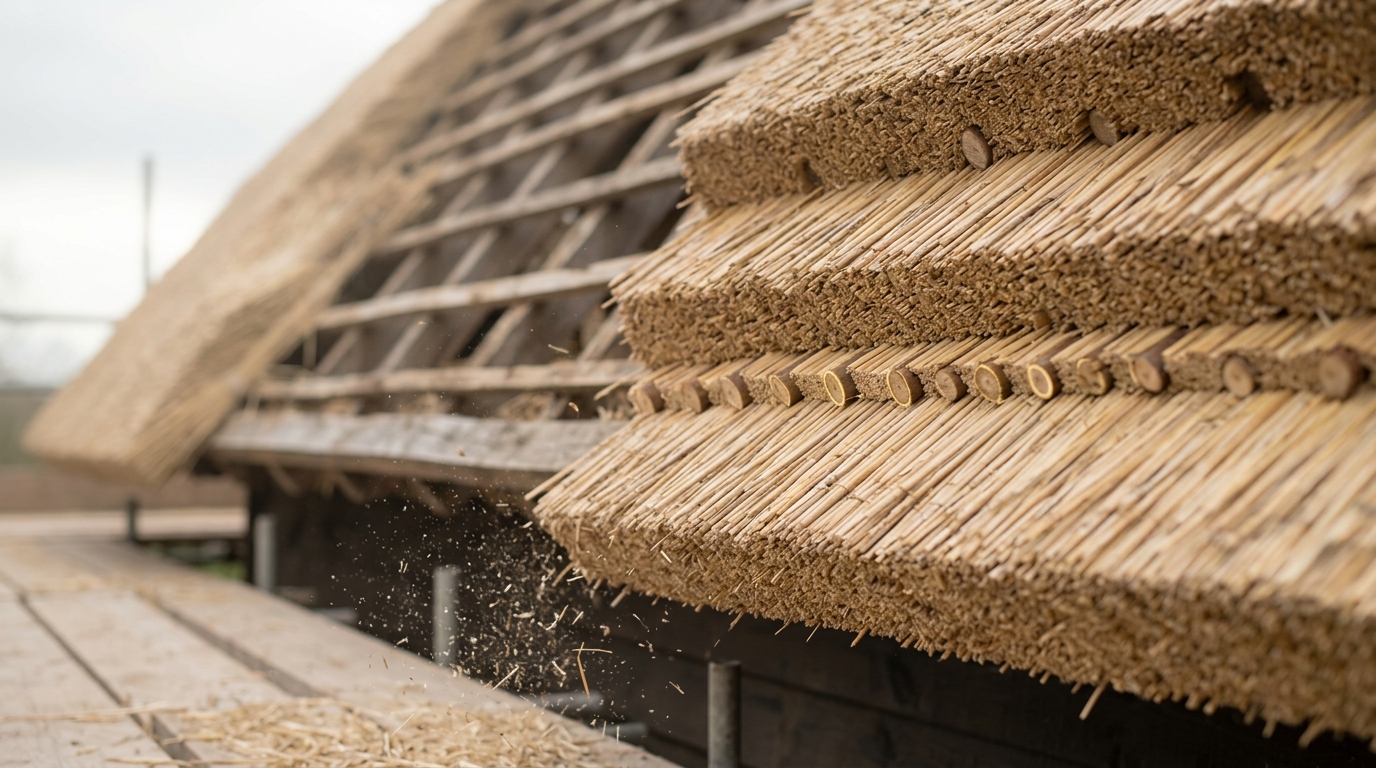
Thatching supplies the living version. Heritage Crafts records three historically distinct English traditions — combed wheat reed in the south-west, long straw across the Midlands and southern counties, and water reed in the east — and attributes twentieth-century decline to a compound of causes, including the two world wars breaking up thatching families, the disbanding of estates, rural emigration, farmers abandoning thatch on agricultural buildings, combine harvesters producing straw of unsuitable length, and shortages of the wooden spars that discontinued estate woodland management had previously supplied [15]. Several of those are supply failures rather than knowledge failures, which is itself the point: a technique is not stored in a head alone but in a system that includes the material, the tool and the person who can judge the result.
Population size and connectedness: an open question, fairly stated
If fidelity is imperfect and losses compound, then the number of people carrying a technique and the way they are connected should matter. This is one of the most productive and least settled questions in the field, and it should be presented as unsettled.
The demographic case has both a modelling and an archaeological arm. Powell, Shennan and Thomas argued that demography is a major determinant in the maintenance of cultural complexity, and that regional variation in subpopulation density or migratory activity produces spatial structuring in the accumulation of cultural skill. Their striking observation is a mismatch of timing: the Upper Palaeolithic transition in western Eurasia occurred around 45,000 years ago, while comparable behavioural features appear in southern Africa roughly 45,000 years earlier — and genetic estimates of regional population size indicate that early Upper Palaeolithic European densities were similar to those in sub-Saharan Africa at the point when modern behaviour first appeared there [8]. On this account, geography of demography rather than a change in cognition explains the pattern.
Experimental work has supported the mechanism in the laboratory. Derex and colleagues used a dual-task computer game played by groups of different sizes and reported that in larger groups cultural knowledge deteriorated less, improvements to existing traits were more frequent, and trait diversity was maintained more often [9].
The archaeological critique is direct. Vaesen, Collard, Cosgrove and Roebroeks argue that the influential demographic models support a relationship between population and culture only under implausible conditions, and that their predictions conflict with the available archaeological and ethnographic evidence. Two of their specific objections are worth stating because they are structural rather than rhetorical. First, on transmission mode: they observe that vertical transmission is dominant in small-scale societies, which cuts against the modelling assumption that learners preferentially copy the single most skilled individual in the population — an assumption the demographic result leans on heavily. Second, on the Tasmanian case: they note that Tasmanians continued to produce artefacts more intricate than the bone points whose abandonment the model is built to explain, including woven baskets, bark canoes and waterproof shelters, alongside complex practices such as ochre mining and body scarification. They also press the Upper Palaeolithic timing directly, noting that sub-Saharan African populations grew steadily from around 160,000 years ago while the behavioural signature appears only around 90,000 to 75,000 years ago [10].
I do not think this dispute is resolvable from the outside, and I am not going to pretend otherwise. The demographic modellers and their critics largely agree on the arithmetic and disagree about whether the parameter regimes in which the arithmetic bites are the ones that obtained in the past — a disagreement about historical plausibility, not about mathematics. What can be said is that the naive form of the claim, in which head-count alone predicts retained complexity, is not currently well supported, and that both camps have moved past it.
Structure has turned out to matter as much as size. Derex and Boyd compared fully connected and partially connected groups of equal size on a task with a complex fitness landscape, and found that in fully connected groups the propensity to learn from successful individuals sharply reduced cultural diversity, while partially connected groups sustained more diverse solutions and reached complex solutions that fully connected groups never produced — with the reported result that no fully connected group discovered the most complex innovations against 58 per cent of partially connected groups [11]. Full connectivity produces premature convergence on whatever currently looks best. Partial isolation preserves the variation that later recombination needs.

That result reframes journeyman travel, which I turn to next, as something more interesting than a way of spreading best practice. A system of partially isolated regional workshops linked by circulating individuals is close to the topology Derex and Boyd found to be productive. Whether pre-modern craft institutions were shaped by that dynamic or merely happen to resemble it is not something the experiment can establish, and I am putting it forward as an interpretation.
Indenture, guild, journeyman
Read as information technology rather than as labour law, the institutional apparatus of the pre-modern craft looks purpose-built. Epstein’s account of European craft guilds is that they emerged to supply transferable skills through apprenticeship, and that they persisted for more than half a millennium because they sustained interregional markets for specialised labour and contributed to technological invention in two ways: by stimulating technical diffusion through migrant labour, and by giving inventors temporary monopoly rents. His conclusion about their end is the part most often misremembered — on his reading they disappeared not through adaptive failure but because national states abolished them by decree [12].
De la Croix, Doepke and Mokyr formalise the underlying mechanism. Their model of pre-industrial technological progress is built explicitly on person-to-person transmission of tacit knowledge, with the young learning as apprentices from the old, and with the family, the clan, the guild and the market treated as alternative institutions that determine who learns from whom. Their central comparative claim is that guild apprenticeship, being independent of family ties, permitted knowledge to disseminate across an entire economy, whereas transmission confined within closed kinship systems impaired it [13]. This is an argument about network reach, and it sits naturally alongside the connectivity result above.
The institutions were not frictionless, and it matters that they were not. Wallis’s work on premodern England documents that a high proportion of London apprenticeships in the seventeenth century ended before the contracted term was served, with late arrival and early departure both widespread; his account explains this by the way training costs and their repayment were distributed across the contract, so that neither master nor apprentice was badly exposed by an early exit [14]. The lesson is not that indenture failed. It is that a multi-year contract was doing something beyond guaranteeing a fixed quantity of instruction: it was aligning incentives over a period long enough for a slow, unobservable transfer to happen at all.
Modern practice preserves the timescale. Heritage Crafts records that thatching apprentices historically trained alongside experienced thatchers on live jobs, averaging six or seven years before they could work independently, and gives the contemporary requirement as roughly four years of training plus a further two years of thatching before a thatcher is competent [15]. Those durations are not ceremonial. They correspond to feedback cycles in the material itself: the Building Conservation Directory notes that a water reed coat could be expected to last on the order of fifty to sixty years, and that a ridge, which takes the brunt of the weather, needs attention on average every ten to fifteen years [16]. An apprentice who works only on new coats may never see the consequence of a bad decision. Long terms and mixed work exist because the error signal is slow.
Why the manual was never enough
Pull the strands together and the reason written instruction has never been sufficient for craft skill is not that practitioners were inarticulate or secretive. It is structural, and it has three parts.
The first is the diagnosticity gap already described: where the finished artefact conceals the causal structure that produced it, product-oriented copying reproduces appearance and drops function. The second is the feedback-latency gap: where failure arrives years after the decision that caused it, a learner cannot close the loop alone within any useful time, and needs someone who has already seen the failure. The third is the evaluation gap: a text can specify a target but cannot assess a partially completed workpiece against it, which is why the master’s role is less to describe than to look at unfinished work and say when it is wrong.
None of this makes documentation useless. It makes documentation a complement whose value depends on a living practice to interpret it — which is exactly what the Roman concrete case demonstrates from the far side, where the text survived and the interpreting practice did not [7, 6].
A scenario, clearly labelled as such rather than as a forecast: it is conceivable that instrumented capture changes the diagnosticity gap. Dense sensing of a craftsman’s hands and tools, or process monitoring embedded in the workpiece, could in principle externalise part of what is currently tacit, in the way that materials analysis externalised Roman hot mixing. That would not eliminate apprenticeship; it would shorten the portion of it devoted to acquiring what the artefact hides.
A prediction, with its terms exposed. Over a ten-year horizon to 2036, I expect that craft trades whose transmission runs through multi-year supervised work will not be materially shortened by improved recorded or machine-generated instruction, because the binding constraint is supervised production judged by a competent practitioner rather than the availability of description. The assumptions are: that no deployed system reliably evaluates a partially completed physical workpiece in situ against a tolerance; that heritage-consent and insurance regimes continue to require an accredited practitioner’s sign-off; and that supply of craft-grade materials remains thin enough to keep practice concentrated. The observable indicators are the number of registered craft apprenticeships, the median time to independent working, and the supervised-hours requirements published by trade associations. The disconfirmation condition is specific: if within the horizon a recognised craft body reduces its required supervised hours while explicitly citing recorded or machine-assisted instruction, and independent condition surveys over the following coat cycle show no increase in premature failure, then the claim above is wrong and should be withdrawn.
The thatcher’s problem is the general problem in an unusually honest form. The roof will not tell you what was done to it. Neither will most artefacts, most institutions, or most working systems. What can tell you is a person who was standing on the scaffold when it happened, and the whole architecture of apprenticeship — the indenture, the term, the travel, the slow accumulation of jobs seen from beginning to end — is what a society builds when it needs that person to still be there in thirty years.