Every human technology alive today is the residue of thousands of small edits nobody fully remembers making. A spear-thrower, a bicycle derailleur, a sourdough culture — each is a solution no single person invented from scratch, improved across generations past what any one mind could work out alone. Researchers call this cumulative culture, and for a long time the term did a lot of unexamined work: it explained everything and predicted nothing. Three lines of evidence now pin it down to something closer to a mechanism, with parts that can fail independently.
The transmission chain: where copying breaks down
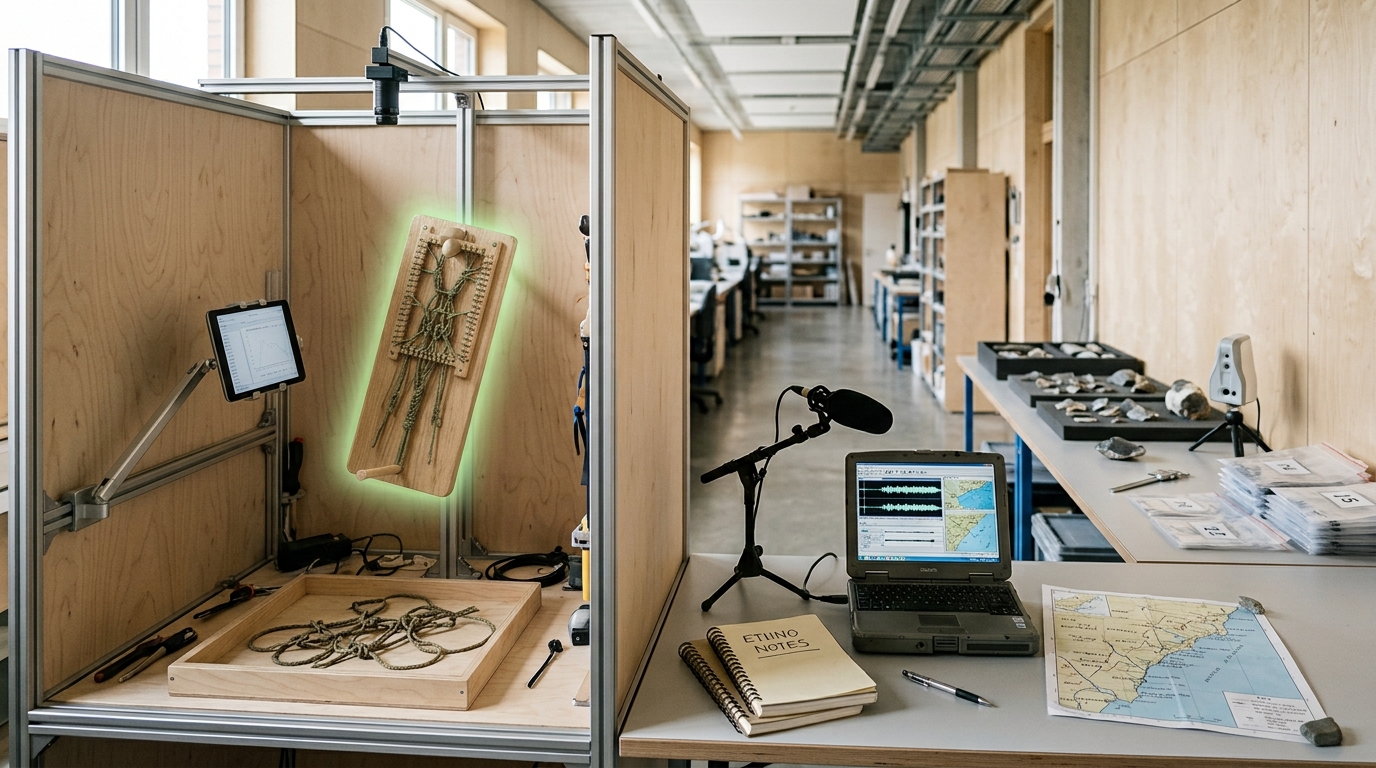
The cleanest experimental tool for this is the transmission chain: seat one person in a booth, show them a previous participant’s attempt at a task — building a tower from spaghetti and tape, folding a paper glider for distance — then let them try, unaided, and only their result passes to the next booth. Nobody in the chain sees the instructions, only the artifact one step behind them [1].
The finding that made this design useful is not that performance rises — it does, reliably, tower height and glider distance both climb across generations of a chain — but that it rises unevenly and with visible fidelity loss at each handoff. A chain does not transmit a method; it transmits an artifact, and every station has to reverse-engineer the method from the object alone. Some improvements survive intact for many generations; others are lost the moment the one participant who found them fails to make the underlying trick legible in the object they hand forward. This is the experimental definition of transmission fidelity: not whether information is copied, but how much of why it worked survives the copy [1]. Fact: this design and its reliable generational improvement is a replicated experimental result, not a claim about any specific real-world craft.
The ratchet effect: why apes don’t have this
Chimpanzees have local traditions — nut-cracking with stones in some populations, not others — that look superficially cumulative. The comparative argument is that they are not, because they lack a ratchet: a mechanism that keeps an improvement from sliding back down once found. Tennie, Call, and Tomasello’s account distinguishes ape culture, built from individual learning plus a product-oriented copying (attend to the outcome, reinvent the method) that never locks in a gain, from human culture, whose process-oriented imitation, active teaching, and social pressure toward conformity mean that once a genuine improvement appears, group members reproduce the method precisely enough that it doesn’t have to be rediscovered next time [2].
Analysis: the ratchet claim is doing narrower work than it is often given credit for. It does not say apes cannot learn socially, or that ape cultures are static — it says specifically that ape social learning does not preserve the steps, only the goal, so each generation re-solves the same problem rather than starting one rung higher. Put differently: the ratchet is a claim about fidelity of process transmission, and it is testable exactly the way the transmission-chain design tests it in humans.
That prediction was tested directly. Dean and colleagues ran the same three-stage puzzlebox — solve stage one to unlock stage two, solve stage two to unlock stage three, with escalating food rewards — on capuchin monkeys, chimpanzees, and 3- to 4-year-old children, all under identical conditions and reward structure. Only the children reliably reached the third, highest-value stage, and their success tracked directly with observed teaching (including verbal instruction), imitation of the exact method demonstrated, and prosocial sharing of the reward — a specific package of social-cognitive behaviors that was largely absent in the other two species [3].

Fact: this is one puzzlebox paradigm, one comparison across three species, published in a single peer-reviewed study; it demonstrates that this bundle of behaviors correlates with cumulative success in this task, not that any one of teaching, imitation, or prosociality is independently necessary in general.
Population size and the Tasmanian loss
The transmission chain and the puzzlebox both isolate the transmission mechanism. A separate, population-level constraint governs whether a skill, once transmitted with reasonable fidelity, is retained at all: how many skilled people are around to keep transmitting it.
Joseph Henrich modeled this using the documented archaeological record of Tasmania. When sea levels rose roughly 10,000 years ago, Tasmania was cut off from mainland Australia, and the resulting population — some few thousand people, permanently isolated — subsequently lost a substantial list of technologies attested in the earlier archaeological layers: bone tools, specialized cold-weather clothing, barbed and multi-pronged spears, hafted stone tools, and (per the ethnohistoric and archaeological record Henrich reviews) fishing technology, over roughly eight millennia of isolation [4]. Mainland Aboriginal Australian groups, larger and interconnected, retained equivalent or more complex toolkits over the same span.
Henrich’s model treats a skill as something that decays a little in each transmission event — copying error, incomplete demonstration, an apprentice who never quite matches the teacher — and asks how many parallel skilled practitioners a population needs for the best available performance to keep pace with that decay generation after generation. Below a population-size threshold specific to a skill’s difficulty, the pool of practitioners skilled enough to reproduce it shrinks probabilistically until, by chance, nobody capable is left to teach it — even though no single choice to abandon the technology was ever made. Analysis: this reframes “cultural loss” from a story about forgetting or environmental unsuitability into a population-dynamics problem with a threshold, which is why Henrich’s title calls it an adaptive process producing a maladaptive outcome — every individual transmission step behaved normally; the population-level result was still net loss [4].

Later experimental and simulation work sharpened the mechanism further. Derex and Boyd found, in a controlled online cultural-transmission experiment, that groups with partial rather than full connectivity between members accumulated more complex solutions over time: full connectivity let the single best current solution spread everywhere immediately, which suppressed the diversity of independent attempts needed to stumble onto further improvements, while partial connectivity preserved parallel variation long enough for accumulation to continue [5]. Analysis: this complicates a simple “bigger population is always better” reading of the Tasmanian case — the mechanism is not raw population size alone but the combination of enough skilled carriers and enough independent variation in how they solve the problem, both of which shrink when a population becomes small and tightly interconnected, as an isolated island population does.
What this rules in and out
Vendor-style claim to flag and reject as unsupported here: that any modern institution or platform “recreates” the ratchet effect by simply enabling more copying. The evidence above says the ratchet depends on high-fidelity process transmission (teaching, precise imitation) plus a population large and variable enough to sustain net accumulation — volume of copying alone, without those properties, is not what these studies measured or support.
Scenario, clearly labeled as such: if a modern skilled trade’s practitioner population fell by an order of magnitude within one generation while task difficulty stayed constant, Henrich’s model predicts a nonzero probability of unrecoverable skill loss even with functioning apprenticeship, not certainty of loss — the process is stochastic, not deterministic.
Prediction, with horizon and disconfirmation condition: if transmission-chain methodology continues to be applied to digital and organizational knowledge transfer over the next five to ten years, expect published studies to identify analogous fidelity thresholds in document-based or video-based instruction (as opposed to face-to-face teaching). This would be disconfirmed by transmission-chain studies showing that recorded instruction reproduces process fidelity as well as live teaching does — a result the puzzlebox and chain literature so far has not shown, since every cited study here used live, in-person demonstration.
What the transmission chain, the ratchet comparison, and the Tasmanian case share is a refusal to treat “culture accumulates” as a single fact. Each names a specific point where accumulation can stop: a handoff that loses the reason behind a change, a copying style that reproduces goals but not methods, or a population too small to keep enough skilled carriers in circulation. Cumulative culture is not a trait humans have and other species lack in the abstract — it is the outcome of these mechanisms all clearing their thresholds at once, and the same evidence shows exactly how each one can fail to.