Every information revolution arrives advertised as a clean break from what came before it, and every one of them turns out, on inspection, to be a modification of an existing system rather than a replacement of it. Cuneiform script grew directly out of an accounting practice that predated it by millennia. Gutenberg’s press did not invent movable type — Bi Sheng had built ceramic movable type in China around 1040, and Korea’s Goryeo dynasty printers cast a metal-type edition, the Jikji, in 1377 — but he assembled the type, ink, press, and paper into one reusable production system suited to a script and market at continental scale. Search engines did not invent indexing; libraries and states had been building indexes for centuries. What changes, revolution to revolution, is scale, unit cost, and who gets to write the record — not the underlying act of turning a thought into a durable mark that someone else can retrieve later.
This is a history of that underlying act: five documented transitions in how humans externalize memory, told from primary and archaeological evidence where it exists, with vendor claims, scholarly interpretation, and forward-looking scenario kept visibly separate from settled fact throughout.
Fact: writing began as accounting, not literature
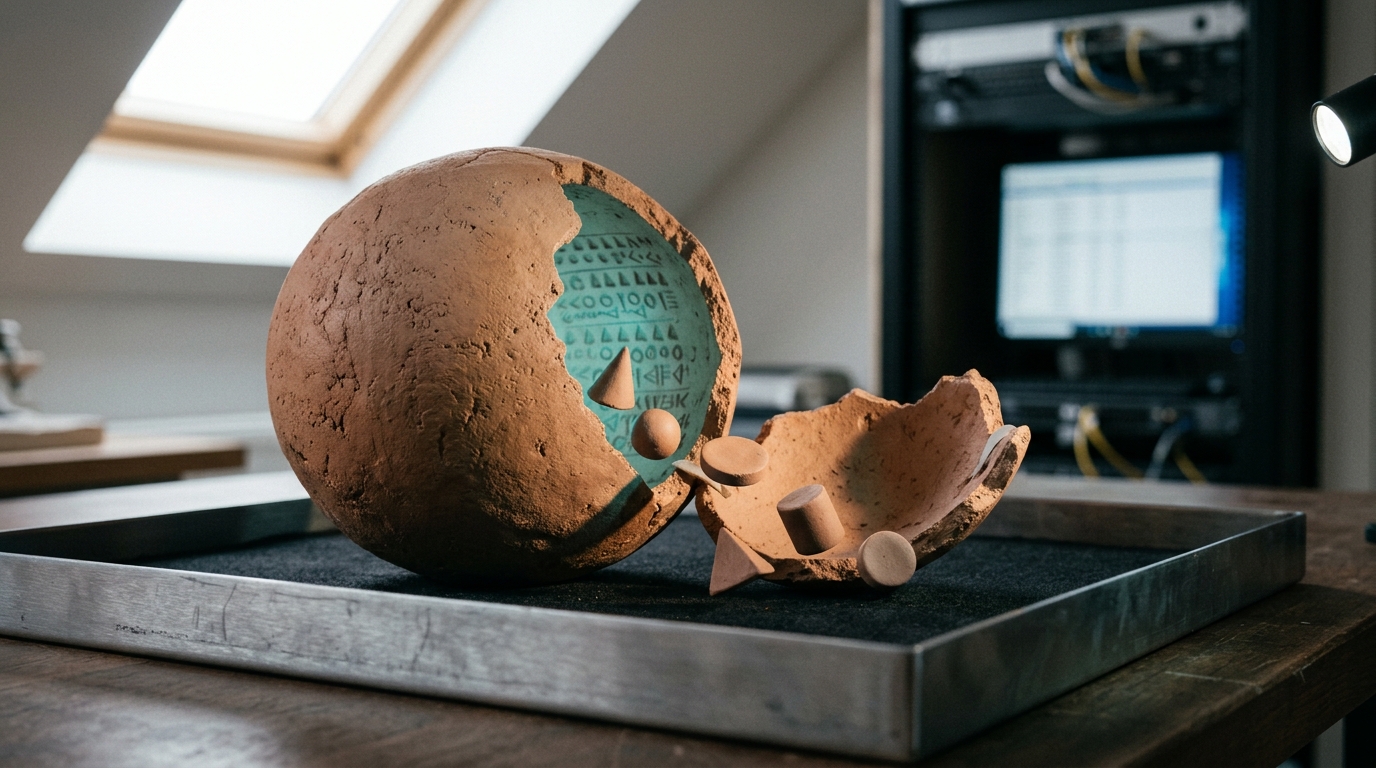
The earliest verifiable step toward writing is not a poem or a decree. It is a token. Archaeologist Denise Schmandt-Besserat’s decades of excavation and analysis across Near Eastern sites established that small clay tokens — cones, spheres, disks, cylinders in a limited set of shapes — were used across the Fertile Crescent from roughly the eighth millennium BCE to represent countable goods: a sphere for a measure of grain, a cylinder for an animal [1]. These were not writing in any linguistic sense. They were a physical accounting technology, portable units of a shared symbolic system for tracking who owed what to whom.
The transition to writing proper happened when tokens representing a transaction began to be sealed together inside a hollow clay envelope — a way of making a record tamper-evident, since the envelope had to be broken to check its contents. Because the sealed tokens were invisible once enclosed, scribes began pressing the tokens into the envelope’s wet outer surface before sealing them inside, creating a two-dimensional impression of a three-dimensional object. Schmandt-Besserat’s account is explicit about the mechanism: this reduction of tokens to their imprinted image is the origin of pictographic signs, and from there the system evolved through a documented sequence — from concrete token-impressions, to abstract pictographic signs pressed with a stylus rather than a token, to signs that recorded sound rather than the object itself, to a fully phonetic writing system [2]. Actual cuneiform script, wedge-shaped marks pressed by a cut reed stylus into wet clay, crystallizes out of this process in Mesopotamia by roughly 3200 BCE.
This origin story matters for what it rules out. Writing was not invented to record epics, laws, or prayers. Every one of the surviving early Uruk-period tablets is an administrative document: a tally of barley rations, a receipt for livestock, a record of labor owed. Literature, historiography, and law are downstream applications that a society discovered it could put a general-purpose recording technology to, once the technology existed for a narrower reason — tracking debts in a society whose agricultural surplus and long-distance trade had outgrown living memory. The lesson generalizes: the more consequential a recording technology’s abstract capabilities look in retrospect, the more likely it was built to solve a mundane bookkeeping problem in the first place.
Analysis, not settled fact: the four-stage progression from token to phonetic script is Schmandt-Besserat’s interpretive framework, built from a very large but incomplete archaeological sample; other cuneiform specialists broadly accept the token-to-envelope-to-pictograph mechanism but debate details of timing and regional variation. Treat the stages as the best current reconstruction, not an uncontested fact established with the certainty of a dated tablet.

Fact and analysis: the Library of Alexandria was a completeness project, not a building
Founded under the early Ptolemaic dynasty in Egypt, with Demetrius of Phaleron credited as an early architect of the project around 295 BCE and construction proceeding under Ptolemy I Soter and Ptolemy II Philadelphus, the Library of Alexandria pursued a goal distinct from anything a Mesopotamian archive attempted: not recording new transactions, but centralizing and copying the existing written output of the Mediterranean world in one place [4] [3]. Ships docking at Alexandria’s harbor reportedly had scrolls aboard confiscated for copying, with the copy returned to the ship and the original retained by the library — an account preserved in later, secondhand sources rather than a contemporary Ptolemaic record, and one modern historians treat as illustrative of the library’s acquisitive ambition rather than a verified administrative procedure.
What is well attested is the scale of the ambition: a library and an attached research institution, the Mouseion, that together functioned as the closest ancient equivalent to a national library and research university combined, housing scholars who worked on textual criticism of Homer, mathematics, astronomy, and medicine. Its eventual loss is one of the most mythologized events in the history of the written record, and the myth is worth separating from the evidence. There was no single catastrophic fire that is well documented as the library’s end; the record instead points to a gradual decline through multiple events over centuries — a fire associated with Julius Caesar’s military campaign in Alexandria in 48 BCE that likely damaged warehoused scrolls near the docks rather than the main library itself, the decline of royal patronage under later rulers, and the institution’s eventual disappearance from the historical record sometime in the following centuries, its ending untraceable to one date or one act [3].
Analysis: the durable lesson from Alexandria is not about fire. It is that centralization creates a single point of failure that no other contemporary information system shared. A cuneiform archive was one of thousands scattered across Mesopotamian cities; the loss of any one changed little about the total ancient record. Alexandria concentrated an outsized share of the ancient Mediterranean’s copied texts in one institution, and the corresponding, still-uncertain scale of loss — how many unique works existed nowhere else — reflects that same concentration, whatever combination of events actually caused it. Every subsequent archive, from monastic scriptoria to national libraries to today’s cloud data centers, inherits this tradeoff between the efficiency of centralizing a record and the fragility of doing so.

Fact: Gutenberg’s innovation was a reusable production system
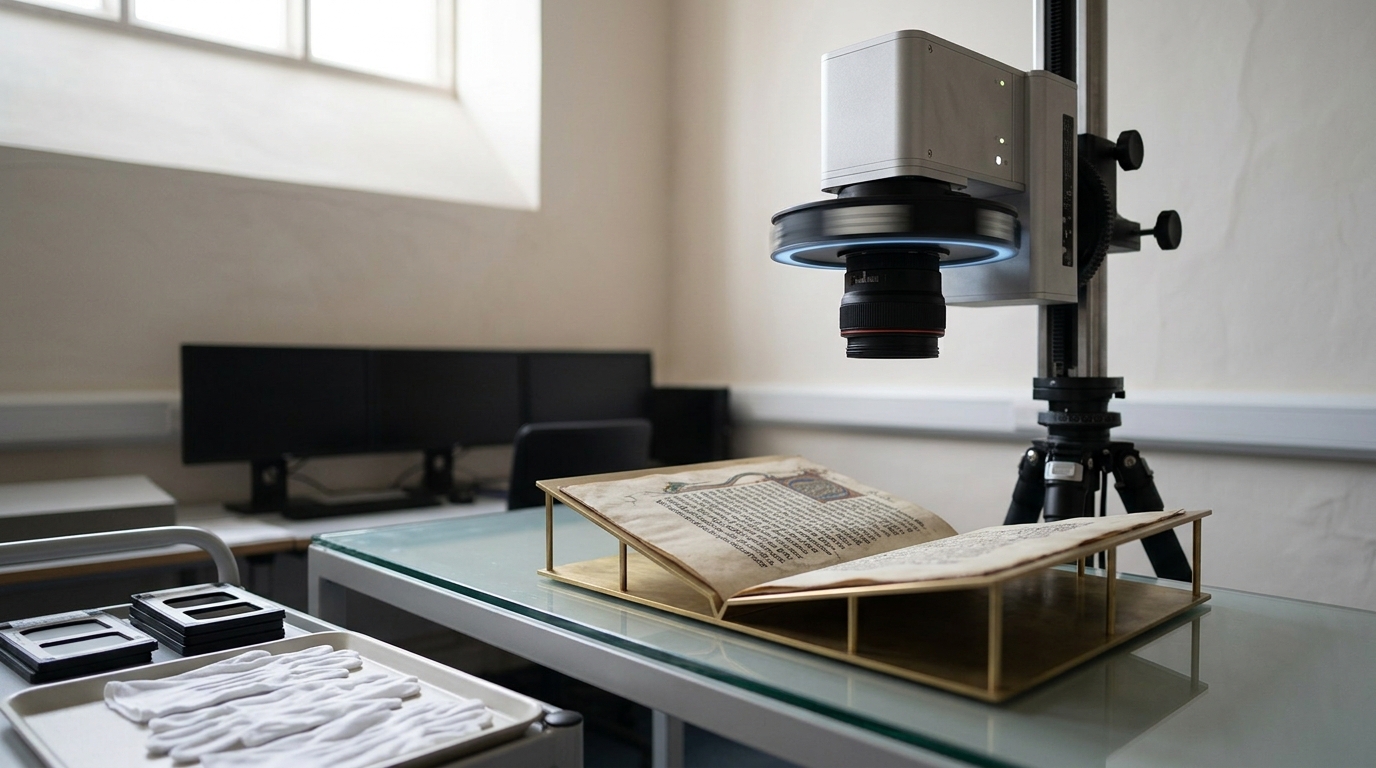
Johannes Gutenberg’s press, developed in Mainz and producing its best-documented surviving product — the 42-line Bible — by around 1455, is verifiable in a way few technologies of its era are: physical copies survive, and institutions including UNESCO’s Memory of the World register and the Gutenberg Museum in Mainz have documented and preserved them [5] [6]. The Gutenberg Museum’s own collection includes reconstructions of Gutenberg’s wooden press alongside the type-casting and composing tools that made his system reproducible, not just his individual press unique [6].
The 42-line Bible itself demonstrates the system’s ambition and limits at once: two volumes totaling 1,282 pages, an edition of roughly 180 copies, about 150 printed on paper and 30 on the more expensive parchment, produced between approximately 1452 and 1455 with the help of numerous assistants [7]. Of the historically documented run, 49 copies are known to survive today, a subset preserved well enough across nearly six centuries to be individually cataloged and compared page by page — the British Library alone holds multiple copies on both paper and vellum [7].
What made the system reproducible rather than a one-off feat was the combination, not any single piece: cast metal type from a reusable matrix, letting a broken or worn letter be recast rather than requiring an entire new block to be carved by hand; an oil-based ink adapted to metal type rather than the water-based ink used for woodblock printing; and a wooden screw press adapted from an existing device, most plausibly the wine or paper press, rather than an invention from nothing. None of these three elements was individually novel to Gutenberg. Their combination into one repeatable workshop process — a system that other print shops across Europe could copy and scale, and did, within decades of Gutenberg’s Mainz workshop — is the documented innovation.
Analysis, not fact: the often-cited claim that European book output rose from a few thousand manuscript copies before Gutenberg to many millions of printed volumes by 1500 rests on later historians’ aggregate estimates of surviving and cataloged editions (incunabula), not on any single contemporary census — treat the order of magnitude as broadly credible and the precise figures as estimates with real uncertainty bands, since incunabula survival itself is uneven across regions and genres.

Fact: the bureaucratic archive is an information technology, not a filing convenience
Separately from libraries and print, states developed the archive as infrastructure for their own continuity — a technology whose job is not to disseminate information but to make a specific past claim checkable by someone in the future who was not present when it was made. The United States National Archives’ stewardship of the Declaration of Independence, the Constitution, and the Bill of Rights is a modern, well-documented instance of the same underlying function performed by chancery archives, monastic cartularies, and royal registries for a thousand years before it: a physical original, kept in one custodial chain, that can be produced to settle a dispute about what was actually said or agreed [8].
The bureaucratic archive’s defining technical problem is retrieval at scale, not preservation of a single document. A state that keeps every tax roll, land grant, and court judgment it ever produced but cannot locate the relevant one when a dispute arises has built a warehouse, not an archive. The solution — docket numbers, indexes, cross-referenced registries, and eventually microfilm and digital scanning — is the same retrieval problem that libraries and, later, search engines solve, applied to records whose authority depends on being an original rather than merely a copy.
Analysis: this is why the archive and the library, though they share shelving and cataloging techniques, are functionally distinct technologies. A library optimizes for making many copies of a text available to many readers. An archive optimizes for making one authoritative instance of a record retrievable and provably unaltered. Digital systems have made this distinction sharper, not softer: a library’s job — wide copying — is nearly costless online, while an archive’s job — proving a specific digital record has not been altered since a specific date — remains a genuinely hard unsolved problem for large classes of records, addressed only partially by cryptographic timestamping and version-controlled provenance chains, discussed further below.

Fact: the web and the search engine restructured retrieval, not creation
Tim Berners-Lee’s March 1989 proposal to CERN management, “Information Management: A Proposal,” is a primary source that survives in full on the W3C’s own history archive, and it is worth reading against the myth of the web as a sudden invention [9]. The proposal explicitly frames itself as a practical response to a documentation problem at CERN — information scattered across incompatible systems, lost when staff turned over — and proposes a “global hypertext system,” a term Berners-Lee notes he had not yet settled on calling the “World Wide Web” until he began writing the actual code in 1990 [9]. Hypertext itself, as a concept — documents linked by reference rather than read in a fixed sequence — predates Berners-Lee’s proposal by decades in academic computer science. What his proposal and subsequent implementation contributed was a specific, simple, openly documented protocol and addressing scheme that any institution could adopt without a license or a proprietary system, which is a distinct and separable claim from “inventing linked documents.”
Pew Research Center’s 2014 retrospective on the web’s first 25 years documents the resulting adoption at a scale hypertext research systems never reached: by early 2014, the Center found 87% of American adults were internet users, and 90% of those users said the internet had been a good thing for them personally [10]. That adoption curve created a second, distinct problem that the original hypertext protocol did nothing to solve: once millions of independent documents existed with no central catalog, finding a specific one became the binding constraint, not creating or linking it.
Search engines are the resolution to that constraint, and their own scale is separately documented rather than merely claimed. Google’s official blog, in a 2008 post titled “We knew the web was big…,” stated that the company’s indexing systems had processed one trillion unique URLs at once — a number the post itself frames as a milestone in the scale of the crawlable web rather than a claim about the size of any single search index at query time, a distinction the original post draws explicitly [11]. Treat this figure as a documented historical data point about web scale circa 2008, not as a current measure of any present-day index, which has continued to grow and which no public source in this article’s sourcing list quantifies for the present day.
Vendor claim, marked as such: any modern search company’s marketing language describing its index as “comprehensive” or “the whole web” is a claim, not a fact — no crawler indexes the web exhaustively in real time, since new pages are created continuously and some content is deliberately excluded from crawling by site operators. Analysis: the practical effect of the search-engine era was to invert the archive’s classic bottleneck. Where the bureaucratic archive’s hard problem was retrieval of a known-scarce set of authoritative originals, the search engine’s hard problem is retrieval within an effectively unbounded and unauthoritative set of copies, versions, and forgeries — ranking relevance and trustworthiness rather than merely locating a unique original.

Analysis: what actually changed across five revolutions, and what did not
Laid side by side, the five transitions covered here — tokens to cuneiform, scattered scrolls to the Alexandrian library, manuscript to movable type, ad hoc record-keeping to bureaucratic archive, and scattered documents to indexed search — share a structure. Each one reduces the marginal cost of one specific operation in the information life cycle (recording a transaction, aggregating existing texts, copying a text, proving a record’s authenticity, or finding a document) without meaningfully reducing the cost of the others. Cuneiform made recording cheap but did nothing for retrieval at scale. Alexandria made aggregation possible but not resilient. Gutenberg made copying and distribution radically cheaper but did nothing to solve authentication — a printed forgery is exactly as reproducible as a genuine edition, a problem book history calls the piracy and false-imprint era of early print. The bureaucratic archive solved authentication for a narrow, custodially controlled set of records but never scaled to the volume search engines now index. And the search engine solved retrieval at unprecedented scale while making authentication and provenance comparatively harder, not easier, because it operates over documents it does not control the origin of.
This is the frame through which digital provenance should be read, rather than as a genuinely novel problem. Scenario, not prediction: if digital records continue to be trivially copyable and editable with no built-in record of prior versions, and if cryptographic provenance schemes (content-addressed storage, signed timestamps, verifiable version chains) remain a minority practice adopted mainly by institutions with strong incentives — courts, national archives, scientific data repositories — rather than becoming a default property of general-purpose digital storage, then the twenty-first century’s information record will likely resemble the pre-Gutenberg manuscript era in one specific respect: authenticity will again depend on custodial chain and institutional reputation rather than on any property of the artifact itself, exactly as it did for a hand-copied medieval manuscript. This scenario assumes no low-friction, universally adopted standard for cryptographic provenance emerges within the next decade; the observable indicator to watch is whether major cloud storage and content-hosting providers adopt content-addressing or signed-provenance metadata as a default rather than an opt-in feature. It would be disconfirmed by broad, low-friction adoption of such a standard across ordinary consumer and enterprise storage, not merely within specialist archival institutions.
What has not changed, across four thousand years and five discontinuous technologies, is the underlying function every one of them serves: allowing a claim made by one person, at one time, to be checked by a different person, at a later time, who was not there when it was made. Clay tokens sealed inside an envelope, a scroll copied and shelved at Alexandria, a print run of identical Bibles, a docket filed by number in a records office, and a page returned by a search query are five very different technologies solving one persistent problem. None of them solved it completely, and the history of information technology, read honestly, is less a story of revolutions than a story of which part of that one problem each generation manages to make marginally cheaper.