A lump of bronze that took decades to become a machine
In the autumn of 1900, Greek sponge divers sheltering from a storm off the island of Antikythera found a Roman-era shipwreck on the seabed. Among the statues, glassware and coins they raised was a shapeless, corroded lump of bronze and wood, catalogued with the rest of the cargo and stored at the National Archaeological Museum in Athens [5]. It sat there for more than a year before anyone noticed a gear wheel embedded in it, teeth still visible under the corrosion.
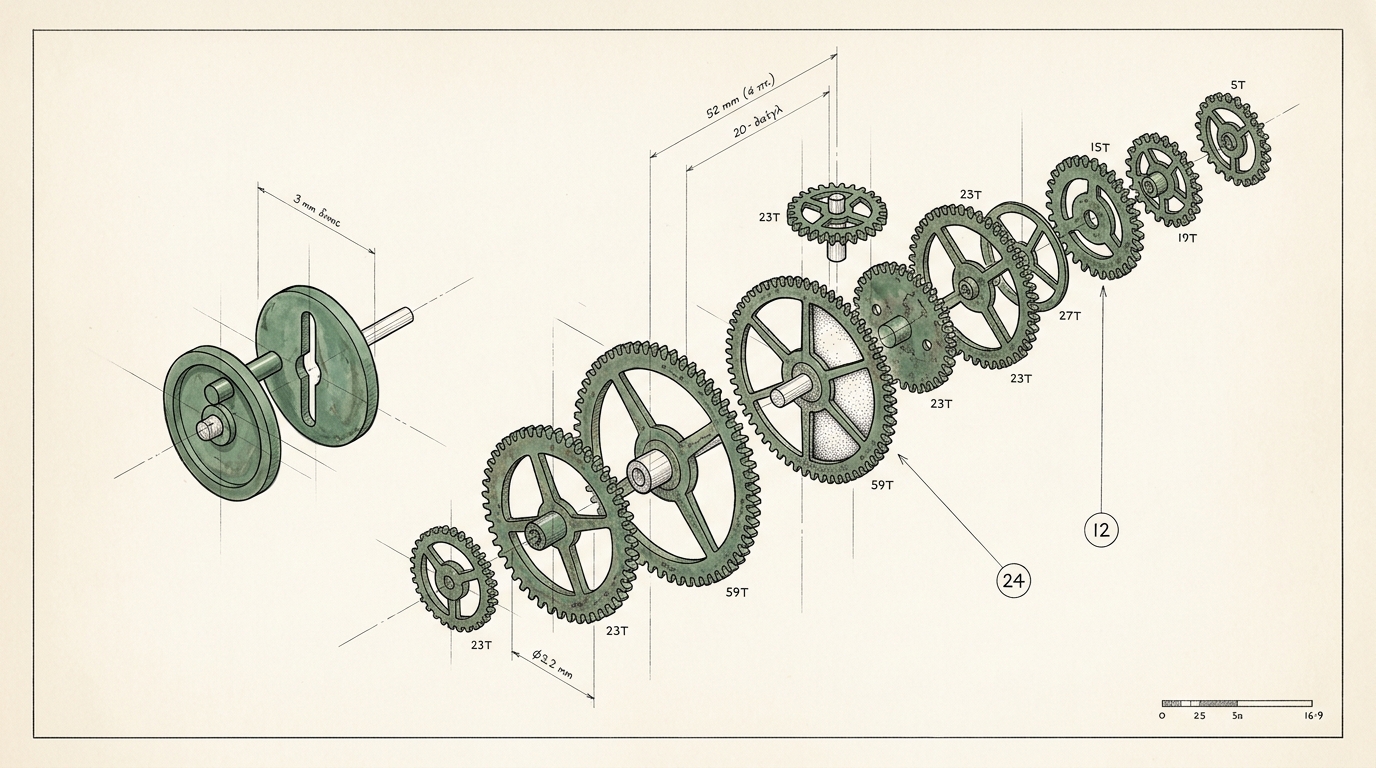
That casual discovery is now recognized as the most sophisticated surviving mechanical artifact of the ancient world: a hand-cranked bronze device, roughly the size of a large book, built to calculate and display astronomical cycles — the position of the Sun and Moon against the zodiac, lunar phases, the timing of eclipses, and the four-year cycle of the Panhellenic games. It is dated, from the wreck’s other cargo and the mechanism’s own inscriptions, to roughly the second century BCE [5]. Decades of study, and one very good use of a CT scanner, have shown it is not a curiosity. It is evidence of an engineering tradition that almost nothing else survives to describe.
What imaging actually established
For most of the twentieth century, what was known about the mechanism came from its corroded surface, plus X-ray and gamma-ray plates taken by physicist Derek de Solla Price in the 1970s. Price’s 1974 monograph Gears from the Greeks was the first systematic attempt to count gears and infer function from those images, correctly identifying the device as a calendrical and astronomical calculator with more than thirty gears [1]. It also got a great deal wrong, including the layout of the back dials.
The turning point came in 2005, when the Antikythera Mechanism Research Project brought a purpose-built microfocus X-ray computed tomography system to the museum and imaged the fragments’ interiors without touching them. The resulting 2006 Nature paper, led by Tony Freeth, read tooth counts directly off the CT slices rather than inferring them from a corroded surface — confirming a 223-tooth gear tracking the 223-lunar-month Saros eclipse cycle, and recovering inscriptions naming eclipse glyphs and calendar months [3]. That is the difference running through the rest of this article’s evidence: some claims rest on teeth a machine literally counted; others rest on a plausible model built to fit what survives.
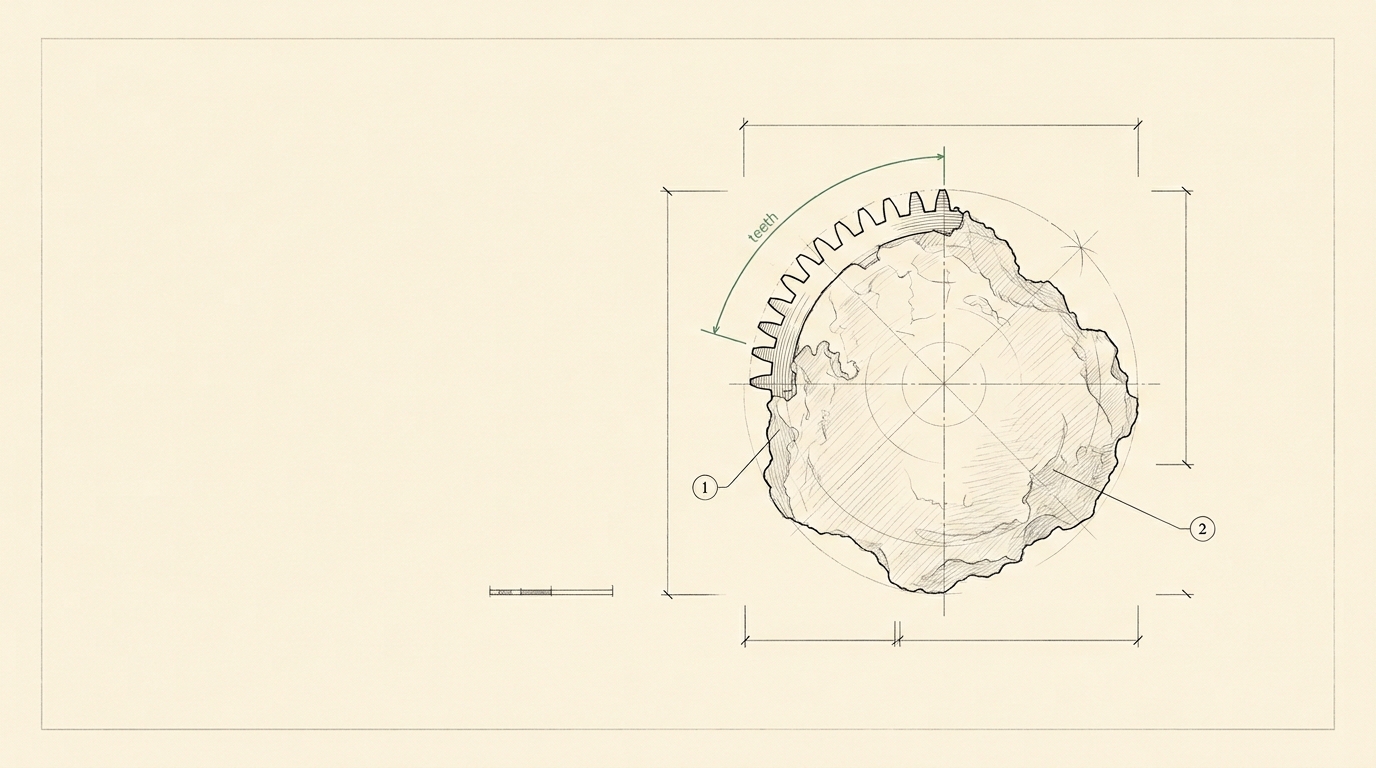
Fragment A, the largest surviving mass of gearing, shows the gap between the two kinds of claim. It holds most of the main gear train fused into a single corroded block roughly the size of a hand. Only a minority of its teeth are legible to the eye; the rest — full tooth counts, exact gear ratios — comes from tomography reading through the corrosion, not from anything anyone can currently see [3].
The cleverest part
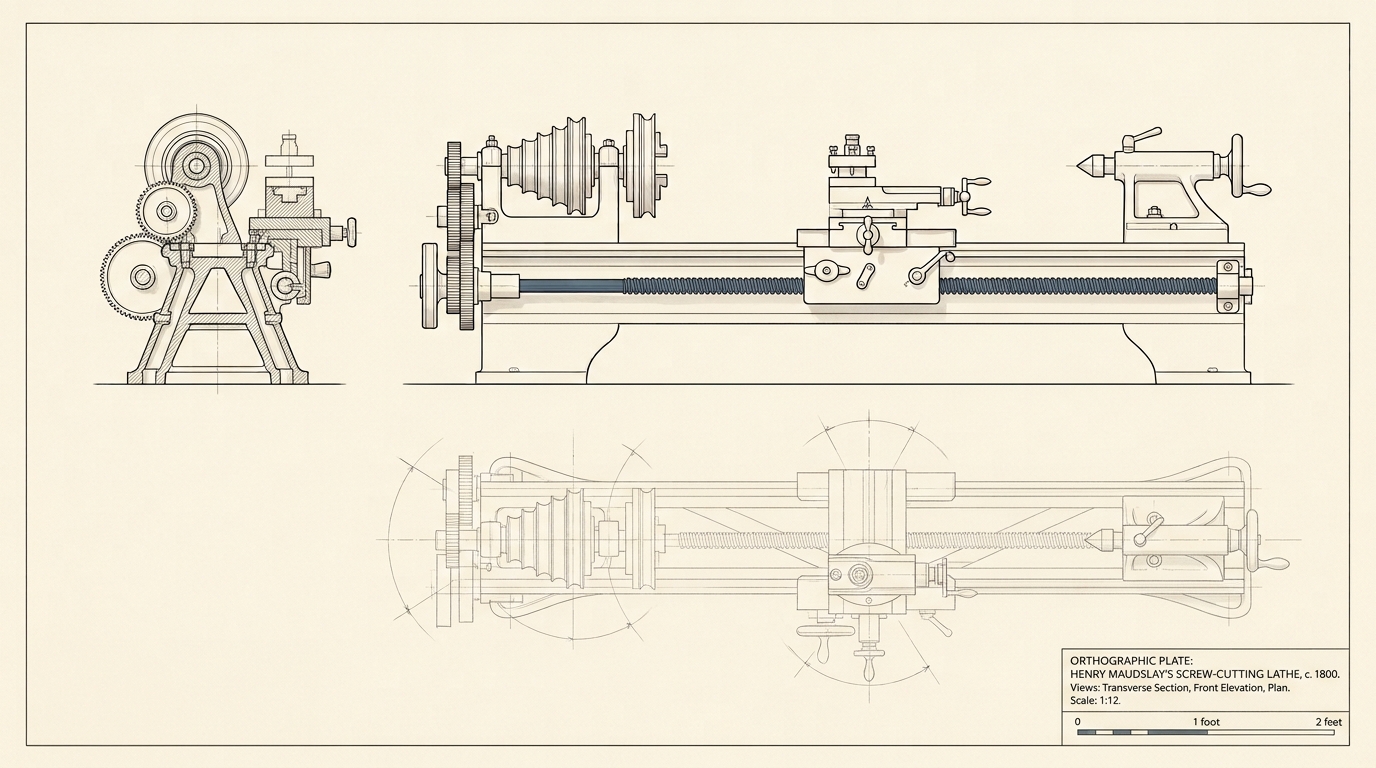
The single most inventive piece of engineering in the mechanism sits on its back plate: a pin-and-slot pair that turns a steady input into an unevenly paced output. One wheel carries a pin near its rim; a second, mounted on an axis slightly offset from the first, carries a radial slot the pin rides in. As the first wheel turns at a constant rate, the pin’s changing distance from the second wheel’s true centre speeds it up and slows it down once per revolution — reproducing the Moon’s real variable apparent speed, a consequence of its elliptical orbit around the Earth [2].
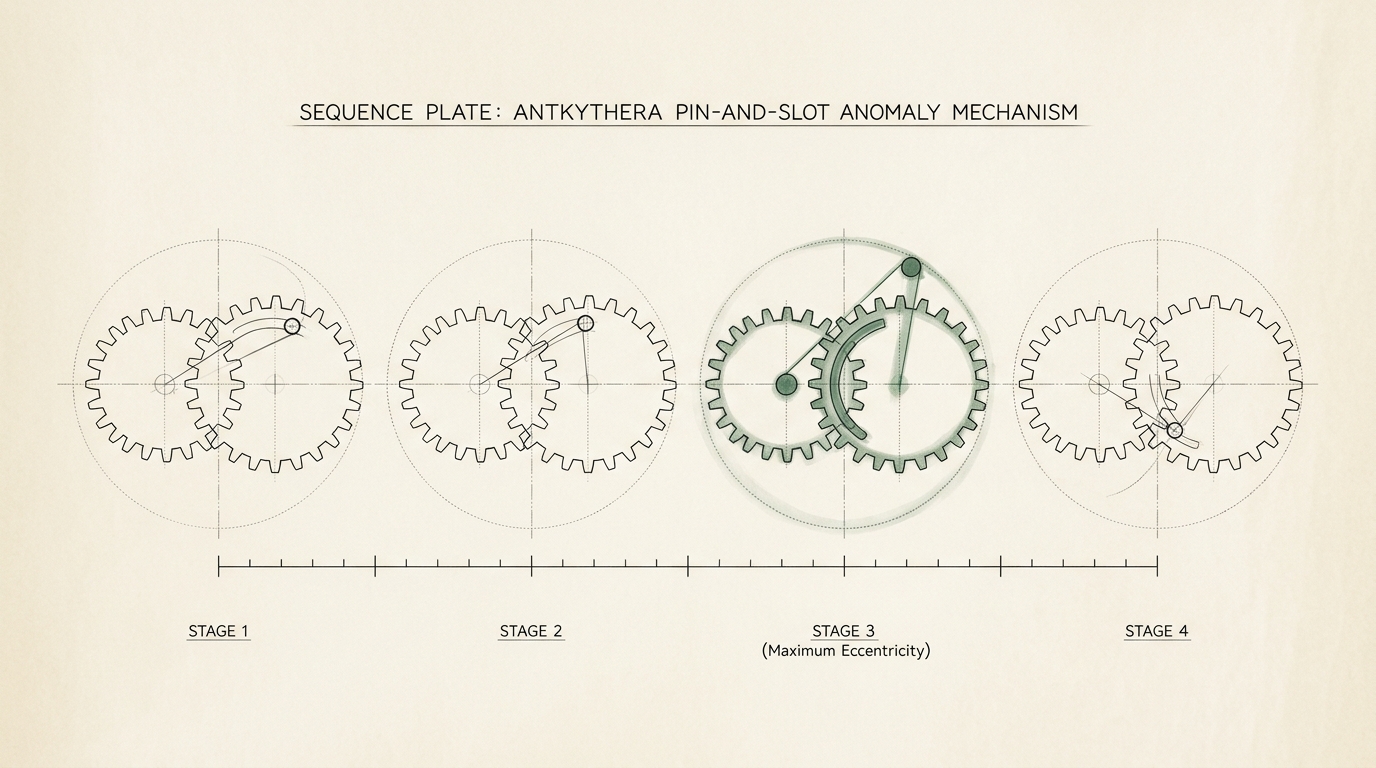
Price’s original reconstruction placed this pair differently and missed its function. It was Michael Wright, a former curator at London’s Science Museum, who spent decades re-examining the fragments and corrected the model, showing the offset pin-and-slot pair for what it is: a mechanical solution to the lunar anomaly that Greek astronomers, following Hipparchus, had already described mathematically [2]. The device does not merely display astronomy; it computes it, through the plain geometry of two off-axis wheels.
Milestones in the reconstruction
| Year | Researcher / team | What was established |
|---|---|---|
| 1901–02 | Divers and museum staff, Athens | Fragments raised from the wreck; a gear noticed embedded in the corrosion [5] |
| 1974 | Derek de Solla Price | First systematic gear count and function model, from X-ray and gamma-ray plates [1] |
| 2007 | Michael Wright | Independent physical reconstruction; correctly modeled the pin-and-slot lunar-anomaly pair [2] |
| 2006 | Antikythera Mechanism Research Project (Freeth et al.) | Microfocus CT reads tooth counts and inscriptions directly; confirms the 223-tooth Saros eclipse gear [3] |
| 2021 | UCL Antikythera Research Team (Freeth et al.) | Proposes a reconstruction of the front “Cosmos” display for Sun, Moon and five planets, built from inscription-based gear-ratio constraints [4] |
The shift in method matters as much as the dates: from eye and X-ray plate, to a hand-built physical model, to a scanner reading gear teeth unseen since assembly, to a computational model constrained by inscriptions rather than by any surviving front gear.
Not a first attempt
A device that computes an orbital anomaly through offset-axis gearing is not something a workshop arrives at on a first try. It implies false starts, simpler prior devices, and craftsmen who already knew how to cut accurate gear teeth in bronze — a nontrivial skill with no earlier surviving evidence [1]. The mechanism reads like the mature product of an established tradition, not an isolated stroke of genius. Literary sources support that picture only obliquely: Cicero, writing decades later, describes geared bronze devices by Archimedes and Posidonius modeling the Sun, Moon and planets — none of which survive [1]. If real, the Antikythera mechanism was not unique even within its own century.
What is genuinely strange is not that such a workshop existed, but how completely it disappears from the record afterward. Nothing of comparable gearing survives from the centuries immediately following it.
A gap in survival, not necessarily in existence
That absence deserves honest treatment rather than mystification. Bronze is valuable and endlessly recyclable; unlike stone or fired clay, a broken bronze instrument does not become inert debris — it becomes scrap for the next casting. Almost every ancient bronze object surviving today does so by accident, removed from the melting-down economy that consumed the rest. A shipwreck is exactly that kind of accident, which is precisely why the Antikythera mechanism survives at all.
The record is not entirely silent, either. A portable Byzantine sundial with calendrical gearing, dated on stylistic and epigraphic grounds to the late fifth or early sixth century CE, survives in four bronze fragments now in London’s Science Museum; its excavators connect its gearing explicitly to the same Hellenistic tradition [6]. And a complete geared astrolabe made by Muhammad ibn Abi Bakr of Isfahan in 1221–22 CE — well over a thousand years later, and considerably simpler — is described by its holding museum as the oldest complete geared machine in the world, part of a largely lost tradition reaching back to Antikythera [7]. Neither device approaches the mechanism’s sophistication. Both show the underlying idea of geared astronomy thinned out to a handful of fragile survivors rather than vanishing outright, each preserved by its own separate accident.
What is still genuinely unresolved
Not everything above the level of tooth counts is settled. The 2021 UCL reconstruction of the front dial — a proposed display of the Sun, Moon and all five known planets, driven by a gear train inferred from inscription-based cycle lengths rather than from surviving front gearing, which is almost entirely lost — is a model built to satisfy the evidence, not a directly observed structure [4]. Its authors call it the first model consistent with all the evidence, a claim about fit, not proof it matches what the makers cut. Earlier researchers, including Wright, proposed different front-gearing arrangements from the same fragments [2]. On the makers, the place of origin, and the full front-panel gearing, specialists still work from inference and disagree.
The better question
Asking how one workshop, two thousand years ago, built something this precise treats the mechanism as an isolated miracle. The more productive question is what its refinement implies about everything absent from the museum case: the training pipeline that produced makers able to cut gear teeth to this train’s tolerances, the simpler prototypes that must have preceded it, and the scientific culture — plausibly connected to figures like Hipparchus, whose lunar theory the pin-and-slot pair encodes — that made building it worth the bronze. The gap is not evidence this knowledge appeared once and vanished. It measures how much a technical culture can be lost when its only durable output is a metal later hands always wanted to melt down and reuse.