A reactor where the combustor should be
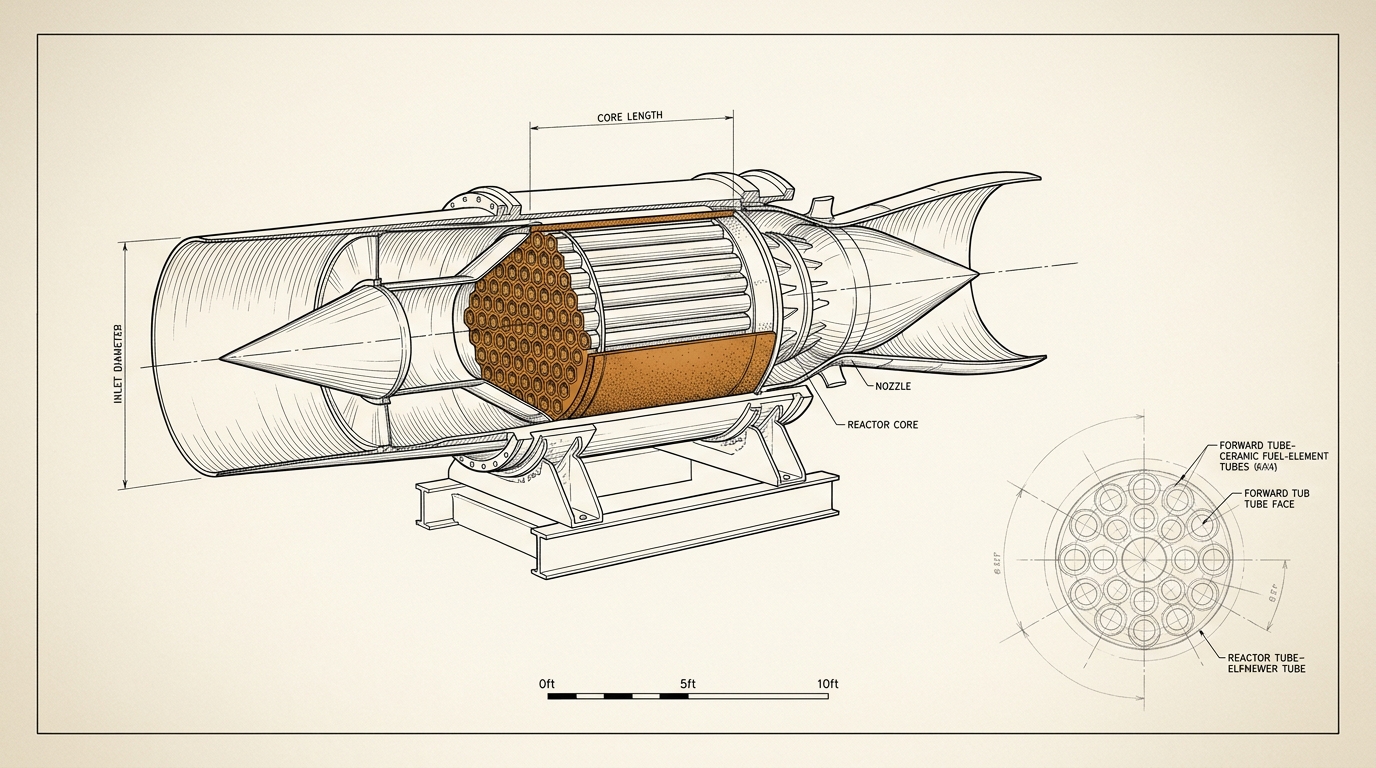
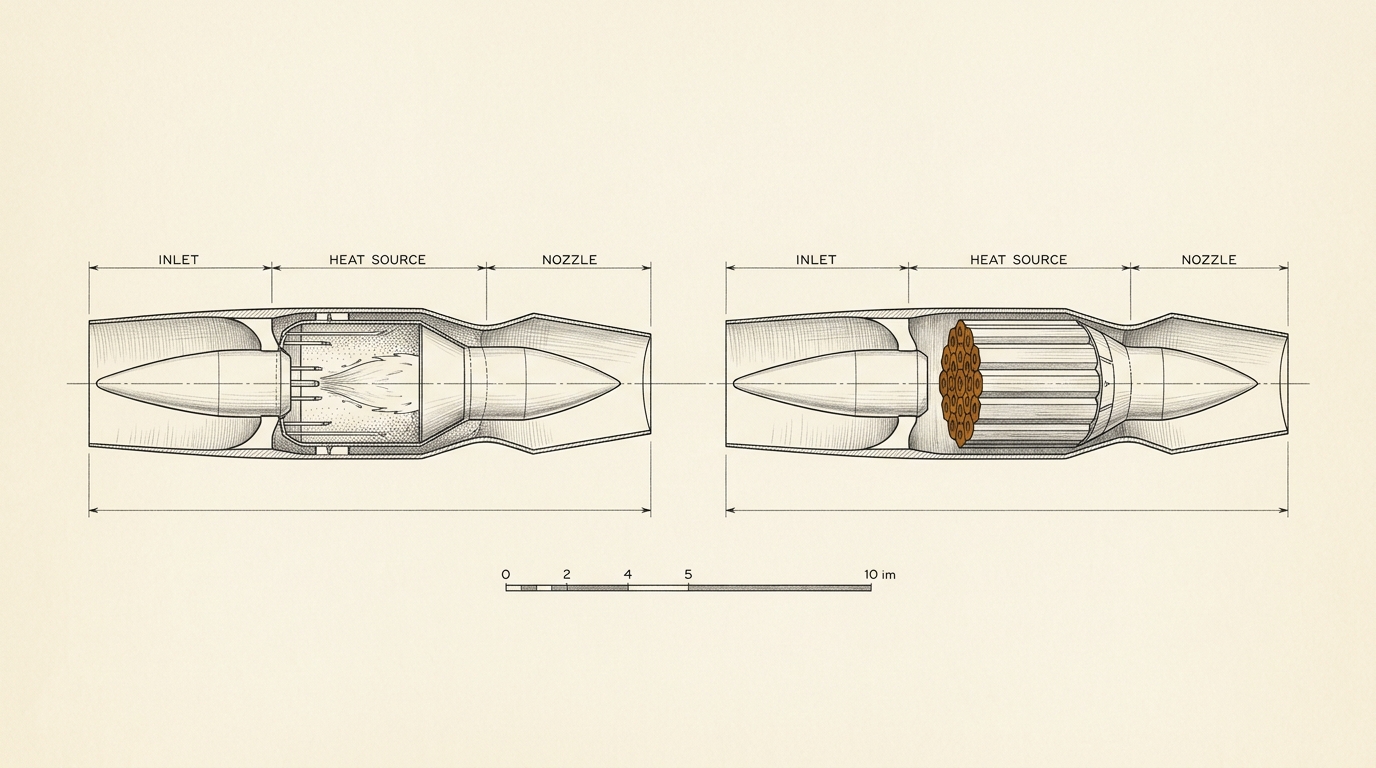
A ramjet has no moving parts and, ordinarily, no reactor. Air rammed in by forward speed is slowed and compressed by the inlet, fuel is sprayed into it and burned in a combustor, and the hot, expanding gas accelerates out through a nozzle to produce thrust. Project Pluto, run for the US Atomic Energy Commission and Air Force out of the Lawrence Radiation Laboratory beginning in January 1957, kept every part of that layout except one [2]. In place of the combustor it put a nuclear reactor core, and the ram air itself did the work a heat-exchanger loop would normally do: it passed directly through channels bored into the reactor’s own fuel elements, picked up their heat, and left through the nozzle exactly as combustion gas would have [1]. There was no intermediate coolant and no heat exchanger — the air was the coolant, and the reactor was, functionally, the combustor.
That single substitution is the whole idea, and it is why the vehicle, developed as the SLAM (Supersonic Low Altitude Missile) and nicknamed by its own engineers for its brute-force simplicity, needed no onboard fuel supply beyond what got it to speed. With the reactor supplying heat for as long as its structure held together, endurance stopped being a fuel-tankage problem and became a materials problem instead. A contemporary account in Air Force Magazine, written as the programme’s fate was being decided in Congress, described a vehicle able to cruise at Mach 3 at altitudes as low as 500 feet for a period its authors treated as effectively unlimited, carrying a larger warhead load than a Polaris submarine or several Minuteman missiles combined [5].
Two reactors on one test stand
Testing moved from Livermore to a dedicated site at Jackass Flats on the Nevada Test Site: eight square miles built around a two-mile automated rail line, so a reactor made intensely radioactive by its own operation could be shuttled between test stand and disassembly building without anyone standing near it [1]. Two distinct test articles ran there.
| Reactor | First run | Duration | Power reached | What it demonstrated |
|---|---|---|---|---|
| Tory II-A | May 14, 1961 | ~45 seconds to about one minute, depending on the account | ~50 MW, roughly a third of its 160 MW design rating | Proof-of-concept core; three further 1961 runs reached and then exceeded the 160 MW design point with no structural failure |
| Tory II-C | May 20 or 22, 1964, sources disagree | About five minutes at full power | 461–513 MW per DOE and Wikipedia; 600 MW in contemporary Air Force Magazine reporting | Flight-representative core; full steady-state power sustained, producing an estimated 35,000-plus pounds-force of thrust |
The published record does not agree on several of these figures exactly. Livermore’s own 65th-anniversary history times the first Tory II-A run at 45 seconds [2], while the reactor’s own 1963 final test report describes the same run lasting close to a minute at 50 megawatts — about a third of the reactor’s 160-megawatt design point, at a core temperature some 300°F above design [4]. Tory II-C’s date and power are similarly unsettled: the Department of Energy’s site history and a standard secondary account both give May 20, 1964, and a power near 500 megawatts, citing figures between 461 and 513 MW [1, 6], while Air Force Magazine’s contemporary account, drawing on a House Appropriations Committee report issued that June, dates the test to May 22 and states an output of 600 million watts [5]. What every account agrees on is the outcome: full power sustained for several minutes, ended by a deliberate, manual shutdown rather than any failure [1].
The programme was the ceramic
No metal survives, unshielded, at the temperature and radiation environment Pluto’s core demanded. Livermore’s own account puts the operating requirement at 2,500°F, hot enough that “even high temperature alloys would lose structural strength” [1]. The material that could survive it was a ceramic: a sintered, homogeneous mixture of enriched uranium dioxide fuel and beryllium oxide moderator, extruded into hollow hexagonal rods whose central bore doubled as an air passage, so the same tube that held the fuel also carried the air being heated [4, 3]. Coors Porcelain Company, a firm better known for tableware, manufactured the tubes [1].
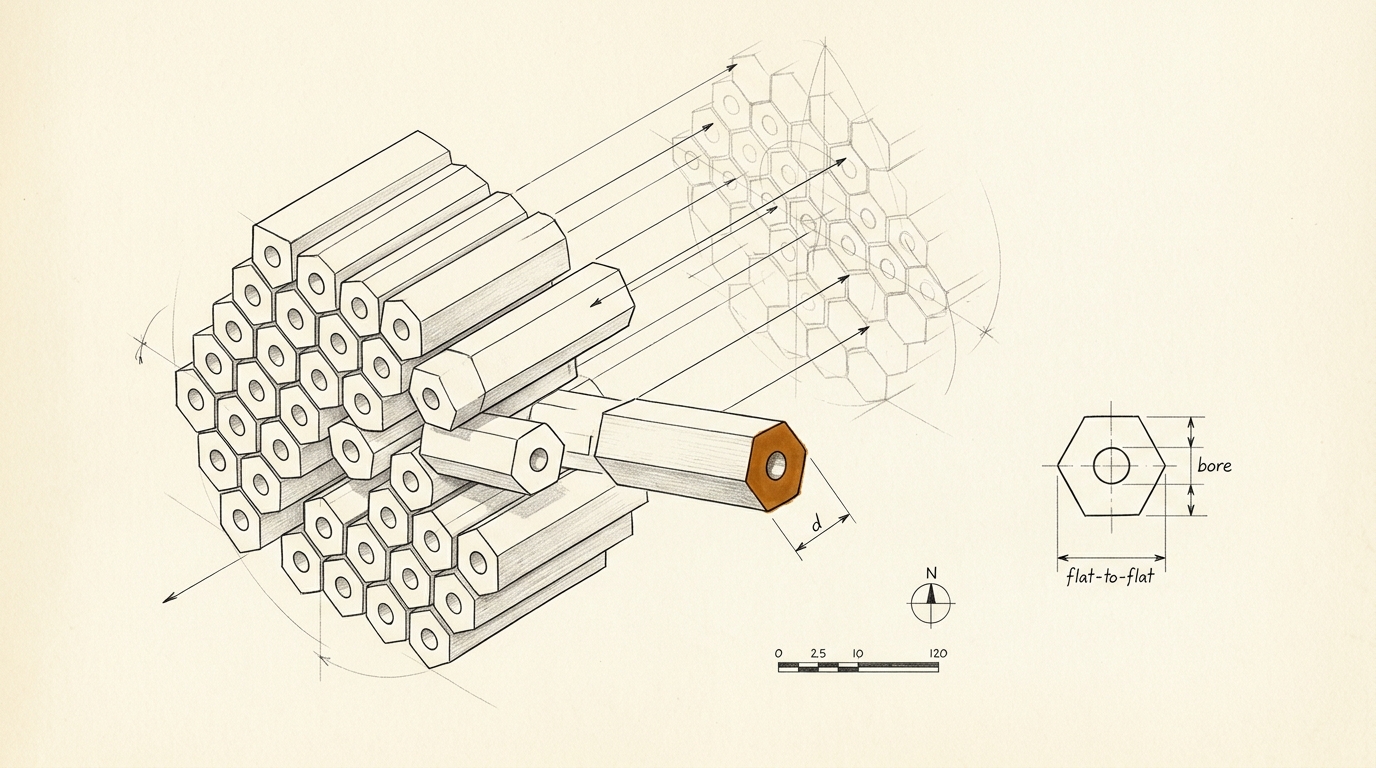
The count of these tubes is itself a small case study in how loosely even the basic numbers get reported. The Department of Energy’s public history states that the Tory reactor “contained 500,000 pencil shaped fuel elements” [1], while a more granular account of the Tory II-C core specifically gives roughly 293,000 fueled tubes plus 16,000 unfueled ones — a total closer to 309,000 [6]. Whichever figure is nearer the truth, the scale of the manufacturing problem is the point that matters: Livermore’s historians describe engineers being challenged to “devise ceramic fuel elements that had the required neutronics properties for the reactor yet were structurally strong and resistant to moisture and oxidation at high temperatures,” in quantities that “had to be mass producible” [2]. Ceramic is brittle, thermal shock cracks brittle materials, and a cracked fuel element sitting in a fast-moving, radioactive air stream is a structural failure and a release of fission products at once. The 1963 final report on the Tory II-A tests records exactly that hazard managed rather than avoided: the reactor survived its runs, including several beyond its design power, but with “manageable thermal stress cracks” in the fuel bed and no blocked air passages [4]. Getting that acceptable — cracks that did not propagate, elements that did not shed material into the airstream, a core built from several hundred thousand ceramic tubes and made on something close to a production schedule — was Project Pluto’s actual seven years of work. The reactor physics of a small, fast, unshielded core had been worked out comparatively early [3]; keeping that many ceramic tubes intact against their own heat was the part that took until 1964.
Cancelled, not defeated
None of that difficulty shows up in why the programme ended. Six weeks after Tory II-C’s full-power success, on July 1, 1964, the Atomic Energy Commission and Air Force cancelled Project Pluto after seven years and roughly $260 million [1]. Livermore’s own retrospective is blunt about the immediate mechanism: the project was “halted for lack of a firm military commitment” [2], echoing the House Appropriations Committee’s own language from that June, which credited the May test with having “amply demonstrated the successfulness of the ramjet propulsion reactor powerplant” before concluding that “since there is still no military system or requirement for this powerplant… the Committee sees no reason why further development and testing work is necessary” [5].
The requirement had gone missing because ballistic missiles had already answered the strategic question SLAM was built to answer. By 1964 the Air Force and Navy were fielding Minuteman and Polaris, both able to deliver warheads over intercontinental range far faster than a Mach 3 cruise vehicle and without first needing to survive a low-altitude flight of thousands of miles [5]. On top of that, SLAM’s own operating principle worked against it in a way no amount of successful testing could fix: the vehicle carried its reactor unshielded to save weight, since shielding heavy enough to matter would have consumed the payload margin the whole design existed to provide. That meant a flight test — let alone an operational sortie — meant flying a live, unshielded reactor at treetop height and eventually crashing or disposing of it somewhere [1]. Those were problems of mission and disposal, not of engineering, and the distinction is what the record actually supports: every source consulted here agrees the reactor worked as designed; none records a technical failure driving the cancellation. Project Pluto is, in that narrow sense, a rarer thing than a failed weapons programme — a working one that its own sponsors chose not to want.