An engine already fifty years old when Watt touched it
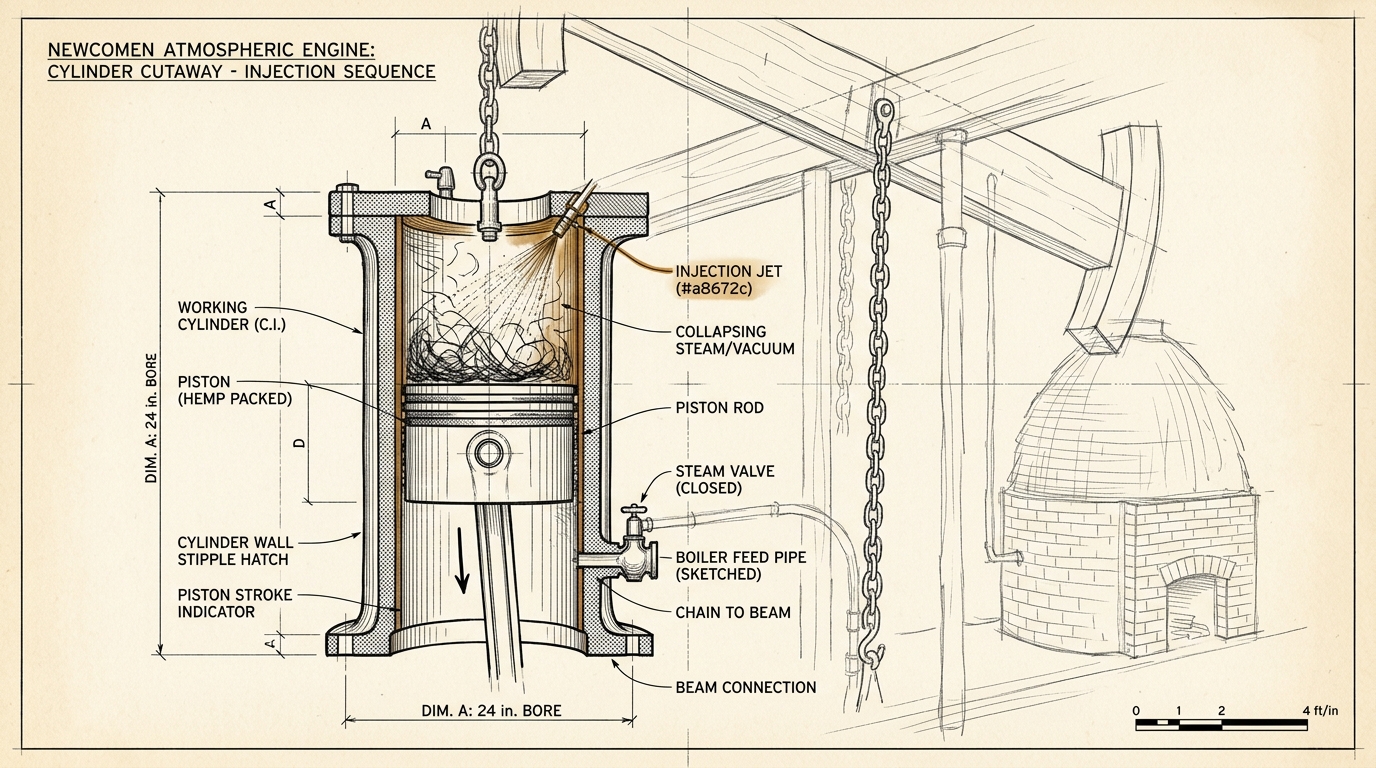
Thomas Newcomen’s atmospheric engine went to work at a coal pit near Dudley Castle in 1712, pumping floodwater out of mine shafts by letting atmospheric pressure drive a piston down a vertical cylinder once the steam inside it had been condensed into a partial vacuum [5]. It was not a laboratory curiosity: a peer-reviewed survey of the surviving historical record counts roughly a hundred further Newcomen engines built over the next twenty years alone, eleven of them on the European continent [11]. By the time a young Glasgow instrument-maker named James Watt was handed a broken teaching model of one to repair in 1763–64, Newcomen-pattern engines had been pumping mines across Britain and Europe, largely unchanged in principle, for more than fifty years [1]. The popular version of the steam-engine story compresses that half-century into a footnote, so that “Watt invented the steam engine” swallows the whole narrative. It is worth being precise about what was already sitting in front of him, and what, exactly, he changed.
What repairing a model actually showed him
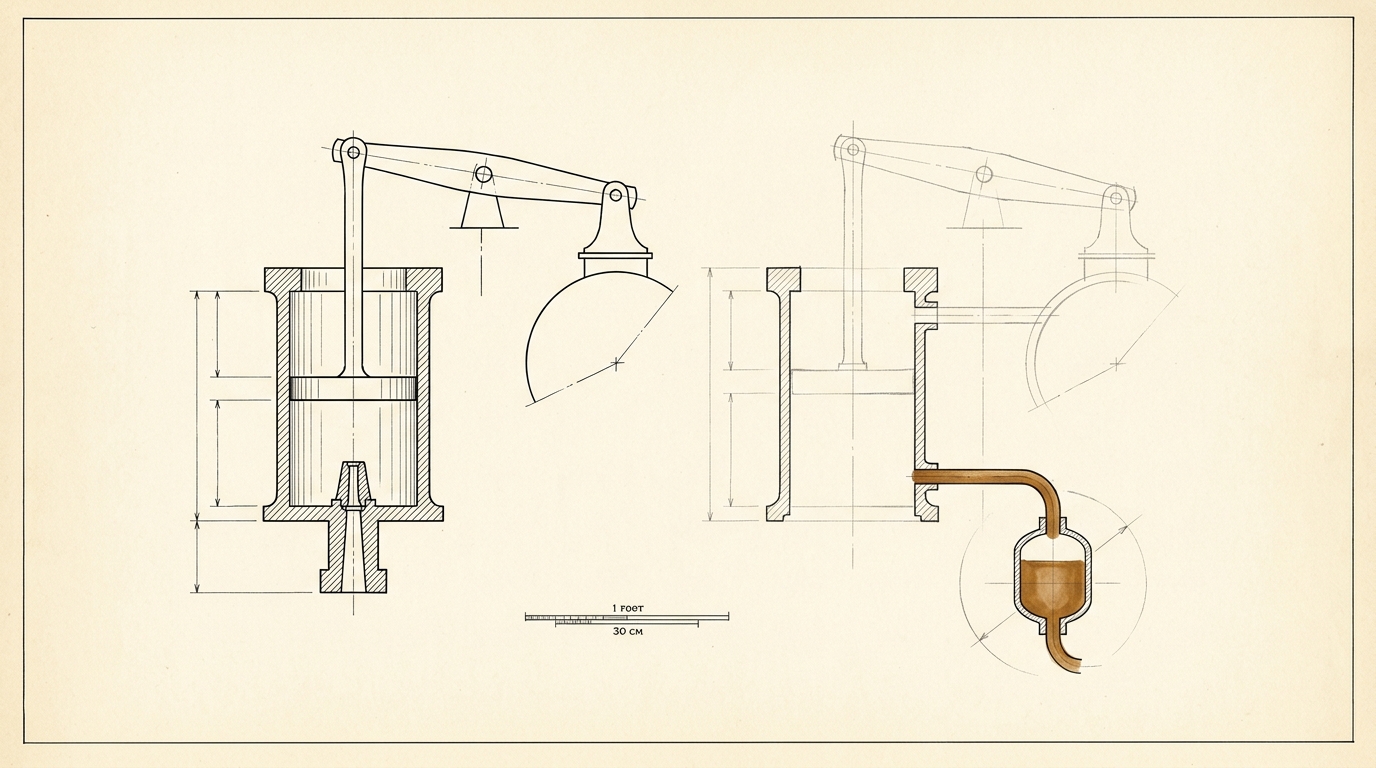
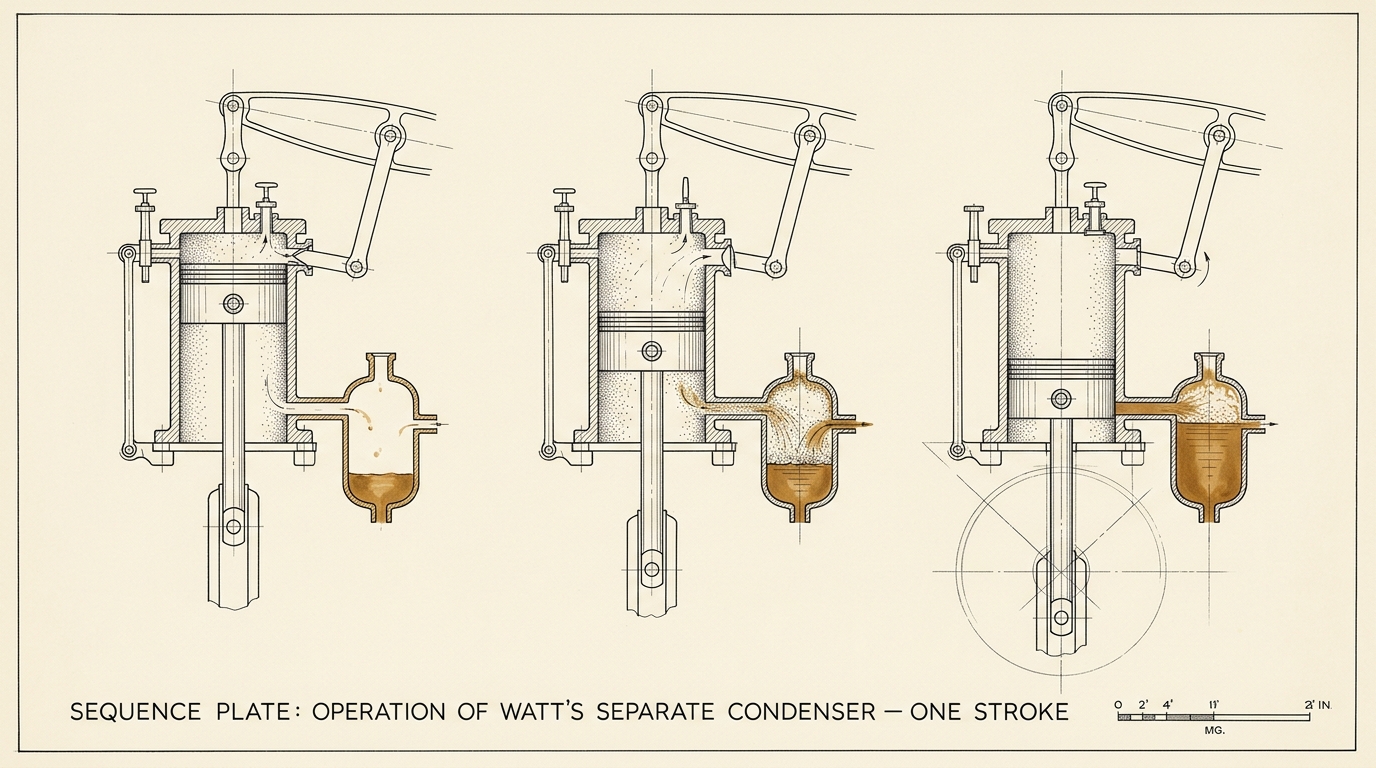
Newcomen’s cycle worked by admitting steam into the cylinder, then injecting a jet of cold water directly into that same cylinder to condense the steam and pull the piston down under atmospheric pressure. The next stroke required fresh steam to be let back in — into a cylinder whose walls the injection water had just chilled. Newcomen’s engine converted only around one percent of the steam’s thermal energy into useful work, because so much of each stroke’s fuel went into reheating cold iron rather than lifting a pump rod [7]. Working the problem in Glasgow in 1765, Watt built a second, more elaborate demonstration piece — the object survives today in the Science Museum’s collection — showing steam condensing in a chamber kept separate from the working cylinder [3]. By one contemporary account, Watt told a colleague he had “made an engine that shall not waste a particle of steam” [1]. His insight was narrow and specific: condensation had to happen somewhere the cylinder wall never felt it. If steam condensed in a second, permanently cold vessel connected to the cylinder by a pipe and valve, the working cylinder itself could stay as hot as the boiler, stroke after stroke [1].
That is the whole invention. Watt did not reimagine how steam engines produced motion, and he did not discover atmospheric pressure or vacuum-driven pistons — both were already Newcomen’s, and before him, Thomas Savery’s, whose sweeping 1698 patent on raising water by fire meant Newcomen could not patent his own, mechanically quite different engine and had to fold his work into a commercial partnership under Savery’s patent instead [8]. Watt patented one addition: a separate condenser.
The patent, read plainly
Patent No. 913, enrolled on 5 January 1769, describes Watt’s “New Invented Method of Lessening the Consumption of Steam and Fuel in Fire Engines.” Its central claim is exactly the fix above: condensation performed in a vessel distinct from the cylinder, kept cold, while the cylinder is kept hot by being cased and by admitting steam above the piston rather than cooling it directly [2]. The specification is notably sparse — Watt’s advisers talked him out of including drawings, so the surviving document is close to pure text describing a principle rather than a fully worked machine [2]. That sparseness matters for how the story is often told: the patent protected an idea about where condensation should happen, not a finished, manufacturable engine. Turning the idea into one took another decade, an outside partner’s capital, and someone else’s machine tool.
Why coal pits could live with the waste, and factories couldn’t
Newcomen engines were installed almost exclusively at collieries [5], and stayed commercially viable there for fifty years despite burning through most of their fuel doing nothing useful — a colliery was the one setting where a fuel-hungry pump did not have to compete on fuel cost. The separate condenser’s real economic effect was to expand where a steam engine made sense at all: contemporary accounts of Watt’s invention describe it explicitly as carrying steam power’s use “from mines to factories, mills, and workshops” for the first time [1] — inland sites that had to buy and haul every basket of coal they burned, rather than pumping water out of the same seam that fed their boiler. A multi-fold cut in coal burned per unit of work was the difference between steam being a coal-pit curiosity and steam being a general industrial prime mover.
What the duty records actually show
Eighteenth-century engineers measured fuel economy in duty: the number of foot-pounds of work an engine produced per bushel (84 pounds) of coal burned. According to the Institution of Civil Engineers’ own account of the rivalry, John Smeaton’s 1767 survey of fifty-seven working Newcomen engines on Tyneside found an average duty of around 6 million foot-pounds per bushel for the larger engines, with the single best example reaching 7.44 million; when Smeaton later tested his own re-engineered version of the same design at Long Benton colliery, the older engine on that site returned 4.6 million against 9.1 million for his improved one — close to the practical ceiling for a design that still cooled the same cylinder it worked in. Once installed in Cornwall from the late 1770s, early Boulton & Watt engines are reported by the same account as averaging around 17 million foot-pounds per bushel and reaching as high as 25 million [10].
Institutional sources do not fully agree on the size of the gain. These duty figures imply roughly a threefold improvement between Smeaton’s best Newcomen-type engine and an average early Watt engine — short of the fourfold gain (a 75 percent fuel cut for the same work) that Britannica and the Science Museum Group give elsewhere for the separate condenser [7, 4]. That is not really a contradiction: eighteenth-century duty trials were one-off tests of individual engines, not a standardized benchmark, so pairing different engines yields different ratios. What survives every version of the comparison is the shape of it: Smeaton’s careful engineering of the old cylinder-cooling design topped out around 9 million; Watt’s one structural change cleared that mark immediately and kept climbing.
What the record does not let you claim
Crediting Watt with “the steam engine” erases two debts the record is explicit about. First, as above, Newcomen himself could never patent his own engine, because Savery’s 1698 patent already claimed the ground [8]. Second, the separate condenser was patentable in 1769 but not buildable at scale for years afterward: it needed a piston fitting its cylinder far more precisely than existing hammered-iron cylinders allowed, or the vacuum leaked past the piston and the whole advantage was lost. That was only solved once Matthew Boulton’s Birmingham partnership, formalised in 1775, supplied the capital to keep Watt working [6], and once John Wilkinson — already known for boring cannon barrels to unusual accuracy — adapted that technique to cast-iron engine cylinders more precisely than any other founder in Britain could manage [9]. Watt’s idea, Boulton’s money, and Wilkinson’s tolerances were three separate, necessary conditions; crediting only the first is the myth this record does not support.
The invention that mattered was an efficiency fix
None of this diminishes what Watt did. It relocates it. He did not invent steam power, atmospheric pressure engines, or the piston-and-beam layout — those were fifty years old and working commercially before he was born. What he invented was a fix for one specific, previously tolerated waste: a cylinder that had to be reheated from scratch every single stroke because the same vessel that did the work also did the cooling. Separating those two functions is a narrow, almost bookkeeping-level correction to an existing machine. It is also, on every version of the duty record, the single change that took steam power from something that only made sense at the pithead to something that made sense almost everywhere — which is a fair description of what actually launched the steam-powered stretch of the Industrial Revolution.