The record begins as a receipt
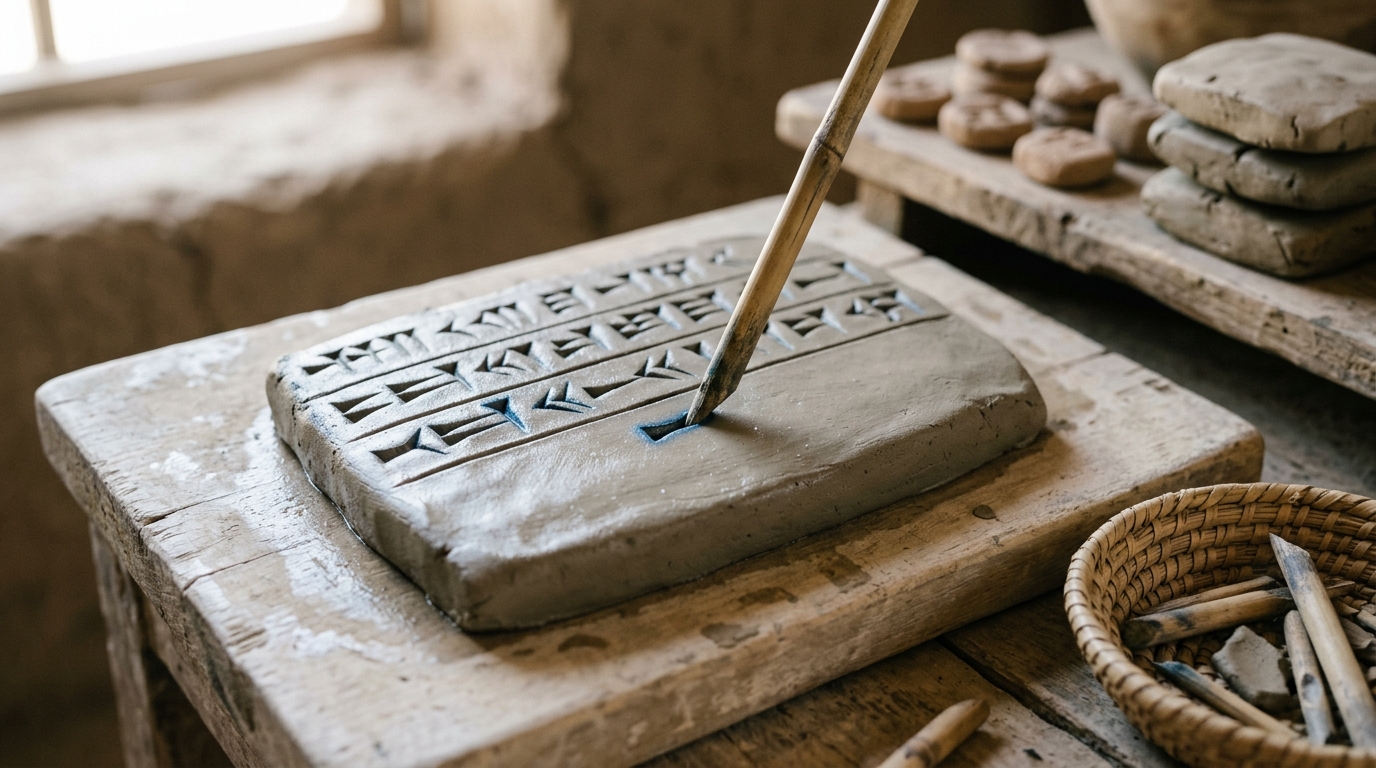
The history of writing is usually told as a prelude to literature. That framing gets the sequence backwards. The earliest large corpus of writing recovered from southern Mesopotamia is administrative: Peter Damerow’s survey of proto-cuneiform describes a body of tablets of which “most of them are bookkeeping documents, representing activities of economic administration rather than stories, arguments or descriptions”, with the principal non-administrative genre being school texts, chiefly lexical lists [1]. Whatever else writing became, it entered the record as an instrument of institutional bookkeeping.
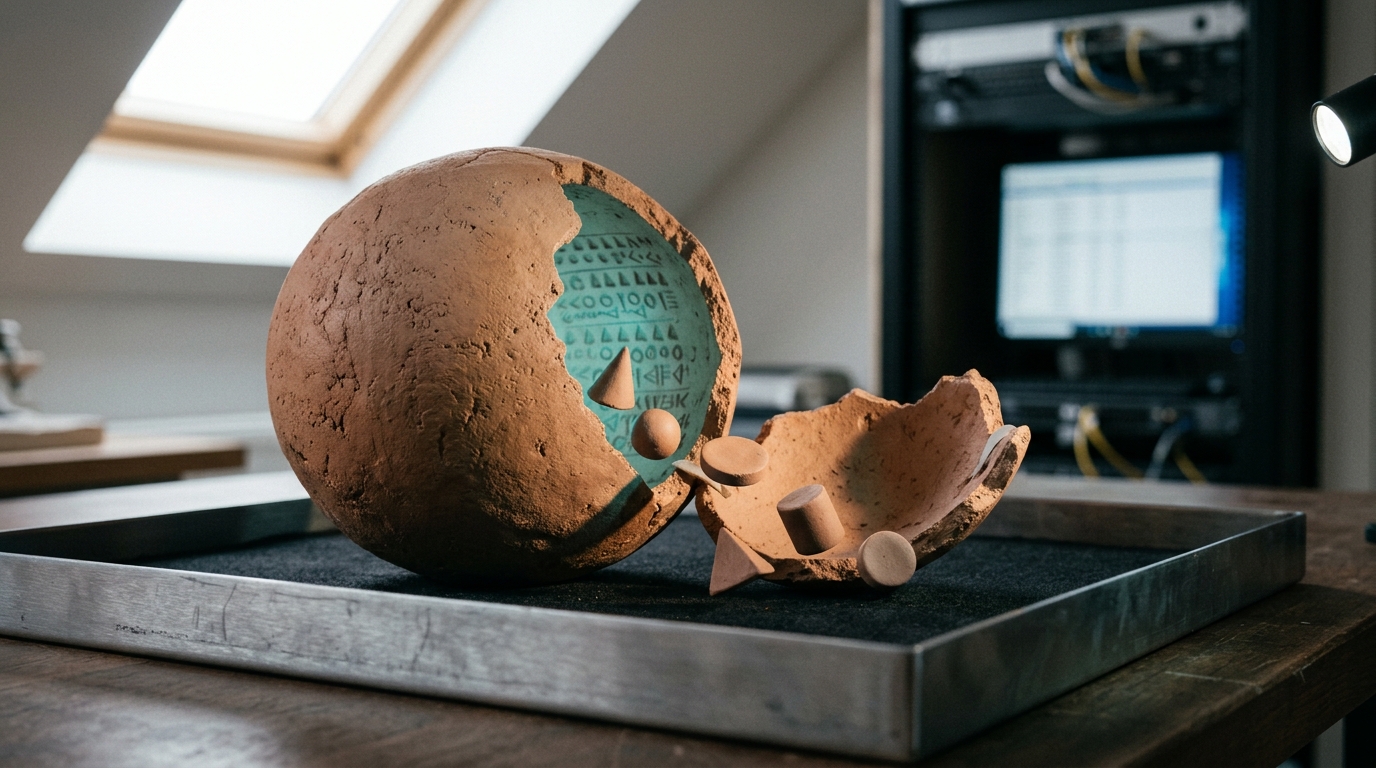
Damerow draws a strong inference from this. He argues that proto-writing encodes knowledge through structures that are not primarily linguistic, and that “there is, at least, no longer any reason today to assume that the desire to represent language in an enduring medium was the only motive that triggered the invention of writing” [1]. On his account, the invention of proto-cuneiform “turned out to have been only the last step in a long tradition in the development of a prehistoric means of administration”, continuous with the earlier use of clay tokens to record objects and quantities.
That continuity claim is not settled, and the disagreement is worth stating plainly rather than smoothing over. Kathryn Kelley, Mattia Cartolano and Silvia Ferrara have argued that pre-literate cylinder-seal motifs — among them designs they describe as a “fringed cloth” and a “netted vessel”, circulating roughly between 4400 and 3400 BCE — were transformed into proto-cuneiform signs, and they note directly that “token-to-sign comparisons … are rarely demonstrable” [2]. Their proposal is not that tokens were irrelevant but that seals, tokens and numerical tablets operated together, so that sign forms have a plural ancestry rather than a single accounting lineage. Damerow, for his part, declines to adjudicate whether writing was invented once and spread or invented independently more than once, observing only that the idea appears to have propagated outward from Mesopotamian and Egyptian centres early in the third millennium BCE [1]. The catalogue of the Oriental Institute’s survey of the question treats four systems — Mesopotamian, Egyptian, Chinese and Mesoamerican — as “pristine” inventions made without prior exposure to texts [3].
So the origin question has at least two live axes: whether writing descends from one administrative technology or converges from several visual practices, and whether the capacity was invented once or several times. What is not in serious dispute is the character of the earliest surviving mass of it. If the first thing writing does at scale is count barley and account for labour, then the design problem writing solves first is not memory. It is dispute. An account exists so that somebody who was not present can check it later. Everything in this article follows from that: the record is a technology for making a claim survive the absence of the person who made it.
From the witness to the document that stands alone
For a long stretch of documentary history, a written instrument was not the proof. It was an aide to the proof, which was human. M. T. Clanchy’s study of England between 1066 and 1307 describes exactly this transition: from a culture that trusted the memories of reliable witnesses, along with physical signs and seals, toward one in which claims to property came to rest on documents, with the change turning on whether people were willing to treat a written record as evidence in itself [4]. His evidence is deliberately material — the kinds of documents produced, the changing scripts, the use of seals, and the technology of writing itself, meaning handwriting, ink and parchment.
The interesting part of that history is not that documents won. It is what had to be added to a document before it could win. A record expected to stand alone needs three things that a witnessed transaction did not: a fixed form whose alteration is detectable, an origin that can be attributed without asking the author, and a custody history that connects the object in front of you to the moment it was made. The medieval instrument acquired all three by convention — formulaic diction, dating clauses, sealing, and enrolment in a register kept by an institution.

That is precisely the ground of diplomatics, the analysis of documentary form developed to establish whether an instrument is what it purports to be. Luciana Duranti’s argument for reviving it treats the intellectual and physical form of a record as itself the evidence of authenticity, and proposes that this old science has new uses in modern records systems [10]. The claim underlying diplomatics is a strong one and worth making explicit as analysis rather than fact: authenticity is not a property that inheres in an object, but a conclusion supported by regularities in how records of that kind were produced. Forgery is the reciprocal of that conclusion, and Clanchy’s account treats the forging of documents as a normal accompaniment of the spread of documentary proof, not an aberration from it [4].
The carrier decides what we are able to know
Clay, papyrus, parchment and paper are not neutral substrates. Each has a different failure profile, and the differences select what reaches us. This is not merely regrettable; it is a measurement problem that runs underneath every general claim about the textual past.
The most careful recent attempt to quantify it borrows unseen-species estimators from ecology. Mike Kestemont and colleagues treated medieval works as species and surviving manuscript copies as sightings, and estimated original populations for chivalric and heroic narrative in six European vernaculars [5]. For the combined assemblage they report a survival ratio of 68.3 percent for works, with a confidence interval of 63.2 to 73.5 percent, and 9.0 percent for documents, with an interval of 7.5 to 10.7 percent. In absolute terms, of an estimated 1,170 works that once existed, 799 survive; of an estimated 40,614 manuscript copies, 3,648 remain. The variation between traditions is larger than the aggregate suggests: English works survive at an estimated 38.6 percent against 79.0 percent for German, while the two insular traditions show point estimates of 77.3 percent for Irish and 81.0 percent for Icelandic works, against 16.9 and 19.2 percent for their documents.
Two cautions belong with those numbers. The authors themselves note that their richness estimator yields a lower bound on the original population, so more may have been lost than the figures imply, and they set their results against earlier catalogue-based estimates for the Holy Roman Empire of roughly 7 percent survival for general-purpose manuscripts, adjusted upward to about 20 percent for higher-end codices [5]. Different methods, different assemblages, different numbers: this is an active area, not a settled ledger.
The mechanism of loss is instructive because it inverts the intuition about durability. Parchment is tough, and its toughness made it valuable as raw material: the same study notes manuscripts recycled into small boxes, stiffening for a bishop’s mitre, tailors’ measures and packing material, with strips used by binders to strengthen spines [5]. A carrier robust enough to survive centuries is also robust enough to be worth cannibalising. Fragility and utility both destroy records, by opposite routes.

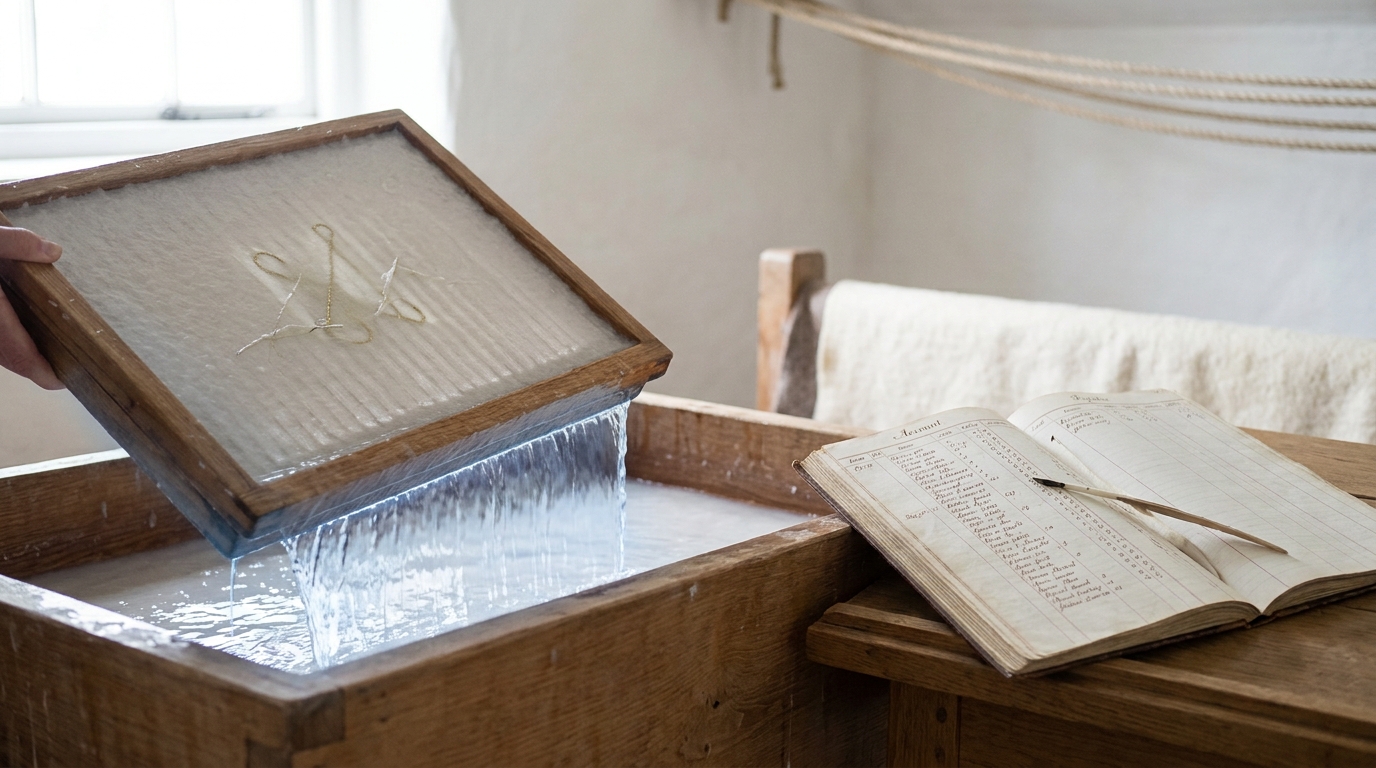
Paper reversed the economics of the carrier and then imposed a chemistry problem. The degradation of paper is driven by acid hydrolysis of cellulose along with oxidation, light, air pollution and microbiological attack, and the rate depends on the origin of the fibre, the pulping and papermaking procedure, the additives used and the storage conditions [14]. The institutional response was a specification. The American national standard for the permanence of paper in libraries and archives sets out what a durable sheet must be [12]; the Library of Congress summarises its requirements as a minimum 2 percent alkaline reserve, less than 1 percent lignin, a pH between 7.5 and 10.0, and good tear resistance [13].
Read that specification backwards and it is a description of the failure it was written against. A standard that demands low lignin and an alkaline buffer is a standard written because the prevailing industrial carrier had high lignin and was acidic. That reading is my inference rather than a claim in the standard, but it is a modest one, and it generalises: carrier standards are legible as forensic accounts of the previous carrier’s defects.
Copying error and the correction apparatus
Before mechanical reproduction, every additional copy was an opportunity to introduce error, and the tradition that survived was the one that built machinery for catching it.
The best-documented example is also among the most heavily annotated books in existence. The Codex Sinaiticus Project’s transcription records not only the work of the original scribes — hands designated A, B and D, with the B material possibly divided between two scribes — but the layered work of correctors, distinguishing corrections made by the scribes themselves from later revising hands worked between the fifth and seventh centuries and grouped as ca, cb, cc and others, with a further hand that rewrote text that had faded and another that made only limited changes; corrections that cannot be assigned to a hand are marked as such rather than silently absorbed [6]. The corrections themselves fall into four operations — adding text, deleting text, substituting wording and reordering words — and the great majority are changes to spelling.

Several features of that apparatus are recognisable as error-correction engineering rather than as scholarship in the modern sense. Corrections are attributed to agents, so the audit trail survives alongside the corrected text. Uncertain attributions are flagged rather than resolved by fiat. And one hand’s job was to rewrite faded text, which means the apparatus was repairing carrier decay, not only transcription error — a maintenance function, not a critical one.
It is tempting to model manuscript transmission as pure decay. If
which for any constant per-generation fidelity below one falls exponentially in
Printing changed the price of fidelity, and the rest is contested
Print is routinely described as an acceleration. The more defensible description is a change in cost structure. Composing and correcting a forme is a fixed cost paid once; each additional impression from that forme is a marginal cost that does not include re-reading the text. Correction therefore migrates upstream, into proofing, and the errata list becomes a public, printed admission that the migration was incomplete. Speed is a consequence; the primary change is that fidelity stopped being re-purchased with every copy.
What print then did to knowledge is genuinely disputed, and the disagreement is live rather than historical. Adrian Johns, writing in a forum organised around the question, characterises Elizabeth Eisenstein’s account in The Printing Press as an Agent of Change as resting on a small set of asserted core elements — increased production rates, textual standardisation, and preservative power — from which a long list of effects on early modern life was derived [7]. He identifies two principal points of difference with her: how much autonomy historians should ascribe to readers of printed works, and “the character, potency, and even existence of something called ‘print culture’”. His alternative is a cultural history of print that is, in his words, “broadly constructivist about its subject”, explaining print’s character by reference to “the complex social processes by which books came to be made and used” — the practices of printers, booksellers, readers and censors — rather than treating standardisation and fixity as properties the press possessed on delivery.
Johns presses the point through a case study, arguing that a printed letter from Pierre Gassendi soliciting European observation of the 1631 transit of Mercury, which Eisenstein treated as an exemplary demonstration of print’s collaborative power, probably never existed: Gassendi’s account was handwritten, followed rather than preceded the transit, and was printed only later [7]. Whether one accepts that reconstruction, the methodological claim is separable and is what the disagreement is really about. Eisenstein’s position, as he represents it, treats the printing revolution as sui generis; his own treats fixity as an achievement that particular communities had to manufacture and defend.
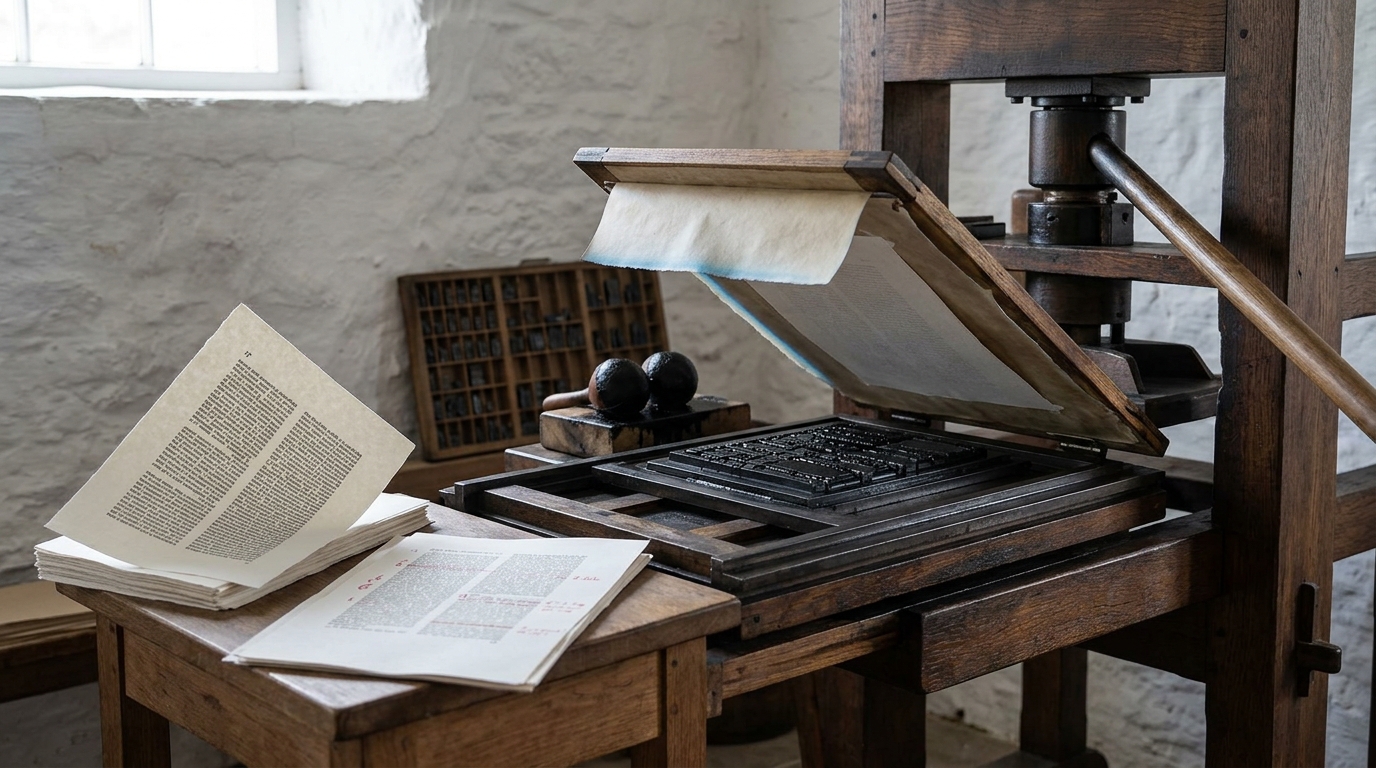
There is a piece of material evidence that neither side disputes and that constrains the strong standardisation claim. Even in the period when printed books were acquiring their navigational apparatus, “variety was the rule, even within single editions” [8]. Copies from one edition could differ. That is a fact about hand-press production, and it means that the identity of an edition was itself something readers and cataloguers had to establish rather than assume. My own reading, offered as analysis rather than as either historian’s conclusion: print made identical copies cheap without making identity automatic, and much of the apparatus described in the next section exists to close that gap.
Navigation had to be invented
A record that stands alone still has to be findable inside, and the devices that make that possible were not obvious. Systematic numbering was rare in Western European manuscripts; makers relied instead on signatures, the ordinal marks that told a binder the order of gatherings [8]. Printing changed what numbering could do, because for the first time the same number fell on the same content in every copy. Foliation was adopted tentatively in the fifteenth century, sometimes still added by hand, and more enthusiastically in the early sixteenth; pagination appeared at the start of the sixteenth century, spread quickly, and was standard by its end, alongside the standardised title page giving title, author and publication details [8].
The consequence is an addressing scheme. Tables of contents, alphabetical indexes and lists of errors all became more accurate once tied to printed page numbers, and the combination permitted a precision of citation not previously available — with Henri Estienne’s Plato of 1578 producing the Stephanus numbers still used to cite Plato today [8]. A footnote, on this reading, is not primarily a scholarly manner. It is a pointer, and a pointer is worthless without a stable address space and a way to identify which edition the address belongs to. The title page supplies the second; pagination supplies the first.
Finding devices also have a demand side, and it long predates print. Ann Blair traces the alphabetical index to the thirteenth century, arising in response to pressures of overload articulated in Vincent of Beauvais’s preface to the Speculum maius of 1255, which cites “the multitude of books, the shortness of time and the slipperiness of memory” as the reason for compiling a summary [9]. The early modern complaint is continuous with it: Conrad Gesner’s universal bibliography of 1545 protested a “confusing and harmful abundance of books”, and by 1685 Adrien Baillet was warning that the multitude of books would drive later centuries into a barbarity comparable to that following the fall of the Roman Empire [9]. The responses Blair catalogues — florilegia, dictionaries, encyclopedic compilations, book reviews, and note-taking systems built on selecting, sorting and storing — are recognisable as retrieval infrastructure.
Two points are worth separating. As a matter of record, indexing predates printing by two centuries [9]. As analysis, what printing supplied was not the idea of an index but the stable target that made an index reliable across copies [8]. Confusing those two produces the familiar overstatement in which the press invents everything downstream of it.
The institution that stands behind the document
The apparatus described so far is internal to the object. The last component is not. An archive, a registry, a notarial office or a chancery converts a document into evidence by asserting an unbroken relationship between the record and the body that kept it. Duranti’s programme for diplomatics is explicitly about making that assertion analysable rather than merely asserted [10].
The digital case has forced the underlying logic into the open. Heather MacNeil’s account of the InterPARES authenticity work describes the identification of conceptual requirements for verifying authentic electronic records in stages: defining the elements of a record relevant to authenticity using archival diplomatics, testing those elements against case studies of real systems, and deriving requirements for long-term preservation [11]. The resulting structure distinguishes benchmark requirements, which support a presumption that records are authentic, from baseline requirements, which support an archival institution’s certification of copies. That distinction is the whole argument in miniature. Authenticity in a digital environment is not established by inspecting bytes; it is presumed on the strength of how a custodial system behaved, and certified by an institution willing to stake its standing on the copy.
The professional statement of that position is now formal. The International Council on Archives’ Universal Declaration on Archives was endorsed by UNESCO’s General Conference in November 2011, framing archives as public infrastructure rather than as storage [15].
The pattern, and what would falsify it
A pattern recurs across these episodes, and I state it as a proposed generalisation rather than a finding. Each new carrier or reproduction technology initially reduces the trustworthiness of records, and trust is restored only when an authentication practice specific to that carrier matures. The documentary case in medieval England fits: written instruments were not initially accepted as proof in themselves, and acceptance followed the spread of sealing, dating and enrolment conventions [4]. The digital case fits: electronic records forced an explicit reconstruction of what had been implicit, producing benchmark and baseline requirements where custom had previously sufficed [11]. The industrial-paper case fits in a narrower, material sense: a cheaper carrier degraded faster, and a written specification followed [12, 14].
The limits of that generalisation should be stated. Three cases are not a sample; they are not independent, since later archivists studied the earlier ones deliberately; and the print case cuts across it, because whether print reduced or increased reliability is exactly what Eisenstein and Johns disagree about [7]. A clean counterexample would be a carrier adopted at scale with no observable trust deficit and no new authentication practice, and I am not aware of a well-documented one, which is weaker than saying none exists.
Prediction, with a horizon of ten years to 2036. Institutional authentication of digital records will consolidate around custody and provenance metadata rather than around artefact-intrinsic detection of synthetic content. The assumptions are that generative systems continue to lower the cost of producing plausible artefacts faster than detectors improve, that archival and legal institutions retain the authority to certify copies, and that no cryptographic method becomes cheap enough to be applied retroactively to legacy holdings. Observable indicators would include archival and records-management standards elaborating custody chains and integrity metadata rather than content classifiers; courts and registries admitting records on the strength of custodial testimony about the system that held them; and procurement specifications for records systems foregrounding provenance capture. The disconfirming condition is specific: if by 2036 the dominant accepted practice in courts and national archives is to authenticate a record by analysing the artefact itself — statistical detection, embedded content signals evaluated without reference to custody — then the prediction is wrong and the historical pattern it rests on was misread.
What the pattern is actually about
Read as information technology rather than as literature, the history of the record is a sequence of answers to one question: what has to be added to a claim so that it can be checked by someone who was not there. Accounting supplied the first answer, because accounting is the case where the checker is guaranteed to be absent. Sealing, dating and enrolment supplied the second. Correction hands, collation and errata supplied the third. Pagination, title pages and indexes supplied the addressing scheme that makes a claim locatable. Archives supplied the custodial guarantee that a located claim is the one that was made.
None of these is redundant. They form a stack, and the failure of any layer degrades the ones above it: an unlocatable citation cannot be checked, a checkable text with no custody history cannot be attributed, and an attributed text on a disintegrating carrier will shortly not exist. The recurring institutional error is to assume that a new medium inherits the whole stack from the old one because it inherits the content. It does not. Each layer was engineered, contested, and paid for, and each has had to be engineered again every time the carrier changed.