Ask most people to sketch the history of computing and they will draw one line: mechanical calculators, then ENIAC, then microchips, then the internet, then AI, arriving at the present as if by a single escalator. The archival record does not support that picture. What actually happened is four separate research programs — the mathematical theory of computation, symbolic artificial intelligence, packet-switched networking, and statistical machine learning — that developed on mostly independent timelines, occasionally borrowed vocabulary from one another, and only recently converged into something that looks, in retrospect, like a single story. This article follows each thread on its own terms, using primary papers and institutional archives rather than the compressed folklore, and marks explicitly where a claim is an established fact, a contemporary participant’s own characterization, or a later historian’s interpretive judgment.
Thread one: what a computation even is
The theoretical foundation predates any electronic computer by roughly a decade. In 1936, Alan Turing published “On Computable Numbers, with an Application to the Entscheidungsproblem” in the Proceedings of the London Mathematical Society [1]. The paper is not, on its surface, about building machines. Turing was answering a question posed by David Hilbert: whether there exists a general mechanical procedure that can decide, for any mathematical statement, whether it is provable. Turing’s method was to define, with total precision, what “mechanical procedure” itself means — a head reading and writing symbols on an unbounded tape, moving left or right according to a finite table of rules. He then showed that some well-defined problems (including a version of the halting problem) cannot be solved by any such procedure, which settled Hilbert’s Entscheidungsproblem negatively.
That, as a fact, is the entire content of the 1936 result: a negative answer to a specific question in mathematical logic. Its status as the theoretical ancestor of every stored-program computer is a later interpretive judgment, not something Turing claimed for the paper at the time — the paper contains no blueprint for hardware. The judgment is nonetheless well-supported: the Turing machine’s abstraction of a computation as a sequence of state transitions over symbols is precisely the model that von Neumann and others drew on when specifying how a general-purpose electronic computer should be organized a decade later. It is fair to call 1936 the moment the concept of computation was pinned down independent of any physical machine to run it, and 1945–1946 the moment machines began to be built to instantiate that concept electronically.
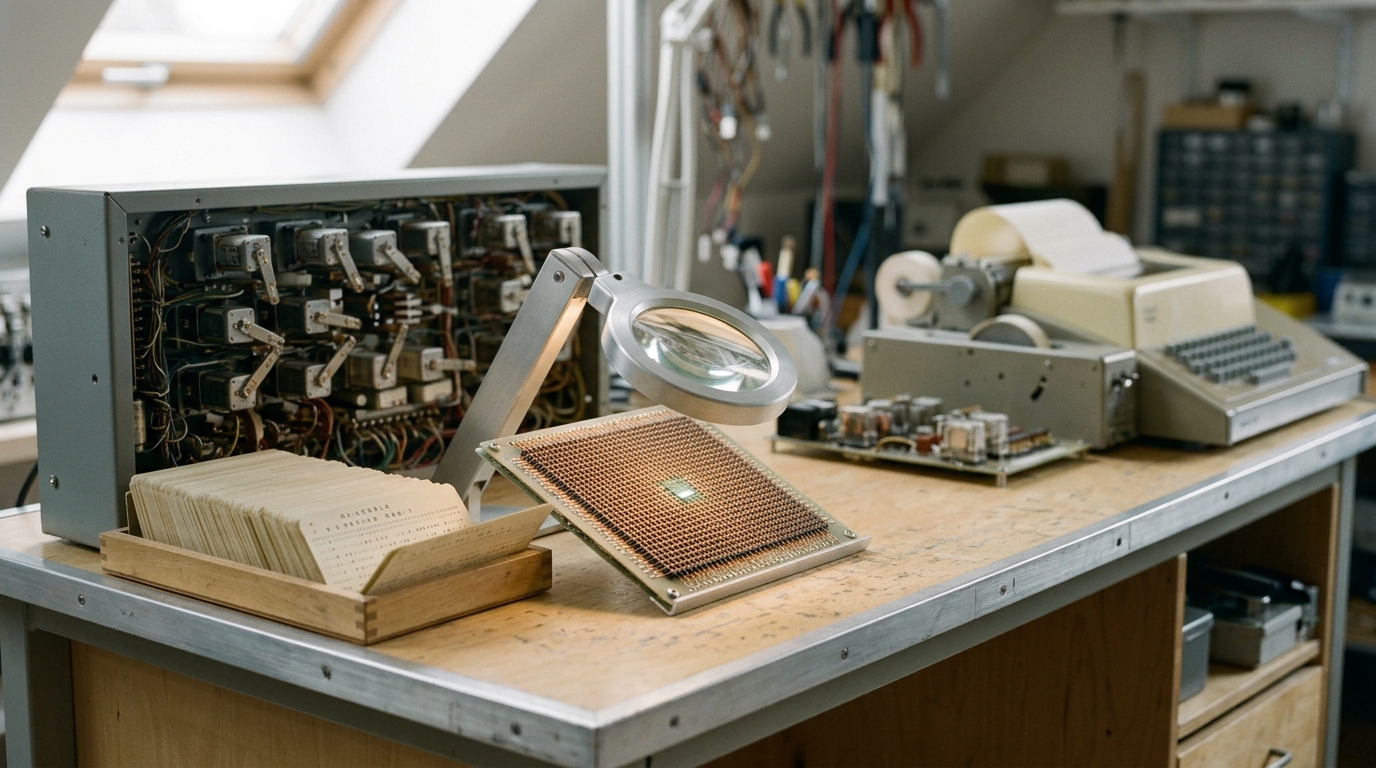
Those machines existed empirically before the theory was fully connected to them in engineering practice. The Electronic Numerical Integrator and Computer, built at the University of Pennsylvania between 1943 and 1945 under a wartime contract to compute artillery firing tables, is documented by the Computer History Museum as containing around 18,000 vacuum tubes and twenty accumulator units, and as suffering roughly one tube failure every one to two days before maintenance crews learned to isolate faults in minutes [5]. ENIAC became public on February 15, 1946, when the New York Times reported it on its front page — a fact the museum’s archive dates precisely, and a reasonable marker for what many historians call the start of the electronic computer age [5]. It is worth being precise about what ENIAC was not: it was not general-purpose in the modern sense at first (reprogramming meant physically replugging cables), and its programming was carried out by a team that included Frances Bilas and Betty Jean Jennings, both trained mathematicians whose work is now recognized as some of the earliest software engineering, even though it went largely uncredited at the time [5]. That omission is a historiographical fact about how credit was allocated, not a technical claim about the machine.
Thread two: control, feedback, and a name for the field
A parallel program, less concerned with what a machine can compute and more with how a system regulates itself, took shape at almost the same moment. Norbert Wiener’s 1948 book Cybernetics: Or Control and Communication in the Animal and the Machine coined a term — Wiener had used it with colleagues including Arturo Rosenblueth as early as 1947 — for the study of feedback and control across biological and mechanical systems alike, drawing an explicit line back to James Clerk Maxwell’s nineteenth-century work on governors [3]. Cybernetics is best understood as a sibling discipline to what would become artificial intelligence rather than an ancestor of it: it supplied a vocabulary of feedback loops, homeostasis, and control that later roboticists and systems theorists still use, but it did not itself propose that machines could reason symbolically. That distinct, narrower proposal came from a different group less than a decade later, and it is the moment that gave the field its modern name.
In August 1955, John McCarthy, Marvin Minsky, Nathaniel Rochester, and Claude Shannon submitted “A Proposal for the Dartmouth Summer Research Project on Artificial Intelligence” to the Rockefeller Foundation, a seventeen-page typescript now archived at Dartmouth College and Stanford, and later reprinted in full by AI Magazine [2]. The proposal’s own words, as reproduced in that reprint, state the working conjecture plainly: that “every aspect of learning or any other feature of intelligence can in principle be so precisely described that a machine can be made to simulate it.” That sentence should be read as exactly what it is — a research hypothesis these four authors proposed to test over one summer at Dartmouth College in 1956, not a settled finding. The proposal is nonetheless the documented origin of the term “artificial intelligence” as a field name, which is why the 1956 workshop it produced is conventionally treated as the field’s founding event even though cybernetics, information theory, and earlier work by Turing and others had already been circulating related ideas for years.
The two programs that followed from this founding wager diverged quickly. Symbolic AI, built on hand-written rules and logical search, produced its most durable practical success in medicine rather than in the general-reasoning systems the Dartmouth proposal had imagined. MYCIN, developed at Stanford through the early-to-mid 1970s as Edward Shortliffe’s doctoral work under Bruce Buchanan, used roughly 600 hand-authored backward-chaining rules to recommend antibiotic therapy for bloodstream infections, taking patient data interactively from a physician user [7] [10]. MYCIN is a genuine demonstration that a narrow domain, if specified thoroughly enough by human experts, could be encoded into a rule base that performed competitively — published evaluations found MYCIN’s recommendations judged acceptable at rates comparable to specialist physicians in blinded review, according to the Buchanan and Shortliffe account of the Stanford Heuristic Programming Project [10]. It is equally a demonstration of the paradigm’s brittleness: MYCIN’s roughly 600 rules covered one narrow class of infection, required extensive manual re-engineering to extend, and — as later historians of expert systems have widely noted — was never deployed clinically, partly over liability concerns and partly because rule maintenance did not scale the way its designers had hoped. That non-deployment and the reasons for it are analytical characterizations drawn from the secondary literature, not a claim found in MYCIN’s own technical papers.
A rival, statistical strand of the same founding decade fared differently over the following decades, and its early history is instructive precisely because it looked, at first, like it might beat symbolic AI to general capability. Frank Rosenblatt’s 1958 paper “The Perceptron: A Probabilistic Model for Information Storage and Organization in the Brain,” published in Psychological Review, proposed a device that adjusted weighted connections based on error, loosely modeled on neuronal learning [4]. The perceptron could learn simple linearly separable classifications from examples rather than from hand-written rules — a genuinely different research bet than the Dartmouth proposal’s logic-first approach, developed independently and roughly contemporaneously with it. That bet went into a long period of reduced funding and attention through the 1970s and much of the 1980s, commonly called the “AI winter” in retrospective accounts, before returning to prominence decades later in a form its original author did not live to see. Rosenblatt’s 1958 paper itself makes no claim about deep, many-layered networks; the deep architectures that eventually succeeded descend from his single-layer proposal only by lineage of idea, not by direct technical continuity, and that lineage claim is a historian’s judgment rather than something asserted in the 1958 text.
Thread three: a network with no single inventor
The third thread has almost nothing to do with either logic or learning, and its own history complicates the tidy image of a lone inventor. The Advanced Research Projects Agency funded network research beginning in 1966, when Bob Taylor secured roughly one million dollars for the project; ARPA awarded the contract to build Interface Message Processors — the packet-switching routers of the early network — to Bolt Beranek and Newman in January 1969, drawing on packet-switching concepts developed independently by Donald Davies in the United Kingdom and Paul Baran in the United States [6]. The first host-to-host connection over what became ARPANET occurred on October 29, 1969, between UCLA and the Stanford Research Institute, when a UCLA programmer named Charley Kline attempted to log in remotely and the system crashed after transmitting only the letters “l” and “o” of the word “login” — a widely repeated anecdote that is nonetheless documented as fact in the network’s own operational history, not an embellishment [6]. By December 1969 four nodes were connected; the network was declared fully operational in 1971.
What ARPANET was not, at that stage, is “the internet.” It ran on the Network Control Program, a protocol specific to that one network. The technical step that made an internet — a network of networks — possible was the development of TCP/IP by Vint Cerf and Bob Kahn beginning in 1972–1974, and its adoption as ARPANET’s sole protocol on January 1, 1983, an event commemorated as “flag day” in the network’s history [6]. ARPANET itself was formally decommissioned in 1990, by which point the protocols it had incubated were already running a much larger, multi-network internet that had outgrown the original single project. The chain from 1969 packet-switching experiment to the 1990s commercial internet spans two full decades and several distinct protocol generations; treating “ARPANET” and “the internet” as synonyms, as popular retellings often do, elides that this was a three-part story — a single research network, a protocol re-engineering to connect networks of networks, and a much later decommissioning of the original — rather than one continuous thing simply getting bigger.
Thread four: from a decade-long stall to a discontinuity
The fourth thread — statistical machine learning, and specifically the neural-network branch of it — supplies the clearest example in this history of a long, well-documented stall followed by a sharply dated discontinuity, and it is worth being careful about what changed and what did not. Through the 1990s and 2000s, neural networks were a minority approach within machine learning, competing against kernel methods and other statistical techniques that were, for most benchmark tasks of the period, competitive or superior. The reversal is unusually well-dated because it is tied to a public, adjudicated benchmark. In 2012, Alex Krizhevsky, Ilya Sutskever, and Geoffrey Hinton trained a deep convolutional network — later known as AlexNet — on the ImageNet Large Scale Visual Recognition Challenge’s 1.3-million-image training set, using a network with roughly sixty million parameters, and achieved a substantially lower error rate than the next-best entrants that year, as reported in the paper itself at the Neural Information Processing Systems conference [8]. The paper is explicit that this was achieved on general-purpose graphics processing hardware rather than specialized research computers — a low-cost combination of consumer GPUs and a large labeled dataset that had simply not been assembled together at that scale before. That the 2012 result triggered the field’s subsequent, sustained reallocation of research effort and industrial investment toward deep learning is a widely shared historical judgment among AI researchers and historians of the field, not a claim the 2012 paper makes about its own significance; the authors reported an error-rate result on one benchmark, and the causal claim about what followed from it is analysis layered on afterward.
The architecture that dominates the field a decade on did not, however, descend directly from AlexNet’s convolutional design. In June 2017, Ashish Vaswani and seven co-authors published “Attention Is All You Need,” proposing the Transformer: a network built entirely from attention mechanisms, explicitly dispensing with the recurrent and convolutional structures — including the convolutional approach AlexNet had used — that had dominated the previous decade [9]. The paper’s own claim, stated in its abstract, is narrower than its later reputation: it reported superior results on machine-translation benchmarks with less training time than prior architectures. It did not claim, and could not have claimed in 2017, that the same architecture would scale to the general-purpose large language models that would be built on it in the years following; that scaling behavior is a separate, later empirical finding from subsequent work, not a result of the 2017 paper itself. Reporting “Attention Is All You Need” as though it predicted the current generation of language models overstates what the paper demonstrated at the time it was published, and this article treats that distinction as load-bearing rather than a footnote.
Where the threads actually cross, and where popular history invents crossings
Laid out this way, the four programs cross at only a few identifiable points, and it is worth naming the crossings that did not happen alongside the ones that did. Turing’s 1936 theory of computation and the hardware built at Penn in the 1940s cross through von Neumann’s architectural work, which is documented history, not speculation. The Dartmouth proposal’s symbolic program and Rosenblatt’s statistical program do not meaningfully cross until decades later — they were rival, largely non-communicating bets for most of the twentieth century, and treating MYCIN and the perceptron as steps on the same ladder misrepresents two competing research traditions as one continuous one. ARPANET’s networking thread crosses the AI thread only recently and mostly through infrastructure: the same protocols and, eventually, the same commercial cloud data centers that carry ordinary internet traffic are what trained AlexNet’s successors and now serve transformer-based models at scale — a material dependency, not a shared intellectual lineage. Cybernetics’ feedback vocabulary survives today mostly inside control theory and robotics rather than inside mainstream deep learning, contrary to a popular but historically loose habit of treating Wiener as a direct ancestor of modern AI.
A forecast, and what would falsify it
One conditional forecast follows from this reconstruction, and it is worth stating with its assumptions and its failure condition attached rather than left as vague optimism about “convergence.” The forecast: over roughly the next decade, the historiography of computing will increasingly treat the four threads described here as branches of one field rather than as separate disciplines with occasional contact, because the material infrastructure — data centers, interconnects, and shared software toolchains — is already shared across what were once distinct research communities in a way it was not in 1990. This is a scenario, not a fact already observed, and it rests on three assumptions that could each fail on their own: that large-scale compute remains concentrated enough that networking, hardware, and machine-learning research continue to be procured and built by the same small set of organizations; that no successor paradigm to the transformer displaces it as decisively as deep learning displaced symbolic AI’s dominant position after 2012; and that funding institutions continue to organize grants and departments around “AI” as a single administrative category rather than re-fragmenting into the narrower specialties that briefly stalled cybernetics as a field after the 1950s. An observable indicator supporting the forecast would be an increasing share of citations in computing-history journals that treat 1936, 1956, 1969, and 2012 as a single connected timeline rather than as four separate historiographies, a trend that a citation-network study could measure directly rather than assert. The disconfirmation condition is equally concrete: if a genuinely new computing substrate — for instance a non-von-Neumann architecture that does not run on today’s GPU-centric supply chain — becomes dominant within the forecast window, the shared-infrastructure assumption underlying convergence breaks, and the four threads would more plausibly re-diverge into separate technical histories again, the way they diverged after 1956. This forecast should be read as one informed reading of the evidence assembled above, not as an extension of any single cited source’s own claims; none of the primary papers cited here make forward-looking claims of this kind, and attributing this forecast to them would misrepresent what they actually say.
None of the reconstruction above is a prediction about where these four threads go next; it is a reconstruction of where they have actually been, checked against the documents each program left behind rather than against the compressed version of the story that gets retold once dead ends fold out of view. What replaces the single-line legend is not tidier, but it is truer to what was actually built, argued, and abandoned along the way — four research communities that mostly worked past one another, occasionally borrowed each other’s tools, and only in the last fifteen years or so began to look, from the outside, like a single field with one history.