The quick version
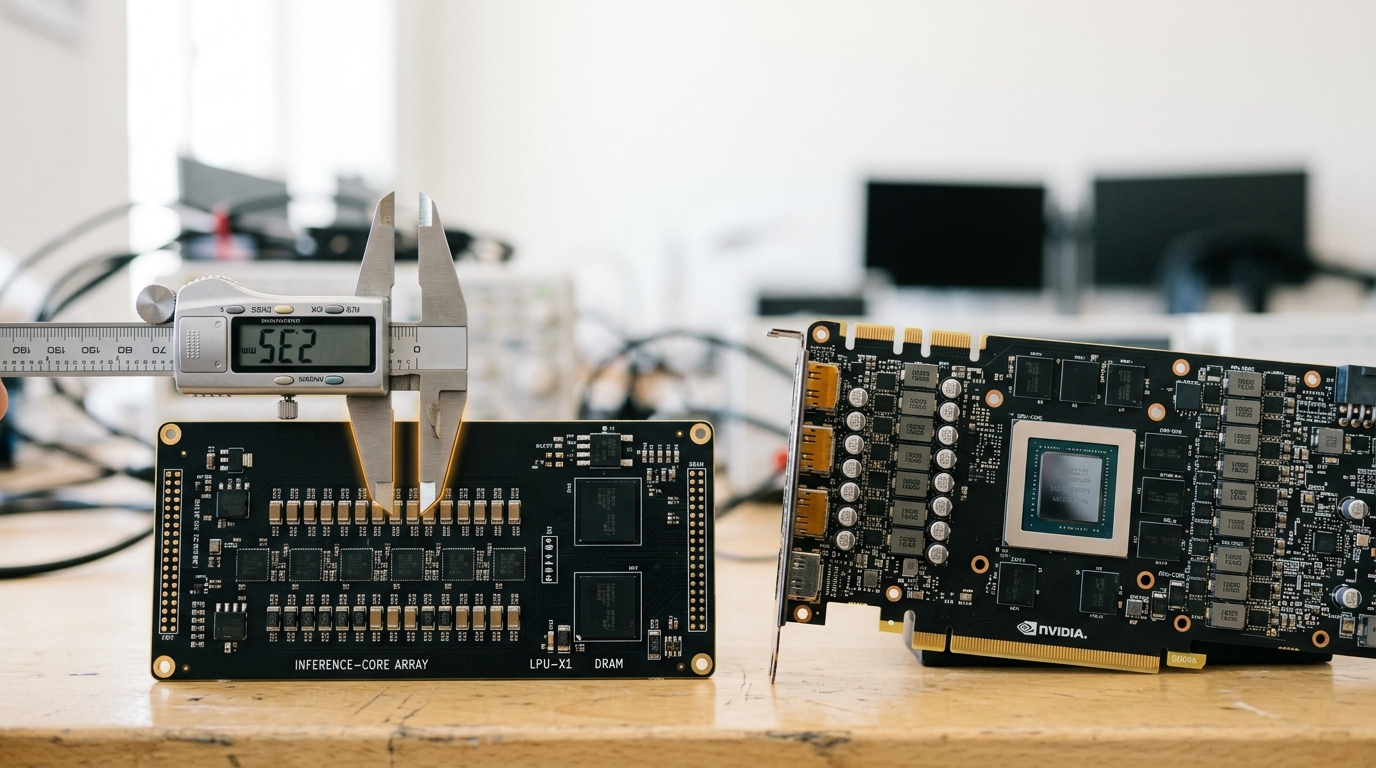
Groq builds a chip it calls an LPU — a language processing unit, purpose-designed for AI inference rather than adapted from a general-purpose GPU architecture. The company’s founding argument was straightforward: a GPU carries decades of graphics and general-compute design baggage that inference workloads don’t need, and a chip built from scratch for inference alone could be faster and more efficient for that one job [3].
What actually happened with Nvidia
Reporting on Groq’s relationship with Nvidia is genuinely inconsistent across sources — one compilation describes a roughly $20 billion Nvidia acquisition of Groq’s technology, while another describes Groq continuing to operate independently, having raised $1.75 billion of its own capital [1] [2]. This briefing states that plainly rather than picking one version. For the fuller treatment of why the two descriptions don’t obviously match, and what would need to be verified to settle it, see this cohort’s companion briefing, “Why Would Nvidia Buy the Chip Designed to Kill the GPU?”
Why it’s a big deal regardless of the exact deal structure
Whatever the precise arrangement, the fact that Nvidia — the dominant incumbent Groq’s entire founding thesis argued against — is now connected to Groq’s technology in some form is itself the story worth knowing quickly. It suggests the architectural argument Groq made had enough merit that even the company it targeted took it seriously.
Where Groq ranks among its peers
Independent comparisons place Groq alongside Cerebras and SambaNova as the three most-discussed non-GPU inference architectures, each with a different core technical bet — Groq on deterministic, simplified compute, Cerebras on wafer-scale integration, SambaNova on reconfigurable dataflow — covered as their own separate briefings elsewhere in this cohort [4].
The one-paragraph takeaway
Groq is a real, technically credible challenge to the assumption that GPUs are the only sensible architecture for AI inference, backed by real revenue and a real relationship with the industry’s dominant incumbent — the exact shape of that relationship is the one detail worth reading the longer, more careful companion piece for before repeating it as settled fact.
Why the LPU name matters
Groq’s choice to name its chip a “language processing unit” rather than simply another kind of accelerator is itself a small but deliberate positioning statement, distinguishing it explicitly from the CPU and GPU categories that came before it. The company is arguing, through the name alone, that inference for large language models is a distinct enough computational problem to deserve its own hardware category, not merely a workload that happens to run on repurposed graphics silicon. Whether “LPU” becomes an industry-standard term the way “GPU” itself did decades ago, or fades as a marketing label specific to one company, is its own small but genuine test of how differentiated the underlying architecture actually turns out to be over time.
The fast-reading summary for anyone catching up
If you remember only one thing from this briefing: Groq makes a chip built specifically for AI inference rather than adapted from a graphics architecture, it has real revenue and real enterprise customers, and it now has some kind of connection to Nvidia whose precise terms are reported inconsistently enough across sources that this cohort declines to state them as settled fact. Everything else — the deeper architecture comparison, the competitive landscape against Cerebras and SambaNova, the Nvidia relationship’s exact structure — is covered in more careful detail across this cohort’s other briefings for readers who want the fuller picture rather than the fast version. This piece exists specifically for the reader who wants the headline and the core fact pattern in under two minutes, without the deeper sourcing dive the companion briefing provides for anyone who needs to cite the relationship precisely. As with every fast-reading piece in this cohort, brevity here is a deliberate editorial choice rather than a shortcut around verification — the underlying facts stated above are the same ones the longer companion briefing builds on, simply presented without the fuller argument and the additional caveats a more careful treatment requires. If you are citing anything about Groq in your own work, start with the companion piece and its sources rather than this summary alone.