A note on what this briefing can and cannot confirm
Reporting on Nvidia’s relationship with Groq is genuinely inconsistent across sources. One industry compilation describes Nvidia acquiring Groq’s technology in a deal valued around $20 billion; a separate source describes Groq as continuing to “operate independently post-Nvidia deal,” having raised $1.75 billion of its own capital [1] [2]. Those two descriptions are not obviously compatible — a full acquisition and an independently operating company that merely has some relationship with Nvidia are different outcomes — and this briefing states that discrepancy plainly rather than resolving it. Before treating any specific deal structure as fact, a reader should check Nvidia’s own regulatory filings or an official joint statement for the precise terms.
Why the relationship is interesting regardless of its exact structure
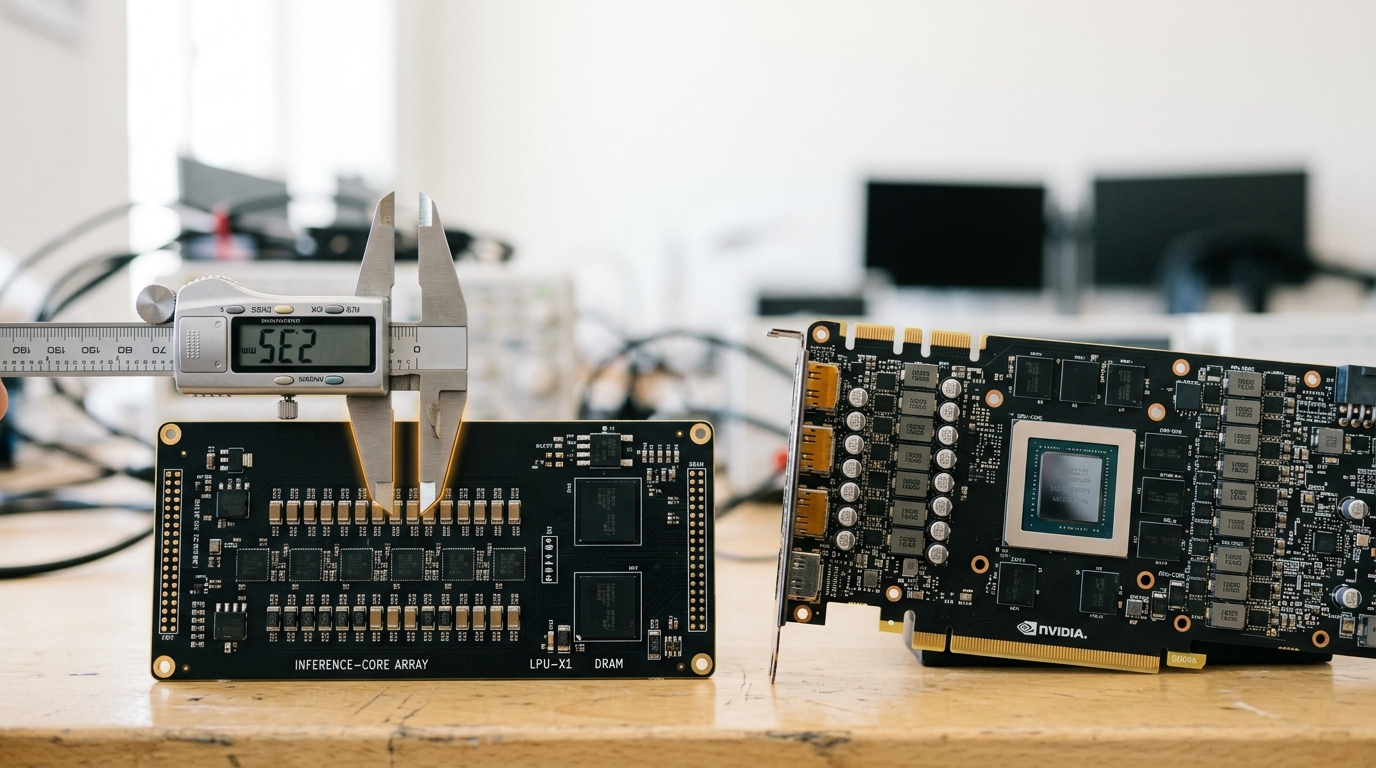
What is not in dispute is the underlying tension worth examining: Groq’s founding argument was that general-purpose GPUs are architecturally the wrong tool for AI inference specifically — that a purpose-built chip, without a GPU’s graphics and general-compute legacy baggage, could serve inference workloads faster and more efficiently. That argument is precisely the one this cohort’s broader accelerator-landscape briefing tracks as gaining real commercial traction: ASIC and purpose-built inference silicon are growing at roughly 44.6% year-over-year, nearly triple merchant GPU growth of 16.1% [3]. Nvidia holding any stake in, or technology relationship with, the company that made that exact architectural argument against Nvidia’s own core product is worth examining on those terms alone.
Reading one: the hedge
The more charitable reading is that Nvidia, sitting on close to 70% of the AI accelerator market, is doing exactly what a dominant incumbent with resources should do: buying optionality against every credible architectural threat to its own core product, rather than betting the entire company on GPUs remaining the right answer for inference forever. Under this reading, the Groq relationship is a rational insurance policy, similar in spirit to how a large company might acquire a promising smaller competitor’s technology to ensure it controls the outcome either way.
Reading two: the concession
The less charitable, and not unreasonable, reading is that a company only pays a premium for a competitor’s core technology when its own product roadmap cannot credibly answer the same argument on its own merits. Under this reading, Nvidia’s move into Groq’s technology is a quiet acknowledgment that purpose-built inference silicon has a real efficiency advantage over GPUs for at least some inference workloads — an advantage large enough that owning it directly was more attractive than continuing to compete against it with the general-purpose architecture alone.
Why both readings can be true at once
These two readings are not actually mutually exclusive. A hedge and a concession look identical from the outside: both involve the dominant player acquiring the technology of the company making the strongest architectural argument against its own product. The custom-ASIC growth-rate data already cited in this cohort’s companion briefings suggests the underlying pressure Nvidia is responding to is real regardless of which internal motivation actually drove the decision [4]. What would help settle the question is visibility into how Groq’s technology gets integrated into Nvidia’s own product roadmap over the following several product generations — a genuine hedge would likely see it stay separate and optional; a concession would more likely see Groq’s architectural ideas absorbed directly into Nvidia’s own next-generation designs.
Why this single relationship is worth more attention than its dollar value suggests
Even at the higher end of the reported figures, this deal is small relative to Nvidia’s own market capitalization and annual revenue — far smaller, in pure dollar terms, than Broadcom’s or Marvell’s custom-silicon partnerships covered elsewhere in this cohort. Its significance is not financial magnitude; it is what the relationship reveals about how the single most dominant company in AI hardware assesses its own architectural vulnerability. A company with Nvidia’s resources rarely needs to acquire technology defensively unless internal analysis has concluded the external threat is credible enough to warrant it. Reading the deal this way — as a revealed preference about Nvidia’s own confidence in its GPU-centric roadmap for inference specifically, rather than training, where GPUs remain far less contested — is more informative than treating it as an isolated corporate transaction.
A distinction worth holding onto: training versus inference
Nothing in this briefing should be read as suggesting Nvidia’s position in AI training is under similar pressure. The architectural argument Groq built its company around targets inference workloads specifically, where a purpose-built chip’s advantages are most pronounced. Nvidia’s dominance in training clusters, where flexibility across many different model architectures matters more than any single workload’s optimal efficiency, faces a different and generally less acute set of competitive pressures — a distinction this cohort’s broader accelerator-market briefings return to repeatedly, because conflating the two workloads is one of the most common errors in casual coverage of the AI hardware competitive landscape.