A note on this briefing’s sourcing
Qualcomm’s specific datacenter-inference product plans are less thoroughly documented in available 2026 reporting than the other accelerator vendors covered in this cohort. This briefing is deliberately conservative as a result: it establishes the strategic context and competitive position clearly, while flagging that specific product names, timelines, and technical specifications for Qualcomm’s datacenter push should be verified against the company’s own investor disclosures before being cited in more detail than this briefing provides.
Why Qualcomm needs a second business
Qualcomm’s core business is built on mobile chips, an enormous but structurally mature market: smartphone unit volumes have grown slowly for years, and Qualcomm’s own revenue is tied closely to that ceiling. AI datacenter silicon, by contrast, sits inside a global semiconductor market projected to reach $1.3 trillion in 2026 with the AI-accelerator segment growing far faster than the industry average [4]. A company as large as Qualcomm has an obvious incentive to establish a position in the faster-growing market before its absence becomes a structural weakness relative to competitors already there.
The competitive field Qualcomm is entering
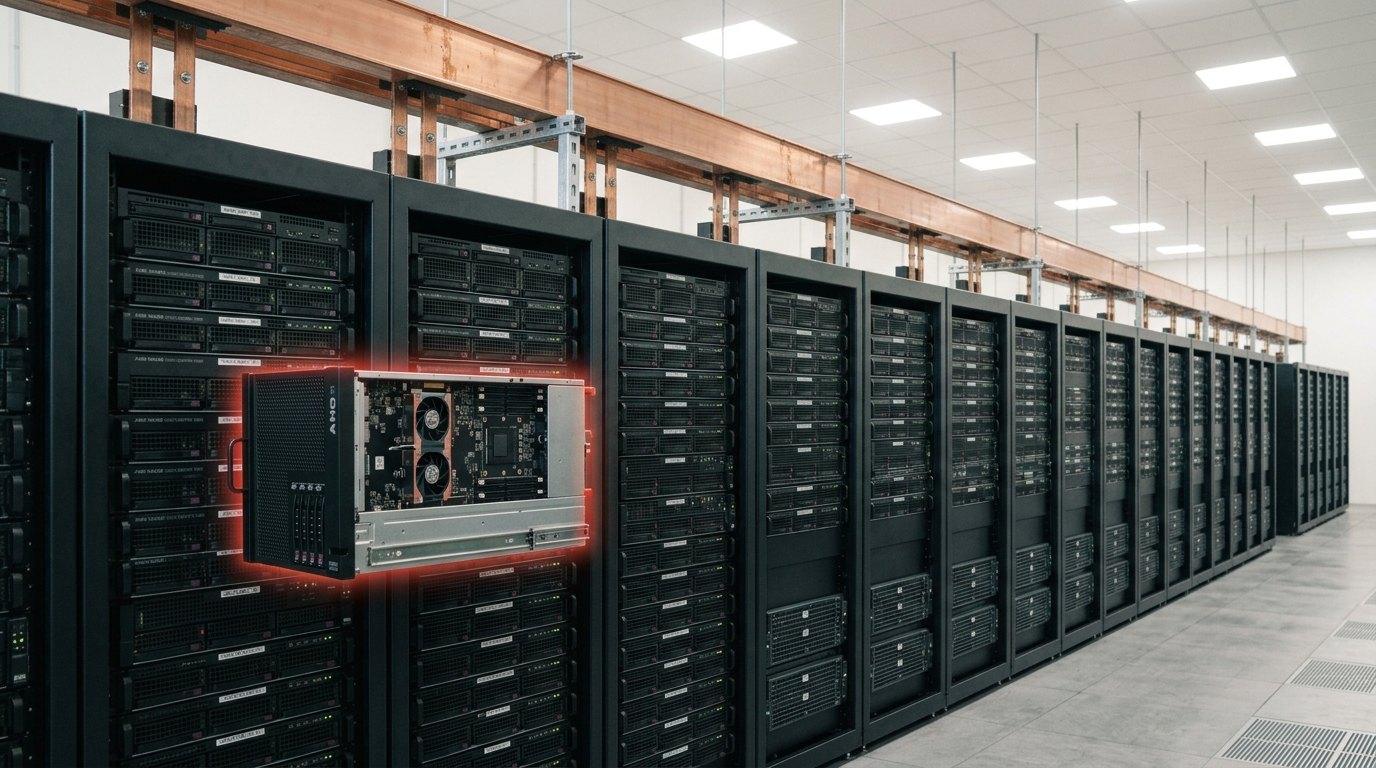
Qualcomm’s move into datacenter inference silicon puts it into direct competition with an already-crowded field: Nvidia’s dominant position, AMD’s established MI-series, the Broadcom- and Marvell-enabled hyperscaler custom-silicon ecosystem, and a wave of specialized inference startups, all covered elsewhere in this cohort [1]. Custom ASIC and inference-specialist silicon is growing faster than merchant GPU shipments industry-wide, which is the same trend drawing Qualcomm toward the space — but it also means Qualcomm is entering during a period when the market is actively fragmenting across many specialized approaches rather than consolidating around a small number of winners, making it a harder market to enter late than it might have been a few years earlier [2].
The advantage Qualcomm might actually have
Qualcomm’s one genuinely differentiated asset, relative to most datacenter-focused competitors, is decades of design discipline built around power efficiency — a mobile chip has to run inside a phone’s thermal and battery budget in a way a datacenter GPU historically has not had to. This cohort’s power-infrastructure briefings establish that AI datacenters are now themselves severely power-constrained, not merely compute-constrained. If that framing holds, Qualcomm’s low-power design heritage could be a genuine competitive asset in a market segment specifically valuing efficiency per watt over raw peak throughput — a plausible strategic rationale, though one this briefing states as a reasonable hypothesis rather than a confirmed technical advantage, since it depends on execution details not yet publicly verified in detail.
Qualcomm’s separate foundry-side story
Notably, Qualcomm also appears as a customer in this cohort’s Samsung Foundry briefing, reportedly in discussion for a 2nm chip manufactured by Samsung — though explicitly not for Qualcomm’s flagship Snapdragon line [3]. That detail is worth holding alongside Qualcomm’s datacenter ambitions: a company simultaneously diversifying its foundry relationships and its end-market exposure is executing two separate strategic pivots at once, and success in one does not guarantee success in the other.
What would actually validate this bet
The clearest test, as with several other briefings in this cohort, is a named, large customer commitment — a hyperscaler or major enterprise AI deployment specifying Qualcomm datacenter silicon at meaningful volume, not a pilot or a technology demonstration. As of this briefing, that specific proof point has not been established in the available reporting, which is precisely why this piece treats Qualcomm’s datacenter push as a strategic bet in progress rather than a completed success story.
Why Qualcomm’s timing is harder than it looks
Entering the datacenter accelerator market in 2026, rather than several years earlier, means Qualcomm is arriving after Nvidia’s dominant position, AMD’s established second-place position, and the Broadcom/Marvell custom-silicon design-partner duopoly are all already structurally entrenched, each backed by years of accumulated customer relationships and software-ecosystem investment this cohort’s other briefings document in detail. A software ecosystem in particular — the accumulated tooling, driver maturity, and developer familiarity built around an incumbent’s architecture — is often a harder competitive barrier to overcome than raw hardware capability alone, since customers weigh switching costs as heavily as any single benchmark result. Qualcomm’s mobile-chip business faced a broadly comparable ecosystem barrier decades ago and overcame it gradually rather than immediately, which may be the more realistic timeline to expect here as well, if the datacenter push succeeds at all.
The realistic version of success for this bet
Given the ecosystem barriers just described, the more plausible near-term outcome for Qualcomm’s datacenter push is not displacing Nvidia or AMD at the center of frontier-scale training clusters, but carving out a specific, defensible niche — plausibly power-constrained edge-inference deployments or specific enterprise inference workloads where Qualcomm’s efficiency heritage matters more than raw peak throughput. A niche win of that kind would still represent genuine strategic success for a company diversifying away from a maturing mobile-chip ceiling, even if it falls well short of unseating any of the datacenter incumbents covered elsewhere in this cohort.