The narrowest bet in this cohort’s startup track
Most AI chip startups covered elsewhere in this cohort hedge toward at least some flexibility — Groq’s LPU, SambaNova’s reconfigurable dataflow, and Cerebras’s wafer-scale approach are each architecturally distinctive, but none refuses training workloads outright the way Positron does. Positron’s chip is built for inference exclusively, with no attempt to compete for training workloads at all — a total commitment to specialization that most competitors, including Nvidia and AMD, deliberately avoid by keeping their architectures broadly capable across both.
Why total specialization is a real strategy, not just a limitation
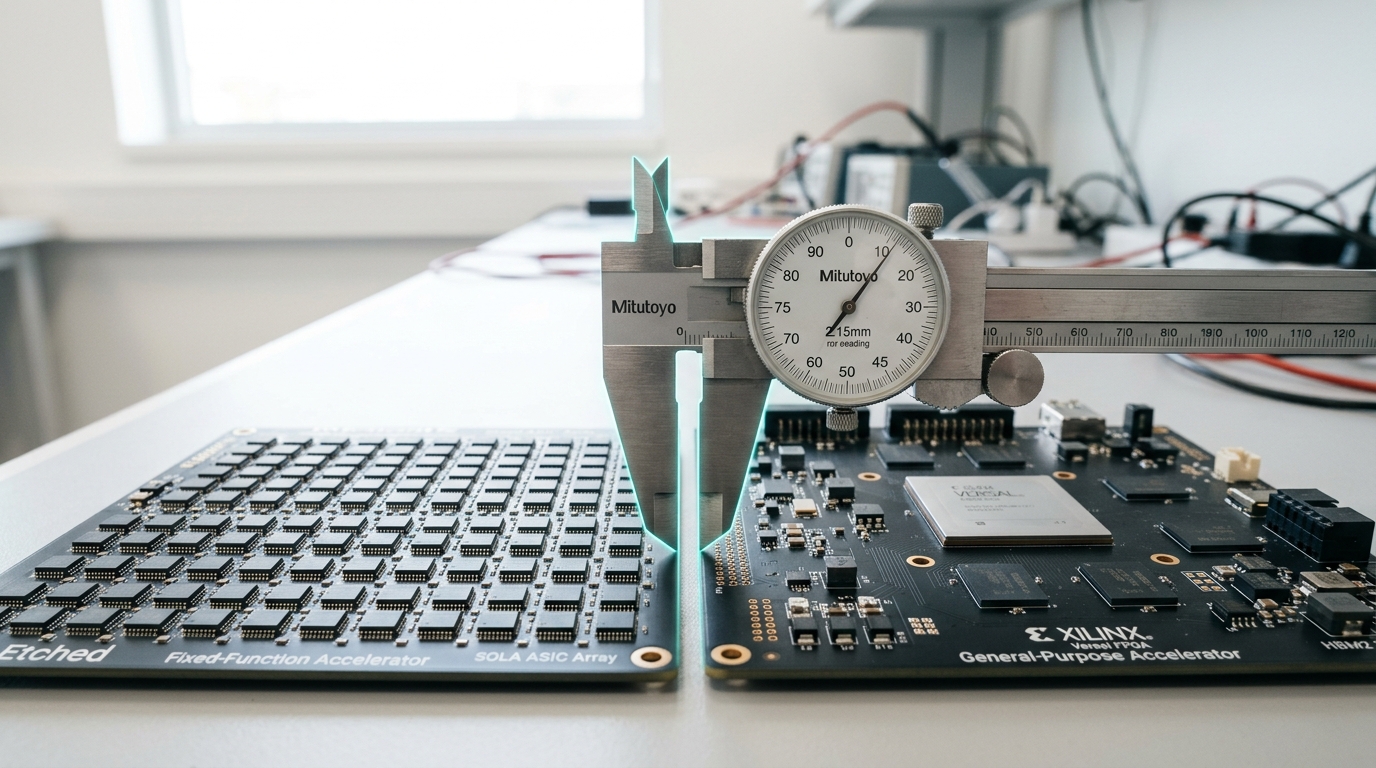
Refusing to support training simplifies the underlying silicon meaningfully: a chip that never needs to run backpropagation, never needs to store optimizer state, and never needs the flexibility a training workload’s varied computational graph requires can dedicate more of its transistor budget and memory bandwidth entirely to the specific, narrower computational pattern inference actually uses. This is the same specialization logic driving the broader custom-ASIC growth trend this cohort documents extensively — ASIC and purpose-built inference silicon growing at roughly 44.6% year-over-year, far outpacing merchant GPU growth, precisely because inference- specific designs can extract efficiency gains a general-purpose architecture leaves on the table [3].
The valuation and what it implies
Positron carries a reported valuation of $1 billion or more [1] — a serious figure for a company this narrowly focused, and one that suggests investors believe the inference market alone, independent of any training business, is large enough to support a standalone, specialized company at real scale. That is a defensible bet given this cohort’s broader market data: inference workloads, not training, are widely described as the faster-growing and ultimately larger share of total AI compute demand as deployed AI systems move from research to production use at scale.
The risk this total specialization accepts
The clear risk in refusing training entirely is optionality: a company like Nvidia or AMD can shift its own internal resource allocation between training and inference silicon as market demand shifts between the two, while Positron has permanently forgone that flexibility by design. If the inference market’s own requirements evolve in a direction Positron’s specific architecture handles poorly — a shift toward more variable, less predictable inference workloads, for instance — the company has no training-market fallback to lean on the way a more general-purpose competitor would. Independent industry rankings generally place Positron among the higher-risk, higher-conviction bets in the inference-startup landscape for exactly this reason [4].
What would validate the bet
The clearest evidence to watch for is whether Positron’s inference-only chips demonstrate a decisive efficiency advantage — measured in cost or power per inference request — over general- purpose alternatives running the same production workloads, published as independently verified benchmark data rather than company-sponsored comparisons. A meaningful, sustained efficiency advantage would validate the total-specialization bet directly; a narrower or inconsistent advantage would suggest the flexibility Positron gave up was worth more than the specialization it gained, a genuinely open question this briefing does not attempt to resolve in advance of that evidence [2].
How Positron differs from Etched’s even narrower bet
This cohort’s companion briefing on Etched covers a company that specializes one step further still — not just for inference generally, but specifically for the transformer model architecture that dominates today’s large language models. Positron’s inference-only focus is narrower than a general-purpose accelerator but broader than Etched’s architecture-specific commitment, occupying a middle position on the specialization spectrum this cohort’s startup track maps out across more than a dozen companies. That middle position carries its own trade-off: less efficiency upside than Etched’s most extreme bet if the transformer architecture remains dominant, but less downside risk if a successor architecture eventually displaces it, since Positron’s inference focus does not depend on any single model architecture remaining unchanged.
Why customer concentration matters especially for a narrow bet
A company this specialized is particularly exposed to customer concentration risk: because Positron’s chip cannot be repurposed for training or redirected toward a different workload category if a major customer’s needs shift, losing a large inference customer would be harder to offset than it would be for a more flexible competitor with a broader addressable workload range. Readers evaluating Positron’s long-term prospects should weigh its customer diversification alongside its raw efficiency numbers, since the latter matters far less if the company’s revenue depends heavily on a small number of relationships that could change their own infrastructure strategy independently of anything Positron does.