The insult that lost its referent
To call someone a Luddite is to accuse them of a particular error: fearing a machine because it is a machine. The word ends an argument about technology without anyone having to conduct it. It carries a compressed history — that around 1811 a group of English textile workers, frightened by mechanisation and unable to grasp that productivity growth would eventually enrich them, smashed the machines that were about to make them prosperous, and were refuted by everything that followed.
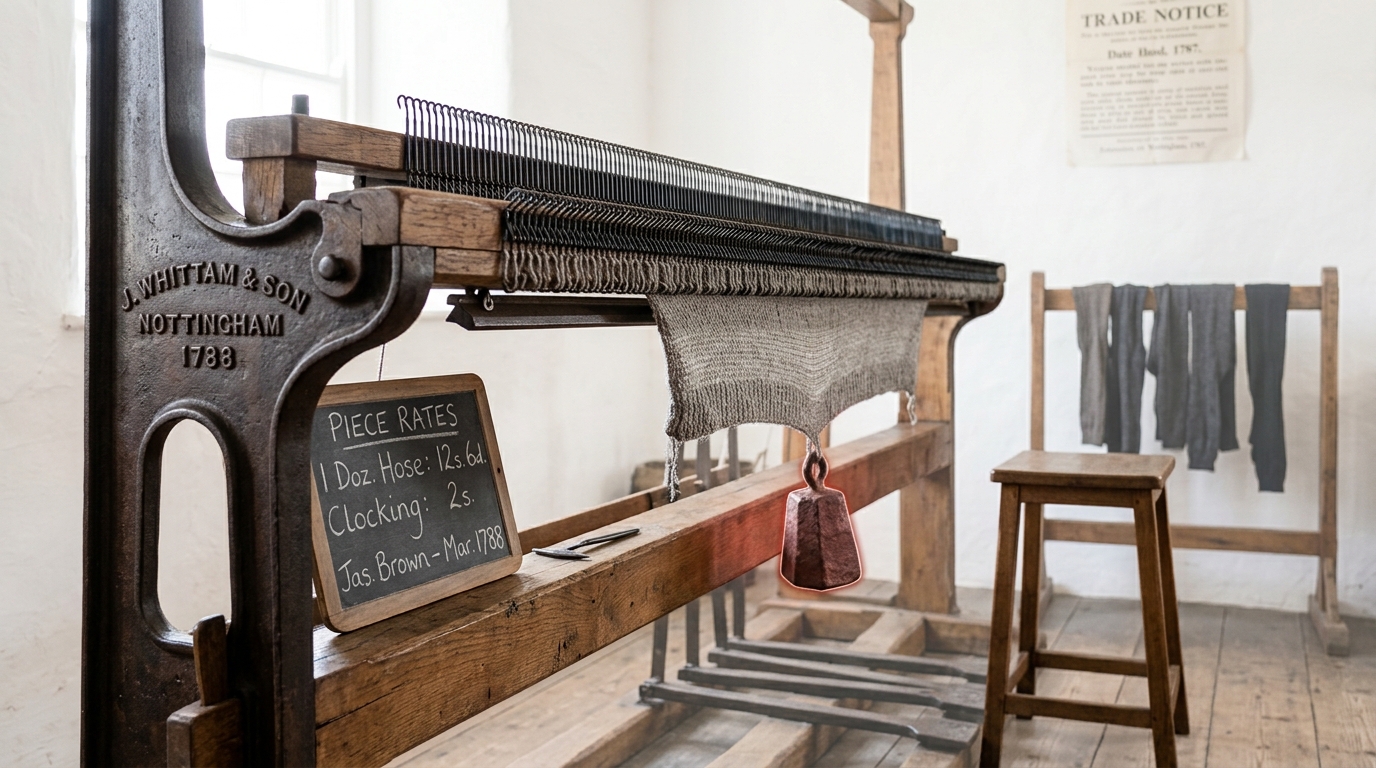
That story is not so much false as precisely inverted. The framework knitters of Nottinghamshire, Leicestershire and Derbyshire were not confronting a new machine. They were confronting an old machine operated under new rules. The stocking frame they attacked had been in regulated use long enough that Charles II had granted the trade a charter over it; the 1812 parliamentary select committee that examined their petitions dated that charter to 1664 and found that it had become “a dead letter”, ignored by the hosiers and unenforced by local authorities [3]. A trade does not spend a century and a half building customary law around a device it considers illegitimate.
What the framebreakers said they wanted is recoverable, because they wrote it down, and because Parliament put their grievances on the record while debating whether to hang them for expressing them.
Read the declaration
The document usually called the Framework Knitters’ Declaration was posted publicly at Radford on 1 January 1812 and survives both as the posted proclamation and as a clerk’s copy in the Home Office papers. It is signed from “NED LUD’S OFFICE” in “Sherwood Forrest”. Its claim is legal, not technophobic: that under the charter granted by “our late Sovereign Lord Charles the Seacond”, the framework knitters were “Impowre’d to breake and Distroy all Frames or Engines” that “fabricate Articles in a fraudilent and Deceitfull manner”, and to destroy the goods so made [1].
The target set is then specified twice over. It covers “all manner of frames Whatsoever that make the Following spurious Articles”, and — a clause the popular version never quotes — “all Frames Whatsoever that do not pay the regular prises” [1]. Machines are not the category. Fraudulent output and sub-scale piece rates are the category. A frame producing sound work at agreed prices is, on the document’s own logic, exempt.
Byron’s maiden speech in the Lords on 27 February 1812, opposing the bill that made frame-breaking a capital offence, describes the same mechanism from the other side of the class line. He notes that “one man performed the work of many, and the superfluous labourers were thrown out of employment”, but he is explicit that the objection ran to what the wider frames produced: “the work thus executed was inferior in quality; not marketable at home, and merely hurried over with a view to exportation. It was called in the cant of the trade, by the name of ‘Spider work’” [4]. Byron’s framing — that the workers “instead of rejoicing at these improvements in arts so beneficial to mankind, conceived themselves to be sacrificed to improvements in mechanism” — is itself a sympathetic outsider’s gloss, and should be read as advocacy rather than as testimony about what the knitters believed.
The formal parliamentary demand is the strongest evidence, because it was drafted for a committee rather than for a wall. In March 1812 Gravenor Henson’s United Committee of Framework Knitters set out its grounds for seeking an Act. The four heads were: that cut-up framework-knitted goods be prohibited except for a named list; that plain and ribbed stockings and gloves “have their sizes regulated by the number of jacks”, with quality “regulated by the gauge of the Frame”; that machine-made net be measured by the rack; and that machine-made net offered for sale carry a stamp “descriptive of their real quality” [2].
That is a programme of product standards, metrology and honest labelling. It contains no proposal to remove a machine, restrict horsepower or cap output. It is, in modern terms, a demand for a conformity-assessment regime.
The distinction that carried the whole dispute
The technical grievance turns on how a stocking is made. Knitting to shape — fully fashioned work — widens and narrows the fabric by adding and removing loops, so the finished hose has a continuous selvedge and every edge is locked by the loop structure itself. A wide frame instead knits a plain rectangular web at speed; the stocking is then cut from that web and seamed. A weft-knitted fabric has no self-locking boundary at a cut edge, so a cut-up stocking is structurally predisposed to run at exactly the places where a fashioned one cannot. That is the physical content of “spider work”, and it is why the first head of the 1812 petition is a prohibition on cut-ups rather than on frames [2, 4].

The second grievance is the erosion of entry control. Fashioned work is a skill with a long training tail; cut-up work on a wide frame is not. Once the product standard collapses, the training requirement collapses with it, and once the training requirement collapses the wage floor that the training requirement supported collapses too. The three are one mechanism, which is why the knitters treated a quality regulation as a wage policy without ever asking for a wage regulation. The select committee noted the point in its own way: it identified “fraudulent work” as “the principal cause of the decline of the trade” while recording that “none of the witnesses had called for a regulation of wages” [3].
Honesty about the evidence requires two qualifications. First, the apprenticeship system being defended was already leaky well before 1811. Wallis’s data on seventeenth-century London show that a high proportion of apprenticeships ended before the term of service was complete, and he reconstructs the distribution of training costs and repayments so that neither master nor apprentice bore a large loss from early termination [6]. That is evidence about London a century and a half earlier, in other trades, and it does not transfer directly to East Midlands hosiery; but it is a caution against reading customary apprenticeship as a stable institution that machinery suddenly broke. Second, the Luddites’ constitutional claim — that the charter empowered them to destroy fraudulent frames — was their reading, asserted in a proclamation, not an adjudicated fact. Parliament’s answer was to make frame-breaking capital rather than to test the claim.
Parliament’s own debate makes the political character of the choice plain. In the Commons on 20 February 1812, Hutchinson attributed the disturbances to “distress perhaps unparalleled” among a class he described as “a grave, plodding, quiet, discreet” one driven to outrage by “intolerable distress”, while Sinclair read the same events as a “premeditated plan of systematic aggression” and defended the death penalty on the ground that a capital sanction “when it is for the first time enacted against an offence… cannot… fail to deter many persons” [5]. The state had two available instruments — regulate the product or criminalise the resistance — and it selected the second.
The lag, and what the lag was made of
The confident modern reading of Luddism rests on an implied empirical claim: that the workers were shortly proved wrong. The wage evidence does not support the word “shortly”.
Feinstein’s reconstruction of nominal earnings and the cost of living for British male and female manual workers from 1770 to 1870 concludes that “the standard of living of the average working-class family improved by less than 15 percent between the 1780s and 1850s”, a “long plateau” he argues is consistent with other economic, political and demographic indicators [7]. Seventy years is not a transition; it is two working lifetimes.
Allen’s analysis of the same period gives the mechanism a name. Across 1760–1913 he finds a two-stage evolution of inequality in which, over the first half of the nineteenth century, “the real wage stagnated while output per worker expanded”, the profit rate roughly doubled, and profits’ share of national income rose at the expense of labour and land; only after mid-century did real wages resume growing in line with productivity, with factor shares stabilising [8]. The gap between output per worker and the real wage is an accounting identity once the labour share is admitted:
where

Two cautions belong here. Real wage series for this period are contested — cost-of-living indices, regional coverage, unemployment adjustment and household composition all move the answer, and the optimist–pessimist debate is long-running rather than closed. And Allen’s account is one interpretation of the causes, not a consensus reading; the identity above is arithmetic, the story about capital accumulation and induced technical change is a model. What survives both cautions is the shape: a several-decade interval in which measured productivity rose and measured worker living standards did not.
Mokyr, Vickers and Ziebarth make the historiographical point that anxiety about machine substitution is not a recurring error to be laughed at but a recurring topic in economics itself, alongside two other durable anxieties — about the moral consequences of technological progress, and about progress having exhausted itself [9]. Their comparison of the historical and contemporary manifestations is a useful antidote to both triumphalism and alarm: the argument keeps returning because the underlying distributional question keeps returning.
Displacement and reinstatement
The modern apparatus for this question is task-based, and it is more useful than either “machines destroy jobs” or “machines create jobs” because it makes both effects simultaneous and lets their balance be an empirical quantity.
In the Acemoglu–Restrepo formulation, production consists of a continuum of tasks, each allocated to capital or to labour. Automation moves a task from labour to capital and “shifts the task content of production against labour because of a displacement effect”, with the consequence that automation “always reduces the labor share in value added and may reduce labor demand even as it raises productivity”. The creation of new tasks in which labour holds comparative advantage moves the content the other way through “a reinstatement effect”, and “always raises the labor share and labor demand” [10]. Their fuller model endogenises capital accumulation and the direction of research, and shows a stabilising force: automation lowers the cost of producing with labour, which discourages further automation and encourages new-task creation [11].
Written schematically, the change in labour demand decomposes as
where tasks are indexed by

The empirical decomposition matters more than the algebra. Acemoglu and Restrepo report that slower US employment growth over the three decades to the late 2010s is accounted for by “an acceleration in the displacement effect, especially in manufacturing, a weaker reinstatement effect, and slower growth of productivity than in previous decades” [10]. In their Econometrica paper they push the same framework onto the wage structure and find that between 50% and 70% of changes in the US wage structure over four decades are accounted for by relative wage declines of worker groups specialised in routine tasks in rapidly automating industries — a relationship they report as robust to controls for market power, deunionisation and non-automation capital deepening [12].
Autor, Chin, Salomons and Seegmiller add the reinstatement side with direct measurement. Building a database of new job titles across eight decades linked to census microdata and patent-based exposure measures, they find that most current employment sits in job specialties introduced since 1940, that the locus of new-work creation shifted from middle-paid production and clerical occupations before 1980 to high-paid professional and low-paid service occupations after it, and — the finding that bears hardest on the present — that “the demand-eroding effects of automation innovations have intensified in the past four decades while the demand-increasing effects of augmentation innovations have not” [19]. Reinstatement is real and measurable, and it has been getting weaker relative to displacement.
Where the empirical literature actually stands
The framing that dominated the 1990s was skill-biased technical change: technology raises demand for skill, so the college premium rises. Autor, Levy and Murnane reframed it around routineness, arguing that computer capital substitutes for workers in cognitive and manual tasks that follow explicit rules and complements them in non-routine problem-solving and complex communication, and showing that computerisation was associated with falling routine and rising non-routine cognitive task input within industries, occupations and education groups [13]. Autor and Dorn connected that to the observed hollowing of the middle, showing that local labour markets specialised in routine tasks adopted information technology differentially, reallocated low-skill labour into service occupations, and experienced earnings growth at both tails [14]. Goos, Manning and Salomons documented the pervasiveness of job polarisation across sixteen Western European countries from 1993 to 2010 and estimated a framework in which routine-biased technical change and offshoring explain much of it, within and between industries [15].
This is not a settled consensus, and the dissent is serious. Card and DiNardo argued that a key problem for the skill-biased account is that “wage inequality stabilized in the 1990s despite continuing advances in computer technology”, and that it “fails to explain the evolution of other dimensions of wage inequality, including the gender and racial wage gaps and the age gradient in the return to education” [16]. Beaudry, Green and Sand argued that around 2000 the demand for cognitive tasks underwent a reversal, after which high-skilled workers moved down the occupational ladder and displaced less-educated workers in less skill-intensive jobs [17] — which is difficult to reconcile with a monotonic skill bias. Autor himself, surveying the field, judged that polarisation was “unlikely to continue very far into future” [18].
The robot literature shows the disagreement at its sharpest, and the divergence is instructive rather than embarrassing. Acemoglu and Restrepo, using variation in local exposure to industrial robots across US commuting zones from 1990 to 2007, estimate that “one more robot per thousand workers reduces the employment-to-population ratio by 0.2 percentage points and wages by 0.42%” [20]. Graetz and Michaels, using a panel of robot adoption within industries across seventeen countries from 1993 to 2007, find that increased robot use “contributed approximately 0.36 percentage points to annual labor productivity growth” while raising total factor productivity and lowering output prices, and report that robots “did not significantly reduce total employment, although they did reduce low-skilled workers’ employment share” [21].
These are not contradictory measurements of the same object. One estimates local-market effects where displaced workers and the demand they would have generated are both geographically fixed; the other estimates national industry aggregates where reallocation across sectors and regions is absorbed. A technology can lower employment in the places it lands while leaving the national total roughly unchanged, and both facts can matter to different people. The literature’s honest summary is that the aggregate employment effect of a given automation wave is small and contested, and the distributional and geographic effects are large and much better identified.

Is the present case different
Two features of the current wave are worth separating from the noise. The first is the breadth of exposure. In the study behind the Science paper on large language models, the authors estimate that “around 80% of the U.S. workforce could have at least 10% of their work tasks affected by the introduction of LLMs, while approximately 19% of workers may see at least 50% of their tasks impacted” [23, 22]. These are exposure estimates, not employment forecasts: they measure the share of task descriptions a model could plausibly assist with, and they are silent about reliability, verification cost, liability and workflow integration.
The second is the direction of the skill gradient in the few clean field studies available. Brynjolfsson, Li and Raymond study a staggered rollout of a generative-AI conversational assistant across 5,172 customer-support agents and find productivity rising 15% on average in issues resolved per hour, with “less experienced and lower-skilled workers” improving both speed and quality while “the most experienced and highest-skilled workers see small gains in speed and small declines in quality” [24]. If that pattern generalised, it would be compression rather than skill bias — the opposite sign to the canonical account of computerisation. The evidence for generalisation is thin: one firm, one task family, one assistant, one period. Treat it as a well-identified result about a specific setting and an open question about everything else.
What is genuinely different is the exposure profile, not the mechanism. Routine-biased technical change hollowed the middle because rule-following tasks were the cheapest to codify [13, 15]. Language models are strongest where output is text-shaped, tacitly specified and cheaply verified — which places a substantial share of professional and clerical work inside the exposure set for the first time. That changes who is exposed. It does not change the task-based arithmetic, and it does not by itself determine the sign of
The institutional variable
Here is where the historical case earns its keep. In 1812 the technology was fixed and the outcome was not. Parliament could have passed Henson’s product-standard bill and the displacement would have proceeded within a framework that preserved training and price floors; it instead made frame-breaking a capital offence and left the trade unregulated [2, 5]. The framebreakers lost a legislative argument, not a technological one.
The same variable runs through the modern evidence, though the identification is weaker and the claim should be stated as interpretation rather than as a finding. The cross-country dispersion in polarisation outcomes documented by Goos, Manning and Salomons occurred under broadly similar technological access [15]; the divergence between local and national robot estimates is a statement about adjustment institutions and mobility as much as about robots [20, 21]; and Acemoglu and Restrepo’s finding that task displacement retains its explanatory power after controlling for deunionisation is a claim about which channel dominates, not a claim that bargaining institutions are irrelevant [12]. Naidu’s account of why US union density remains low despite unions remaining popular — that employer opposition and labour law together impose collective-action problems that workers must solve before recognition is possible — describes a bargaining structure that is a policy variable, not a technological consequence [25].
The lesson is not that institutions are always benign or that regulation always helps. It is that the technology underdetermines the distribution, and that the part of the outcome which is chosen is the part worth arguing about.

Three conditional predictions
These are speculation, offered with horizons and with the evidence that would refute them.
By 2031, aggregate employment-to-population ratios in high-income economies will not show a decline attributable to generative AI that is large relative to business-cycle variation. The task-based decomposition and the robot literature both suggest aggregate effects are second-order compared with distributional ones [10, 21]. This is disconfirmed if a sustained fall of more than roughly two percentage points appears across multiple high-income economies and survives controls for demographics and the cycle.
By 2036, measured within-occupation wage dispersion in exposed professional occupations will have risen more than between-occupation dispersion. This follows from exposure being task-level and heterogeneous within job titles [23]. It is disconfirmed if exposed occupations move as blocks — uniform wage declines within title, with dispersion flat.
Cross-country variation in worker outcomes will remain wider than cross-country variation in model access. If access diffuses faster than institutions adapt, the institutional term dominates. This is disconfirmed if outcome dispersion across countries narrows toward capability dispersion as diffusion completes — which would be strong evidence that the technology, not the institutional setting, is doing the work.
What the caricature removes
The framework knitters were wrong about several things. They were probably wrong that the charter empowered them to break frames; they were wrong that a product-standards regime could have held the line indefinitely against a cost advantage of that size; and the anonymous proclamation from Ned Ludd’s Office was, whatever its legal claim, an instrument of coercion. None of that is a reason to accept the version in which they were simply afraid of machines.
They were right that the machine was being used as an instrument in a distributional fight, and right that the fight was about training, quality customs and price floors rather than about mechanisation. They were right that the gains would take a long time to reach them; Feinstein’s plateau and Allen’s pause are, in the aggregate, a vindication of their timing intuition even where their tactics failed [7, 8]. And they were right that the outcome depended on what Parliament decided, which is why they petitioned before they broke anything and why they kept petitioning afterwards.
The modern usage of their name performs a specific piece of work: it converts a question about who bears the adjustment cost into a question about whether one is for or against progress. That substitution is not an accident of language. It was already the government’s position in February 1812, and it won.