What the record actually says, and what it does not
“Industrial revolution” is a label applied after the fact to a process that, in the surviving documentary record, looks far slower and more uneven than the phrase suggests. This briefing walks through three specific mechanisms with documented data behind them — factory mechanization, steam power, and electrification — and then states plainly what economists mean by “general-purpose technology,” a term that gets used loosely far more often than it gets defined.
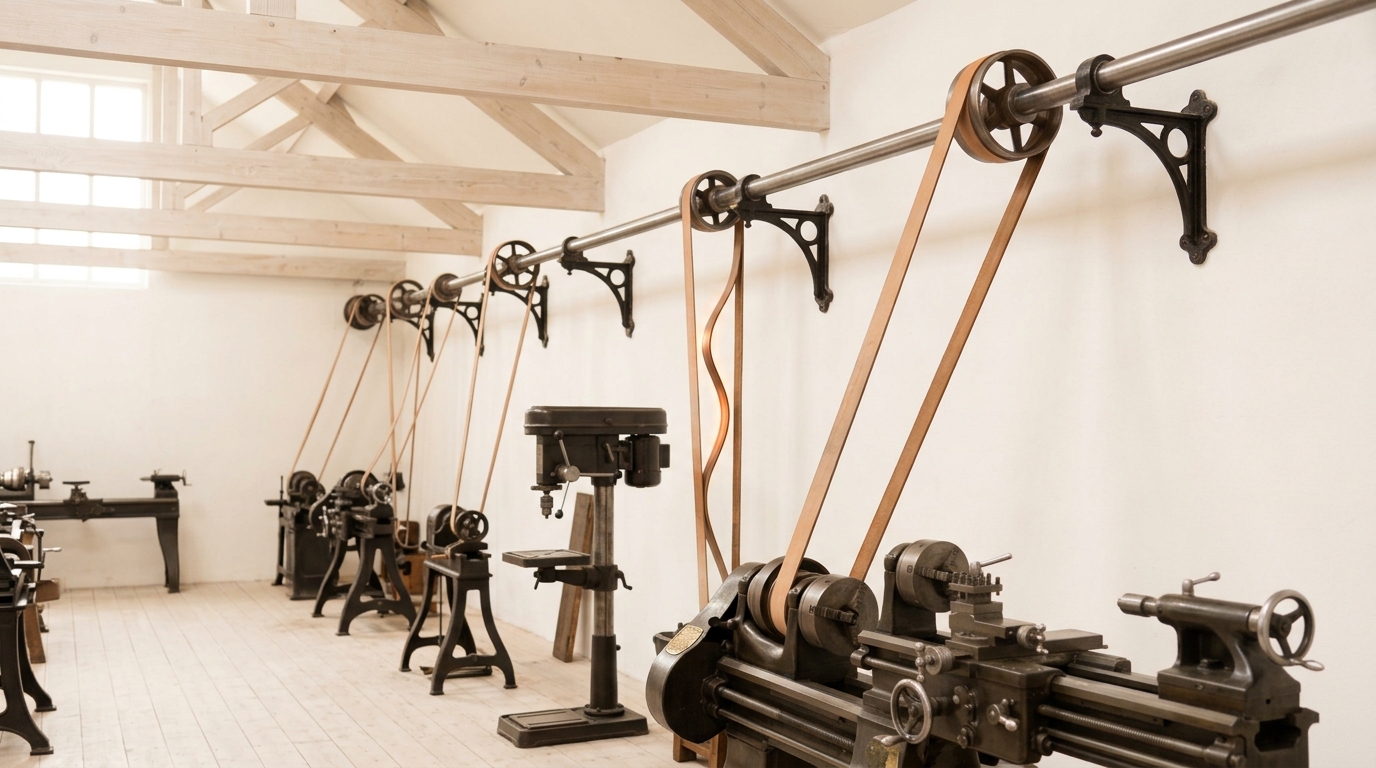
Fact. British cotton-textile output per worker rose sharply between the mid-eighteenth and mid-nineteenth centuries as spinning and weaving moved from hand tools operated in homes to powered machinery operated in centralized factories. The mechanism was straightforward: a water wheel or steam engine driving line shafting could turn many spindles or looms at once, at a pace and consistency no hand operator could sustain, and the factory building existed specifically to put many machines within reach of one power source. This is a real, measurable productivity effect, and it is the part of the story most popular accounts get right.
What the record complicates. Nicholas Crafts’s growth-accounting analysis of steam power in Britain found that steam’s contribution to aggregate economic growth stayed small through the early nineteenth century and only became large roughly a century after Watt’s improved engine, once high-pressure steam technology spread widely after 1850 [2]. A textile mill running powered looms in 1800 tells you mechanization worked at the level of one industry; it does not tell you that steam had already transformed the economy as a whole. Those are different claims, and the aggregate one took much longer to become true than the mill-level one.
What “general-purpose technology” actually means
The term is precise, not a synonym for “big” or “important.” Timothy Bresnahan and Manuel Trajtenberg define a general-purpose technology (GPT) by three criteria taken together: pervasiveness — it is used as an input across a wide range of downstream sectors, not confined to one industry; inherent potential for continued technical improvement over a long period rather than arriving finished; and innovational complementarities — improvements in the GPT raise the returns to inventive effort in the many sectors that use it, and inventive effort in those sectors in turn improves uses of the GPT [1].
By this definition, steam power, electricity, and later semiconductors qualify because each was pervasive, kept improving for decades, and pulled a wide cascade of downstream invention along with it — not merely because each was economically large. A technology can be enormously valuable to one industry and still fail the GPT test if it never generalizes; a GPT, conversely, can look unremarkable in its early decades precisely because its downstream complements have not yet been built. This is analysis, not a restatement of fact: the three-criteria framework is a model economists apply to interpret data, and reasonable researchers disagree about exactly which historical technologies clear the bar.

Electrification: the documented multi-decade lag
The best-documented case of delayed diffusion is factory electrification in the United States. Warren Devine’s archival study of the transition from steam- and water-driven line shafting to individually electric-motor-driven machinery found that American manufacturers began adopting electric power in the 1880s and 1890s, but that the productivity gains commonly attributed to electrification did not show up broadly in factory output data until roughly the 1920s — a lag of about fifty years [4].
Paul David’s widely cited analysis explains why the lag was structural rather than accidental: factories that simply replaced a steam engine with an electric motor at the same shaft kept the old layout, in which machines were arranged for shaft-and-belt distribution rather than for workflow. The large productivity gain came only once factories were rebuilt from the ground up around unit drive — one small motor per machine — which let owners rearrange machinery along the logic of the production process itself rather than the logic of a rotating shaft, and which required a new generation of factory managers, electrical engineers, and layout conventions that did not yet exist when the technology first arrived [3]. David drew the explicit analogy to computerization in the late twentieth century, where measured productivity growth also lagged widespread computer adoption for decades, arguing the two cases share a common structural cause: a GPT’s payoff depends on complementary reorganization, not on the device alone.

Skills, firms, and unequal diffusion
None of this diffusion was uniform across firms, regions, or workers. Devine’s record shows large firms with capital to rebuild plant layouts adopting unit-drive electrification well before smaller firms that could only afford to bolt a motor onto an existing shaft system, which reproduced the old inefficiency under a new label. Crafts’s steam findings likewise show growth effects concentrated late and in specific high-pressure applications, not spread evenly across British industry from Watt’s era onward. Comparative economic-development research beyond the scope of this briefing has documented that this unevenness in adoption speed — which firms, which regions, which countries build the complementary skills and organizations first — is a recurring driver of divergent development outcomes wherever a general-purpose technology diffuses, a pattern visible again in the twentieth-century computer and in the current diffusion of AI systems, though tracing that later pattern in comparable statistical detail is a separate research task from the one this briefing undertakes.
Analysis versus prediction, kept separate
The facts above are: measured textile productivity gains under mechanization, Crafts’s growth-accounting timeline for steam, and Devine’s fifty-year electrification lag. The GPT framework itself is analysis — a model for classifying technologies, not a measured quantity. This briefing makes no prediction about any current technology’s diffusion timeline; the historical lags documented here are offered as a base rate for how long complementary reorganization has taken in the two best-measured precedents, nothing more.