A building is not an explanation
The factory is normally introduced as a place: a large structure, a source of power, rows of machines, a workforce assembled inside. That description is accurate and explains almost nothing. Buildings full of machines were possible long before the factory system, and many of the first factories contained machines no better than the ones already working in cottages. What changed was not principally the hardware. What changed was where decisions were made, who could observe what, and how a specification could travel from one head to another without being carried in a head at all.
Read that way, the factory belongs to the history of information and coordination rather than to the history of mechanical power. Its distinctive inventions are not the spinning frame and the steam engine but the shift fork, the works clock, the limit gauge and the instruction card — devices whose function is to place a decision somewhere specific and keep it there. Each of them takes a judgement that formerly lived inside a skilled person and relocates it: into a shaft overhead, into a bell, into a piece of hardened steel, into a written procedure produced by someone who does not do the work.
This framing is a claim about emphasis, not a discovery. The empirical questions it raises are old and, in important respects, unresolved. The most basic of them — why work was gathered under one roof at all — has been argued for half a century without a settlement, and the honest thing to do is to lay out the competing answers rather than choose among them.
Four explanations, and no agreed winner
The first explanation is mechanical. A single prime mover is indivisible: it must drive many machines to be worth its cost, and machines driven from one shaft must be near it. On this account the factory is what a large engine implies. There is real evidence for the association. Atack, Bateman and Margo, analysing United States census manufacturing data for 1850 to 1880, found that larger establishments were considerably more likely to adopt steam power, and that steam-powered establishments had higher labour productivity than those relying on hand, animal or water power even after controlling for size, location and industry; they attribute between 22 and 41 percent of labour productivity growth over that period to the diffusion of steam, with the estimate varying by establishment size [8]. That is a strong association. It is not, by itself, a demonstration that power caused gathering rather than the reverse, and the authors treat adoption as something larger establishments did rather than something that made them large.
The second explanation is supervisory. Stephen Marglin’s 1974 argument was that the factory’s decisive feature was not machinery but the centralisation of the workforce under one roof, and that this centralisation served control rather than technique [1]. Okazaki quotes him directly: the key to the factory’s success “was the substitution of capitalists’ for workers’ control of the production process; discipline and supervision could and did reduce costs without being technologically superior”, and, more pointedly, “the steam mill didn’t give us the capitalist; the capitalist gave us the steam mill” [4, 1].
The third explanation concerns quality and the fourth concerns theft, and both are really the same observation about what a merchant could and could not see. Under the putting-out system, materials were issued to dispersed producers and finished goods came back; everything in between was unobservable. Poor work, adulterated materials and retained yarn all present the same way in the merchant’s accounts, which is to say they do not present at all. Okazaki notes that Oliver Williamson took up Marglin’s argument from this direction, interpreting supervision and discipline as devices for reducing transaction costs [4]. On this reading the factory is not primarily a power plant or a whip but an observation post.
These are not variants of one thesis, and the field has not merged them. David Landes replied to Marglin at length in 1986, arguing that the thesis “misreads history and is essentially ideological” and that employers performed genuine coordinating and technical functions rather than manufacturing an artificial role for themselves [2]. Okazaki, surveying the literature, reports that despite Marglin’s very wide citation, most economic historians are critical of his separation of organisational from technological change [4]. That is a statement about where the weight of opinion sits, not a proof, and Marglin’s question survives its unpopularity.
Two quantitative attempts are worth stating precisely because they bear on the dispute without ending it. Gregory Clark, using nineteenth-century British evidence, compared disciplined factories with undisciplined workshops and concluded that “discipline succeeded mainly by increasing work effort”, summarising the result in a deliberately inverted phrase: “workers effectively hired capitalists to make them work harder” [3]. Okazaki, using data from the Japanese weaving industry between 1905 and 1914 — a period in which factories, home workshops and the putting-out system coexisted, and in which some factories used no power at all — found that production value per worker was four to seven times larger in nonpowered factories than among weavers working out under the putting-out system, and that the difference reflected the number of working days and the intensity of work rather than mechanisation [4]. Both results give organisation a large role. Neither shows that power transmission was incidental, and neither author claims it was.
The dispute is worth preserving rather than resolving, because the four explanations imply different things about what a factory is. Only one of them is about horsepower. The other three are about who knows what.
The line shaft was a constitution
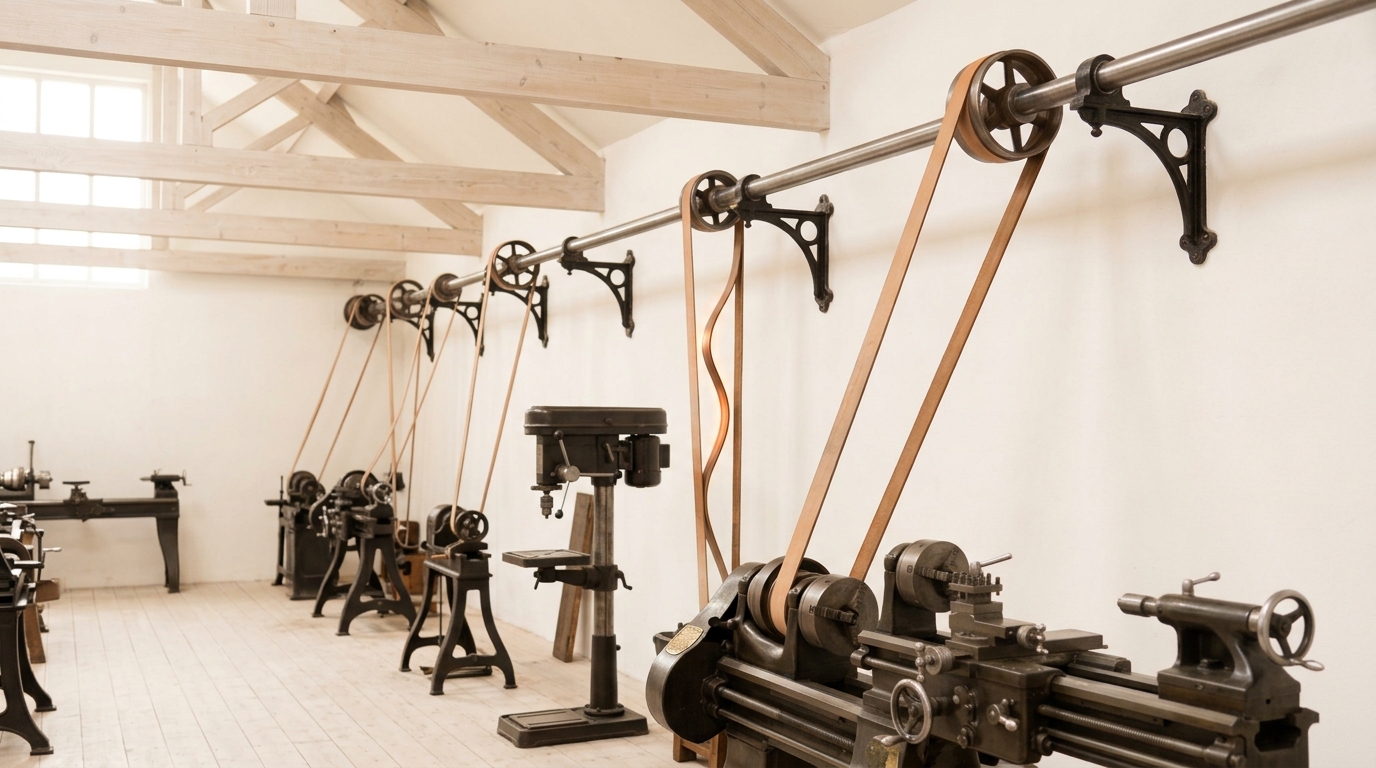
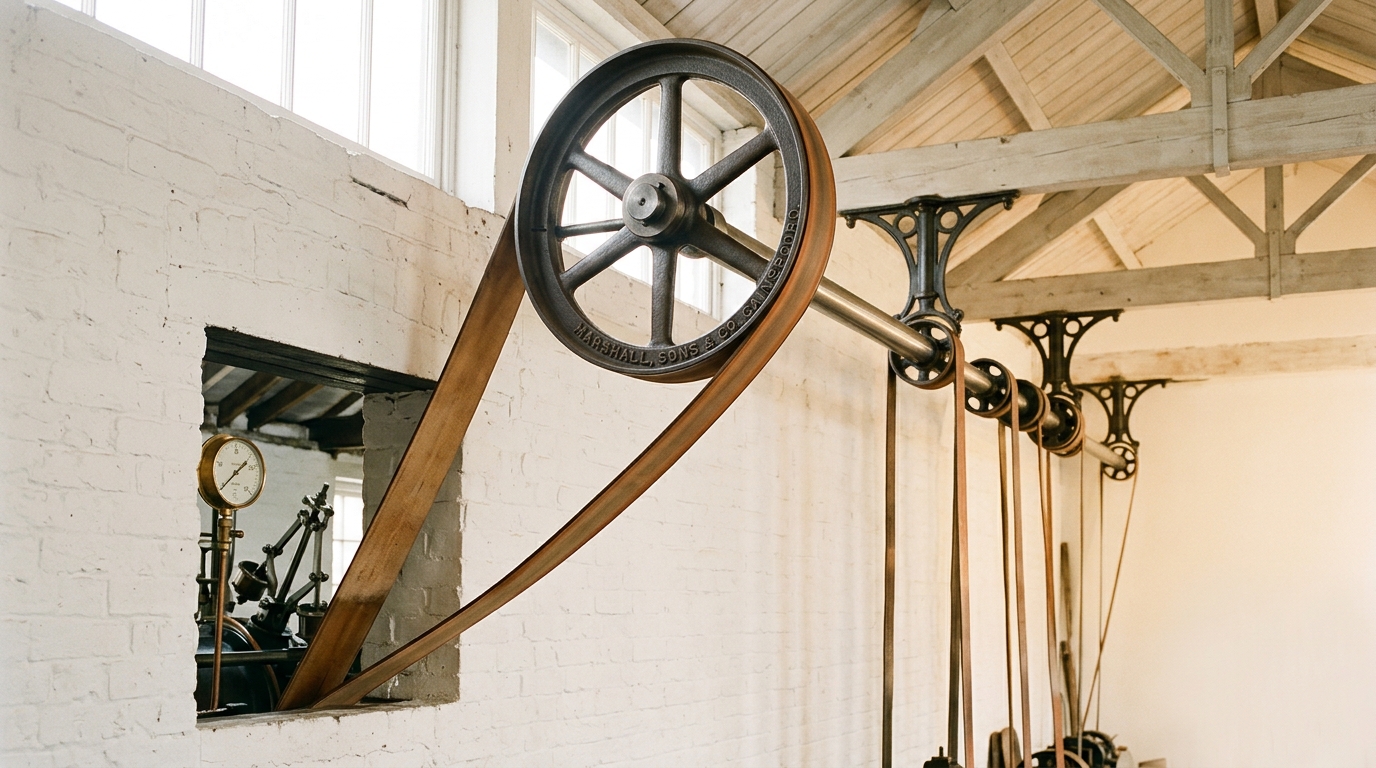
Whatever caused the gathering, the arrangement that followed had a very specific physical form, and that form deserves more attention than it usually gets. Power from a prime mover went first to a main line shaft, a length of polished steel turning continuously on hangers bolted to walls or roof trusses and running the length of the shop. Flat leather belts descended from pulleys on that shaft, often by way of a countershaft that stepped the speed to something a particular machine could use. Each machine took its motion from a belt, and each belt terminated at a pair of pulleys: one keyed to the machine, one running free on the same spindle. A forged fork slid the belt from one to the other. That fork was the entire local control system.
The consequences run further than they first appear. Because power arrived from above along a fixed line, machines had to stand where the shaft was, in rows parallel to it, regardless of the order in which work actually passed between them. Layout was dictated by the transmission, not by the sequence of operations. Because friction losses grow with the length and speed of shafting, there was a strong incentive to keep runs short and to stack them, and Paul David records that the aim of reducing power losses in turning very long line shafts “had dictated the erection of more costly multistory structures” [7]. The multi-storey mill is not an architectural preference. It is a consequence of leather and friction.
Working hours followed the same logic. The shaft turns or it does not; there is no partial state. Every machine in a shop therefore starts and stops on a single decision taken somewhere else, and the working day is defined by when the engine is in steam rather than by when any particular job needs doing. Maintenance obeys the same constraint in reverse: David notes that under the earlier arrangements the entire power system had to be shut down in order to make changes in one department or section of the mill [7]. A repair to one machine could stop a hundred.
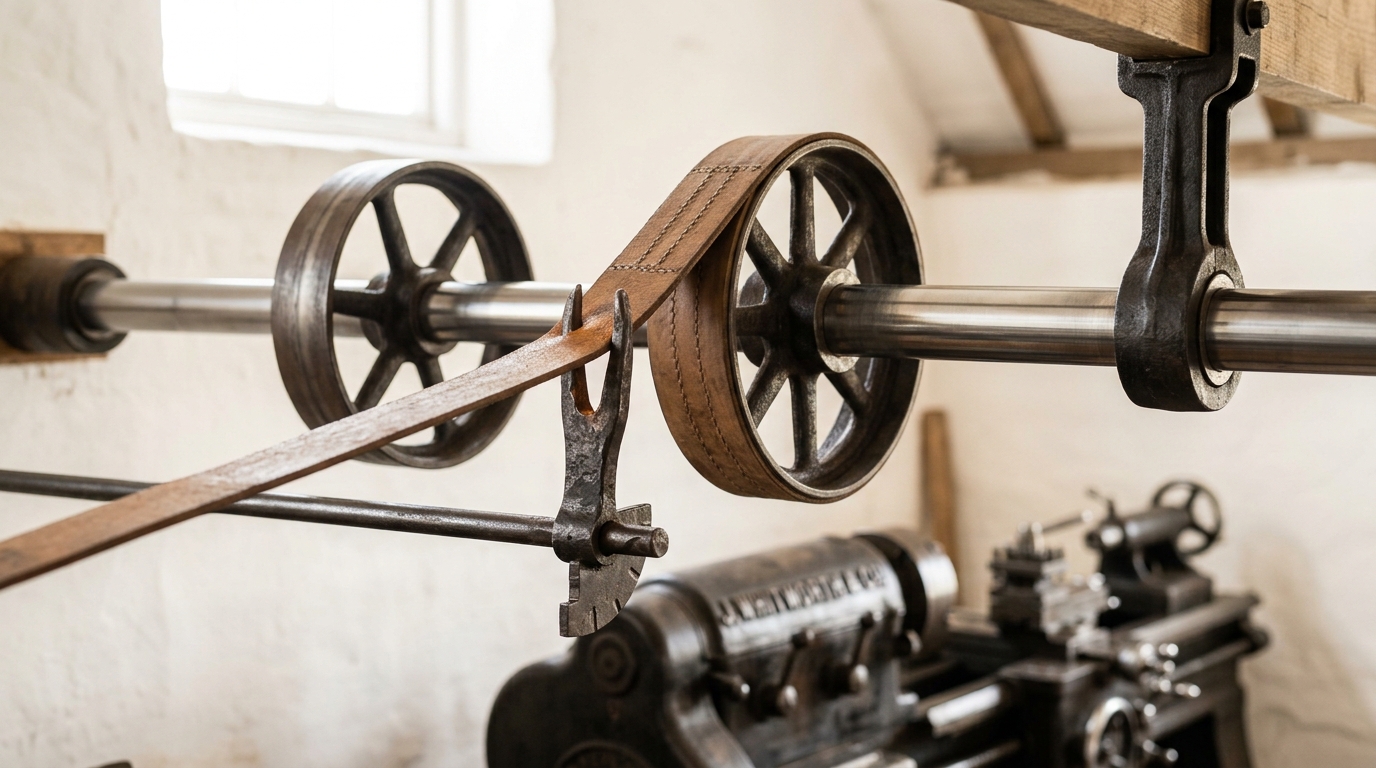
What survives at the level of the individual machine is a single binary: participate or do not. Shift the belt to the loose pulley and the shaft still turns, the shop still runs, and this one machine is idle. That is the whole of the discretion the arrangement leaves in place, and it is a good physical model of what centralised control actually feels like from below. You may opt out. You may not set the pace, the hours or the position of your own machine.
The period engineering literature treats this as ordinary rather than remarkable, which is itself informative — it was the water in which the trade swam. Joseph Wickham Roe, writing in 1916 as a professor of machine design rather than as a historian, took shafting and belting as the unexamined background of every shop he described, and reserved his attention for the tools mounted beneath [13].
What unit drive removed
The electric motor is usually credited with ending this arrangement, and it eventually did, but not quickly and not in the way the credit implies. Warren Devine’s account of the transition describes an evolution between roughly 1880 and 1930 from water and steam prime movers with shaft-and-belt drive toward electric motors driving individual machines, and argues that the important gain was not the reduction in energy needed to turn machinery but the increase in output per unit of capital and labour input [6]. That distinction matters. The first-order saving — not having to keep long shafts turning to run a few machines — was real but modest. The second-order saving came from being allowed to rearrange everything.
The intermediate stage is the revealing one. Early factory electrification largely retained the shafting and substituted an electric motor for the steam engine at the head of it, or divided the shop into sections each with its own motor. David records that this group-drive arrangement remained in vogue in the United States from the mid-1890s to the eve of the 1920s, and that retrofitting steam- or water-powered plants typically meant adding electric motors to the existing stock of equipment rather than replacing the transmission [7]. The motive power changed; the constitution did not. Machines still stood where the shaft was.
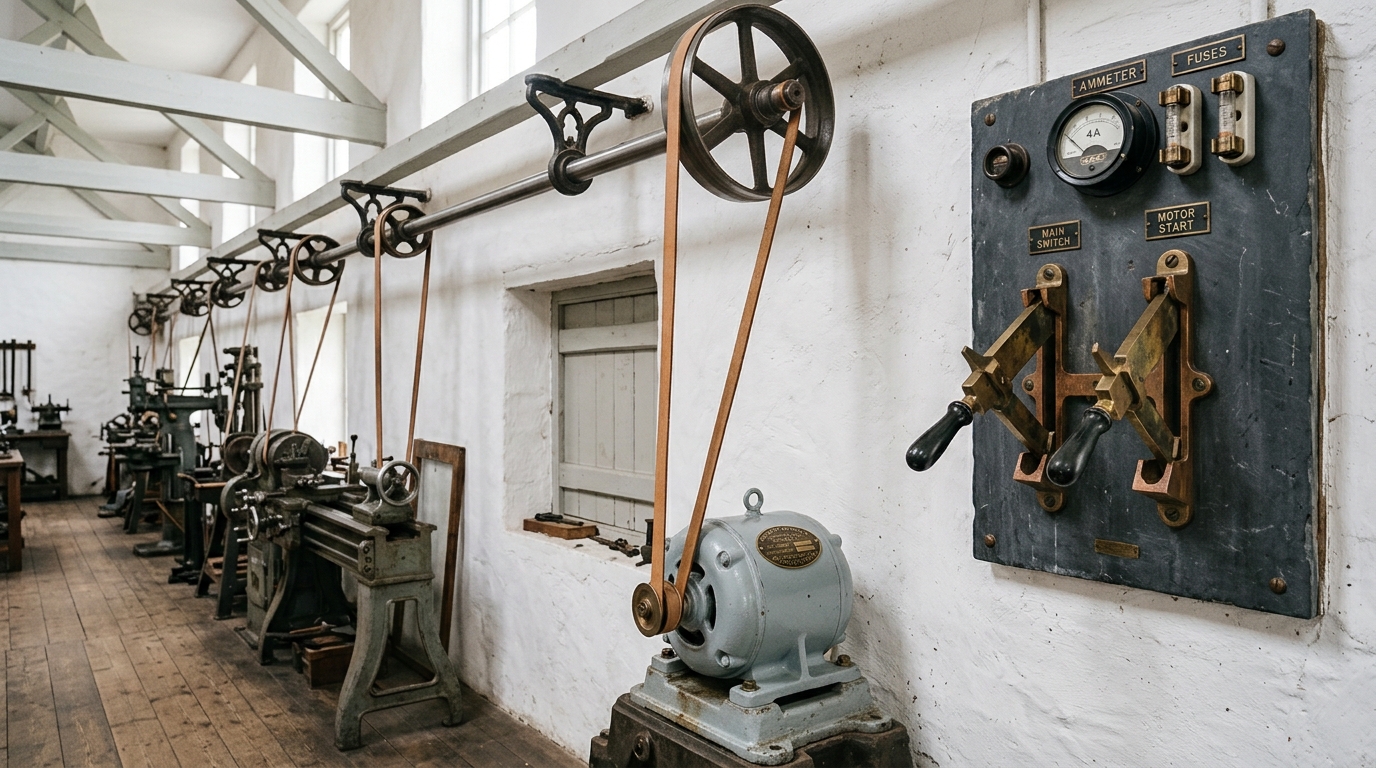
Unit drive — a motor on each machine — removed the constraint rather than easing it, and David enumerates what followed. Factory structures could be redesigned once the bracing needed to carry heavy shafting and overhead belt-housings was dispensed with, which allowed lighter construction; that permitted single-storey buildings, since there was no longer a reason to stack floors to keep shaft runs short; single-storey linear layouts in turn permitted attention to materials handling and flexible reconfiguration of machine placement as products and processes changed; and the modularity of wiring meant the whole power system no longer had to be shut down to alter one section [7].
Read as a control story rather than an energy story, this is a redistribution rather than a release. The start-stop decision returned to the individual machine. Simultaneously, the removal of the physical constraint on layout made it possible to arrange machines in the order in which work actually flowed — which is to say, to impose a sequence on the work that the shaft had previously prevented. The line is only buildable once the shaft is gone.
David’s larger argument is that this is why the productivity gains arrived so late. He records that in 1899 the horsepower capacity of electric motors installed in United States manufacturing establishments represented less than 5 percent of factory mechanical drive, that it took roughly two more decades to reach the 50 percent level, and that factory electrification had no substantial impact on manufacturing productivity growth before the early 1920s — four decades after the first central generating station opened [7]. His explanation is that the binding constraint was the slow accumulation of experienced factory architects and electrical engineers who knew how to design for the new arrangement, not the availability of motors. This is an argument about complementary reorganisation, and it is his interpretation of the lag rather than a measured cause; Devine, working from the engineering side, emphasises the same substitution but frames the payoff in terms of capital and labour productivity rather than diffusion timing [6].
The clock as a coordinating instrument, and as a contested one
A shop that starts together needs a shared account of when together is. E. P. Thompson’s 1967 essay distinguished task-orientation, in which the working day is bounded by the job, from timed labour, in which time is the thing bought and sold. He proposed three things about task-orientation: that it is in a sense more humanly comprehensible than timed labour, since the worker attends to an observed necessity; that communities organised this way show the least demarcation between “work” and “life”; and that to people accustomed to labour timed by the clock, the attitude appears wasteful and lacking in urgency [5].
His evidence for how the transition was actually enforced is unusually concrete, and it predates the factory proper. The Law Book of the Crowley Ironworks, dating from around 1700, required a Monitor and a Warden to keep a time-sheet for each employee entered to the minute. The arithmetic is stated openly: from five to ten is fifteen hours, less one and a half for breakfast and dinner, leaving “thirteen hours and a half neat service”, with further deductions specified for time spent at taverns, alehouses and coffee houses, and for “playing, sleeping, smoaking, singing, reading of news history, quarrelling, contention, disputes or anything forreign to my business, any way loytering” [5].
Crucially, the same document shows that the instrument was understood to be contestable from the beginning. A later addition to the Monitor’s order complains that clerks “have been so unjust as to reckon by clocks going the fastest and the bell ringing before the hour for their going from business, and clocks going too slow and the bell ringing after the hour for their coming to business”, and the Warden was ordered to keep the watch “so locked up that it may not be in the power of any person to alter the same” [5]. Whoever holds the clock holds the definition of the day, and the Crowley works knew it in 1700.

The nineteenth-century testimony Thompson assembles makes the same point from the other side. A Dundee witness reported that clocks at the factories “were often put forward in the morning and back at night, and instead of being instruments for the measurement of time, they were used as cloaks for cheatery and oppression”, adding that a workman known to carry a watch was liable to be dismissed. Another described a mill where the only watch belonged to the master’s son and had been taken into the master’s custody. A witness before Sadler’s Committee described a clock whose minute hand, weighted, dropped three minutes at once as it passed the point of gravity, leaving twenty-seven minutes of a thirty-minute break [5].
Thompson himself did not treat the clock as merely an instrument of exploitation, and it is worth quoting his own caution: he wrote that the changes under examination were “not only changes in manufacturing technique which demand greater synchronization of labour and a greater exactitude in time-routines in any society” but also those changes “as they were lived through in the society of nascent industrial capitalism”, and that he was concerned simultaneously with “time-sense in its technological conditioning” and with “time-measurement as a means of labour exploitation” [5]. Both readings are in the essay. The synchronisation requirement is genuine; so is the fact that whoever owns the measuring instrument owns a lever. His account of what workers eventually did with the new categories is the sharpest sentence in the essay: the first generation were taught the importance of time by their masters, the second formed short-time committees, and the third struck for overtime and time-and-a-half, having “learned their lesson, that time is money, only too well” [5].
Clark’s finding cuts across this in a way worth flagging rather than smoothing over. If discipline worked mainly by raising effort, then the clock is doing something more than synchronising [3]. If synchronisation is the whole story, Clark’s effort premium is hard to explain. The two readings are not formally incompatible — a device can coordinate and intensify at once — but the historians weight them very differently, and the reader should know that.
The gauge: a specification you can hold
Assembly is where the information problem becomes unavoidable. When parts are fitted, a skilled worker holds the tolerance in his hands: he files, tries, files again, and the finished assembly is correct because he made it correct in that instance. Nothing about that process produces a second correct instance, and nothing about it can be transmitted except by apprenticeship.
Assembly by interchange requires the opposite. The acceptability of a part must be decidable by someone who did not design it, did not make it and does not need to understand it — which means the specification has to leave the head of the designer and take up residence in an object. That object is the gauge. A limit gauge does not measure; it decides. It converts a dimensional question into a binary that requires no judgement, no arithmetic and no trade knowledge, and it can be copied and issued to a contractor two hundred miles away.

The American armories are where this was worked out as a system rather than an aspiration. The National Park Service describes Springfield Armory as a leader in the development of interchangeability, in mechanisation and in specialisation in precision manufacturing, and locates the motive in the repair and supply failures experienced during the War of 1812 [14]. The direction of transmission is recorded in the period engineering literature too: Roe notes that England in 1855 imported the Enfield gun machinery from America and adopted what the English themselves styled the “American” interchangeable system of gun making [13].
What the gauge relocates is worth stating exactly. Before, the standard of acceptance lived in a craftsman’s trained judgement, and disputes about a part were disputes between people. After, the standard lives in hardened steel held by an inspection department, and disputes are between a part and a gauge. That is a genuine gain in scale and a genuine loss of standing for the person at the bench, and both are the same event. Interchangeability is not primarily a machining achievement. It is a decision about where a specification is allowed to live.
The scale of the resulting reorganisation of work is visible in the most detailed source available for the period. The United States Bureau of Labor’s Hand and Machine Labor study, published in 1899, paired establishments producing the same specific goods by traditional artisanal methods and by then-modern machine methods, and recorded the individual tasks in each. Atack, Margo and Rhode digitised it, and in setting out its background they quote an illustration from the Commissioner of Labor’s earlier 1886 report to Congress drawn from exactly the industry where armory practice originated: in small arms production, one worker using conventional hand tools turned and fitted one musket stock in a ten-hour day, whereas with specialised machines and the tasks divided between them three workers could turn and fit between 125 and 150 stocks per day — a 40- to 50-fold gain in labour productivity [9].
Their analysis of the task data makes the control point more directly than any productivity figure could. New tasks — operations present under machine production with no counterpart in hand production — made up about one-third of all tasks in machine labour, against roughly 4 percent of hand tasks that disappeared. Many new tasks were tied to the power source, with engineers and firemen accounting for about 15 percent of them. But the more important group of new non-powered tasks, in the authors’ assessment, were those related to monitoring workplace activity and inspecting the finished product — foremen, supervisors, inspectors, examiners, packers and finishers — making up about 20 percent of new tasks and being, in their words, essential to the flow of production and the quality of the product “given that no single worker or group thereof assumed responsibility for the outcome of the production process” [9]. They also report that the median number of tasks per worker fell from two under hand production to one under machine production, describing the division of labour in machine production as virtually complete [9].
That is the mechanism in one paragraph of evidence. Mechanisation did not simply speed work up; it fragmented responsibility to the point where responsibility for the whole had to be re-created as a separate job.
Scientific management: moving method out of the worker
Frederick Winslow Taylor made the relocation explicit and, in his own account, desirable. He described managers assuming “the burden of gathering together all of the traditional knowledge which in the past has been possessed by the workmen and then of classifying, tabulating, and reducing this knowledge to rules, laws, and formulae”, and stated plainly that “in most cases one type of man is needed to plan ahead and an entirely different type to execute the work” [10]. The problem he claimed to be solving was deliberate under-working, which he called “soldiering” and held to be “almost universal in industrial establishments”; his claimed remedy was a system in which workers’ initiative “is obtained with absolute uniformity” while “the managers assume new burdens, new duties, and responsibilities never dreamed of in the past” [10].

Those are Taylor’s assertions about his own system, and should be read as such. They are a sales case as much as an analysis, and the historical record on adoption is more modest than the case implies. Daniel Nelson’s account places scientific management as a refinement of the earlier systematic management movement rather than a break with it, describing it as an answer to the problems of factory coordination, and finds that firms typically installed selected elements rather than the whole system [12].
The contemporary criticism was official and specific. Robert Hoxie, investigating for the United States Commission on Industrial Relations, recorded organised labour’s objections in numbered form: that the system “tends to gather up and transfer to the management all the traditional knowledge, the judgment and the skill of the workers”; that it “deprives the worker of the opportunity learning a trade” and “tends to destroy his individuality and inventive genius”; and that it is unscientific in its determination of tasks and “furnishes no just or scientific basis for calculating the wage rate” [11]. Hoxie’s own assessment was that the system “deals with human beings as it does with inanimate machines”, and that its ideal of instruction in particular specialised tasks was ill-calculated to develop workers [11].
Two things should be said fairly. Hoxie was reporting for a commission created amid industrial conflict, and his brief was labour’s relationship to the system, so the report is an inquiry with a standpoint rather than a neutral audit. And Nelson finds that opposition often targeted particular features — time study and incentive wage plans especially — rather than the system entire, and that documented disputes at Sayles Bleachery, Mare Island and Watertown Arsenal followed reforms that were, on the evidence, improperly applied [12]. Note also that the first objection labour raised is a precise restatement of Taylor’s first claim. Both sides agreed about what the system did. They disagreed about whether it was a benefit.
Control relocated, not simply increased
Read in sequence, the mechanisms describe one repeated move. Gathering work under one roof relocated the decision about pace from the household to the shop, whichever of the four explanations one prefers for why it happened. The line shaft relocated the decision to start and stop from the machine to the engine house and left a single binary — participate or do not — at the bench. The clock relocated the definition of the working day into an instrument, and the Crowley Ironworks locked that instrument in a case because it understood exactly what it had built. The gauge relocated the decision about whether a part is acceptable out of a craftsman’s judgement and into an artifact that an inspector could apply without the craft. Scientific management relocated method itself, and said so.
Output rose at most of these steps, sometimes enormously. But output is the visible consequence, not the mechanism, and treating it as the mechanism produces a history in which the factory is a machine that got bigger. The mechanism is a series of decisions about where knowledge and authority are allowed to live, each of which had to be built out of physical material — a fork, a bell, a locked case, a piece of hardened steel, a printed card — because in that era there was no other way to make a decision stay put.
Unit drive is the useful counter-example, because it runs the other way and shows the pattern is not a one-directional ratchet. Giving each machine its own motor returned genuine local control over starting and stopping. It also, by removing the constraint that had fixed machine positions, made it possible to impose a production sequence that the shaft had prevented. Control moved. It did not simply loosen.
What the pattern does and does not license
Three separations are worth stating explicitly, because the temptation to collapse them is strong.
The factual claims here are narrow: the physical description of shafted transmission and its layout consequences; the diffusion figures David reports; the task-transition proportions Atack, Margo and Rhode compute; the wording of the Crowley orders and the Dundee testimony; and Taylor’s and Hoxie’s own sentences. Each is attributed above.
The analytical claim — that these episodes are better described as relocations of control than as increases in output — is mine, and it is an interpretive frame rather than a finding. It is compatible with all four explanations of the factory’s origin, which is a point in its favour as description and against it as an explanation, since a frame consistent with every rival account discriminates between none of them.
The prediction is deliberately small. Horizon: through 2032. Claim: in work coordinated by scheduling, routing and quality-inspection software, the observable trend will be a continued increase in the share of roles whose primary output is monitoring or verification rather than production, mirroring the roughly one-fifth of newly created tasks that Atack, Margo and Rhode found devoted to supervision and inspection in the 1899 data [9]. Assumptions: that the automation of production tasks continues to outpace the automation of verification, and that liability continues to require an identifiable human accepting an output. Observable indicators: occupational classification data showing growth in inspection, audit, compliance and review categories relative to direct production categories within the same industries. Disconfirmation: if verification roles decline as a share of employment in industries with rising automation intensity over a sustained period — say five consecutive years — while production output holds, the claim fails and the correct conclusion is that automated verification is substituting for human acceptance rather than complementing it.
The nineteenth-century record does not settle any of that. What it does is warn against a specific error: reading a change in tooling as if it were only a change in throughput. The factory debate has lasted fifty years precisely because the participants understood that the interesting variable was never how much came out of the building. It was who inside it was still permitted to decide.