The Anatomy of an Academic Orthodoxy
In September 2023, a research team led by scholars from Harvard Business School released a field experiment that rapidly became the definitive empirical foundation for corporate artificial intelligence strategy [1]. Conducted with 758 management consultants from the Boston Consulting Group, the study examined performance across eighteen realistic business tasks using OpenAI’s GPT-4. The authors reported two striking and seemingly contradictory findings that captured executive imagination:
- Inside the Frontier: For tasks falling within the model’s capabilities (such as creative ideation, marketing strategy, and product positioning), consultants using artificial intelligence completed tasks 25.1% faster and produced output rated over 40% higher in quality compared to a control group. Furthermore, consultants scoring in the bottom quartile of baseline ability experienced the largest performance jump (43%), leading the authors to describe generative models as an unprecedented “skill leveler.”
- Outside the Frontier: For a single analytical task engineered to lie beyond the model’s raw capabilities—a business problem involving nuanced company data designed with a subtle trap that the base model misinterpreted—consultants using artificial intelligence were 19 percentage points less likely to produce a correct solution than colleagues working without the tool. The authors noted that participants experienced a cognitive failure mode they termed “falling asleep at the wheel,” uncritically adopting the model’s fluent but flawed recommendations.
From these observations, the authors formulated the thesis of the “jagged technological frontier”: an unpredictable, irregular boundary where tasks of seemingly equivalent complexity are handled with effortless mastery on one side and catastrophic failure on the other, defying intuitive human heuristics about what is easy or difficult.

This conceptual framing has since been cited hundreds of times across organizational economics, management science, and enterprise technology roadmaps. It is treated as an immutable law of machine capability: that artificial intelligence is fundamentally a black-box oracle with an invisible, jagged edge, requiring knowledge workers to navigate an unpredictable minefield of automated brilliance and automated delusion.
That thesis is methodologically flawed. By treating raw, zero-shot conversational chat prompting as a proxy for artificial intelligence capabilities, the Harvard experiment conflated un-scaffolded interface latency with structural model limits. When examined through the rigorous lenses of control systems engineering, declarative agent architectures, cognitive psychology, and macroeconomic task models, the “jagged frontier” is revealed not as a property of frontier intelligence, but as an artifact of an impoverished experimental setup.
The Scaffolding Fallacy: Raw Chat vs Closed-Loop Systems
The central architectural defect of the Harvard study lies in its experimental treatment. The 758 consultants were provided with direct access to a standard, un-scaffolded ChatGPT-4 conversational interface—a bare chat window accepting unstructured natural language prompts and returning free-form text.
In software engineering and systems architecture, evaluating a base foundation model through a raw chat interface is equivalent to benchmarking the computational performance of a raw semiconductor die without a memory controller, cache hierarchy, or operating system scheduler. A transformer checkpoint is an unconstrained probabilistic distribution over next-token completions; it possesses no internal state verification, no deterministic execution sandbox, and no mechanism for iterative back-propagation against external ground truth [5].
When a knowledge worker asks a bare conversational model to analyze a multi-variable spreadsheet with interdependent business constraints, the model must perform several disjoint cognitive operations within a single autoregressive forward pass:
Because token generation is strictly left-to-right and causal, any early latent error in intermediate arithmetic or structural interpretation compounds multiplicatively across subsequent tokens. If the prompt lacks an explicit scratchpad, state harness, or programmatic tool-execution loop, the model cannot pause, verify an invariant, execute a deterministic calculation, or revise an earlier premise [6, 7].
The Declarative Alternative
Researchers at Stanford and Princeton have demonstrated that task capability boundaries are primarily functions of system-level scaffolding, rather than raw parameter weights. Khattab and colleagues introduced DSPy, showing that when declarative task constraints, assertion modules, and automated prompt-optimization pipelines are compiled around a foundation model, complex multi-hop reasoning tasks that routinely fail in raw chat achieve high reliability and error recovery [5].
Similarly, the ReAct framework developed by Yao and colleagues at Princeton and Google demonstrates that interleaving reasoning traces with external execution actions (such as querying an API, executing Python code in a sandboxed interpreter, or retrieving verified database records) transforms the error surface [6]. Consider the multi-step failure task in the Harvard BCG study: a brand performance evaluation across different business units where financial figures were distributed across text and tables. When this class of problem is routed through a tool-augmented harness (such as Toolformer or an agentic code execution sandbox), the probability of arithmetic hallucination drops to zero because the calculation is delegated to a deterministic runtime [7]:
By restricting their experimental subjects to a bare conversational interface and forbidding or omitting structured agentic harnesses, Dell’Acqua and colleagues did not measure the boundary of what artificial intelligence can accomplish in knowledge work. They measured the boundary of zero-shot conversational ergonomics. Defining an immutable “jagged frontier” from an un-scaffolded chat experiment is equivalent to declaring that internal combustion engines cannot cross oceans while testing them strictly inside automobiles rather than aircraft.
Automation Bias as an Open-Loop Control Failure
The most widely sensationalized behavioral finding in the Harvard study is that consultants “fell asleep at the wheel”—blindly accepting incorrect recommendations on tasks outside the perceived frontier, resulting in a 19% quality deficit. The authors interpreted this as an intrinsic human psychological vulnerability: that the overwhelming fluency and authoritative tone of generative outputs induce cognitive complacency in professional workers [1].
This psychological explanation misdiagnoses a classic control systems failure. In 2000, Parasuraman, Sheridan, and Wickens published their foundational framework on human interaction with automation, defining four stages of automated processing: (1) information acquisition, (2) information analysis, (3) decision selection, and (4) action implementation [8]. A central axiom of human-machine systems engineering is that automation complacency is not an unprovoked moral or cognitive failure of the human operator; it is the predictable consequence of an open-loop interface with zero observability and uncalibrated confidence presentation.

When a conversational model produces an output, it presents text with uniform typographical certainty. A fabricated financial figure is rendered in the exact same typeface, cadence, and syntactic structure as an empirically verified quotation. The interface provides the human operator with:
- Zero calibrated confidence intervals (e.g., token log-probability distributions or ensemble variance).
- Zero explicit provenance links back to source data cells.
- Zero visible execution traces or disconfirmation checks.
In classical supervisory control theory, when an automated subsystem provides high apparent reliability across simple tasks but supplies no diagnostic instrumentation during failure states, human operators naturally calibrate their monitoring frequency to the average success rate rather than the worst-case tail risk [8]. The human is forced to act as an open-loop filter over an un-instrumented stream.
When systems engineers close the control loop—by introducing calibrated error indicators, verifiable citation spans, explicit disconfirmation steps, and structured human-in-the-loop validation gates—the “falling asleep” pathology is largely mitigated. Treating user reliance on conversational fluency as an inherent flaw in human nature, rather than a catastrophic failure of interface telemetry, shields poor product design behind a veneer of behavioral mystery.
The “Skill Leveling” Illusion and Long-Horizon Cognitive Deskilling
A secondary claim of the Harvard BCG experiment—echoed in separate studies by Noy & Zhang at MIT and Brynjolfsson, Li, & Raymond at Stanford—is that generative systems act as an egalitarian “skill leveler,” providing massive performance gains to bottom-quartile workers while offering modest increments to top-tier performers [3, 4].
While this equalizing effect is empirically real in short-horizon laboratory trials, celebrating it as unambiguous democratization overlooks a fundamental distinction in cognitive science and epistemology: the separation between syntactic fluency and semantic grounding [9].

In the Harvard experiment, task quality was evaluated using subjective rubrics scored by human graders assessing writing clarity, persuasiveness, logical structure, and creative breadth. On these specific dimensions, generative language models excel at synthesizing standard corporate rhetoric, framing arguments with polished syntax, and organizing ideas into structured bullet points. A junior or less capable consultant who struggles with professional business writing receives an immediate boost from an automated draft:
When grading rubrics heavily weight surface fluency and coherence (
1. The Erosion of the Generation Effect
Cognitive psychologists have long established the “generation effect” (Roediger & Karpicke, 2006): active retrieval, formulation, and manual assembly of knowledge produce durable mental models, whereas passive consumption or minor editing of pre-fabricated text produces rapid cognitive decay [10]. By delegating the initial synthesis and conceptual structuring to an automated system, junior workers bypass the essential friction required to develop deep domain expertise. They become proficient editors of synthetic drafts without developing the underlying diagnostic intuition necessary to catch catastrophic hallucinations.
2. The Illusion of Equalized Capability
In high-stakes professional environments (such as semiconductor design, clinical medicine, or legal contract structuring), the value of work is determined not by median fluency, but by the absence of fatal tail-risk errors. A junior practitioner who generates an articulate, impeccably formatted memorandum containing a subtle regulatory omission appears “leveled” to an external reviewer until the error triggers systemic liability. True domain mastery consists of knowing what cannot be true—an epistemic capability that synthetic text generators actively obscure by producing plausible falsehoods with identical confidence.
From Vignettes to Value: The Macroeconomic Aggregation Error
Beyond its micro-level interface limitations, the Harvard study commits a significant macroeconomic aggregation error: extrapolating task-level speedups on isolated consulting vignettes into broad projections of firm-level and economy-wide productivity growth.
In his 2024 treatise The Simple Macroeconomics of AI, MIT economist Daron Acemoglu establishes a formal task-based framework to analyze how microeconomic automation effects aggregate to Total Factor Productivity (TFP) and Gross Domestic Product (GDP) [2, 11]. Acemoglu demonstrates that the economic impact of artificial intelligence is fundamentally constrained by task non-separability, verification overhead, and capital share elasticity.

Let total output
where each task
where
The Three Aggregation Breakdowns
When applied to the Harvard BCG findings, Acemoglu’s macroeconomic framework reveals why the study’s 40% performance gains cannot be translated linearly into organizational throughput:
- Modular Task Selection Bias: The eighteen tasks evaluated in the BCG trial were explicitly selected for modularity—self-contained writing and ideation exercises that could be initiated and completed in under two hours without dependencies on existing corporate enterprise databases, multi-stakeholder approval chains, or physical regulatory constraints. In real-world knowledge work, modular drafting represents less than 20% of an enterprise worker’s total time (
↗). - The Verification Cost Burden: When artificial intelligence is introduced into a workflow without automated verification harnesses, the human time saved during initial drafting is frequently consumed downstream by verification and auditing costs. If verifying an un-instrumented model output requires detailed cross-referencing against primary documentation, the net unit cost savings
↗ shrinks dramatically or turns negative: ↗ - Task Interdependence and Bottleneck Shifts: Production pipelines operate as serial dependencies. Accelerating a single creative task by 40% does not increase organizational throughput if the downstream regulatory compliance, security clearance, or legal approval stages remain manual bottlenecks. Under Leontief-type task dependencies (
↗), the throughput of the system is governed entirely by the slowest non-automated component.
Using rigorous baseline accounting across the United States economy, Acemoglu estimates that generative artificial intelligence will affect no more than 4.6% of total tasks over a ten-year horizon, producing an aggregate TFP increase of less than 0.71% cumulatively over a decade (approximately 0.07% annually) [2]. The breathless projections of 40% corporate workforce expansion derived from micro-task consulting studies collapse when subjected to rigorous general-equilibrium accounting.
The Closed-Loop Systems Paradigm
To move beyond the flawed paradigm of the “jagged frontier,” organizations must transition from conversational interaction models to closed-loop, scaffolded agent architectures.
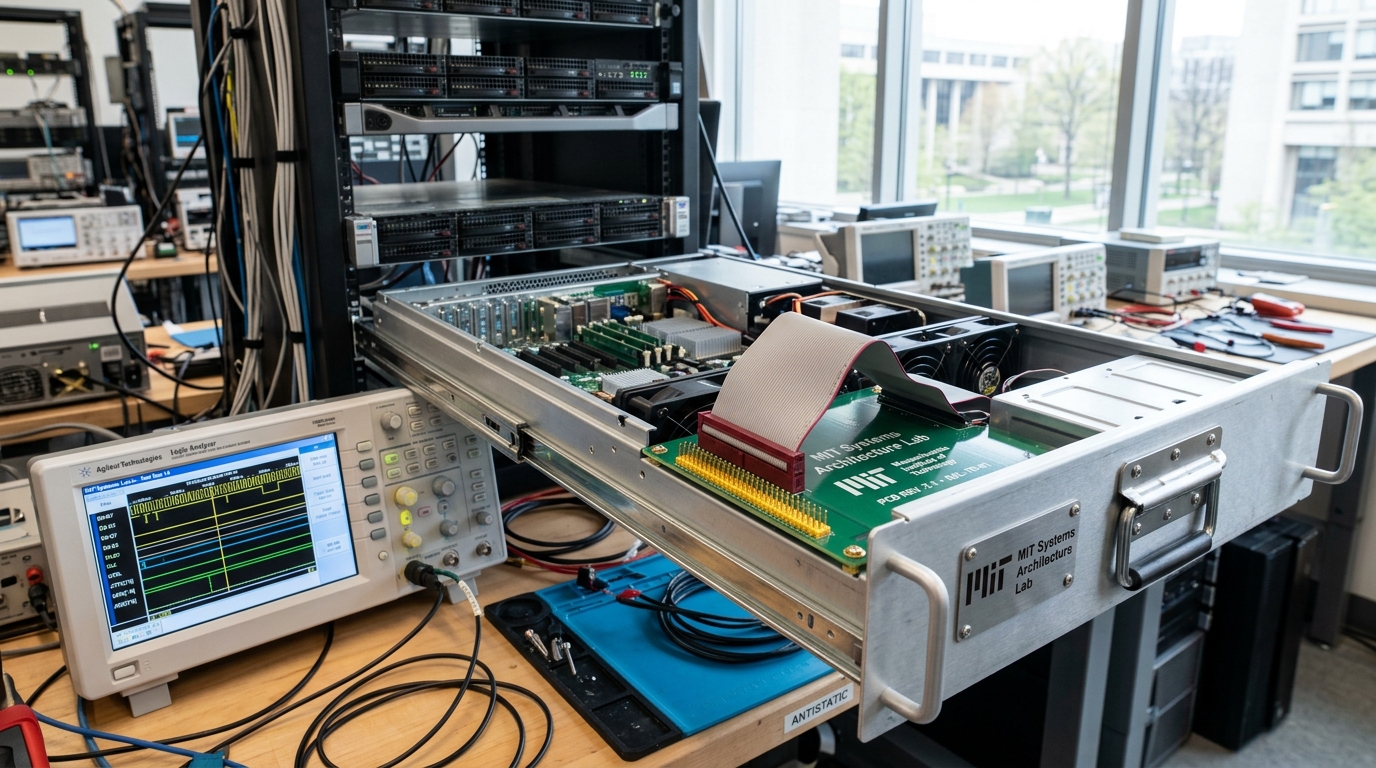
A production-grade knowledge-work system does not present an unconstrained conversational chat box to a human worker and hope they avoid the “jagged edge.” Instead, it enforces a structured architectural contract characterized by four deterministic engineering layers:
| Layer | Functional Mechanism | Failure Mode Prevented | Key Academic Reference |
|---|---|---|---|
| 1. Declarative Task Scaffolding | Structured input/output typing, explicit multi-step sub-goal decomposition, and deterministic orchestration pipelines | Eliminates arithmetic hallucination and unconstrained forward-pass error compounding | Khattab et al. (Stanford, 2023) [5] |
| 2. Sandboxed Tool Execution | Dynamic delegation of numerical computation, code verification, and database queries to external deterministic runtimes | Replaces probabilistic approximations with verifiable factual execution | Schick et al. (Meta/MIT, 2023) [7]; Yao et al. (Princeton, 2023) [6] |
| 3. Observable Interface Telemetry | Explicit exposure of confidence distributions, provenance grounding spans, and disconfirmation indicators | Eliminates open-loop automation complacency (“falling asleep at the wheel”) | Parasuraman, Sheridan, & Wickens (MIT/IEEE, 2000) [8] |
| 4. Human Verification Gates | Explicit asynchronous sign-off protocols placed strictly at state-transition boundaries rather than in drafting loops | Preserves human mental models, ensures accountability, and isolates liability | Brynjolfsson et al. (Stanford, 2025) [4] |
Falsifiable Predictions for the Enterprise AI Lifecycle
To maintain strict epistemic rigor, this critique establishes four concrete, dated predictions concerning the evolution of knowledge-work automation, complete with observable metrics and explicit disconfirmation conditions.
Prediction 1: The Obsolescence of Raw Chat Interfaces in Enterprise Knowledge Work
- Horizon: By December 31, 2027.
- Assertion: In Global 2000 enterprise environments, over 80% of automated knowledge-work value will be generated through structured, declarative agent harnesses and API pipelines rather than un-scaffolded, conversational chat windows.
- Observable Metric: Enterprise software procurement share and telemetry data tracking API-based agent execution volume versus interactive web-chat seats.
- Disconfirmation Condition: If standalone, unstructured conversational chat subscriptions continue to represent the primary mode of corporate generative AI spend and usage in 2028, this prediction is falsified.
Prediction 2: Macroeconomic TFP Realization
- Horizon: By December 31, 2030.
- Assertion: The measured cumulative contribution of generative artificial intelligence to United States Total Factor Productivity (TFP) growth will not exceed 1.0% over the 2024–2030 period, confirming Acemoglu’s task-elasticity bounds over optimistic corporate forecasts.
- Observable Metric: Bureau of Labor Statistics (BLS) multi-factor productivity releases and empirical economic growth accounting literature.
- Disconfirmation Condition: If verified United States non-farm business TFP grows at an annualized rate exceeding 2.5% over the 2024–2030 period with econometric attribution assigning >1.5 percentage points to generative AI adoption, this prediction is falsified.
Prediction 3: The Verification-Cost Inflection in Junior Professional Hiring
- Horizon: By December 31, 2028.
- Assertion: Professional service firms (management consulting, corporate law, auditing) that deploy generative drafting without automated verification harnesses will experience an increase in senior review hours per deliverable, leading to structural revisions in billing models.
- Observable Metric: Ratio of senior partner/manager review hours to junior analyst production hours in major audit and consulting firms.
- Disconfirmation Condition: If senior review hours per deliverable decline by >20% across firms deploying un-scaffolded AI tools while maintaining constant or improved error/liability rates, this prediction is falsified.
Prediction 4: The Eradication of the Synthetic “Jagged Drop” via Scaffolding
- Horizon: By June 30, 2027.
- Assertion: The 19-percentage-point performance deficit observed in the Harvard BCG study on outside-the-frontier analytical tasks will fall below 3 percentage points when the identical tasks are re-tested with identical base models wrapped in declarative agent harnesses (such as DSPy or ReAct tool pipelines).
- Observable Metric: Replicated randomized controlled trial benchmark accuracy comparing raw GPT-4 chat against scaffolded GPT-4 on the original BCG financial analysis test suite.
- Disconfirmation Condition: If a scaffolded agent harness utilizing Python code interpretation and structured state verification fails to achieve parity with or superiority over the unassisted human control group on the BCG test task, this prediction is falsified.
Engineering Beyond the Metaphor
The “jagged technological frontier” was an evocative metaphor for the bewildering early encounters between corporate professionals and unconstrained conversational models. But as an analytical framework for understanding the future of knowledge work, it is obsolete.
By mistaking the awkward ergonomics of conversational text interfaces for the fundamental boundaries of artificial intelligence, the Harvard Business School study obscured the real engineering challenge of our era. The challenge facing enterprise technology is not how to train humans to tiptoe around an unpredictable black-box oracle. It is how to build rigorous, deterministic, and observable control systems that harness probabilistic intelligence without inheriting its unconstrained frailties [9, 5].
When knowledge systems are engineered with declarative scaffolding, sandboxed tool execution, observable telemetry, and formal verification gates, the jagged frontier disappears. In its place emerges what engineering has always sought to build: reliable, predictable, and verifiable instruments of human leverage.