Why four channels and not one forecast
Most public writing about frontier model systems in 2035 is a single-track prediction wearing the costume of analysis. It picks a mechanism it finds congenial — indefinite scaling, an energy wall, an agent explosion, a plateau — and then reads the present as evidence for it. The method has an obvious defect: the mechanisms are not mutually exclusive, and the evidence available in 2026 does not discriminate between them.
Scenario analysis is the honest alternative, and it has a strict form. You identify the smallest number of drivers that are both highly consequential and genuinely uncertain, you cross them, you name the mechanism that produces each cell, and — the part usually omitted — you commit in advance to the observations that would tell you which cell you are in, and to the observations that would kill each cell outright. Done properly it produces no favourite. That is not evasion; it is the output.
This article uses two axes.
Axis A — where the next increment of capability is bought. At one end, gains continue to come chiefly from enlarging pretraining runs: more parameters, more tokens, more training FLOP. At the other, gains come chiefly from post-training and from computation spent at inference time on each individual request.
Axis B — whether the physical constraints on serving bind harder or are relieved. The constraints in question are three: memory bandwidth relative to arithmetic throughput, energy per useful operation, and delivered grid power at the sites where machines are actually installed.
The four cells are four different worlds. Before building them, the documented present has to be set out, because the axes are only defensible if the uncertainty on each is real.
The documented present
Fact. Training compute for frontier systems has grown at rates far above any hardware trend. Sevilla and colleagues characterised three eras and put the deep-learning-era doubling time at roughly six months, with a further discontinuity around 2015 as large-scale efforts began [6]. Epoch AI’s tracking reports frontier language-model training compute growing at about 5× per year since 2020, a doubling time near five months [2].
Fact. The returns on that compute are governed by a power law with an irreducible floor. Kaplan and colleagues established the functional form across more than seven orders of magnitude [3]; Hoffmann and colleagues corrected the allocation, showing that at fixed training compute, parameters and tokens should scale roughly in proportion, and that models of the era were substantially undertrained [4]. Doubling a budget buys a decrement in loss, not a doubling of capability.
Fact. The token supply that fed this is finite in a way the compute supply is not. Villalobos and colleagues project that models will be trained on datasets roughly equal to the stock of public human text between 2026 and 2032, and earlier under heavy overtraining [5]. This is a projection with wide error bars, not a hard date, and the authors name synthetic data, transfer, and data efficiency as the routes around it.
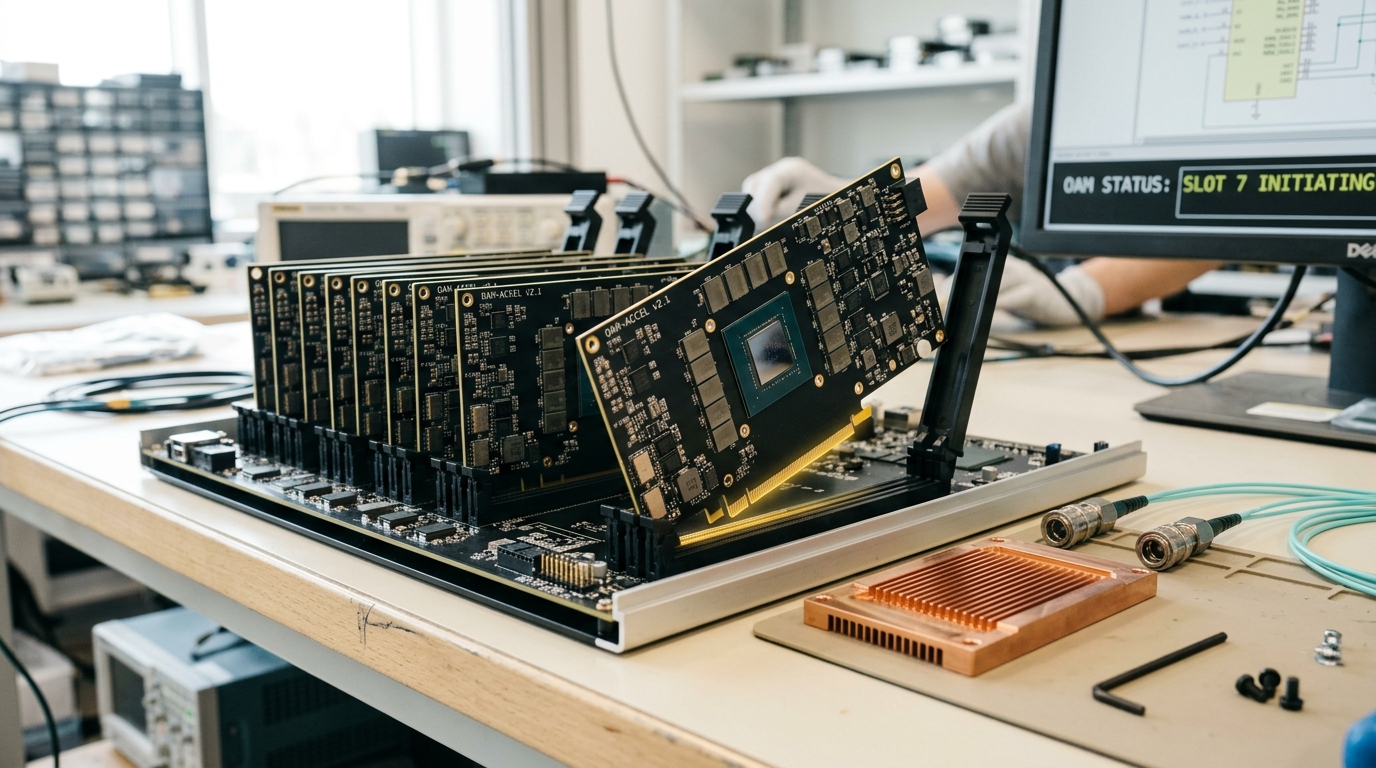
Fact. Hardware has not scaled uniformly. Gholami and colleagues report that over roughly two decades, peak server hardware FLOP/s scaled at 3.0× every two years while DRAM bandwidth scaled at 1.6× and interconnect bandwidth at 1.4× over the same period [1]. Epoch’s independent series puts GPU memory bandwidth growth near 1.28× per year since 2008 against a performance-per-dollar improvement near 1.37× per year [2]. The two series disagree on magnitude and agree on sign: arithmetic has outrun memory movement for twenty years.
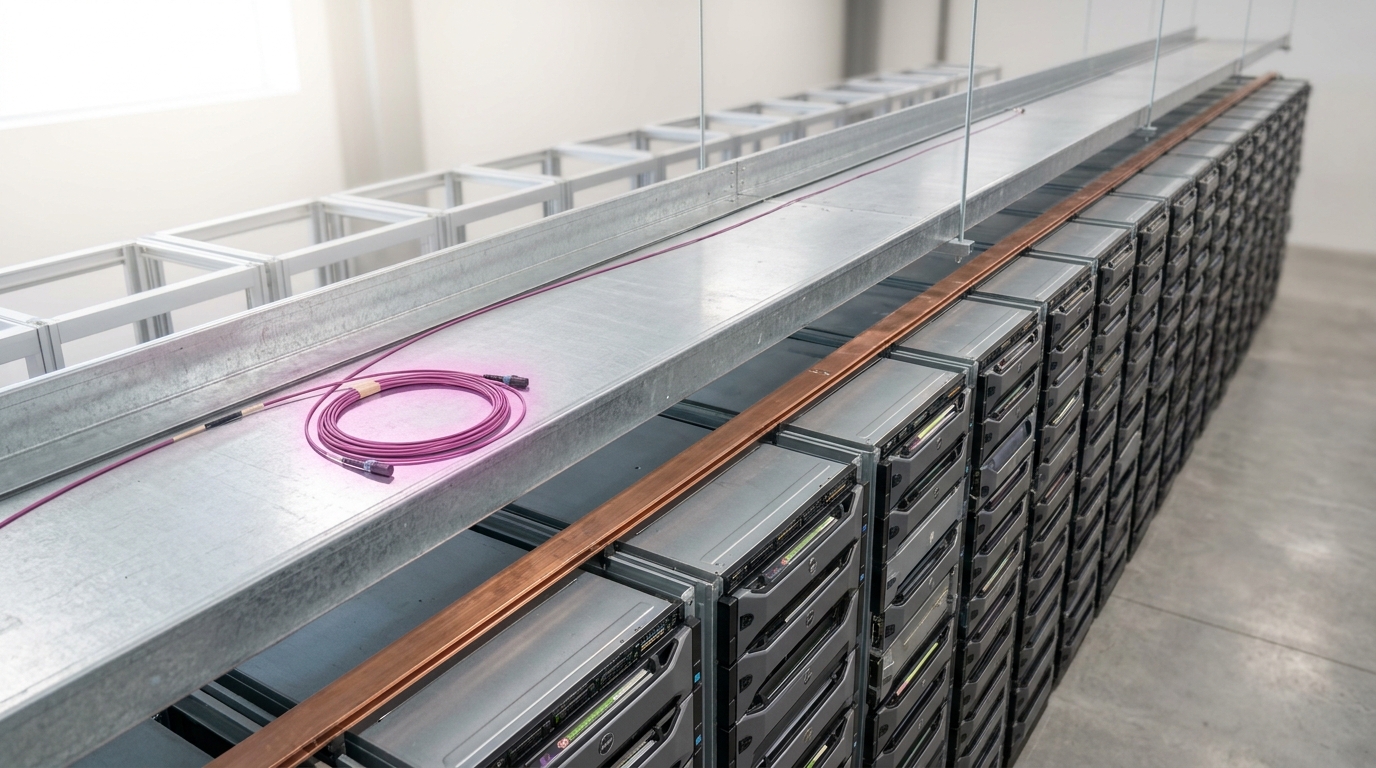
Write
with
where
Fact. Inference-time computation is a second scaling axis with its own measured returns. Snell and colleagues showed that allocating test-time compute according to prompt difficulty beats uniform allocation by more than 4× in efficiency, and that on problems where a smaller base model has non-trivial success rates, test-time compute can outperform a 14× larger model at matched budget [7]. The peer-reviewed demonstration that long deliberation is a trainable policy rather than a prompting trick comes from the DeepSeek-R1 work in Nature, which showed reasoning behaviour emerging from reinforcement learning on verifiable tasks without human-annotated traces [8].
Fact. Per-request compute is now a caller-set parameter, across vendors. OpenAI’s model guidance documents a reasoning_effort control taking none, low, medium, high, xhigh and max, alongside a named family in which gpt-5.6-sol, gpt-5.6-terra and gpt-5.6-luna occupy different capability-per-cost points [9]. Anthropic’s documentation records the same idea in two successive forms: a manual thinking.budget_tokens budget with a 1,024-token minimum, now deprecated on newer models in favour of an adaptive mode whose depth is set by an output_config.effort field [11]. The GPT-5 system card describes a routed system rather than a model — a fast model, a deeper reasoning model, and a real-time router choosing between them [10]. That routing description is a vendor assertion about internal architecture; the API parameters are directly checkable.
Fact. Electricity is now a named constraint with published numbers. The IEA reports data centres at roughly 415 TWh in 2024, about 1.5% of world electricity, projected to more than double to around 945 TWh by 2030, and states that around 20% of planned data centre projects are at risk of delay from grid strain, with transmission lines taking four to eight years to build in developed economies and wait times for transformers and cables having doubled in three years [16]. The U.S. Department of Energy, publishing Berkeley Lab’s assessment, put U.S. data centre consumption at 176 TWh in 2023 — about 4.4% of national electricity — with a 2028 range of 325 to 580 TWh, or 6.7% to 12% [17].
Fact. Relief on the memory axis is being engineered and is partly scheduled. The HBM4 standard released in April 2025 specifies up to 8 Gb/s across a 2048-bit interface for up to 2 TB/s per stack, doubling the independent channels per stack relative to HBM3 [18]. Whether the relief keeps pace with
Arguing for the axes
Analysis. An axis earns its place by being consequential and uncertain. Both here are.
Axis A is consequential because the two ends imply different cost structures, different industrial concentration, and different failure modes. Pretraining-led progress puts almost all cost in a capital event and almost none in the marginal request; deliberation-led progress inverts that, moving cost onto every request and making capability a purchased quantity rather than a fixed endowment. Axis A is uncertain because the evidence points both ways at once: the scaling laws have not been shown to break [3, 4], and the inference-time results are strong but bounded to regimes where a verifier exists and the base model already has non-trivial success probability [7].
Axis B is consequential because it decides whether the compute implied by either end of Axis A can actually be installed and powered. It is uncertain because the trends point in opposite directions: the twenty-year divergence between arithmetic and bandwidth is documented [1, 2], while HBM4 and the serving-software stack represent real, shipped relief [18, 13], and the grid picture contains both large projected demand and named, dated mitigation paths [16].
They are only partly independent, and the coupling must be stated. Three linkages matter. First, the two ends of Axis A load the machine differently: large training runs are dense matrix-multiplication workloads with high arithmetic intensity that sit comfortably on the compute-bound side of
The correct statement is that the axes are partly independent: knowing one constrains but does not determine the other. That is precisely the condition under which a two-by-two is informative rather than decorative.

Scenario A — Wide Channel: scaling continues, constraints relieved
Mechanism. Bandwidth growth reaccelerates as HBM4 and successors ship in volume, packaging and interconnect improvements land, and power procurement keeps roughly to the upper mitigation paths in the published projections. The data ceiling is pushed back by synthetic generation and data efficiency, as Villalobos and colleagues nominate [5]. Pretraining-scale gains keep arriving because nothing stops them arriving; deliberation exists but remains a modest supplement. By 2035 the frontier is a small number of very large models, cheap to serve relative to their size, and capability is again close to a property of the checkpoint.
Leading indicators before 2030. (1) Published accelerator generations in which the ratio of memory bandwidth to peak dense throughput stops falling for two consecutive generations. (2) Frontier training-compute growth holding near the 5×-per-year rate that Epoch reports, past 2028 [2]. (3) Price-per-token at fixed reasoning effort falling faster than price-per-unit-of-deliberation, indicating that gains are landing on the weights side rather than the thinking side.
Disconfirmation. This scenario is dead if, before 2030, two consecutive frontier generations ship with training compute growth below roughly 2× per year and headline capability gains in their own system cards attributed chiefly to post-training or inference-time methods.
Scenario B — Narrow Race: scaling continues, constraints bind
Mechanism. The scaling relationship keeps paying, but the physical envelope does not widen to meet it. The arithmetic-to-bandwidth divergence Gholami and colleagues document continues at roughly its historical rate [1]; grid interconnection remains the binding constraint the IEA describes, with the four-to-eight-year transmission build times and the 20%-at-risk figure holding [16]. The result is not stagnation but concentration: the frontier advances, and the number of organisations able to train at the frontier shrinks toward those holding firm power contracts and fabrication allocation. Serving is rationed by batching, so latency at the frontier gets worse rather than better, and cheap high-volume models diverge sharply from frontier ones. Capability exists; access to it is priced like a scarce commodity.
Leading indicators before 2030. (1) The count of distinct organisations shipping a model at within, say, a factor of three of the largest disclosed training run declining year on year. (2) Published frontier-tier latency at maximum effort rising rather than falling across generations, the signature of throughput being bought with batch size. (3) Grid-side evidence: announced data centre projects slipping on interconnection rather than on capital, at rates consistent with or above the IEA’s 20% figure [16].
Disconfirmation. Falsified if, before 2030, frontier-tier serving prices fall by more than an order of magnitude at constant measured capability and the number of organisations at the frontier increases — the two together are incompatible with a binding physical envelope.
Scenario C — Cheap Deliberation: inference-led gains, constraints relieved
Mechanism. The centre of gravity moves to post-training and inference-time compute, as the measured results already suggest is possible [7, 8], and the bandwidth constraint on decoding is relieved enough that thinking is cheap. Base models stop growing much; the interesting engineering is verifiers, search, and the reinforcement-learning recipes that install deliberation. Because decoding is the bandwidth-bound half of the workload, this world requires Axis B relief specifically where relief is hardest — the coupling noted above is what makes this cell demanding rather than automatic. If it arrives, agents that run for hours become ordinary, capability is elastic in spend across a wide range, and small open-weight bases plus strong post-training close much of the gap to the frontier.
Leading indicators before 2030. (1) Median tokens of internal deliberation per served request rising by more than an order of magnitude while the price of a deliberation token falls. (2) Frontier parameter counts, where disclosed, flat or falling across two generations while measured capability rises. (3) Serving-stack publications reporting decode-side arithmetic intensity improvements — not merely batching wins — of the kind that grouped-query attention and paged caches began [14, 13].
Disconfirmation. Falsified if, before 2030, matched-cost comparisons show that additional inference compute stops improving results outside narrow verifiable domains — specifically, if published studies find the adaptive-allocation advantage Snell and colleagues measured does not transfer to open-ended tasks [7].

Scenario D — Metered Mind: inference-led gains, constraints bind
Mechanism. Deliberation is where the gains are, and every unit of it is expensive, because decoding is bandwidth-bound and the bandwidth does not come. This is the cell in which the two axes reinforce each other most sharply. Compute per request becomes an explicitly rationed, explicitly priced quantity — the direction in which the caller-facing controls already point, from ordinal effort levels toward token budgets and back toward adaptive modes that decide for you [9, 11]. Procurement stops asking which model and starts asking how much thinking per task, with hard budgets. Verifiers become economically central, because when each attempt is costly, knowing which attempt succeeded is worth more than generating another. Capability is real, high, and metered.
Leading indicators before 2030. (1) Providers exposing budgets in units the caller can price — tokens, seconds, or currency — rather than ordinal labels alone, and enforcing them as caps rather than targets. (2) The spread in delivered capability between minimum and maximum effort on one model exceeding the spread between different models at matched effort, on published suites. (3) Deliberation-heavy workloads migrating to batch or off-peak tiers priced against grid conditions, which is what a delivered-power constraint looks like from the customer side [16, 17].
Disconfirmation. Falsified if, before 2030, providers converge on a single automatic setting with no caller-visible budget control and the effective price of deliberation falls faster than the price of a simple completion — a combination that would indicate deliberation had ceased to be the scarce resource.
What all four share, and what would break all four
Analysis. Three things hold in every cell, which makes them the safest things to build on.
First, per-request compute stays a decision, whether the caller makes it or the router does. Both ends of Axis A leave that surface in place, and the documented direction of travel across two vendors is toward more explicit control, not less [9, 11, 10].
Second, a benchmark number without a budget is not a measurement. If capability is a function of spend, a score is that function evaluated at an unreported point. This holds in all four cells and is the single most useful discipline available today.
Third, the serving system, not the checkpoint, sets marginal cost. That is true whether the checkpoint is enormous or modest [12, 13].
The scenarios share a failure mode too. All four assume that the sources of capability gain remain the two on Axis A. A third source — an architectural change that alters the arithmetic intensity of generation itself, rather than optimising around it — would not fit any cell, because it would move Axis A and Axis B simultaneously and in the same direction. The set is also silent about demand. Every cell assumes serving volume large enough for marginal cost to matter; a sustained fall in demand would make the whole frame irrelevant rather than wrong.

Predictions, stated separately from the scenarios
Prediction. These are forecasts, not scenario content. Horizon: 8 August 2030. Assumption common to all three: no regulatory intervention that directly caps training compute or inference spend.
One. At least two of the three cross-cell indicators above — explicit priceable budgets, budget-annotated evaluation reporting, and matched-cost comparison as standard practice — will be routine in provider documentation. Disconfirmed if headline evaluation reporting in 2030 still omits inference budget as a matter of course.
Two. The ratio of memory bandwidth to peak dense arithmetic throughput on shipped frontier accelerators will continue to decline, though more slowly than the historical 3.0-versus-1.6 gap implies, because the workload mix now rewards bandwidth commercially in a way it did not for most of the twenty years Gholami and colleagues measured [1]. Disconfirmed if the ratio is flat or rising across two consecutive shipped generations.
Three. No single cell of this two-by-two will describe the whole industry. Frontier training and high-volume serving will sit in different cells simultaneously, because they load the physical constraints differently. Disconfirmed if one cell’s indicators are all satisfied while the other three cells’ indicators are all absent.
Reading the basin
The value of a scale model is not that it predicts. It is that you can put stakes in the bed before you release the tracer, and agree beforehand which stake being wetted means what. Everything above is an attempt to do that: two drivers that are consequential and genuinely open, four channels the flow could take, and for each channel a set of stakes far enough upstream to be reached before the outcome is settled, plus a condition that would drain that channel entirely.
The refusal to name a favourite is the substantive claim. In 2026 the evidence is genuinely split — a twenty-year hardware divergence against a shipped memory standard, a scaling relationship that has not broken against a data stock that is being approached, an inference-time axis with strong results inside verifiable domains and untested results outside them. Anyone reporting a confident 2035 is reporting a preference. The useful work is to know which stake to watch, and to have said in advance what it would mean.