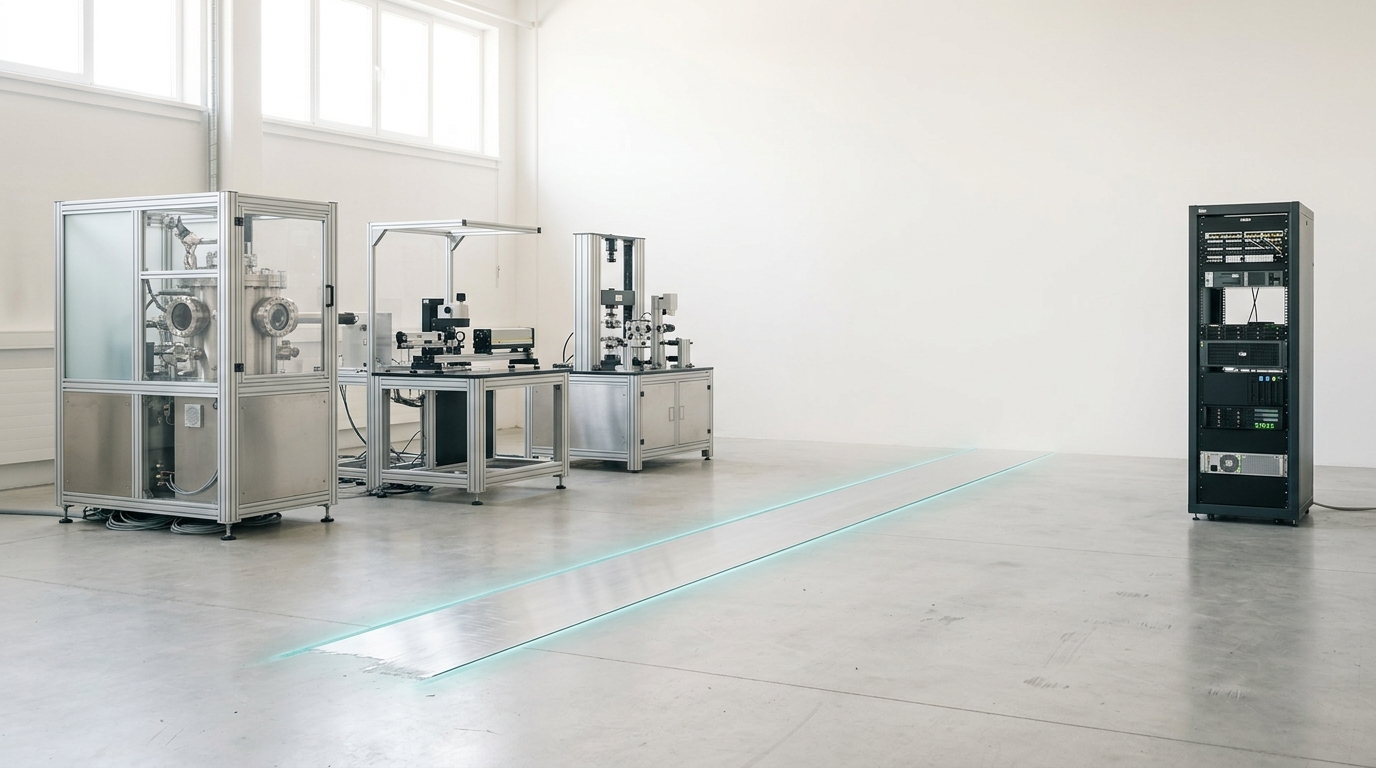
Q.ANT’s second-generation photonic processor launched on November 18, 2025 with two numbers attached to it: “up to 30x lower energy use and 50x higher performance for complex AI and HPC workloads,” measured, the release specifies, against ordinary “transistor logic” — a CMOS chip doing the same job electrically [1]. No benchmark accompanies the release. No third party is quoted testing the claim. The only stated corroboration is a live demonstration at the Leibniz Supercomputing Centre’s own booth during the Supercomputing 2025 conference (November 17–21, the same week the release went out) — the same institution that becomes the center of this trail four months later — with no results promised in writing [1]. That would be an unremarkable way to launch a chip — vendors round up, and demos come later — except that four months on, tracing where those two numbers actually went produces a specific, checkable answer to a question most readers of a “30x” headline never get to ask: what happened next?
This article traces three such numbers forward — Q.ANT’s 30x and 50x, NVIDIA’s “3.5x more power efficiency” for its Quantum-X Photonics switch line, and Lightmatter’s “up to 8x faster training” for its Passage L200 co-packaged optics chip — through every place each one resurfaces over the following months: syndicated wire posts, a named deployment at a European supercomputing center, a named production cluster at a major cloud provider, and the handful of independent analysts who cover this sector professionally. Two of the three claims do reach a real, named, independently disclosed deployment, which is further than a skeptic’s prior might expect. In both cases, the number that survives the trip is still, on the sentence level, the vendor’s own — and in Q.ANT’s case, tracing the trail closely enough surfaces something more specific than “unverified”: the number changed what it was measuring against without changing its size.
A Claim Needs One of Four Things Before It Counts as Checked
Before scoring anything, the check itself needs a definition precise enough that two different people applying it to the same press release would sort it the same way. Call it a four-tier claim-provenance ladder, and put a number on the bottom rung by default:
Tier 1 — press-release-only. The number’s only source is the vendor’s own release or product page. Every subsequent appearance — a trade-press repost, a slide deck, a LinkedIn post — restates it without performing any new measurement.
Tier 2 — peer-reviewed. The number appears in a paper that passed independent peer review, even one authored entirely by the vendor’s own scientists. Peer review does not mean a second lab reproduced the result; it means the methodology was exposed to reviewers with no stake in the outcome before publication, which is real scrutiny of a specific, narrower kind than the tiers above and below it.
Tier 3 — independently replicated. A party with no commercial stake in the claim ran its own test, under its own name, and reported a comparable number.
Tier 4 — deployed at scale with third-party disclosure. The hardware is running in a real operational deployment at a named site with no financial interest in inflating the vendor’s number, and that site has itself made some public statement about the deployment — even if, as this article’s own sample shows, the specific multiplier the site repeats still traces back to the vendor’s release rather than to a meter the site read itself.
Tier 4 is not “verified” in the sense Tier 3 is. A hyperscaler naming a vendor as a supplier confirms the technology works well enough to deploy — a real, meaningful fact — without confirming that the specific efficiency multiplier attached to it in a press release is the one actually observed in production. Distinguishing those two things is the entire point of building the ladder this way rather than collapsing “real deployment” and “real measurement” into a single tier, which is exactly the collapse a reader skimming a headline is invited to make.
Q.ANT’s Trail Runs the Farthest of the Three — Straight Back to Q.ANT
Q.ANT’s 30x/50x number did not stay still for long. Even before the formal NPU 2 launch, the German outlet igorslab.de ran a piece in September 2025 explicitly built around separating the company’s own hype from its own substance, contrasting a vaguer public impression — “big promises are being made: 1000 times the speed, power consumption in the range of an LED” — against what it called Q.ANT’s own more grounded figures: “the figures from the actual development at Q.ANT are much more sober, but still impressive: around 50 times the computing power of conventional AI processors with a 30-fold improvement in energy efficiency” [4]. That framing is a genuine service to a reader drowning in “1000x” claims elsewhere in the sector. It is also, on its own terms, still Q.ANT’s number, laundered through a skeptical-sounding piece that never ran an independent test of it — the piece’s own skepticism is aimed at a different, vaguer figure, not at the 30x/50x pair it treats as the comparatively credible baseline.
The November launch repeated the same pair of multipliers under Q.ANT’s own byline, and coverage that followed — Quantum Zeitgeist’s write-up among it — reproduced them without adding new data: “up to 30x lower energy consumption and 50x higher performance compared to conventional CMOS-based systems,” with no supercomputing-center evaluation or third-party number attached anywhere in that piece either [5]. That is Tier 1, cleanly, for four months running: one release, one set of numbers, several outlets repeating it.
Then, on March 17, 2026, Q.ANT announced something that looks, at first read, like exactly the kind of event that should move a claim up the ladder: its second-generation NPUs going into production evaluation at the Leibniz Supercomputing Centre (LRZ) in Munich, installed as standard PCIe cards alongside the center’s existing CPUs and GPUs [2]. LRZ is a real, named, non-commercial research computing center with no financial stake in how Q.ANT’s numbers look, and its own director is quoted on the record: “This deployment highlights the technological progress from the first to the second generation of Q.ANT’s processors,” said Prof. Dr. Dieter Kranzlmüller, Chairman of the Board of Directors of LRZ. “Our evaluation is conducted under real production workloads and operational requirements” [2, 3]. That is Tier 4 by the definition above — a real deployment, publicly disclosed by the site itself, not merely claimed by the vendor.

Read past Kranzlmüller’s quote to the specific numbers the same release reports, though, and the trail both confirms this article’s pattern and adds a wrinkle the pattern alone would not have predicted. The release states: “In benchmark evaluations at LRZ, Q.ANT’s Gen 2 architecture demonstrated significant improvements over its first-generation NPUs,” and lists three results — “more than 50x higher throughput of matrix multiplications,” “25x faster inference on a ResNet-18 convolutional neural network,” and “6x lower energy consumption for typical workloads” [2]. Kranzlmüller’s own quoted words describe the evaluation’s rigor, not its result — nowhere in his quoted sentences does a specific multiplier appear. The three numbers sit in the release’s own voice, attributed to Q.ANT’s testing of Q.ANT’s hardware, run at LRZ’s facility but not independently measured or restated by LRZ.
The wrinkle is the baseline. Read the November launch release again: 30x lower energy, 50x higher performance, measured against “transistor logic” — ordinary CMOS chips, the class of hardware Q.ANT’s photonic architecture is built to replace [1]. Read the March LRZ release’s own words once more: the 50x, 25x, and 6x figures are explicitly framed as Gen 2 “over its first-generation NPUs” — Q.ANT’s own prior chip, not a CMOS baseline of any kind [2]. A reader who saw “50x” in November and “50x” again in March, four months and one named supercomputing center apart, has no way to know from the headline alone that the second 50x answers a completely different question than the first one did: how much better is Q.ANT’s newest chip than Q.ANT’s own previous chip, not how much better is a photonic NPU than the GPUs and CPUs it is meant to unseat. Both sentences are true on their own terms. Placed side by side, they are not the same claim continuing to hold up under scrutiny — they are two different claims that happen to share a recognizable-looking number, and only one of them has anything to do with what a matrix-multiply “50x faster than a GPU” claim would actually promise a buyer.
NVIDIA’s Customer Names the Deployment and Names NVIDIA as the Source, in the Same Sentence
NVIDIA’s Quantum-X Photonics claim started the same way Q.ANT’s did: a vendor newsroom post, dated March 18, 2025, announcing co-packaged-optics switches built to connect AI clusters at rack scale and stating the photonics switch family delivers “3.5x more power efficiency” using “4x fewer lasers” — compared, the release says only, with “traditional methods,” never naming pluggable optics or any other specific incumbent technology as the baseline — with Quantum-X InfiniBand availability targeted for later that year [6]. As with Q.ANT, no independent benchmark accompanies the release, and the language is explicitly framed as forward-looking.

Unlike Q.ANT’s four-month gap, NVIDIA’s trail reaches an operational, named, large-scale deployment inside roughly a year: Lambda, a cloud provider building GPU infrastructure at hyperscale, states plainly that it is “leading one of the largest deployments of NVIDIA Quantum-X InfiniBand Photonics co-packaged optics switches to date, in an AI factory with 10,000+ NVIDIA GB300 GPUs” [8]. That is a genuine Tier 4 fact on its own: a real customer, with every commercial incentive to complain loudly if the hardware underperformed, chose to build a production cluster around it and said so publicly, under its own name.
What Lambda’s own blog post does with the efficiency number is the more interesting fact, and a cleaner instance of this article’s pattern than Q.ANT’s, because there is no baseline swap to untangle — only a plain, checkable attribution. Lambda’s post states: “At launch, NVIDIA mentioned a 3.5x in power efficiency improvement over traditional pluggable networks,” going on to note that “NVIDIA cites 10x higher resilience and 5x longer AI application runtime without interruption over traditional pluggable networks,” and “NVIDIA cites 1.3x faster time to operation” — three separate figures, three separate uses of the verb “cites,” none of them presented as a number Lambda itself measured on its own ten-thousand-GPU cluster [7]. Lambda’s post is candid rather than evasive about this; nothing in it claims otherwise, and nothing about the language is trying to pass NVIDIA’s number off as Lambda’s own finding. That candor is exactly what makes it useful evidence: the single largest, most credible, most independently-motivated deployment this sample locates still, in its own words, treats the headline multiplier as something NVIDIA said, not something Lambda checked.
This is Tier 4 in its cleanest form — a real operator, at real production scale, disclosing the deployment under its own name, while explicitly declining to convert “NVIDIA says 3.5x” into “we measured 3.5x.” A reader who stops at the fact of the deployment, the way a citation trail usually gets sampled, could easily read “Lambda deploys NVIDIA’s photonics switches at 3.5x efficiency” as a confirmation. Lambda’s own sentence structure — subject “NVIDIA,” verb “cites” — is the trail’s honest ending point, three attributive verbs deep into what looks, from a distance, like independent confirmation.
Lightmatter’s Numbers Have Not Left the Press Office Yet
Lightmatter is the plainer case, because its trail is short rather than misleading. The company’s Passage L200 co-packaged-optics chip, announced in March 2025, carries three figures: a “5 to 10x improvement over existing solutions,” “over 200 Tbps of total I/O bandwidth per chip package,” and “up to 8x faster training time for advanced AI models” [9]. The release quotes one outside voice, Andrew Schmitt of the analyst firm Cignal AI, endorsing the general architectural approach — but his quoted words address the design philosophy, not a specific multiplier, and no independent measurement of any of the three headline numbers appears anywhere in the release [9]. The L200 itself is not shipping yet; Lightmatter states availability “in 2026” [9], which means, as of this writing, there is no deployment for a Tier 4 disclosure to attach to, by any named customer, at any scale.

A second Lightmatter claim, announced in March 2026 in partnership with Qualcomm, reports a “record-breaking 1.6 Tbps throughput per fiber” achieved through a 16-wavelength dense-wavelength-division-multiplexing architecture running at 112 gigabits per second per SerDes lane [10]. This release, too, quotes one outside analyst — Vlad Kozlov of LightCounting — calling the collaboration “a significant advancement” [10]. Kozlov’s quoted language is evaluative, not verificatory: nothing in it states that LightCounting ran its own test of the 1.6 Tbps figure, and no other source in this sample reports an independent measurement of it either. Both Lightmatter numbers, four months apart, are Tier 1 and stay there — not because Lightmatter’s claims are less credible than Q.ANT’s or NVIDIA’s, but because, unlike the other two companies in this sample, no named third-party deployment yet exists for either number’s trail to run through.
Sorted by How Each Number Was Actually Checked, Every One Lands on the Same Shelf
Laid out against the four-tier ladder, the pattern across all three companies is consistent in a specific way that a simple “vendors exaggerate” complaint would miss: it is not that these numbers are all equally unverified in the same way. It is that the ladder’s upper two rungs — independent replication, peer review — are empty across the entire sample, while the two lower-and-highest rungs — press-release-only and deployed-at-scale — are both occupied, sometimes by the exact same number at different points in its life.
| Claim | Tier reached | What actually confirms it | What still traces to the vendor alone |
|---|---|---|---|
| Q.ANT, “30x lower energy / 50x higher performance” (Nov. 2025, vs. CMOS) [1] | 1 — press-release-only | Nothing beyond the release itself | The multiplier and its baseline |
| Q.ANT, “50x / 25x / 6x” (Mar. 2026, Gen 2 vs. Gen 1, at LRZ) [2, 3] | 4 — deployed at scale, third-party disclosed | LRZ’s director confirms the deployment and its methodology is real | The three multipliers themselves; comparison baseline silently changed from CMOS to Q.ANT’s own prior chip |
| NVIDIA, “3.5x power efficiency / 4x fewer lasers” (2025, vs. “traditional methods,” unspecified) [6, 7] | 4 — deployed at scale, third-party disclosed | Lambda confirms a real 10,000+ GPU production deployment | The multiplier and its baseline; Lambda’s own language attributes it to “NVIDIA cites,” not to Lambda’s measurement |
| Lightmatter, “5–10x / 8x faster training” (Mar. 2025) [9] | 1 — press-release-only | An analyst’s endorsement of the approach, not the number | The multiplier; product not yet shipping |
| Lightmatter, “1.6 Tbps per fiber” (Mar. 2026) [10] | 1 — press-release-only | An analyst’s characterization of the achievement, not a re-measurement | The figure itself |
Zero of the five sampled numbers reach Tier 2 or Tier 3. Two reach Tier 4 — a higher bar than a skeptic’s prior about this sector might expect, and worth stating plainly rather than folding into a flatter “nobody checks anything” story. But Tier 4, on close reading of exactly what each named site said, turns out to certify that the hardware is real and running, not that the specific multiplier attached to it is. The gap this article is built to find is not between hype and no evidence; it is between “a real customer deployed this” and “a real customer measured this,” and the sampled press releases consistently invite a reader to round the first into the second.

The pattern is not confined to the three companies sampled by name. TSMC’s own roadmap for its COUPE co-packaged-optics process states only that the technology is “expected to enter volume production in 2026” and “delivers a 5–10x improvement in power efficiency, 10–20x lower latency, and a more compact footprint” — without ever specifying what the multiplier is measured against, no absolute bandwidth-density figure, and no independent test cited anywhere in the reporting [11]. That is Tier 1 by the same ladder applied to a foundry rather than a fabless accelerator startup, which is the more general version of this article’s finding: the habit of publishing a relative multiplier against an unstated or self-selected baseline, without an independent party attaching a number to it, runs across company size and across the interconnect/compute boundary this series otherwise treats as a meaningful architectural line.
The Fair Objection: NVIDIA Draws a Different Kind of Scrutiny — Just Not Yet on This Number
The strongest challenge to treating all three companies as facing the same evidentiary standard is that they plainly do not operate under the same level of outside attention. NVIDIA’s co-packaged-optics roadmap is covered by professional semiconductor analysts in a way neither Q.ANT’s nor Lightmatter’s is: the research firm SemiAnalysis published a report in June 2026, “Powered Down, Lights Off,” arguing that scale-out co-packaged-optics shipments would slip through 2027 with scale-up deployments pushed to 2029, a forecast specific enough that it moved the share prices of several optical-component suppliers within hours [12]. That report was itself directly disputed the next day by another analyst newsletter, Global Semi Research, which argued the shipment-delay conclusion rested on a yield assumption frozen at one pessimistic snapshot and raised to the 32nd power “as though yield never improves,” ignoring the screening, binning, and redundancy mechanics that let real fabs raise yield over time, and pointed to a different data point instead — NVIDIA’s own component orders to laser suppliers Coherent and Lumentum reportedly climbing “from roughly 40 million units in January to about 100 million units by April and May,” a supply signal the newsletter read as evidence for continued 2027–2028 deployment at scale, not delay [12].
That exchange is real, professional, adversarial scrutiny of NVIDIA’s photonics program, and nothing comparable exists yet for Q.ANT or Lightmatter in this sample — which is exactly the asymmetry the objection describes, and it is a fair one. But read closely, neither side of that argument is actually testing the number this article is tracing. SemiAnalysis’s case concerns manufacturing yield and shipment timing; Global Semi Research’s rebuttal concerns laser order volumes as a leading indicator of deployment scale. Neither analyst, in the material this article located, independently re-measures the “3.5x more power efficiency” or “4x fewer lasers” figures themselves. NVIDIA’s claims sit inside a more serious argument than Q.ANT’s or Lightmatter’s do — but it is an argument about when co-packaged optics ships at scale, not about whether the specific efficiency multiplier NVIDIA attached to its own hardware in March 2025 is the one a deployed system actually delivers. The larger company gets a larger, sharper conversation built around its technology category. That conversation has not yet, on the evidence gathered here, turned into an independent test of this specific number.
What Would Move a Number Off the Bottom Shelf
None of this requires assuming bad faith. Kranzlmüller’s quoted words about LRZ’s evaluation methodology read as careful and specific, not promotional; Lambda’s repeated use of “NVIDIA cites” is more transparent about attribution than most vendor-adjacent blog posts bother to be; Lightmatter’s Cignal AI and LightCounting quotes are honestly framed as expert commentary, not measurement. The gap this article documents is not a claim that anyone involved is lying. It is a claim about what a specific sentence — the one that actually gets repeated in a headline or a slide — does and does not license a reader to conclude, and the sampled evidence says plainly: not as much as the sentence implies.
The bar for a claim to clear Tier 3 in this specific market is not exotic. It requires one thing this sample never once produced: a party with no commercial stake in the outcome — an independent lab, a competing cloud provider with nothing to gain from praising the technology, a standards body’s own test suite — running its own comparison and publishing a number under its own name, using its own methodology, on its own timetable. LRZ or Lambda could, in principle, do exactly this at any point without needing new hardware access; both already operate the equipment. Nothing here claims they will not — LRZ’s own stated posture, evaluation “under real production workloads and operational requirements,” is precisely the kind of institutional position that could eventually produce a Tier 3 number rather than a Tier 4 attribution, and a trail that reaches a named supercomputing center within four months of a launch release, the way Q.ANT’s did, is not a slow one by any reasonable clock.
That is also this article’s stated falsifier, not just its closing line: if a majority of the numbers sampled here turn out, on the next pass, to be backed by a re-measurement published under LRZ’s, Lambda’s, or an equivalent independent party’s own name rather than restated from the vendor’s release, the pattern this article documents — that a photonic-computing headline number’s own trail stops at the company that coined it — is falsified for this sector, not merely qualified. Until that pass produces a different table, the honest description of every number sampled here stays the same regardless of how many named sites eventually run the hardware: real chips, real deployments, and a multiplier that has, so far, only ever been reported by the company that built the thing it describes.