The company whose name isn’t on the chip
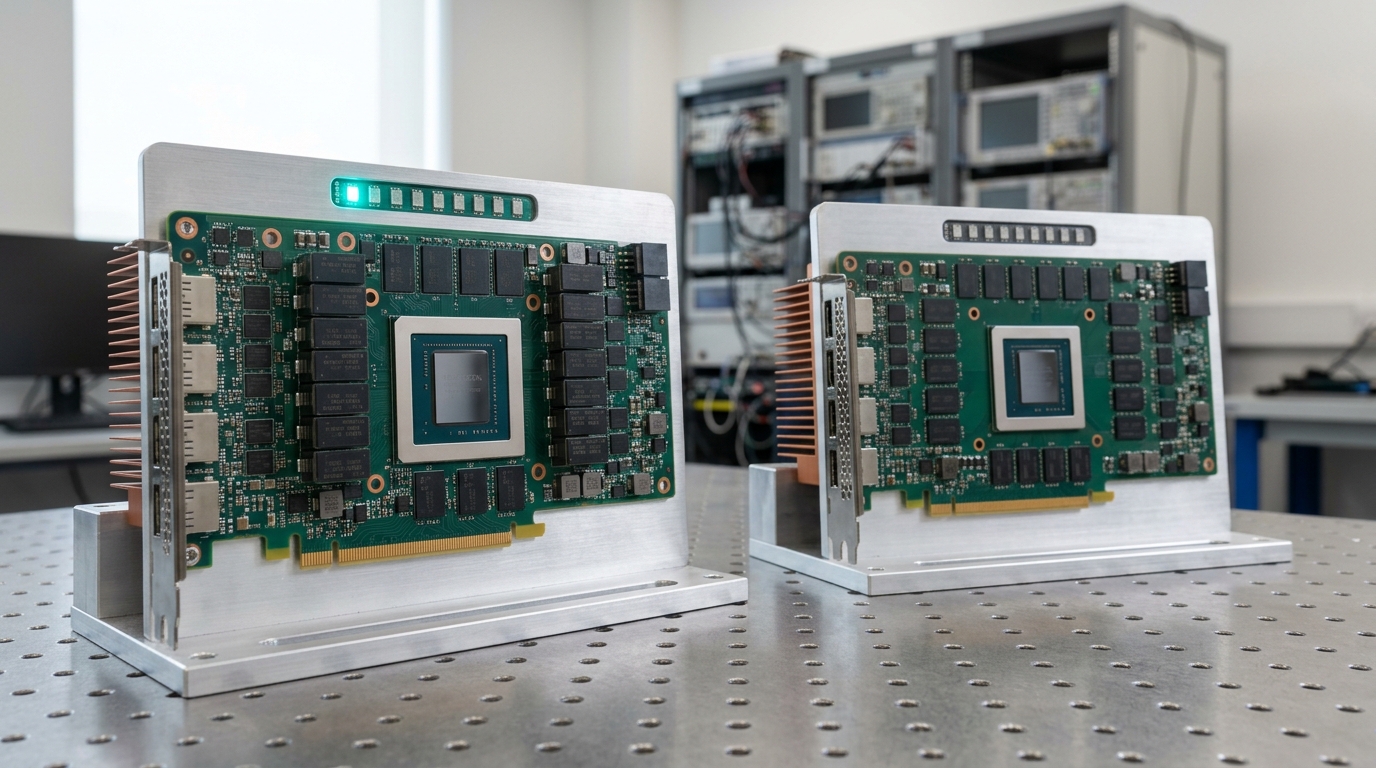
Google’s TPU is one of the most consequential pieces of AI hardware in the industry, and it does not carry Broadcom’s name anywhere a typical reader would notice. It should. Broadcom has co-designed Google’s TPU for seven generations, dating back to 2014 — one of the longest continuous silicon-design partnerships in the industry — and Google remains, by most accounts, Broadcom’s longest-standing custom-silicon customer [1].
The business most readers have never heard named
Broadcom’s custom-XPU business now spans six confirmed major customers, each receiving co-designed accelerator silicon that ships under the customer’s own brand rather than Broadcom’s [1]. This is a fundamentally different business model from Nvidia’s or AMD’s merchant-GPU sales: Broadcom’s customers are not buying a product off a shelf, they are commissioning a design partner with deep semiconductor engineering expertise to build silicon tailored to their specific workloads, which then ships as if the hyperscaler had designed it entirely in-house.
The numbers behind the business
Broadcom’s reported AI revenue surged 106% in the period covered by recent disclosures [2], backed by a $73 billion AI backlog, and the company has stated a target of $100 billion in annual AI chip revenue by 2027 [1]. Whether that target is still realistic given the pace of orders booked so far is a live question analysts are actively debating as of this briefing, without a clear consensus answer [3].
| Broadcom AI business, 2026 | Detail |
|---|---|
| Confirmed major XPU customers | 6 |
| Longest-standing partnership | Google TPU, 7 generations since 2014 |
| Reported AI backlog | $73B |
| Stated 2027 AI revenue target | $100B |
| Reported AI revenue growth | +106% |
Why the design-partner model matters beyond Broadcom itself
Broadcom’s business model is, in effect, the infrastructure underneath the custom-ASIC growth trend covered throughout this cohort: ASIC-based AI server shipments are projected to reach a meaningfully larger share of the market in 2026, growing far faster than merchant GPU shipments. Much of that growth runs directly through Broadcom’s design services, alongside Marvell’s comparable business covered in this cohort’s companion briefing. A hyperscaler wanting custom silicon without building an internal chip-design organization from scratch has, in practice, a very short list of companies capable of executing at Broadcom’s scale and quality — which is a meaningful part of why Broadcom’s backlog has grown as large as it has, even as the company remains far less visible to ordinary readers than the hyperscalers whose products it quietly makes possible.
What would validate or undermine the $100 billion target
The single clearest piece of evidence to watch is whether Broadcom adds a seventh major XPU customer, or expands materially with an existing one, over the next several quarters. The current backlog and six-customer base support strong growth, but reaching $100 billion by 2027 likely requires either meaningfully larger orders from existing customers or genuine expansion of the customer roster beyond six — a detail specific enough that a reader can track it directly against Broadcom’s own quarterly disclosures rather than taking the target on faith.
Why the Google relationship is the template for everything since
Broadcom’s seven-generation TPU partnership predates the current AI boom by nearly a decade — Google began working with Broadcom on custom accelerator silicon in 2014, years before “AI accelerator” was a mainstream industry category at all. That history matters for understanding why Broadcom, rather than a newer entrant, ended up as the design partner of choice for five additional hyperscalers once custom silicon became a mainstream strategy: Broadcom had already spent a decade refining the specific engineering discipline — co-designing accelerator silicon tightly coupled to one customer’s own software stack and workload characteristics — that every subsequent custom-silicon program has needed. Marvell’s Amazon and Microsoft partnerships, covered in this cohort’s companion briefing, follow a broadly similar model, but Broadcom’s head start with Google is the longest continuous run of this specific kind of work in the industry.
The risk concentrated inside a six-customer business
A business built on six major relationships, however large and lucrative, carries meaningfully different risk than one built on thousands of transactions across an open market. Losing even one of Broadcom’s six confirmed major XPU customers to an in-house design effort or a competing design partner would represent a much larger proportional hit to Broadcom’s AI revenue than an equivalent customer loss would represent for a company like Nvidia, selling into a far broader base. That concentration is the natural trade-off of the design-partner business model this briefing describes, and it is worth keeping in mind as a real risk factor alongside the growth story the backlog and revenue figures otherwise tell.