A definition is a promise, not a description
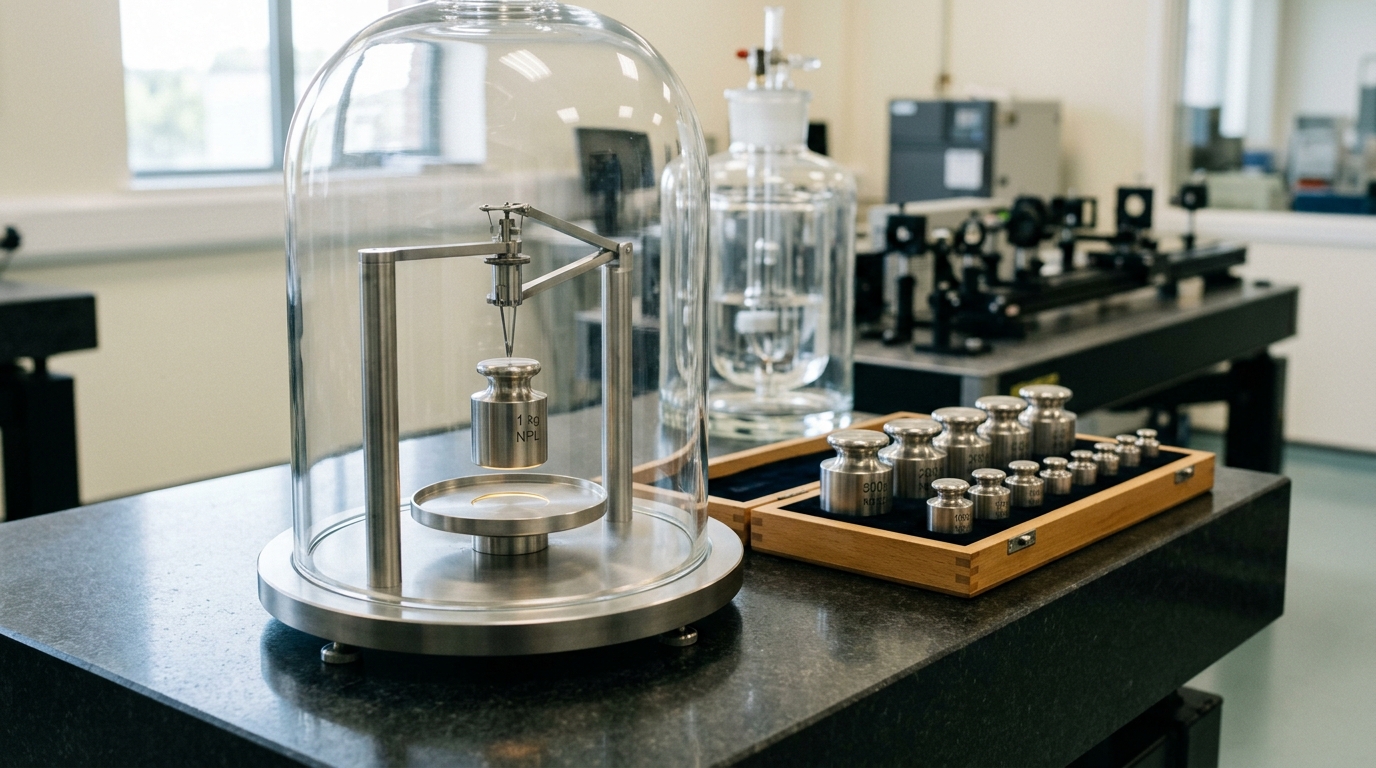
To define a unit is to make a commitment that other people can hold you to. The commitment has two halves that are easy to confuse. The first is semantic: it says what the unit is. The second is operational: it says how anyone, anywhere, can produce a physical instance of it and know how far they are from the ideal. An artefact definition collapses the two halves into one object. That collapse is convenient, and it is also the defect.
The BIPM states the collapse plainly. Among the kinds of definition the SI has used, one type is “specific properties of artefacts such as the mass of the international prototype for the unit kilogram”, and for an artefact “the definition and the realization are equivalent — a path that was pursued by advanced ancient civilizations. Although this is simple and clear, artefacts involve the risk of loss, damage or change” [1]. Every other kind of definition separates the two halves, so that “the units can, as a matter of principle, be realized independently at any place and at any time”, and so that better realizations can be adopted “without the need to redefine the unit” [1].
The kilogram was the last base unit to keep the collapsed form, and it kept it for 130 years [3]. On 20 May 2019 it was replaced by a number [2]. The interesting part of that story is not the ceremony. It is the sequence of technical conditions the metrology community imposed on itself before it was willing to make the swap, because those conditions are a working definition of what a unit definition has to do.
The artefact that could not be wrong
The old definition fixed “the value of the mass of the international prototype of the kilogram, m(K), to be equal to one kilogram exactly”, which meant that the Planck constant “had to be determined by experiment” [1]. The circularity here is not a philosophical curiosity; it is a measurement dead end. Stock and colleagues put it precisely: as a result of the definition, if the prototype “were to be altered irreversibly through accumulation of contamination or mechanical wear it would nevertheless have a mass exactly equal to 1 kg” [3]. There was no measurement anyone could perform, even in principle, that would return the answer “the prototype has drifted”. Drift could only ever be attributed to everything else.
That is why the evidence for instability had to be indirect, and why it is genuinely ambiguous. It came from comparing the prototype with its six official copies at long intervals — the second and third periodic verifications, the latter carried out between 1988 and 1992 [15] — and observing a systematic trend for the copies’ masses to increase relative to the prototype’s [3]. The trend is usually reported as the reason the kilogram had to go. The honest reading is narrower. A divergence between an artefact and its copies tells you the ensemble is not internally stable. It does not tell you which member moved, and the definition forbids the only assignment that would settle it. Davis’s review of the SI unit of mass is a careful statement of that epistemic position from inside the artefact era [16].
The 2014 campaign, an extraordinary authorized use of the prototype and the first since the third periodic verification, complicates the story further. The differences in mass between the prototype and its official copies “have changed by an average of 1 µg” over that interval, and the results “do not confirm the trend for the masses of the official copies to increase” seen earlier; the most likely conclusion drawn by the BIPM team was that prototype and copies had both remained stable since the early 1990s [13, 3]. The same campaign also recorded something less often quoted: the prescribed cleaning and washing removed about 16.8 µg from the prototype itself, and an average of about 15 µg across the seven prototypes involved [13]. A definition whose realization changes by fifteen parts in a billion when you clean it is a definition with an operational asterisk.

The sharper indictment is not drift at all. It is maintenance. Because the prototype had to be protected, it was used at intervals of up to fifty years, which “made it difficult for the BIPM to maintain traceability to the mass unit on its working standards” [3]. When it was finally used in 2014, the BIPM’s own as-maintained mass unit was found to be offset by 35 µg from the prototype [14]. De Mirandés and colleagues traced the offset to wear caused by one modified mass comparator, worst between 2003 and 2010, and concluded that mass values in calibration certificates issued during that period had been overestimated [14]. The definition was not detectably wrong. The chain leading away from it was, and nobody could see it for a decade, because the only instrument that could have revealed the error was locked in a vault.
Even the working standards degrade predictably. The CCM key comparison of 2019 recorded contamination of the BIPM working standards accumulating at 1.6 µg per year since 2014, requiring a correction of +0.008 mg after five years [19]. That is the true cost of an artefact definition: not that the object moves, but that the unit must be shepherded outward by hand, through a chain of comparisons and sub-divisions each contributing its own uncertainty [3], from a single point on the planet.
Fixing a number instead
The strategy adopted in 2018 inverts the relationship between constant and unit. Rather than measuring the Planck constant in terms of a prototype kilogram, the CGPM fixed the numerical value of the Planck constant and let the kilogram follow [2]. The definition reads: the kilogram “is defined by taking the fixed numerical value of the Planck constant, h, to be 6.626 070 15 × 10⁻³⁴ when expressed in the unit J s, which is equal to kg m² s⁻¹, where the metre and the second are defined in terms of c and ΔνCs” [1].
Inverting that gives the unit explicitly in terms of three fixed constants:
which the SI Brochure also writes as approximately 1.475 5214 × 10⁴⁰ times the quantity h ΔνCs divided by c squared [1]. Notice what the definition does not contain: any apparatus, any material, any temperature, any place. That is the point. “The use of a constant to define a unit disconnects definition from realization”, which “offers the possibility that completely different or new and superior practical realizations can be developed, as technologies evolve, without the need to change the definition” [1].
The inversion also relocates the ignorance rather than abolishing it. Before, h carried an experimental uncertainty and the prototype carried none. After, h carries none and the prototype became “a quantity which needs to be determined by measurement” [3]. The number 6.626 070 15 × 10⁻³⁴ was chosen so that, at adoption, the prototype was still one kilogram with a relative standard uncertainty of 1 × 10⁻⁸ — which was simply the standard uncertainty of the best combined estimate of h at that moment [1], about 10 µg in absolute terms [3]. Continuity was purchased, not discovered.
Virtual work: the Kibble balance
A definition in terms of h is only useful if some experiment can turn h into a kilogram. The first of the two recognized primary methods does it by equating two kinds of power that are never actually delivered.
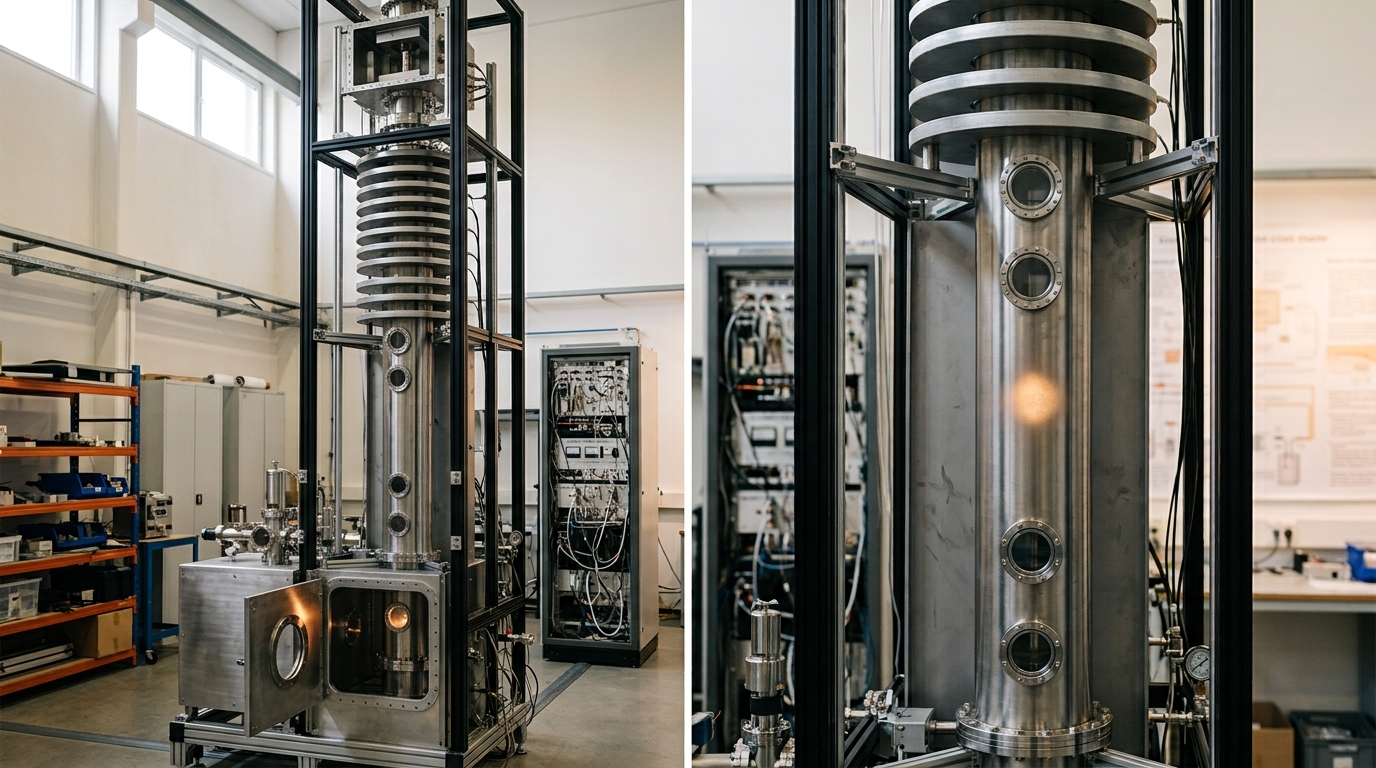
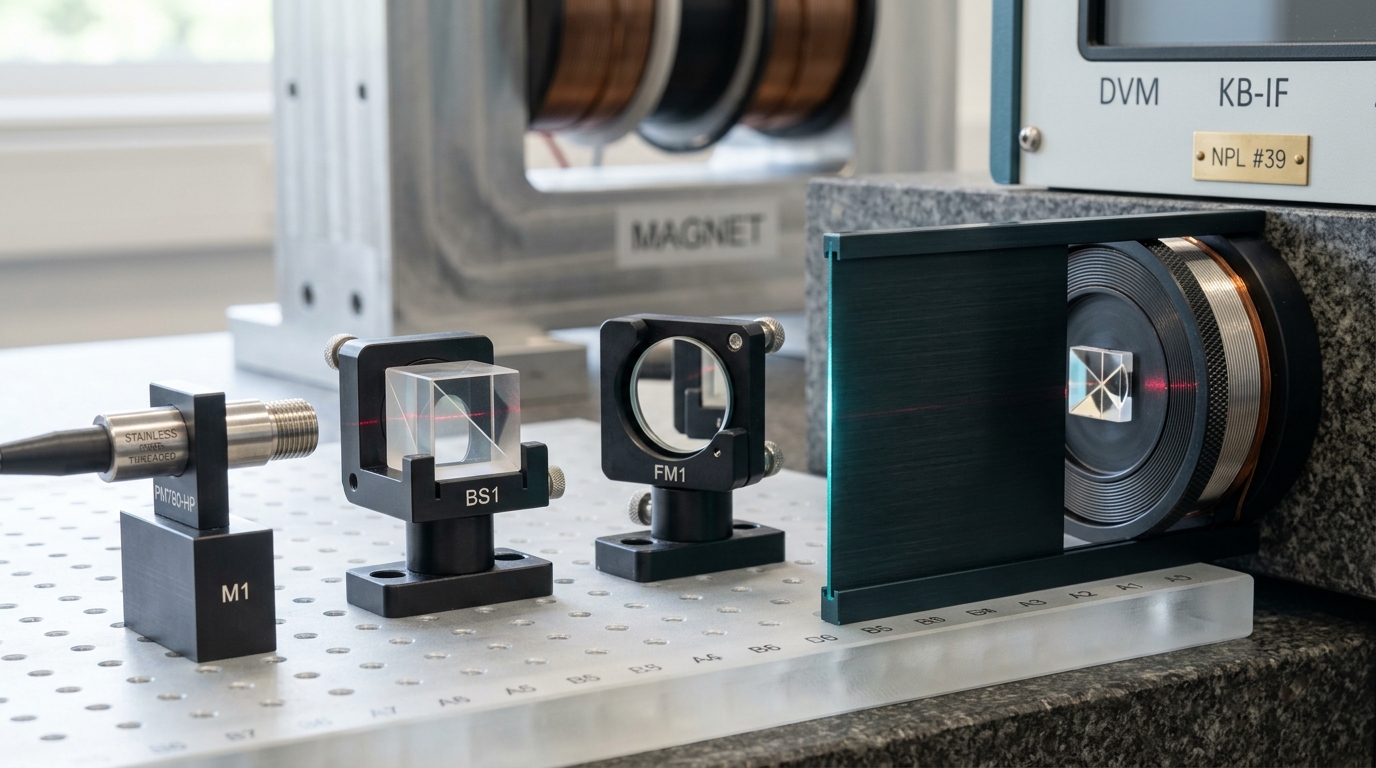
The Kibble balance runs in two modes. In weighing mode, the weight of an artefact of mass m is balanced by the force on a coil of wire length l carrying current I₁ in a radial field of flux density B. In moving mode, the same coil is driven vertically at velocity v through the same field and the induced voltage U₂ is measured [4]:
The geometric factor Bl appears in both and is eliminated between them:
The BIPM’s mise en pratique is careful about what has just happened: “power of a mechanical nature is equated to power of an electromagnetic nature. The powers are manifestly ‘virtual’ in this method of operation because power does not figure in either mode of this two-mode experiment” [4]. No power is transferred in either measurement. The equality is between quantities constructed after the fact.
That is not a rhetorical nicety, it is the whole reason the instrument works at the required level. Robinson and Schlamminger identify the payoff directly: combining the two modes eliminates the need to know Bl, and equating virtual electrical to virtual mechanical power removes “effects of energy loss mechanisms such as resistive losses, friction and eddy current losses” that would otherwise dominate at parts in 10⁹ [6]. A real power measurement would have to account for every dissipative path. A virtual one never generates them.
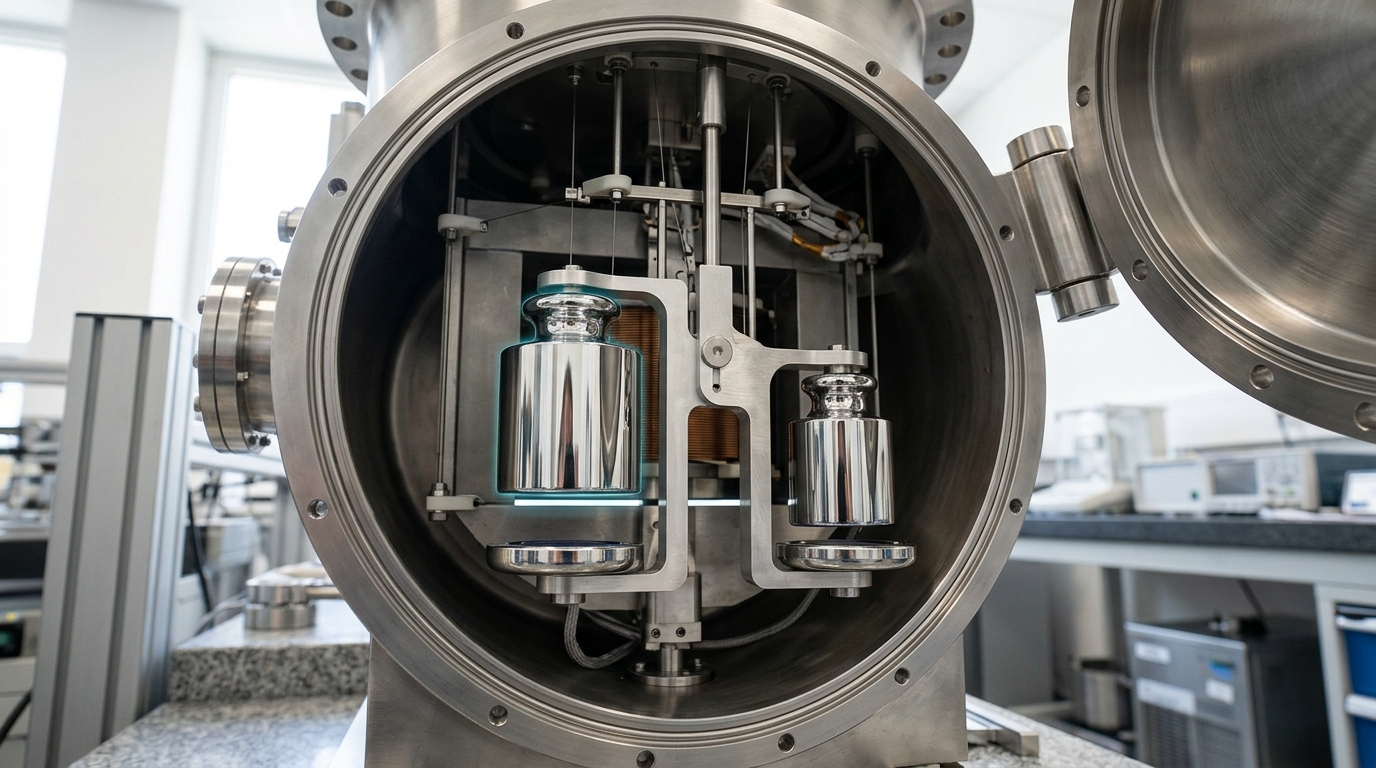
The remaining question is what the electrical quantities are referred to. The current is obtained from a voltage drop across a stable resistor; both voltages are measured against the Josephson constant, taken as KJ = 2e/h, and the resistance against the von Klitzing constant, taken as RK = h/e², so that KJ²RK = 4/h and the mass reduces to h multiplied by an experimental frequency term and divided by the product of local gravity and coil velocity [4]:
This is where the quantum electrical standards earn their place. Since 1990 the practical realization of the volt and the ohm had rested on the Josephson and quantum Hall effects, but with conventional values assigned to the two constants — a decision Taylor and Witt set out when the new reference standards took effect on 1 January 1990, intended to “improve significantly the international uniformity of electrical measurements and their consistency with the SI” [9]. The consequence was a parallel electrical unit system, close to the SI but not identical to it [3]. Fixing h and e together dissolved the parallel system: KJ and RK are now calculated exactly from the defining constants, and the conventional values were retired [3]. A Kibble balance is therefore not merely an accurate balance. It is a mechanical quantity expressed entirely in quantum-referenced electrical terms, which is why the electrical metrology community wanted the kilogram and the ampere redefined in the same act.
Counting atoms: the silicon sphere
The second primary method shares almost nothing with the first except its answer. The X-ray crystal density route determines the mass of a nearly perfect single-crystal silicon sphere by counting the atoms in it. With eight atoms per cubic unit cell of lattice parameter a, the atom count follows from the macroscopic sphere volume, and the sphere mass follows from the count [4]:
The ratio of the silicon-28 atomic mass to h is a constant of nature known to high accuracy, so with h fixed the sphere becomes a primary mass standard [4]. The mise en pratique notes that the second equality is not exact — the total binding energy of the crystal reduces the right-hand side by about two parts in 10¹⁰ — and that this is ignored as negligible against present experimental uncertainties [4]. A definition that lets you write down the correction you are choosing to neglect is doing its job.
The experimental burden is distributed completely differently from the Kibble balance’s. Fujii and colleagues describe spheres of roughly one kilogram made from highly enriched silicon-28, with shape deviations below 50 nm and surface roughness below 0.2 nm; the {220} lattice spacing measured by combined X-ray and optical interferometry to a relative standard uncertainty of 1.4 × 10⁻⁹; molar mass by isotope dilution mass spectrometry reaching relative uncertainties as low as 5 × 10⁻¹⁰ for highly enriched material; and the surface layers of oxide, carbonaceous contamination and adsorbed water quantified separately and subtracted [10]. Nothing on that list appears in a Kibble balance’s error budget, and nothing in a Kibble balance’s error budget — coil alignment, velocity metrology, local gravity, magnet back-action — appears here.

That disjointness is the entire argument for requiring both. The Consultative Committee for Mass and Related Quantities wrote the requirement into its conditions for redefinition: at least three independent experiments, “including work from watt balance and XRCD experiments”, yielding consistent values of h with relative standard uncertainties not larger than 5 parts in 10⁸, and at least one result not larger than 2 parts in 10⁸ [3]. A single method, however precise, can only ever demonstrate its own repeatability. Two methods with disjoint systematics that agree are evidence that neither is dominated by an unmodelled effect. Agreement is not a bonus here; it is the epistemic content of the whole exercise.
The disagreement that nearly stopped it
Fact, and it is worth stating plainly because the redefinition is usually narrated as a triumph: the two best measurements did not agree.
The NRC Kibble balance reported h = 6.626 070 133(60) × 10⁻³⁴ J s, a relative uncertainty of 9.1 × 10⁻⁹, the smallest published at that time [8]. NIST-4 reported h = 6.626 069 934(89) × 10⁻³⁴ J s at 13 × 10⁻⁹, based on over ten thousand weighings of masses from 0.5 kg to 2 kg [7]. On the counting side, the International Avogadro Coordination reported 6.022 140 76(12) × 10²³ mol⁻¹ from the AVO28 crystal at 2.0 × 10⁻⁸ in 2015 [11], then 6.022 140 526(70) × 10²³ mol⁻¹ at 1.2 × 10⁻⁸ from a new, more highly enriched crystal in 2017 [12] — a value differing from the 2015 result by 3.9(2.1) × 10⁻⁸ [3].
The NIST Kibble balance result and the 2017 silicon result were “discrepant by four times their combined standard uncertainty”, a relative difference of 7.1 × 10⁻⁸ [3]. Stock and colleagues translate that into the only units that matter to a mass laboratory: if those two experiments were used to determine the mass of a one-kilogram weight, the answers would differ by 71 µg, “unacceptable for mass metrology” [3]. This was roughly a year after the 2016 CCM Pilot Study had shown good agreement between realizations [18], which made the situation worse rather than better: it suggested the methods had not yet reached the necessary consistency and stability.

The CODATA Task Group’s response was procedural rather than physical. Faced with a data set whose least-squares residuals showed it was not self-consistent, it applied a multiplicative expansion factor of 1.7 to the uncertainty of every input datum, which brought all normalized residuals to acceptable values while still leaving five results below 5 × 10⁻⁸ and two at or below 2 × 10⁻⁸ — so the CCM’s conditions were still met [3]. The special adjustment returned h = 6.626 070 150(69) × 10⁻³⁴ J s with a relative uncertainty of 1.0 × 10⁻⁸, alongside e, k and NA [5]. The final defining value is that number truncated to nine significant figures.
Analysis, not fact: inflating uncertainties is a defensible statistical treatment of an inconsistent data set, and it is also an admission. It says the community believed the spread reflected unidentified systematics in at least one experiment rather than genuine variation in nature, and chose a number that would not be embarrassed by whichever side turned out to be wrong. Where experts disagreed, the disagreement was not resolved. It was absorbed into an uncertainty, deferred, and then managed operationally — which is what the next section is about.
How a definition reaches a bench
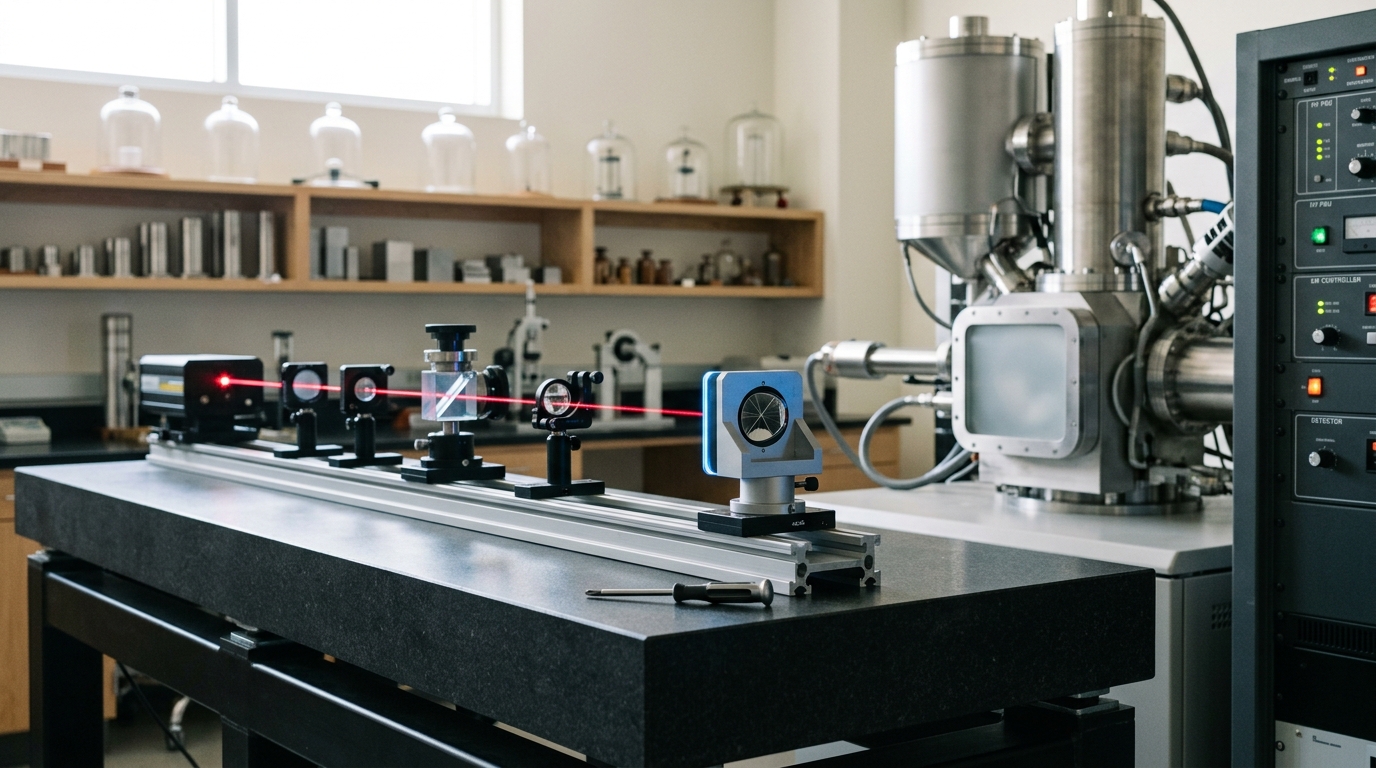
A definition that only exists at the BIPM would be no improvement on a cylinder that only exists at the BIPM. The mise en pratique is the document that carries it outward. It defines a primary method as one determining a mass in terms of h “without use of the definition of the kilogram at some other level of accuracy”, names an artefact calibrated by such a method a primary mass standard, and defines secondary mass standards as those “established through calibration with respect to primary mass standards” [4]. Any national metrology institute, designated institute, the BIPM, or a collaboration among them that can realize the definition may disseminate the kilogram from its own primary standards [4, 17].
In principle this is decentralization. In practice, the 2017 disagreement forced a transitional compromise. Because the dispersion between realizations exceeded their individual uncertainties, the CCM decided that institutes with a realization should “avail themselves of the consensus value” until the spread becomes compatible with those uncertainties, so that calibration certificates remain internationally equivalent [3, 4]. The consensus value is a statistical construction from all available realization data, managed by a CCM task group [4].
The machinery is concrete. CCM.M-K8.2019, the first key comparison of kilogram realizations under the new definition, had seven participants: the BIPM, KRISS, NIST and NRC with Kibble balances, NIM with a joule balance, and NMIJ and PTB with silicon spheres [19]. Each calibrated one-kilogram standards under vacuum against its own realization and shipped them to Sèvres, where they were weighed against BIPM platinum-iridium working standards traceable to the prototype. The key comparison reference value came out at −0.0188 mg relative to the BIPM as-maintained unit, with a standard uncertainty of 0.0075 mg; NRC carried 41 per cent of the statistical weight and PTB 34 per cent [19]. The chi-squared consistency test passed at the 95 per cent criterion, “although the two results with the smallest uncertainty are not in agreement with each other” [19] — the same fault line as in 2017, still there.
The consensus value was then computed as the arithmetic mean of three data sets tied together through the controlled stability of the BIPM working standards: the 2014 prototype campaign, the 2016 pilot study, and the 2019 key comparison reference value [19]. Effective 1 February 2021, the consensus value for the mass of the prototype was 1 kg − 0.002 mg with a standard uncertainty of 0.020 mg [20]. The BIPM continues to calibrate platinum-iridium prototypes and stainless steel standards for member states, now traceable to the Planck constant through that consensus value [20]. Alongside it, the BIPM maintains an ensemble of one-kilogram reference standards in several materials chosen to minimize suspected instabilities, and disseminates from the ensemble average [4, 17].

So the honest description of today’s traceability chain is neither the old one nor the fully decentralized one. It is a chain anchored in a statistically pooled value, with the artefact-derived data still in the pool, and the plan is that the pool is retired once the realizations agree well enough to stand alone [3].
What changed on the day, and what did not
Fact: mass values did not change. All values traceable to the prototype were unchanged when the new definition took effect; what changed is that their uncertainties gained a common component equal to the relative uncertainty of h at redefinition [4]. Institutes whose calibration uncertainties at one kilogram were at or below 0.020 mg had to increase their stated uncertainty once the consensus value took over, and no adjustment to the international mass scale was needed, because the consensus value agreed with one kilogram within its uncertainty [20].
Fact: electrical quantities did shift. Retiring the 1990 conventional values made voltage-related quantities larger by a relative 1.067 × 10⁻⁷ and resistance-related quantities larger by 1.779 × 10⁻⁸ [3]. Stock and colleagues judge that the step “will not be noticeable for the vast majority of users because it will be hidden by the drift or instabilities of the widely used secondary standards”, with the real impact confined to voltage metrology using Josephson standards [3].
Fact: one thing became measurable that had not been. The prototype’s mass is now a measurand, and the CGPM’s chosen number set its value at one kilogram with a relative uncertainty of 1.0 × 10⁻⁸ on the day [3, 4]. If the platinum-iridium changes from now on, that change is in principle observable rather than definitionally invisible.
Institutional claim, reported as such: NIST frames the practical gain as removing “the time-consuming business of periodically sending their own official kilograms to France for comparison”, and describes its Kibble balance as able to measure a mass to within about three millionths of a per cent [21]. That characterizes the direction of travel accurately. As the CCM.M-K8 arrangements show, the shipping has not stopped yet; travelling standards still went to Sèvres in 2019 and 2020 [19].
For anyone below the top of the chain — a pharmacy scale, a freight weighbridge, a semiconductor fab’s microbalance — nothing observable happened. That is the correct outcome. A redefinition that changed working measurements would have failed its continuity requirement, which the BIPM treats as “a generally accepted criterion for revised definitions of SI base units” [4].
Prediction, with a horizon and a way to be wrong
Prediction, horizon 2032: the coordinated dissemination based on a consensus value will be discontinued and national institutes will disseminate the kilogram directly from their own primary realizations. Assumptions: that CCM.M-K8 continues on roughly its planned two-year cycle [19]; that no new class of systematic error is uncovered in either method; and that the Kibble-balance and XRCD communities continue to close the gap that stood at 7.1 × 10⁻⁸ in the CODATA input data [3]. Observable indicators: successive key comparison reference values that move by less than their own uncertainties; a shrinking spread between the two lowest-uncertainty participants; and, decisively, a CCM decision recorded in the mise en pratique retiring the consensus-value clause [4]. Disconfirmation condition: if two consecutive key comparisons after 2026 still show the two smallest-uncertainty results disagreeing at more than twice their combined standard uncertainty, the prediction is wrong and the transitional arrangement should be read as structural rather than temporary.
Scenario, not prediction: if a third primary method matured — the mise en pratique already anticipates being extended, and names volt-balance and joule-balance variants as candidates [4] — the arbitration problem would change shape rather than disappear. Three methods can outvote one; they can also agree for a shared reason nobody has thought of.
What the exchange actually bought
It is tempting to say the kilogram became more accurate in 2019. It did not. On the day of redefinition, the best realization of one kilogram was less certain than the prototype had been by construction, because the prototype had been exactly right by fiat and the new realizations carry parts-in-10⁸ uncertainties [3]. What was bought was different in kind.
First, falsifiability. Under the old definition no experiment could show the prototype had changed; under the new one, its mass is an ordinary measurand with an uncertainty attached [1]. Second, plurality. A definition stated as a constant can be realized anywhere by any equation of physics that links the constant to the quantity, with “no limit to the accuracy with which a unit might be realized” imposed by the definition itself [1]. Third, and least remarked, an audit trail: two methods sharing no systematics must now write the same number onto the same record, and when they do not, the disagreement is visible in a published comparison rather than absorbed into a chain of sub-divisions.
None of this makes measurement easier. The CCM.M-K8 report ends by noting that the stability of the travelling standards could not be verified for all participants because of travel restrictions, and that one platinum-iridium prototype “showed many defects due to intense use” [19]. The apparatus is still physical, still handled, still worn. What changed is where the authority sits. It used to sit in a cylinder that could not be questioned. It now sits in a number that cannot be questioned either — but which no longer has a mass, a temperature, a surface, or a vault.