A clock is a promise about the future, priced in two currencies at once
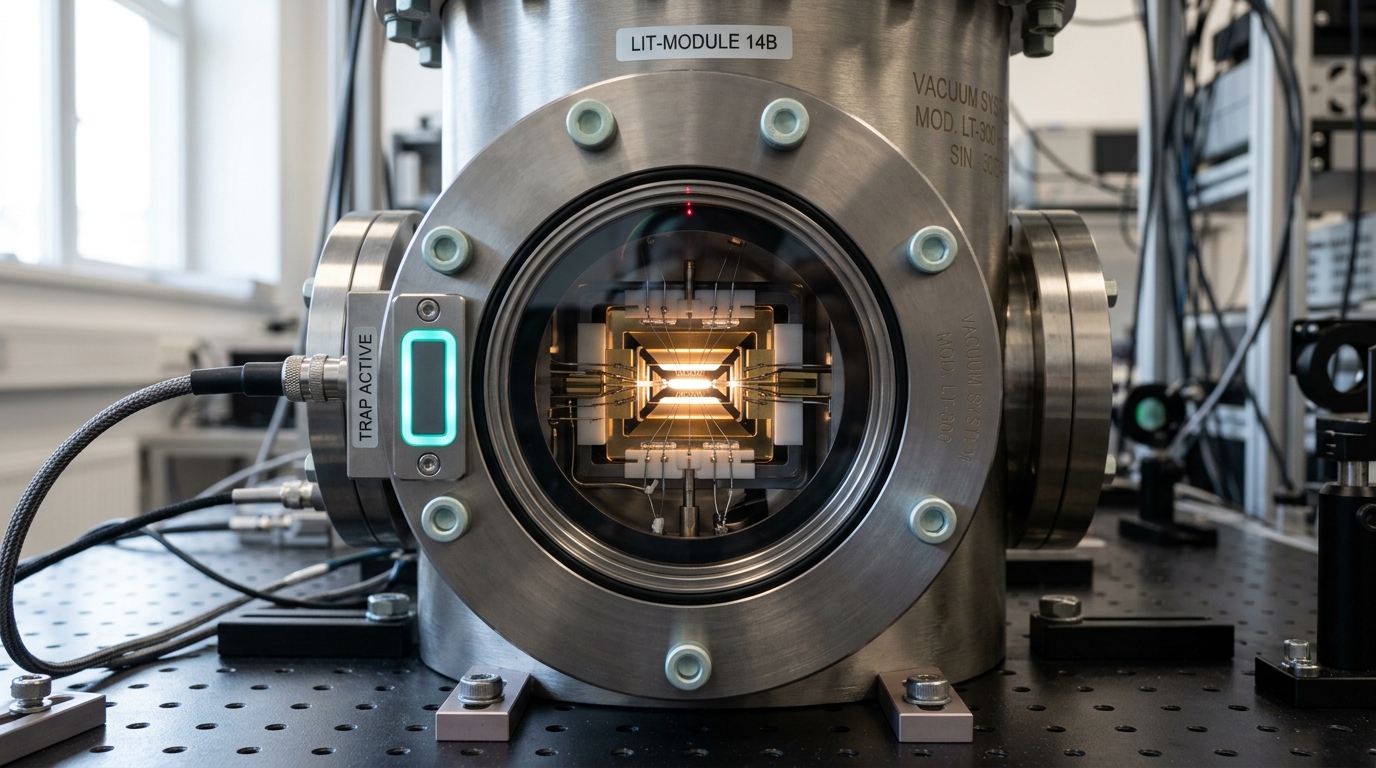
Ask a metrologist how good a clock can be and the honest answer used to be a shrug dressed up as an engineering roadmap: better lasers, colder atoms, longer interrogation times, and see how far that gets you before something new breaks. A new paper closing out The Quantum–Relativity Papers — ten releases in, “How Good Can a Clock Ever Be?” — argues the shrug was premature. Physics prices a clock twice over, in two currencies that do not care about engineering roadmaps at all. Quantum mechanics prices resolution in energy spread: read a tick more sharply and the Mandelstam–Tamm and Margolus–Levitin speed limits make you pay for it in how wildly the clock’s own energy must fluctuate to get there. General relativity prices the energy itself: anything with energy warps the spacetime around it and redshifts its own rate, so a clock’s tick rate is not independent of how much the clock weighs. Multiply the two prices together in the right way, the paper argues, and a floor falls out — an absolute limit on fractional accuracy as a function of a clock’s physical size and how long you are willing to average, sitting far below what any lab has built, but for a reason that has nothing to do with unfinished engineering.
The paper’s real contribution is not spotting that these two prices exist — physicists have known about each individually for decades, sometimes for a full century in the quantum case — but an accounting move that the well-known heuristic lineage on clock-size limits never quite performs: separating what a laboratory can calibrate away from what it cannot, and showing that only the second piece survives as a genuine floor. That move, its consequences for clock design, and its verdict on the more sweeping “Planck-limited spacetime foam” claims that sometimes get attached to clock physics, are what this landing page walks through.
From a caesium tone in 1955 to nineteen decimal places
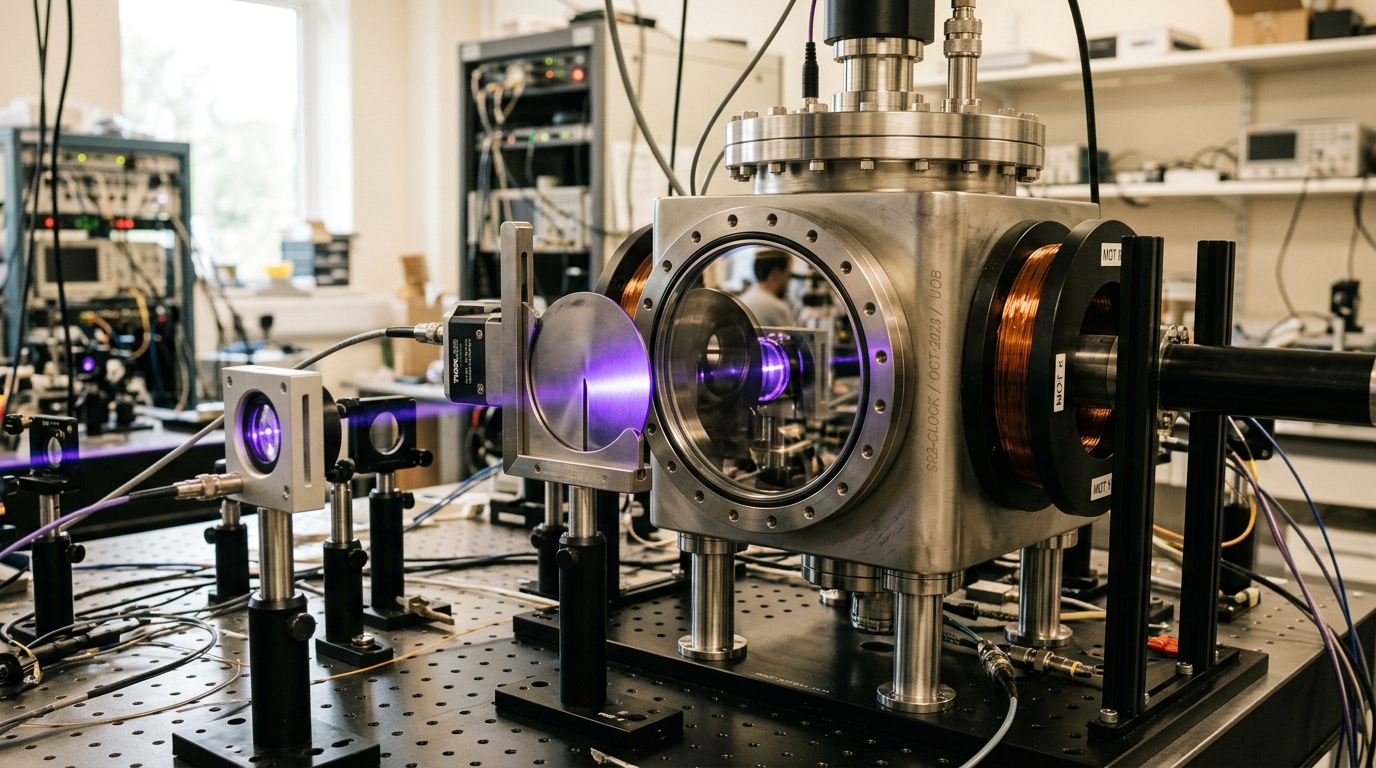
“How good” is not a hypothetical question; it has a seventy-year track record of getting better by roughly an order of magnitude every decade. Louis Essen and Jack Parry built the first practical caesium atomic clock at Britain’s National Physical Laboratory in 1955, establishing the caesium hyperfine transition as a working frequency standard rather than a laboratory curiosity — the lineage every atomic clock built since, caesium or otherwise, descends from [16]. Caesium fountain clocks eventually pushed that lineage to a relative uncertainty near one part in 10¹⁶, a milestone reached at NPL’s own fountain and at the United States’ NIST-F2 [16]. Optical clocks then did to caesium fountains roughly what caesium fountains had done to Essen’s original resonator. A trapped, laser-cooled ²⁷Al⁺ ion referenced against a co-trapped ²⁵Mg⁺ ion for cooling and readout reached a systematic uncertainty of 9.4×10⁻¹⁹ in 2019, the first single-ion clock to clear the 10⁻¹⁸ line with room to spare [7]. As of 2025, the same lineage — the paper’s authors note this is a still-running competition between Al⁺ and Sr-lattice groups rather than a settled record — reached 5.5×10⁻¹⁹, via a longer coherent probe time enabled by transferring laser stability through fibre and a redesigned trap that suppresses micromotion [8]. Differential comparisons, where two clocks of the same design are read against each other rather than against an absolute standard, go further still: a multiplexed optical lattice clock read two atomic ensembles against one another to a fractional uncertainty of 8.9×10⁻²⁰ after a few hours of averaging, exploiting atom-atom coherence times of up to 26 seconds [12]. Every one of those numbers is a statement about the same underlying resource, spelled out in the systematics taxonomy the field’s major review inherits and extends: how tightly a resonance can be read out before something — thermal motion, stray fields, the light shift from the very laser doing the probing — moves it [13].
The quantum price: resolution costs energy spread
The first of the paper’s two prices is not new; it is one of the oldest quantitative statements in quantum dynamics. In 1945, Leonid Mandelstam and Igor Tamm showed that a quantum state’s rate of change is bounded by its energy uncertainty, a relation later sharpened by Norman Margolus and Lev Levitin into a bound stated in terms of mean energy above the ground state rather than energy spread — the two together are usually called the quantum speed limit, and Sebastian Deffner and Steve Campbell’s review treats both as the “important milestones” that essentially every later result in the field builds on [2]. The bound is not an approximation; it is an inequality a system cannot beat regardless of engineering cleverness, in the same spirit as Seth Lloyd’s demonstration that a computer’s maximum operation rate is set by its energy content — Lloyd’s own illustration is that adding one joule to any physical computer can never raise its processing rate by more than about 3×10³³ operations per second, a number the paper’s authors point out reads exactly the same way whether the “operations” are logic gates or clock ticks [3, 1]. Applied to a clock, the translation is direct: resolve a tick’s phase more sharply, over a shorter interval, and the oscillator’s own energy spread has to grow to keep up, whether that oscillator is a microwave hyperfine transition, an optical electronic transition, or eventually a nuclear one. This is the “quantum column” of the paper’s accounting table, and it is inherited rather than original to this paper — Mandelstam and Tamm’s, Margolus and Levitin’s, and the broader speed-limit literature Deffner and Campbell survey.
The relativistic rent: energy warps the clock that carries it
The second price is general relativity’s, and it is where the paper’s own contribution begins to show. Any clock that resolves time finely enough to be interesting has energy — rest mass, binding energy, the energy of the very oscillation being read out — and general relativity says energy curves spacetime and redshifts a clock’s own rate in its own gravitational potential. That much is textbook. What is less often stated carefully is that a quantum clock’s energy is not a fixed number; it has a spread, by the same speed-limit logic just described, and that spread does something a classical mean-energy redshift cannot: it entangles the clock with its own gravitational field. Esteban Castro-Ruiz, Flaminia Giacomini, and Časlav Brukner worked through exactly this scenario for a pair of quantum clocks coupled through gravity, and found that when both quantum mechanics and general relativity are taken seriously at once, the clocks necessarily become entangled through the very time-dilation effect that is supposed to let them each keep their own proper time, with the entanglement eventually degrading the coherence of either clock read alone — recovering the ordinary general-relativistic notion of time only in the classical limit where the energy spread vanishes [5]. Magdalena Zych, Fabio Costa, Igor Pikovski, and Brukner had already shown the sharper, testable version of the same idea for a single clock sent through an interferometer: because proper time runs differently along the two arms whenever the “clock” has internal quantum degrees of freedom, the interference visibility itself drops — not merely the phase — in a way the authors call gravitationally induced decoherence, and which they propose as the first genuinely quantum test of general-relativistic proper time [6]. Between them, these two results hand the paper exactly the tool its own Proposition 2 needs: a clock’s coupling of its own energy fluctuation to its own gravitational time dilation is not a classical bookkeeping detail, it is a real physical dephasing channel.
The turn: a mean shift you can level away, a fluctuation you cannot
Here is the move the paper makes its own, and the reason its authors position it explicitly against the well-known heuristic lineage on clock-size limits — Hartland Salecker and Eugene Wigner’s original quantum-limitations argument, Yun-Jack Ng and Hendrik van Dam’s, and Seth Lloyd’s own — rather than simply adding another entry to it. Every clock’s redshift has a mean part and a fluctuating part, and the paper insists on treating them differently rather than lumping both into one “gravitational limit.” The mean part — the clock’s average mass-energy redshifting its own rate by an amount set by its size and location — is, in principle, a calibrable systematic: measure the clock’s height, its mass distribution, its local gravitational potential precisely enough, and correct for it, the same way a metrology lab already levels a vacuum tank with jacks and a spirit level rather than treating tilt as an unbeatable limit on the clock inside it. Salecker and Wigner’s original 1958 argument, and the later clock-size heuristics built on it, effectively count this calibrable mean shift as though it were a hard limit [14]. The paper’s Proposition 2 argues that is the wrong accounting: only the fluctuation — the part of the clock’s self-energy that its own quantum uncertainty makes unpredictable, tick to tick, in a way no calibration procedure run once can remove — belongs on the “irreducible” side of the ledger. And that fluctuation is bounded from below by exactly the quantum speed limit already on the table: the same energy spread Mandelstam–Tamm and Margolus–Levitin charge for tick resolution is the energy spread that dephases the clock against any external standard through Castro-Ruiz, Giacomini, and Brukner’s gravitational entanglement channel. Combine the two and a single quantity — call it the clock’s fractional accuracy, written 𝒜 as a function of the clock’s physical size R and the averaging time τ — inherits a lower bound built entirely from quantities neither side of the accounting can waive away.
The optimal clock and the floor’s shape
A bound built from a quantum price that improves with more atoms and energy, set against a relativistic rent that gets cheaper the larger the clock, does something a naive “smaller is always better” or “bigger is always better” intuition would not predict: it selects a best size. The relativistic rent falls as 1 over R, so a larger clock pays less rent per unit of energy fluctuation. But a clock cannot be made arbitrarily large without breaking its own coherence — the paper takes Salecker and Wigner’s clock-size ingredient and repurposes it as a constraint rather than the punchline it was built to be: a clock’s different parts have to stay in synchronized causal contact within a single tick, which bounds the clock’s radius by how far light can cross it in the time being resolved, R ≤ cτ [14]. Push the clock to that boundary — as large as coherence allows, no larger — and the two prices combine into a floor whose shape is set entirely by the constants already on the table:
one Planck time, t_P, set against however long a lab is willing to average, squared, times a geometry factor χ the paper’s appendix fixes and does not pretend is order-unity by assumption. The exponent is the point, not the coefficient: it is what makes this a floor derived from an accounting of two established prices rather than a plausible-sounding guess. The paper reports the resulting gap at laboratory clock sizes and realistic averaging times as roughly forty orders of magnitude below today’s best clocks — a number whose precise digits come from the paper’s own seeded numerical appendix and whose exponent, not its coefficient, is the honest thing to quote here.
The map: how far the frontier has come, and how far the floor still sits
Laid on one chart, the paper’s series-closing figure, the distances involved are almost uncomfortable to look at side by side. Essen’s 1955 caesium resonator sits at one end, a working proof that atomic frequencies could be read at all outside a physics paper’s derivation [16]. Caesium fountains at one part in 10¹⁶ sit a full six orders of magnitude better [16]. The Al⁺ quantum-logic lineage — 9.4×10⁻¹⁹ in 2019, 5.5×10⁻¹⁹ in 2025 — and Sr-lattice differential comparisons near 8.9×10⁻²⁰ push another two to three orders past that, all within the last decade [7, 8, 12]. Nuclear clocks are the newest entrant and the one whose position on the map is still moving fastest: Christopher Campbell and coauthors proposed in 2012 that a single trapped Th-229 ion, exploiting a nuclear rather than electronic transition roughly five orders of magnitude narrower in relative linewidth, could in principle approach a total fractional inaccuracy near 10⁻¹⁹ [9], and that proposal has stopped being purely theoretical: a solid-state Th-229 nuclear clock operated in a doped crystal host was shown in 2026 to have an optimal working temperature near 195 kelvin where the transition’s first-order thermal sensitivity vanishes, a point the authors argue could keep temperature-induced systematic shifts below the 10⁻¹⁸ fractional level, with the nuclear transition’s own frequency reproducible to about 280 hertz — a few parts in 10¹³ — across differently doped crystals measured months apart [10]. None of that is close to the Al⁺ or Sr numbers yet; it is a much younger technology clearing its own early systematics for the first time, the way caesium fountains once did. And every single one of those entries, plotted honestly against the paper’s floor, lands in roughly the same place: somewhere between thirty and forty orders of magnitude above it. The gap is not a claim that today’s clocks are unambitious. It is a claim about what “as good as physics allows” actually means, stated as a number rather than an intuition.
What “Planck-limited spacetime foam” gets right, and what it doesn’t
The paper’s last move is a verdict, not a survey, and it grades rather than dismisses. Yun-Jack Ng and Hendrik van Dam’s holographic clock-measurement program argued that combining quantum uncertainty with a gravitational collapse bound on any measuring device’s mass forces a minimum measurable length that scales as the cube root of the length being measured times the Planck length squared — a genuinely striking claim, because a cube-root scaling falls off far more slowly than the linear Planck-length floor naive dimensional analysis would suggest, making it in principle detectable at astronomically accessible baselines rather than only at the Planck scale itself [11]. That is a real, structurally interesting result, and this paper does not claim otherwise. But it has a published rebuttal the popular science coverage of “spacetime foam” often skips: John Baez and Jay Olson showed that the specific mass-versus-collapse trade-off Ng and van Dam’s derivation assumes can be evaded by attaching the measuring device to a massive elastic rod instead of treating it as a free rigid body, whose zero-point fluctuations give an uncertainty that need only clear the Planck length itself, not the larger holographic bound — evading the Ng–van Dam floor “by attaching the measuring device to a massive elastic rod,” in Baez and Olson’s own phrase [4]. This paper’s contribution to the dispute is not to referee it, but to point out that its own Proposition 2 already located the ambiguity: Ng and van Dam’s counting, like Salecker and Wigner’s before it, does not cleanly separate a calibrable mean effect from an irreducible fluctuation, and Baez and Olson’s rod is essentially a calibration strategy for the very mass parameter Ng and van Dam treated as fixed. Graded structured, not exact: the accounting objection applies, but it does not by itself settle whether some version of the cube-root scaling survives a fully quantum treatment. And the observational search for holographic noise has so far come back empty at meaningful sensitivity — the Fermilab Holometer’s paired 39-metre Michelson interferometers pushed their sensitivity to shear-noise power spectral density past the Planck-time benchmark itself, 5.39×10⁻⁴⁴ seconds per root-hertz, across a wide high-frequency band, and reported no detection [15]. The paper’s own floor, by contrast, is not a conjecture awaiting a null result: it is a consistency bound that follows from two experimentally confirmed frameworks, quantum mechanics and general relativity, applied honestly to what a clock is. Ng–van Dam-style claims graded speculative; the Holometer’s null result graded exact, as an experimental fact, while remaining silent on which theoretical scaling it actually constrains; this paper’s own floor graded exact within its stated model, and explicitly not a discovery about quantum spacetime, only a bookkeeping consequence of taking energy fluctuations seriously.
Closing a series that started with one interferometer and ends with every clock at once
Ten papers ago, The Quantum–Relativity Papers opened by pointing out that an interferometer is secretly a clock comparison. This one closes by asking what any clock, compared against anything, could ever in principle achieve — and by refusing to let a seventy-year-old heuristic and a popular conjecture about spacetime foam stand in for an actual derivation. What would change the verdict: a measured departure from either quantum mechanics or general relativity at the energy and length scales a real clock probes, a demonstrated calibration procedure that removes fluctuation rather than mean shift, or a future clock built at a size and timescale close enough to the paper’s own floor to test it directly rather than merely approach it from thirty orders away. None of the ten papers in this series claims to have found such a departure. Each locates, as precisely as the mathematics allows, exactly where one would have to appear.
The Quantum–Relativity Papers, in full: No. 1, Every Interferometer Is Secretly a Clock Comparison; No. 2, An Atom Held in Two Places Develops a Linewidth; No. 3, How Much of Gravitationally Induced Entanglement Is in the Eye of the Frame; No. 4, The Best Source Mass for a Quantum-Gravity Experiment Is Not a Sphere; No. 5, The Coldest Places in the Universe Are Auditing Wavefunction Collapse; No. 6, A Map of Where the Universe Breaks a Bell Pair; No. 7, What a Bathtub Can and Cannot Know About a Black Hole; No. 8, A Heat Engine Made of Spacetime; No. 9, The Corner of the Equivalence Principle No Experiment Has Touched; No. 10, How Good Can a Clock Ever Be?