The Clock That Comes Back Wrong by Exactly Its Mass
Translate, boost, undo both: the classical bookkeeping says nothing happened. The quantum phase disagrees, by an amount fixed by mass — and this program runs that leftover into a real fight over what an interferometer measures.
Research paperRevolutionary Life 75, Series D, No. 3 ·
this page is the paper's summary — the full text is the PDF.
Download the paper (PDF)
Both arms return to the same beamsplitter. Whether they return to the same phase is a separate question, and mass is the difference.Image prompt and art direction by Brecht Corbeel; generation pending.
Abstract
A sequence of frame changes that returns its classical parameters to zero — translate, boost, translate back, boost back — is the identity element of the symmetry group. Acting on a quantum state, the same sequence need not return the identity operator: it can return a phase. For the Galilei group that phase is fixed by mass, the group's central charge. For the Poincaré group no such charge exists; the analogous phase is state dependent, with mass instead entering as an ordinary Casimir label. This article treats both phases, and the ordinary proper-time phase along a worldline, as instances of one operational estimator; derives the Galilei case from the centrally extended commutator; derives the Poincaré case's failure to centralize; and recovers the Galilei phase as the low-velocity contraction of the Poincaré one. It then confronts the construction with a genuine dispute in atom-interferometer physics over whether such a phase can ever be cleanly read as mass once recoil and laser phase are included, states the calculation that would settle it, and reports two exact illustrative evaluations, neither a performed experiment.
ADVERTISEMENT
The Clock That Comes Back Wrong by Exactly Its Mass
Take a wavepacket, kick it sideways with a pair of laser pulses, let it drift, translate the whole apparatus by a fixed distance, kick it back the way it came, translate the apparatus back. Every classical bookkeeping device you own will tell you nothing happened. The net boost applied to the particle is zero. The net displacement of the frame is zero. If you had done this with a marble on a table, the marble would sit exactly where it started, and no instrument would register a residue.
A quantum wavepacket does not agree. When the loop closes, the state does not return to itself; it returns to itself multiplied by a phase. That phase is not noise, not an artifact of an imperfect apparatus, and not a curiosity restricted to some exotic regime. It is fixed, exactly, by the particle’s mass, and it has been sitting in textbook representation theory since 1954, largely quarantined from the word “measurement.”
A second, unrelated-looking fact lives next to it. Send a composite object — an atom with two long-lived internal energy levels — along two paths that meet again at the same point in spacetime but disagree about how much proper time elapsed getting there. The two branches recombine out of phase, and the mismatch is fixed by the object’s rest energy divided by Planck’s constant. This is the ordinary relativistic phase of a free particle, no group cohomology required, and it is the entire content of matter-wave gravitational-redshift proposals that atom-interferometry groups have spent over a decade trying to isolate from everything else an interferometer’s laser field and its own recoil also contribute.
ADVERTISEMENT
Two phases, two mechanisms, one number falling out of both: mass. This paper’s business is to say precisely what kind of object each phase is, to derive rather than assert the algebra behind the first, to show exactly why the second needs no algebra at all, to connect them through the ordinary c→∞ limit, and to run the resulting operational mass estimator into a real, unresolved dispute over whether an actual atom interferometer can ever report it cleanly. The dispute has a name in the literature and a decisive question attached to it. This paper does not resolve the dispute. It builds the object precise enough for the dispute to be stated as an arithmetic disagreement rather than a rhetorical one.
Two Loops That Close in Space and Fail to Close in Phase
Call a frame loopL any sequence of symmetry operations — translations, boosts, elapsed proper time — whose net classical effect, read off the group’s own parameters, is the identity. Two such loops carry this paper.
Neither loop is arbitrary bookkeeping. Both are chosen because an actual laboratory can build them out of actual hardware without inventing new physics to do it: a translation stage, a pair of counter-propagating lasers, and a vacuum tower are enough for the first; two heights and a held clock are enough for the second. What makes them worth a shared name is that both are constructed so that every classical readout — a ruler, a stopwatch reading elapsed coordinate time, a velocity meter — reports zero net change, while the quantum phase is asked to report something else entirely.
The first, LG, lives in the nonrelativistic (Galilei) symmetry group: translate the apparatus by a fixed vector b, apply a velocity boost v to the particle, translate by −b, boost by −v. As abstract group elements this composes to the identity, because ordinary spatial translations and ordinary Galilean boosts, considered as instantaneous operations with no elapsed time attached, form an abelian subgroup: order does not matter, and the net element is trivial by direct substitution.
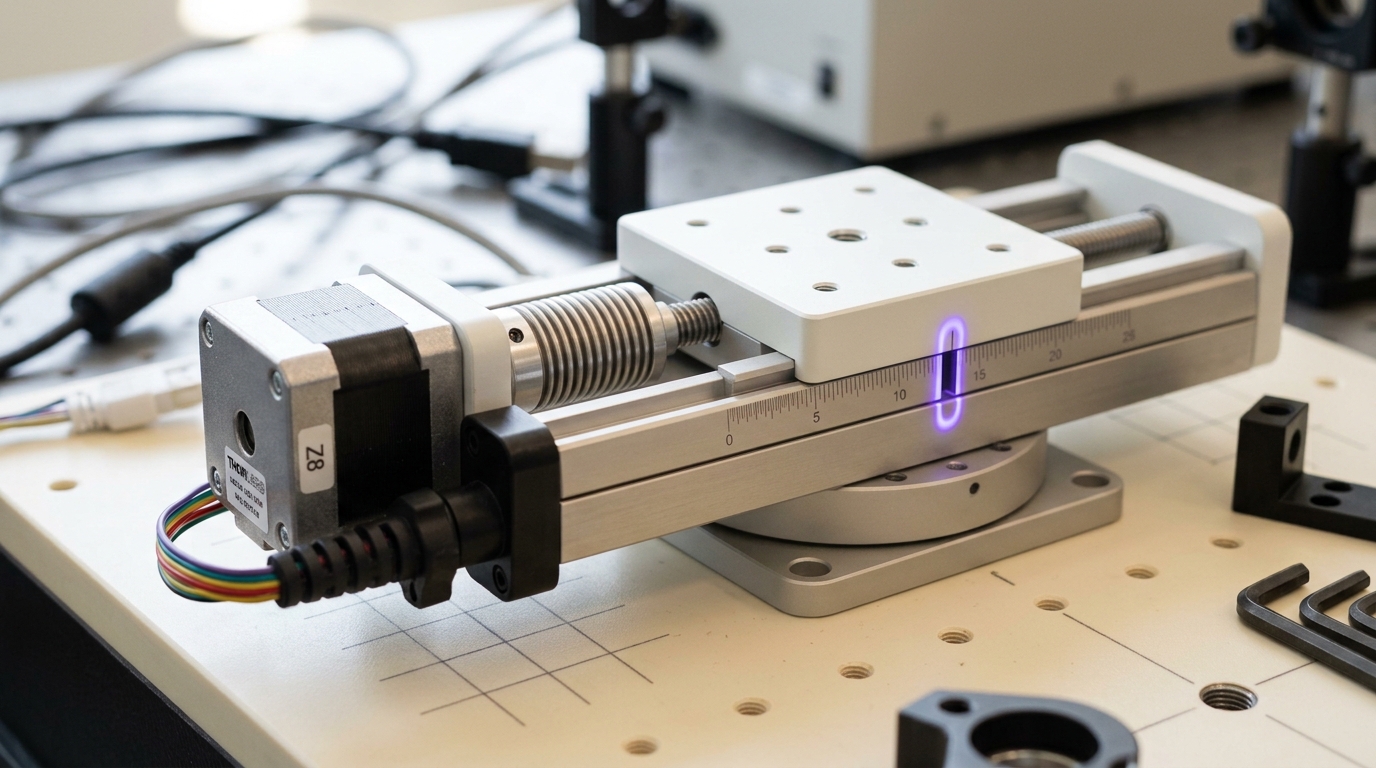
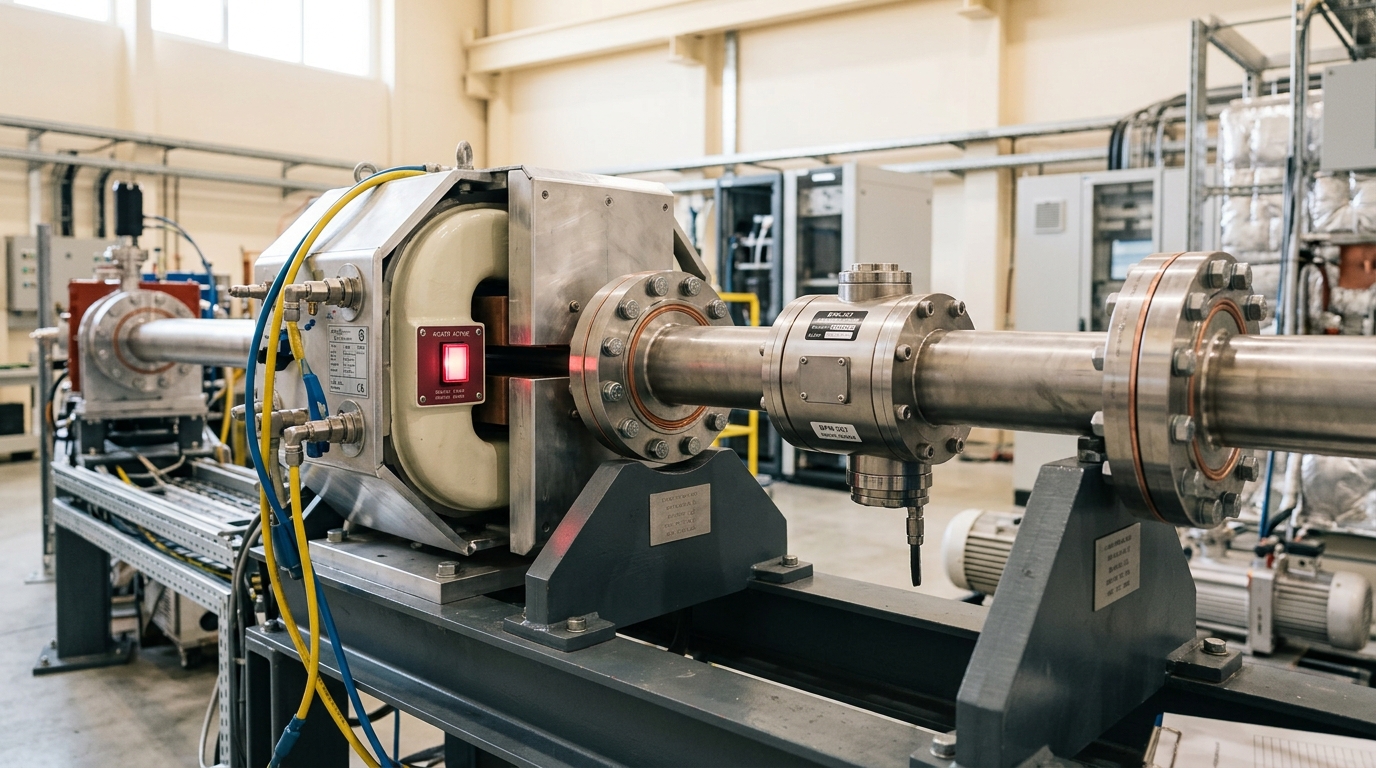
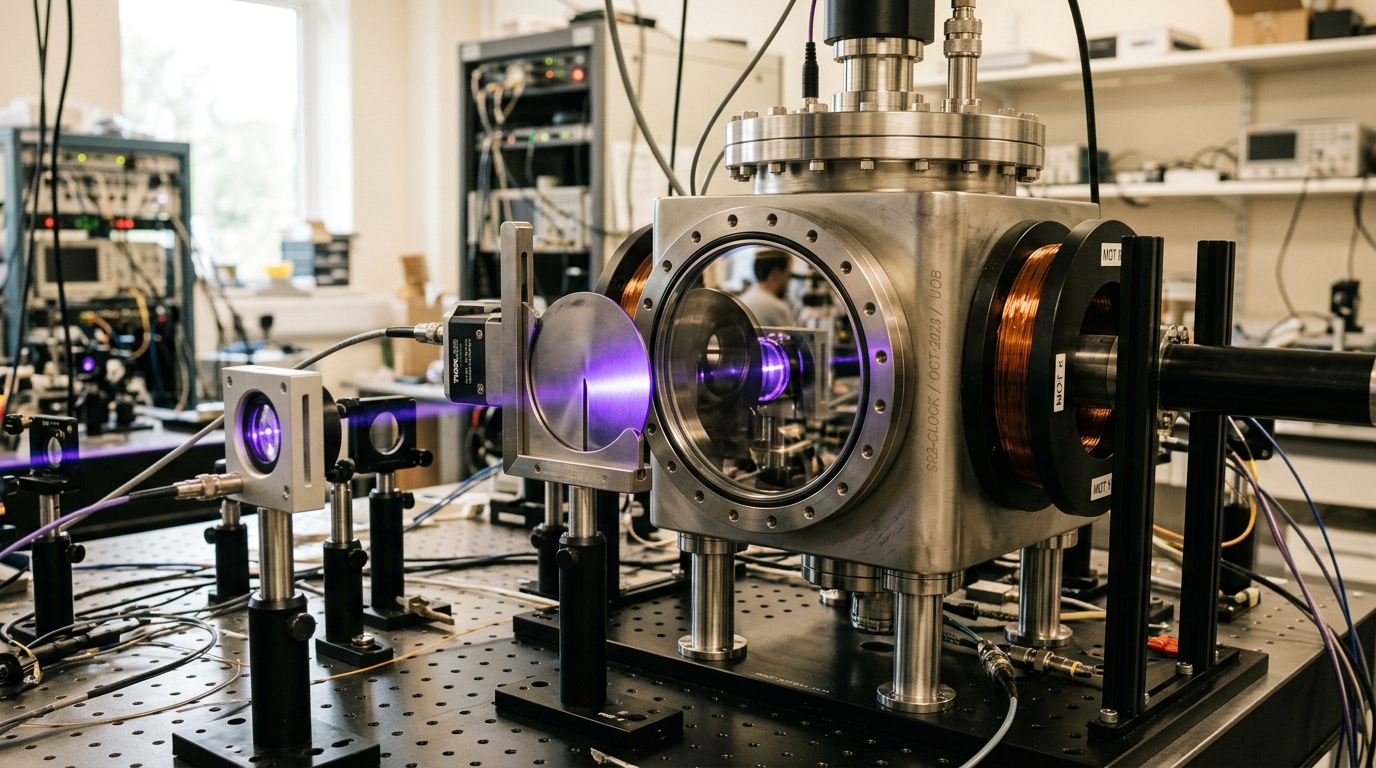
Figure 1. A momentum kick from this table is the "boost" half of the loop; a translation stage supplies the other half. Neither alone is the point.Image prompt and art direction by Brecht Corbeel; generation pending.
The second, LP, lives in spacetime itself: send a system from event A to event B along worldline γ0, and imagine comparing it against a return trip along the reverse of a different worldline γ1 that also connects A to B. The loop closes in space and time — it starts and ends at A — but the two worldlines need not have the same proper time, τ0=τ1, precisely because proper time is path dependent once gravity or acceleration is present. This is not a new observation; it is the entire content of general relativity’s twin-paradox structure, imported into a single-particle quantum phase by early clock-interferometry proposals [10].
ADVERTISEMENT
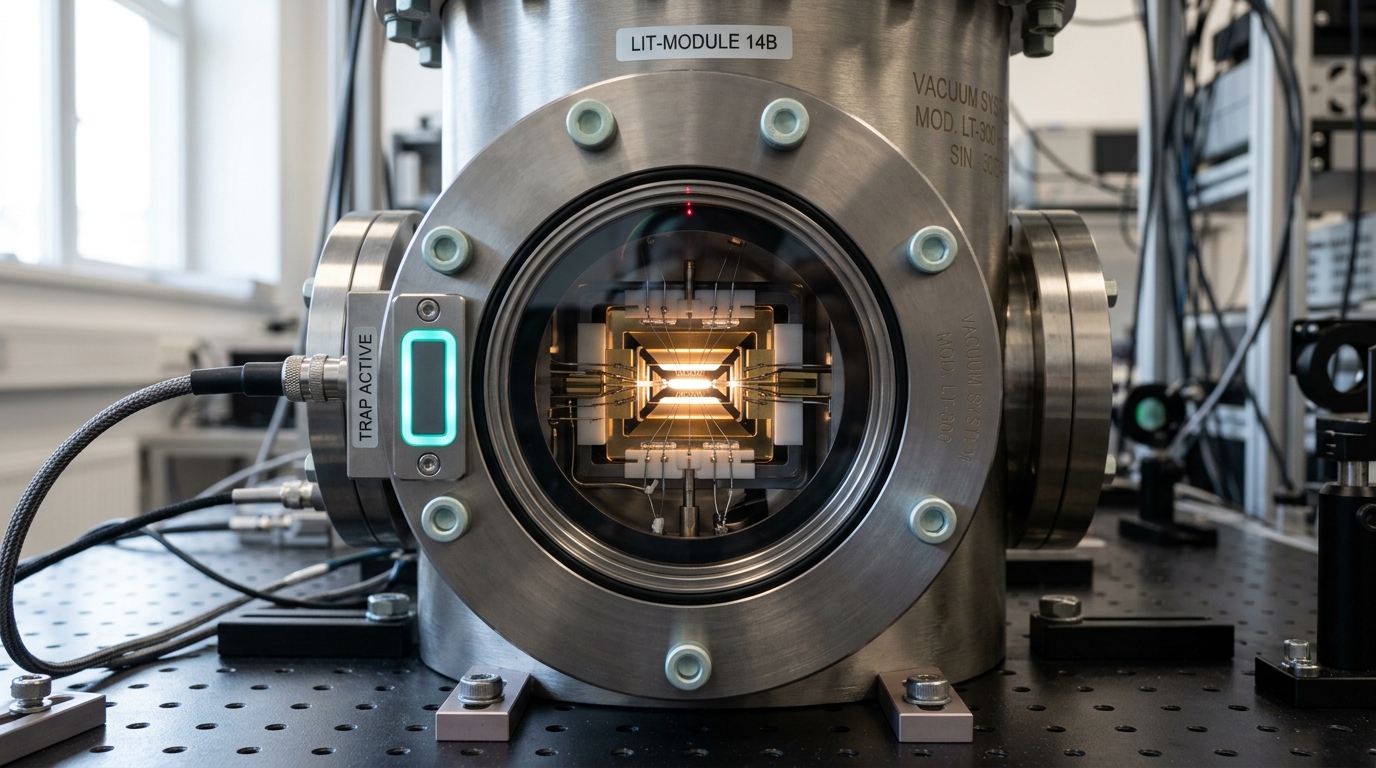
Neither loop is exotic apparatus. The first is realized every time an atom interferometer applies a momentum kick and later closes the trajectory, which every Raman-pulse interferometer since the early 1990s has done as a matter of course [16]. The second is realized every time two paths of a matter-wave interferometer occupy different gravitational potential for different durations, which is the entire operating principle behind gravitationally induced quantum interference going back to the first neutron-interferometer demonstration [15]. What is not standard is treating both as the same species of object — a closed loop whose classical data vanish and whose quantum phase does not — and asking what invariant that phase measures. That is this paper’s object.
The Commutator That a Torsion Balance Would Never Need
Represent the loop LG on a Hilbert space. A spatial translation by b is the unitary T(b)=exp(−ib⋅P/ℏ), built from the momentum operator P; a Galilei boost by v is G(v)=exp(−iv⋅K/ℏ), built from the boost generator K. The classical loop is T(b)G(v)T(−b)G(−v)=1. The operator loop is not automatically the identity, because K and P need not commute as operators even when translations and boosts commute as group elements.
They do not commute. The defining fact of the nonrelativistic symmetry group, established by Bargmann and sharpened by Lévy-Leblond, is that its faithful quantum representations require a centrally extended algebra in which
[Ki,Pj]=iℏmδij1,
with mass m appearing not as an eigenvalue to be measured state by state but as a fixed number multiplying the identity operator across an entire representation [1, 2]. This is what “central” means: the commutator commutes with everything, including K and P themselves.
That triviality is what makes the loop phase exact rather than approximate. Write X=−ib⋅P/ℏ and Y=−iv⋅K/ℏ. Their commutator is
[X,Y]=ℏimb⋅v1.
Because [X,Y] is itself proportional to the identity, it commutes with both X and Y, so every higher term in the Baker–Campbell–Hausdorff expansion of eXeYe−Xe−Y vanishes identically, at all orders, with no small-loop approximation required:
ADVERTISEMENT
T(b)G(v)T(−b)G(−v)=e[X,Y]=exp(ℏimb⋅v)1.
The structure is the same one that makes an Aharonov–Bohm phase or a Berry-phase holonomy nonzero: a closed path in a classical parameter space picks up a phase set by a curvature that lives on that space, even though nothing classical distinguishes the endpoint from the start. Here the “curvature” is the commutator [Ki,Pj] itself, and the “charge” that couples to it is mass. The analogy is a guide to intuition, not a claim of identity — there is no background field on the group manifold in the electromagnetic sense, only the algebra’s own structure constants — but it explains why the effect survives however the loop’s interior path is traced, so long as the net translation and net boost at the end match: like a Wilson loop, the phase depends on the loop’s declared endpoints in group-parameter space, not on the particular way the apparatus was walked between them.
Call Φ[LG]=mb⋅v/ℏ the loop’s phase debt: what the representation charges for a loop the classical group considered free. The loop invariant b⋅v carries units of m2s−1, exactly the units of ℏ/mass, so Φ is dimensionless as a phase must be, and mass is recoverable from it as
mop[LG]=b⋅vℏΦ[LG].
Because m enters only through the fixed central charge and b,v are the loop’s own declared parameters, mop[LG] does not depend on which inertial frame is used to describe the apparatus from outside: boosting the whole laboratory changes how an external observer labels positions and velocities, but it does not change which group elements were composed in the lab, nor the central charge attached to the representation. The construction is a scalar of the loop, not an artifact of a chosen external frame. A torsion balance testing the ordinary, classical equivalence principle never needs this fact, because nothing about a suspended mass on a fiber depends on whether translations and boosts secretly fail to commute at the operator level; that failure is invisible to any apparatus that never asks a quantum phase to remember a loop.
Nothing about this phase disturbs conservation of energy or momentum, and it is worth saying explicitly why. Φ[LG] does not come from a new term added to any Hamiltonian; it comes from how already-unitary translation and boost operators compose. Each operator in the product T(b)G(v)T(−b)G(−v) conserves probability on its own, and the product of unitaries is unitary regardless of whether the factors commute, so the loop as a whole still conserves probability and leaves every expectation value of energy and momentum exactly where an ordinary, non-extended calculation would put it. What changes is not a conserved quantity but the bookkeeping of relative phase between branches that took different routes through the group — the same sense in which an Aharonov–Bohm loop conserves energy and momentum throughout while still leaving an interferometer with a phase shift at the end.
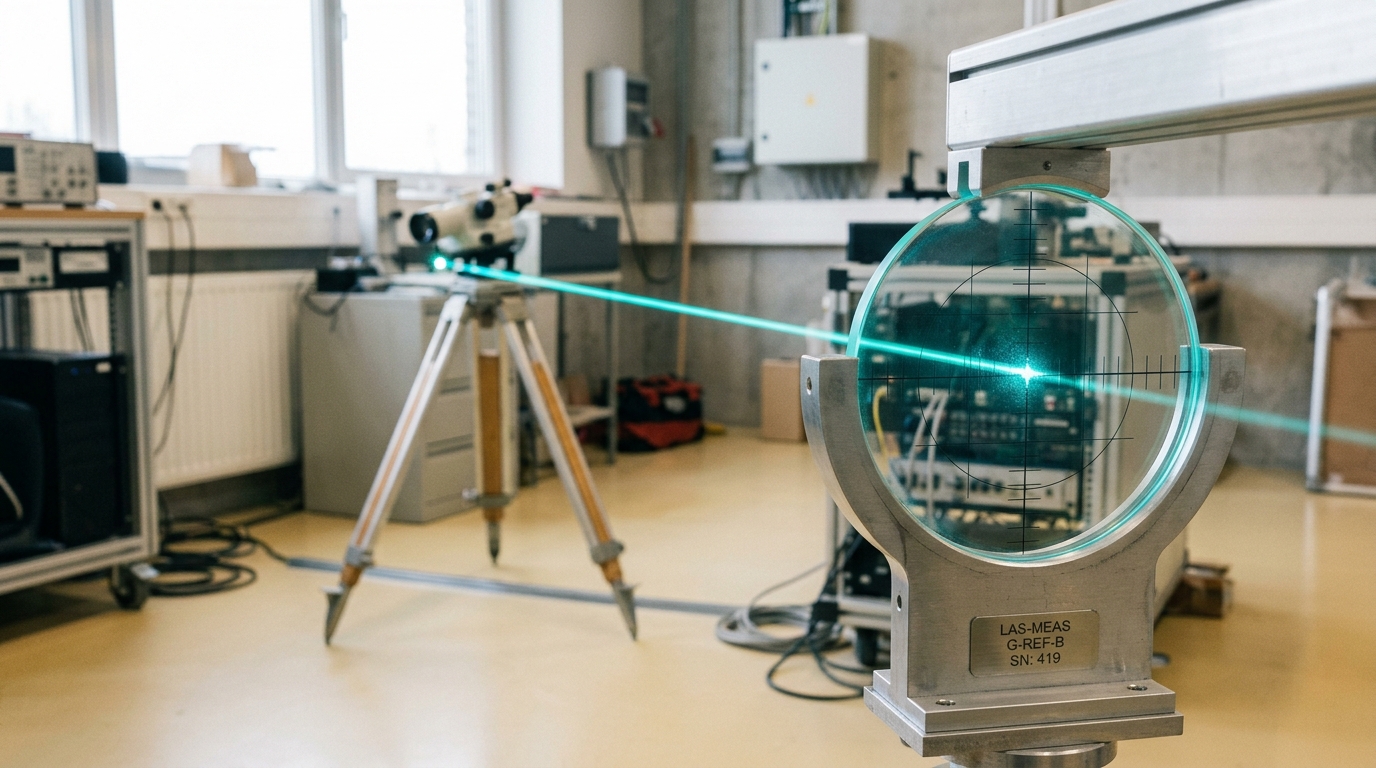
Figure 2. Translate, boost, translate back, boost back: the classical stage returns to zero. The quantum phase it stands in for does not.Image prompt and art direction by Brecht Corbeel; generation pending.
Why Special Relativity Never Needed This Escape Hatch
The obvious next question is why ordinary relativistic quantum mechanics gets along without any of this. Run the identical calculation on the Poincaré group. The relativistic analogue of the boost–momentum commutator is
[Ki,Pj]=c2iℏδijH,
where H is the total energy operator [2]. The right-hand side is not proportional to the identity. It is proportional to H, an operator with a spectrum, different on every energy eigenstate. Repeating the loop calculation of the previous section on a state with sharp energy ⟨H⟩ gives a phase ⟨H⟩b⋅v/(ℏc2) that varies from state to state. A central extension, by definition, must give the same phase to every vector in the representation; a state-dependent phase is not a central extension, it is an ordinary consequence of ordinary dynamics, and it can be removed by working with true, non-projective unitary representations of the Poincaré group throughout. This is the content of Bargmann’s own cohomology theorem: semisimple factors such as the Lorentz group admit no continuous central charge, so relativistic quantum mechanics carries no analogue of the mass superselection rule that follows from the Galilei case [1, 4]. Mass in special relativity shows up instead as the ordinary Casimir invariant PμPμ=m2c2: a quantum number you diagonalize, not a phase a loop leaves behind.
The two pictures are not independent theories that happen to share a symbol. The Galilei phase is the c→∞ residue of the Poincaré non-extension, and the residue can be taken explicitly rather than asserted. Write the energy operator for a system at rest as H=Mc2+HNR, separating the rest energy from whatever nonrelativistic energy — kinetic, internal — sits on top of it. The relativistic loop phase becomes
ℏc2⟨H⟩b⋅v=ℏMb⋅v+ℏc2⟨HNR⟩b⋅v.
Holding b, v, M, and ⟨HNR⟩ fixed and sending c→∞, the second term vanishes and the first survives unchanged, converting a state-dependent relativistic phase into a fixed, universal constant multiplying every vector in the fixed-M sector — Bargmann’s central charge, reconstructed as the low-velocity limit of a quantity that was never central to begin with. This is exactly the contraction procedure Inönü and Wigner formalized for groups and their representations in general [3], applied here to one specific commutator rather than asserted as a general slogan. The nonrelativistic mass superselection rule is, on this reading, the shadow a fully relativistic, non-superselected world casts onto its own c→∞ limit — a point developed independently in later work reconciling the rule with ordinary relativistic quantum mechanics [4].
A Mass Gauge Built From a Derivative, Not a Snapshot
Before pointing this construction at an interferometer, one methodological trap needs naming. A single measured phase Φ at one fixed loop area cannot, by itself, distinguish m from an unknown additive offset baked into the apparatus — any constant phase shift from an uncalibrated pulse timing, an unaccounted path-length difference, or a stray field looks identical to a rescaling of b⋅v. The estimator that survives this is a derivative, not a snapshot:
mop=c2ℏ∂Δτ∂Δϕ,mop[LG]=ℏ∂(b⋅v)∂Φ.
The sign convention on the proper-time form follows the phase of a free relativistic particle, Δϕ=−mc2Δτ/ℏ, so that mop=−(ℏ/c2)∂Δϕ/∂Δτ recovers m identically when Δϕ has no other dependence. Both forms require sweeping the loop’s own parameter — hold time, translation distance, boost velocity — across at least two settings and fitting the slope, exactly as a spectroscopist extracts an energy gap from a swept detuning rather than from one photon count. A single unswept measurement cannot report a mass gauge at all; it can only report a phase.
Two degenerate limits of the proper-time form confirm the derivative is doing the right job rather than hiding a division problem. As m→0, Δϕ→0 at every fixed Δτ, so the slope — and therefore mop — vanishes identically: a massless worldline is exactly the case with no proper time to speak of in the first place, and the formula correctly returns nothing to divide. And if the two branches are held at equal proper time, Δτ=0, then Δϕ=0 regardless of m; a single measurement at that one setting is a 0/0 statement about mass, not a small number. Both limits are trivial once stated, and both are exactly why the estimator was built as a slope across a family of loops rather than a ratio taken at one of them.
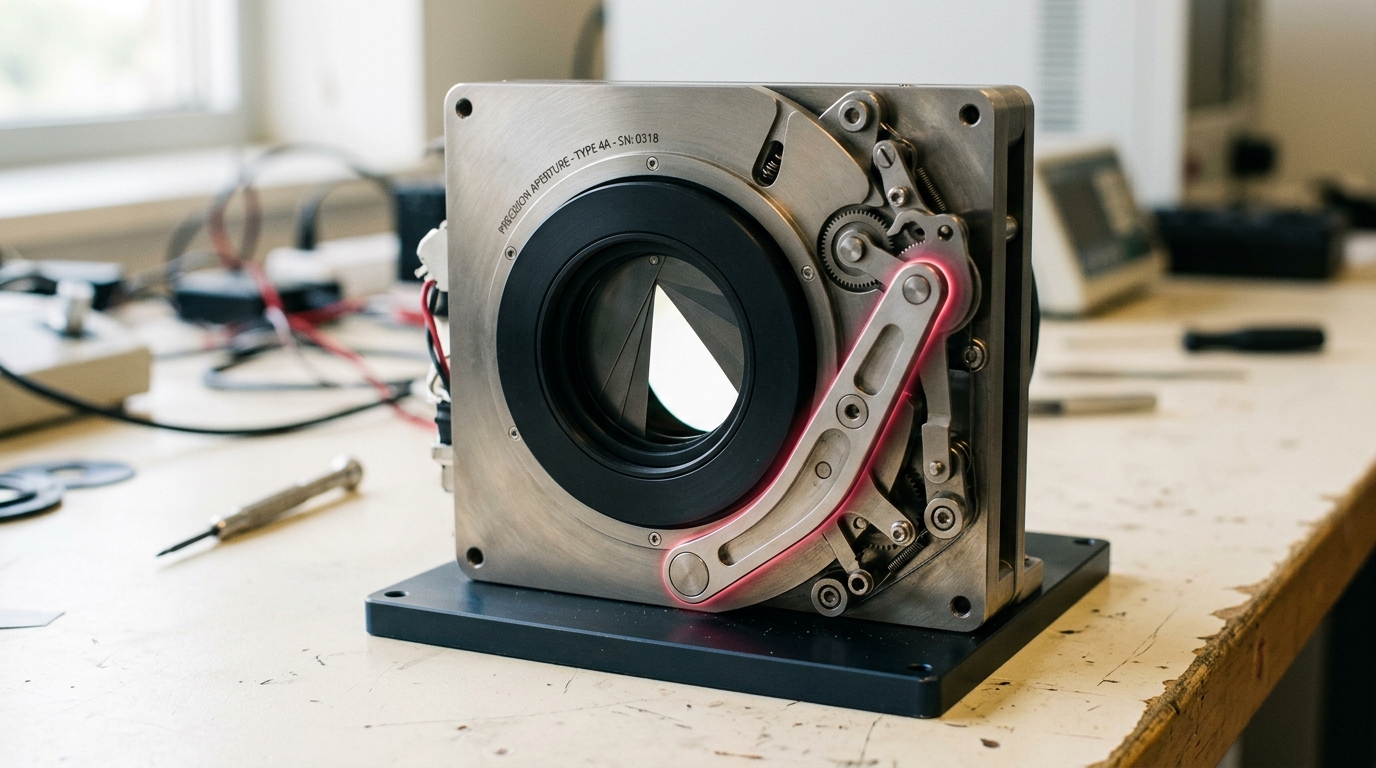
Figure 3. A single phase value cannot separate mass from an offset. Only the slope against a swept hold time can, and the sweep is unfinished.Image prompt and art direction by Brecht Corbeel; generation pending.
The Galilei loop admits an exact, non-simulated numerical check of the whole chain, because Φ[LG] is precisely the recoil phase every stimulated-Raman atom interferometer already uses for its own calibration. Take a sodium atom, m=3.8175×10⁻²⁶kg, driven by a two-photon stimulated-Raman transition on the 589nm line, effective wavevector keff=2(2π/589nm)=2.1335×107m−1[16]. The associated recoil velocity is vr=ℏkeff/m=5.894cms−1. Hold the loop open for T=50ms, comparable to the short interrogation times of early stimulated-Raman interferometers, so the translation leg is b=vrT=2.947mm. The loop area is vrb=vr2T=1.737×10⁻⁴m2s−1, and the phase debt is
Φ[LG]=ℏmvrb≈6.29×10⁴rad.
This is an exact analytic evaluation of the formula derived above for stated, idealized parameters — not a simulation, not a measurement, and not the output of any code run for this article. It is offered as illustrative, and it carries a built-in consistency check: because vr=ℏkeff/m by definition of a recoil kick, the same number equals ℏkeff2T/m, the ordinary recoil phase used to extract ℏ/m in precision atom-interferometry measurements through the general path-integral formalism for atomic interferometry [14]. The two expressions are algebraically identical, so this is a check that the loop construction reproduces a quantity the field already measures by an independent route, not new physics. Inverting the formula returns mop[LG]=ℏΦ/(vrb)=m exactly, because the phase was defined from m in the first place. That circularity is the point of this section: it isolates what an idealized, confound-free evaluation looks like, so the next two sections can show exactly what breaks the idealization.
A Composite Clock Owes Its Mass to What It Is Doing Inside
The proper-time loop LP is where mass stops being a fixed label and becomes something an object can carry a little more or less of depending on what it is doing internally. A composite system with an internal excitation of energy ΔE above its ground configuration carries additional rest mass ΔE/c2, by ordinary mass–energy equivalence — no redefinition of either the relativistic or the everyday meaning of mass, simply the standard bookkeeping in which a system’s total rest energy Mc2 includes whatever internal energy Hint it holds: M=M0+Hint/c2. If the same object is sent along two paths that differ in proper time by Δτ, and its internal state differs between the two paths — ground on one, excited on the other — then the two branches’ free-particle phases differ by
Δϕclock=−ℏΔEΔτ.
The shared M0c2Δτ/ℏ term, common to both arms, is an overall phase and drops out of any interference signal — consistent with the rule that only relative phase between branches is ever observable. What survives is a clock-visible term set entirely by the internal-energy difference, first proposed as an observable interferometric signature of general-relativistic proper time by Zych, Costa, Pikovski, and Brukner [10], and later reframed explicitly as a quantum analogue of the twin paradox by Loriani and collaborators [11].
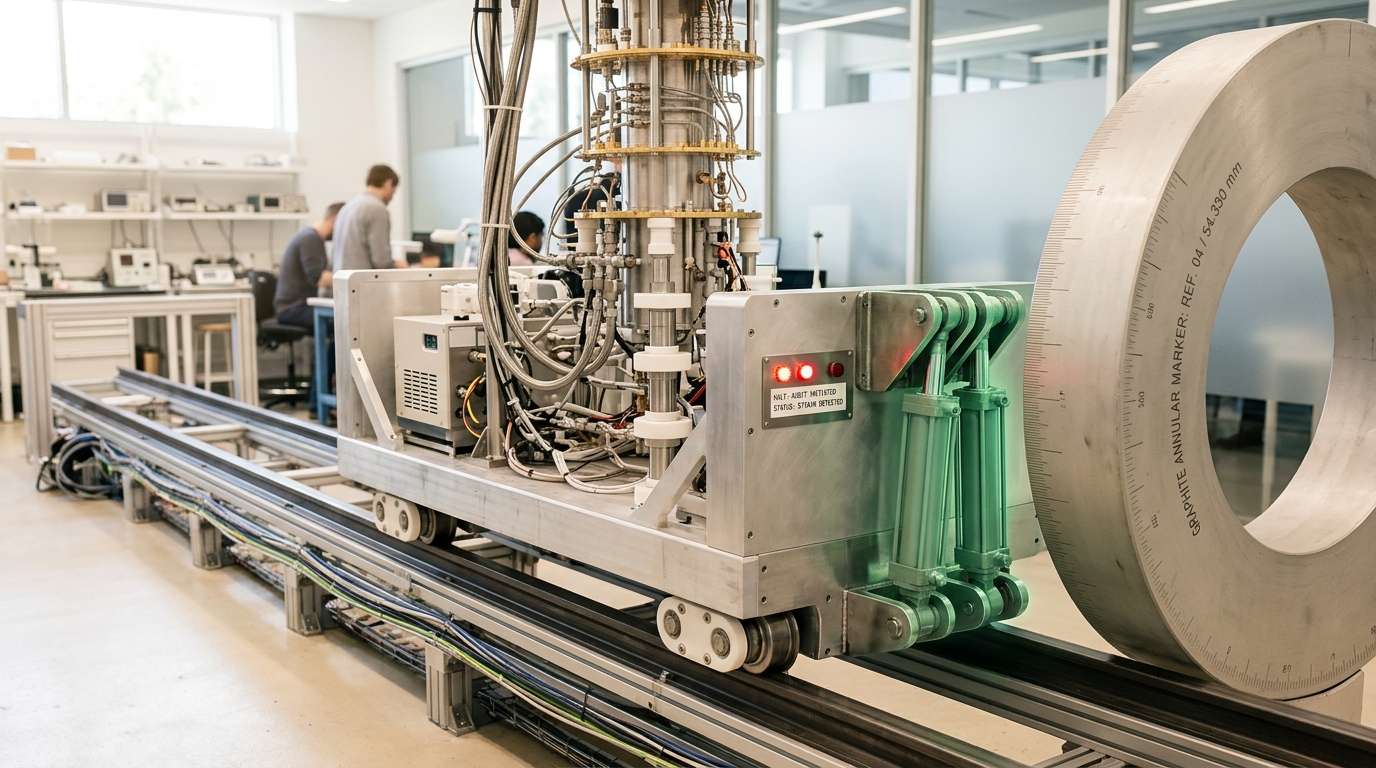
Figure 4. Two heights, one held clock. The proper-time gap between them is real and tiny; the fiber link is what tries to compare it.Image prompt and art direction by Brecht Corbeel; generation pending.
To make this concrete without simulation, take the weak-field proper-time rate dτ/dt≈1+gz/c2 for a static height z in Earth’s field, so that holding two branches at a height difference Δz for coordinate time T gives Δτ≈gΔzT/c2. For Δz=1m and T=1s, Δτ≈1.090×10⁻¹⁶s. Pair this with a single-photon optical clock transition near 698nm, comparable to the transition used in strontium-lattice-clock proposals for this kind of experiment [11, 13], giving Δν≈4.295×10¹⁴Hz and ΔE=hΔν≈2.846×10⁻¹⁹J, a mass excess ΔE/c2≈3.167×10−36kg.
Figure 5. The internal-state label that makes a composite object's mass negotiable is supplied here, and the lock light has not settled yet.Image prompt and art direction by Brecht Corbeel; generation pending.
The resulting clock phase is
Δϕclock=2πΔνΔτ≈0.294rad.
This, again, is an exact evaluation of a stated formula under stated idealized assumptions — a single-photon clock transition, no recoil, no laser phase, a static height difference held exactly one second — offered as illustrative, not as a report of anything measured. No such experiment has been performed at this scale; it is precisely the regime the cited proposals argue is at the edge of feasibility with current optical-clock coherence and large-scale atom-fountain technology, not a regime already demonstrated.
The Rival Account Says the Gauge Never Left the Ground
Here is the strongest objection this construction has to survive, and it is not hypothetical — it was argued in print for over a decade. In 2010, Müller, Peters, and Chu proposed that an ordinary light-pulse atom interferometer’s gravimeter phase already constitutes a measurement of the gravitational redshift at the atom’s Compton frequency mc2/ℏ, reading the standard interferometer as an implicit realization of exactly the proper-time phase this paper formalizes [6]. Wolf, Blanchet, Bordé, Reynaud, Salomon, and Cohen-Tannoudji objected immediately: the standard three-pulse Mach–Zehnder gravimeter phase, computed by the ordinary classical-action method, is ϕ≈keffgT2, a quantity built entirely from the laser wavevector, gravitational acceleration, and pulse timing, with no dependence on the atom’s mass at all [7]. Sinha and Samuel sharpened the point into a slogan worth taking literally: an atom in this configuration is not a clock ticking at the Compton frequency, because nothing in the standard phase formula reads out that frequency [8].
Figure 6. Recoil phase and laser phase are real signals, not noise. Isolating the small internal-energy term means routing them out first.Image prompt and art direction by Brecht Corbeel; generation pending.
This objection is not merely an engineering difficulty to be improved away. It is close to a theorem. The weak equivalence principle — the universality of free fall, tested to extraordinary precision using exactly this kind of dual-species interferometry [12] — guarantees that the center-of-mass trajectory of a falling object cannot depend on its mass or internal composition. Since the dominant term in the standard gravimeter phase is built from that trajectory and from the laser field alone, mass is required to cancel from it; a claimed mass-dependence surviving in the leading term would itself be evidence against the weak equivalence principle, not evidence for a working mass gauge. If the phase debt of LP is going to mean anything operationally, it cannot live in the part of an interferometer phase that the weak equivalence principle already forbids from carrying mass information.
What Survives After Recoil and Laser Phase Are Subtracted
The resolution, worked out over the following decade, is that the objection is correct about the standard configuration and does not apply to a different one. Roura’s 2020 analysis of quantum-clock interferometry shows precisely which terms in a full interferometer phase carry redshift information and under what conditions they can be isolated from the laser-driven center-of-mass phase that the weak equivalence principle protects [9]. Di Pumpo and collaborators extended the bookkeeping to a general accounting of atomic-clock and atom-interferometric redshift tests, making explicit that the redshift signature requires a genuine internal-state superposition correlated with the spatial paths — not merely two branches of the same internal state — together with a symmetric, single-photon pulse design that keeps recoil and laser-phase contributions common to both branches so they cancel rather than swamp the signal [13].
The scale of what needs to be canceled is worth stating plainly, using the same illustrative parameters as the previous section. The laser/center-of-mass term for a single-photon transition near 698nm (keff≈9.00×10⁶m−1) scales as keffgT2≈8.8×10⁷rad for T=1s. The recoil term for a strontium-mass atom (m≈1.443×10⁻²⁵kg) scales as ℏkeff2T/m≈5.9×104rad. The clock term computed above is ≈0.29rad. Both confound terms are, respectively, roughly eight and five orders of magnitude larger than the signal, which is exactly why isolating Δϕclock is described in this literature as requiring careful differential design rather than being visible in a raw phase reading.
This is where the operational construction earns or loses its claim to be a mass gauge rather than a definition with no experimental content. Distinguish two separate clauses of Einstein’s equivalence principle. The weak equivalence principle protects the laser/center-of-mass term, forcing it to be mass-independent; that is not this paper’s target, and no version of LP challenges it. Local position invariance — the universality of clock rates across spacetime position — is the clause the internal-energy term actually probes, and it is a logically separate statement, untouched by the weak equivalence principle’s guarantee. The kill criterion for this whole construction is now a fully arithmetic statement: once recoil phase, laser phase, path-dependent terms, and the internal-energy term are all included through the full accounting given in [9] and [13], if the differential protocol’s extracted mop still disagrees with the independently known ΔE/c2 by more than the protocol’s own stated control budget, the operational mass gauge fails as a measurement concept even in its narrowed, differential-clock form — regardless of whether the underlying phase formula remains theoretically correct. A correct formula that cannot be isolated from its own confounds at the required precision is not an operational estimator; it is an equation.
Where the Gauge Is Already Known to Fail
No experiment has run the differential two-height, two-internal-state protocol at the meter-and-second scale used illustratively above; it remains a proposal, not a result [10, 11]. What existing data already constrain is the space this construction is allowed to occupy. Dual-species atom-interferometric tests of the weak equivalence principle have matched the free-fall trajectories of different atomic species to extraordinary precision by actively canceling the very laser/recoil terms this paper identifies as confounds, which is direct evidence that no large anomalous mass-dependence is hiding in the dominant phase term this construction must avoid [12]. Separately, ordinary macroscopic clock comparisons across height differences already confirm the leading coefficient of gravitational redshift to high precision through completely classical (non-interferometric) means, constraining Δτ≈gΔzT/c2 itself rather than the interferometric phase built from it.
There is a second, sharper constraint worth stating honestly rather than glossing over. Strict, exact Galilean invariance would forbid any coherent superposition of states with different mass eigenvalues outright — the Bargmann superselection rule, taken literally [1]. Every atomic clock ever operated superposes exactly such states, since an excited internal configuration carries strictly more rest mass than its ground configuration by ΔE/c2, and Ramsey-type coherence between them is measured routinely. This is not a contradiction; it is direct, everyday evidence that nature is Poincaré symmetric rather than exactly Galilei symmetric, with the superselection rule surviving only as the strict, unreachable c→∞ limit derived above rather than as an exact law — a resolution argued explicitly by Zych and Greenberger [5] and consistent with the relativistic-origin account given earlier in this paper [4]. The parameter range in which LG's phase debt is a clean, sharp central charge rather than an approximately central one is therefore bounded by how nonrelativistic the apparatus actually is; nothing in existing data forces that approximation to break at laboratory recoil velocities, but nothing guarantees a clean separation at arbitrary precision either.
What the Loop Remembers If the Fusion Fails
Step back to what has and has not been shown. Two derivations stand on their own regardless of what any interferometer eventually reports: the Galilei loop’s phase debt is an exact, non-perturbative consequence of a centrally extended commutator that has been established mathematics since 1954, and the Poincaré loop’s failure to produce an analogous fixed charge, together with its c→∞ contraction into the Galilei case, follows from standard commutation relations and a standard contraction procedure applied here to one explicit quantity. Those are DERIVED, not proposed.
What is PROPOSED is the packaging: treating both phases as instances of one operational estimator, mop[L]=ℏΦ[L]/A[L], built from a loop’s phase debt divided by its specific-action invariant, extracted as a derivative across swept loop parameters rather than read off a single phase. That packaging is new; the algebra underneath it is not, and this paper has tried not to blur the line between the two.
What remains genuinely open, and OBSERVED nowhere yet, is whether the composite-mass instance of this estimator survives contact with a real interferometer once every recoil, laser, and path term the field already knows how to compute is included in full. The thirty-year dispute between Müller, Peters, and Chu on one side and Wolf, Blanchet, Bordé, Reynaud, Salomon, and Cohen-Tannoudji and Sinha and Samuel on the other was not a disagreement about mathematics; both sides agreed on the interferometer phase formula. It was a disagreement about which piece of a correct formula is allowed to be called a measurement of mass. Roura’s and Di Pumpo and collaborators’ answer — a narrow, differential, single-photon protocol in which the confounds are engineered to cancel — is the only version of this construction with a stated, arithmetic path to being tested. If that narrow protocol, run in full, still cannot deliver mop within its own declared error budget of ΔE/c2, then the honest conclusion is not that the algebra was wrong. It is that a closed loop of frames can owe a Hilbert space a phase without any apparatus built so far being able to collect the debt cleanly enough to call it a reading of mass — and the loop, having closed in space, will have refused to forget something no one now knows how to make it repeat back.
Share this Article
Pass along these insights to your network across your favorite platforms.