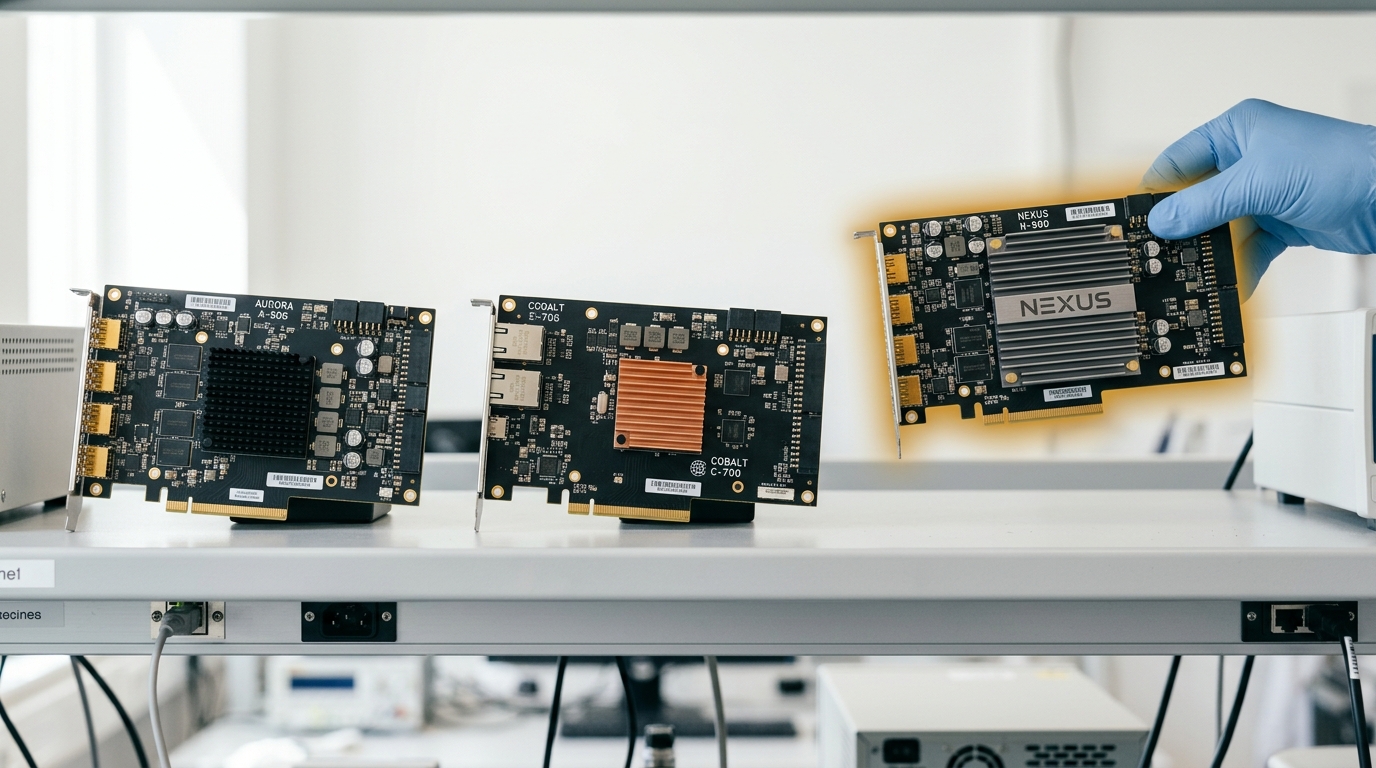
Eight strategies, not one horse race
This cohort’s accelerator and startup tracks cover Nvidia’s challengers individually, company by company. This briefing pulls those threads together into a single synthesis, organized by strategy rather than by company, because the honest answer to “who could unseat Nvidia” depends entirely on which of several structurally different approaches is being asked about.

Strategy one: merchant-GPU parity — AMD
AMD’s approach is the most direct: build GPUs that compete head-on with Nvidia’s on raw specifications and software compatibility, sold to the same customer base through the same commercial channel. This cohort’s AMD briefings document the clearest 2026 evidence of traction — the multi-gigawatt MI450 deal with OpenAI — as the strongest signal this strategy has moved past roadmap promises into signed commercial commitment at meaningful scale.
Strategy two and three: custom-ASIC partnership — Broadcom and Marvell
Rather than competing with Nvidia’s merchant GPUs directly, Broadcom and Marvell both pursue a structurally different bet: designing custom AI accelerator silicon for hyperscalers — Google’s TPU line, Amazon’s Trainium, Microsoft’s Maia — rather than selling a competing merchant product under their own brand. This cohort’s Broadcom and Marvell briefings document Broadcom’s seven- generation TPU design relationship and a stated $100 billion 2027 target, and Marvell’s own Trainium/Maia partnerships backing a $75 billion pipeline claim — both figures this cohort’s coverage treats as claims to be verified against actual delivered revenue rather than accepted at face value.
Strategy four: wafer-scale architecture — Cerebras
Cerebras’s approach is architecturally the most radical on this list: building a single chip the size of an entire silicon wafer, avoiding the chip-to-chip interconnect overhead that dense GPU clusters must otherwise manage. This cohort’s Cerebras briefings cover both the technical bet and its 2026 IPO — a milestone giving the wafer-scale approach public-market validation independent of private funding rounds, a distinction this synthesis treats as meaningfully different traction than a startup still raising exclusively from private investors.
Strategy five and six: architectural specialization — Tenstorrent and SambaNova
Tenstorrent, led by Jim Keller, and SambaNova each pursue architecturally distinct bets — covered in this cohort’s startup track — that trade Nvidia’s general-purpose CUDA-ecosystem flexibility for narrower, purpose-built efficiency gains on specific workload classes. Neither currently reports commercial scale comparable to AMD’s or Broadcom’s disclosed deals, making this strategy category the most technically interesting and the least commercially proven of the eight covered here.
Strategy seven: mobile-to-datacenter expansion — Qualcomm
Qualcomm’s push into AI inference silicon, covered in this cohort’s accelerator-track briefing on the company’s datacenter ambitions, represents a different kind of bet entirely: an established chip company with a dominant position in an adjacent market — mobile silicon — attempting to extend that position into AI inference rather than starting from a clean-sheet design the way the startups on this list do.
Strategy eight: building it yourself — the hyperscalers
The eighth strategy is not a single company but a category this cohort’s Broadcom and Marvell briefings document indirectly: Google, Amazon, and Microsoft each design AI silicon in-house — TPU, Trainium, and Maia respectively — reducing their dependence on any merchant supplier, Nvidia included. This is arguably the strategy with the deepest resources behind it, backed by a combined $725 billion in 2026 hyperscaler capex [2], though it competes with Nvidia only indirectly, by capturing a growing share of each hyperscaler’s own internal workloads rather than displacing Nvidia in the merchant market Nvidia itself measures its dominance against.
What “diversification beyond Nvidia” actually looks like in the market data
This cohort’s markets-track briefing on SOX, SMH, and SOXX documents a concrete 2026 signal for this exact synthesis: SOXX’s 112.8% H1 2026 gain outpaced SMH’s 82.1%, a divergence coverage attributes partly to SOXX’s greater relative weighting toward custom-ASIC and equipment names benefiting as AI spending diversifies beyond Nvidia specifically [3]. That is real market evidence that multiple strategies on this list are gaining investor-perceived traction simultaneously — not proof any one of them displaces Nvidia’s current position, but a meaningful signal the “eight strategies” framing this briefing argues for is already showing up in how capital allocates across the sector, rather than remaining a purely theoretical taxonomy. Direct fund-level comparisons of SMH’s and SOXX’s underlying holdings make the same point from a different angle: the two funds’ diverging construction methodologies increasingly reflect a genuine difference in how much non-Nvidia exposure each carries, not merely a short-term trading anomaly [4].
The honest synthesis
None of these eight strategies currently threatens Nvidia’s overall dominant position, documented elsewhere in this cohort’s Nvidia-specific briefings at a market capitalization and revenue scale none of the eight challengers individually approaches [1]. What has changed by 2026 is that multiple genuinely different strategies now show real signed commercial traction simultaneously, rather than Nvidia facing one clear challenger pursuing one clear counter-strategy. That multiplicity — eight different bets, several with real traction, none yet dominant — is a more accurate and more interesting picture than either “Nvidia is unassailable” or “Nvidia is about to be unseated” would suggest on its own.