The most radical departure in this cohort
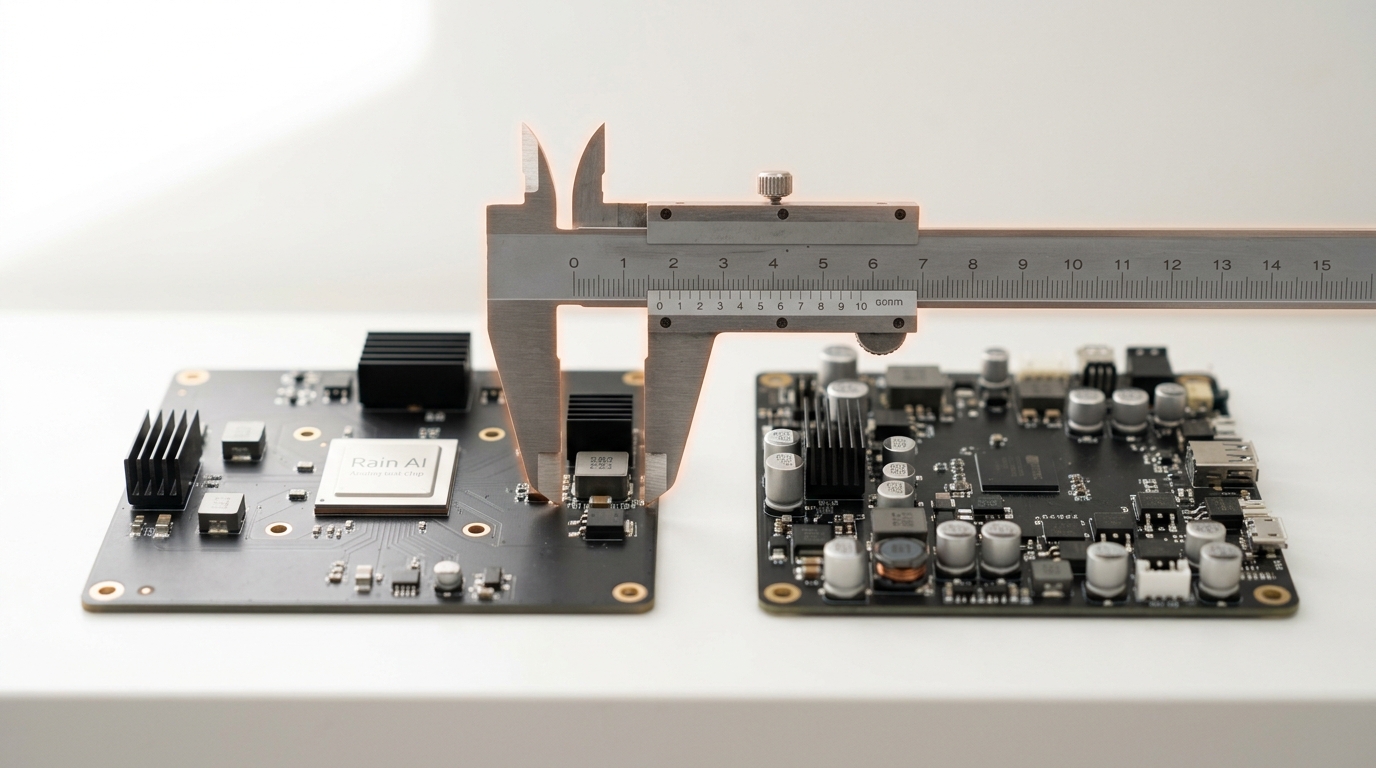
Every accelerator covered elsewhere in this cohort’s startup track — Groq’s LPU, Cerebras’s wafer-scale die, SambaNova’s reconfigurable dataflow, Etched’s transformer-specific ASIC — still computes digitally: information represented as discrete ones and zeros, processed through conventional logic gates, however specialized their arrangement. Rain AI departs from that shared foundation entirely, building analog, brain-inspired compute — silicon that represents and processes information as continuously varying signals rather than discrete digital values, taking direct inspiration from how biological neurons actually compute [3].
Why analog computing promises a fundamentally different efficiency curve
Digital computation’s precision and reliability come at an energy cost: representing information as clean, discrete digital states requires constantly correcting and regenerating signals to prevent noise from corrupting the underlying ones and zeros. Analog computation, by contrast, can in principle perform certain operations — particularly the weighted-sum calculations at the heart of neural network inference — directly in the physical behavior of an analog circuit, without the overhead of digital signal regeneration. This is the theoretical basis for analog compute’s efficiency promise: for the right class of operations, it could be dramatically more power- efficient than digital silicon performing the mathematically equivalent calculation.
Why this promise has taken decades to reach commercial viability
Analog computing for neural networks is not a new idea — researchers have pursued brain-inspired analog architectures for decades without achieving the commercial breakthrough digital deep learning achieved instead. The core obstacle has historically been manufacturing precision: analog circuits are far more sensitive to the microscopic manufacturing variations every chip inevitably has than digital circuits are, since a digital circuit only needs to reliably distinguish “on” from “off” while an analog circuit needs consistent, precise continuous values across every individual device on the chip. Rain AI’s commercial bet depends on modern semiconductor manufacturing precision, decades more advanced than during earlier analog-computing attempts, finally being good enough to make the approach commercially viable rather than merely a research curiosity [4].
Why this is explicitly the long-shot bet in this cohort
Independent industry rankings consistently place Rain AI among the higher-risk, more speculative entries in the broader AI-chip startup landscape, reflecting both the genuine technical difficulty of the approach and the comparative immaturity of analog-computing manufacturing and tooling relative to the decades of accumulated digital-chip production experience every other company in this cohort’s startup track can draw on [2]. That is not a criticism of the company’s ambition — it is a fair description of where analog neuromorphic compute currently sits on the maturity curve, several steps behind the digital specialized architectures covered throughout the rest of this track.
What would count as validation
Given the technology’s early stage, the most meaningful near-term validation would not be a finished, shipping commercial product but a credible, independently reviewed demonstration that Rain AI’s specific analog architecture can be manufactured with acceptable yield and consistency at a scale beyond a research prototype — the manufacturing-precision hurdle this briefing identifies as the historical obstacle every prior analog-computing attempt has failed to clear [1]. Clearing that hurdle would not by itself guarantee commercial success, but it would be the first concrete evidence that this specific attempt might succeed where decades of prior analog-computing research did not.
Why this bet deserves a place in this cohort despite the risk
It would be easy to exclude a company this speculative from a research-oriented publication in favor of only covering more commercially proven bets. This cohort includes Rain AI deliberately, for the same reason it covers Rapidus’s unproven 2nm foundry ambition and Positron’s narrow inference-only wager: understanding where an industry’s edges actually are — the genuinely uncertain bets, not just the safe, already-validated ones — is part of giving an honest account of where the field stands. A long shot that pays off would be one of the more consequential developments in this entire cohort’s coverage; one that doesn’t would still have tested a hypothesis worth testing, and either outcome is more informative to a reader than pretending the bet doesn’t exist.
The comparison every reader should keep in mind
Every other startup in this cohort’s Track D, whatever its own risk profile, is still fundamentally extending or specializing an already-proven digital computing paradigm. Rain AI is the one company in the entire cohort proposing to step outside that paradigm altogether. That makes it simultaneously the hardest company in this track to forecast with any confidence and the one whose success, if it comes, would have the broadest implications — not just for one company’s market share, but for what AI hardware as a category is even built from going forward.