Selection needs variation that already exists
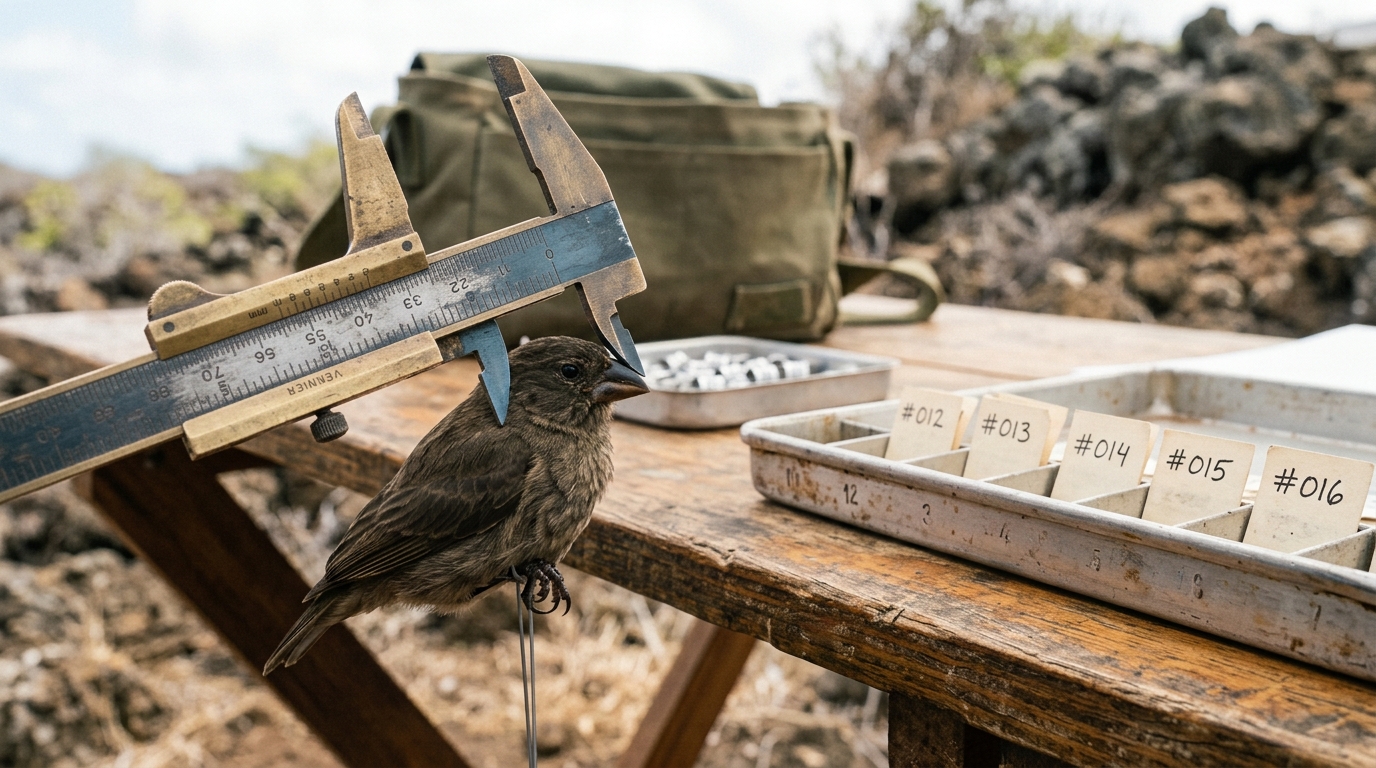
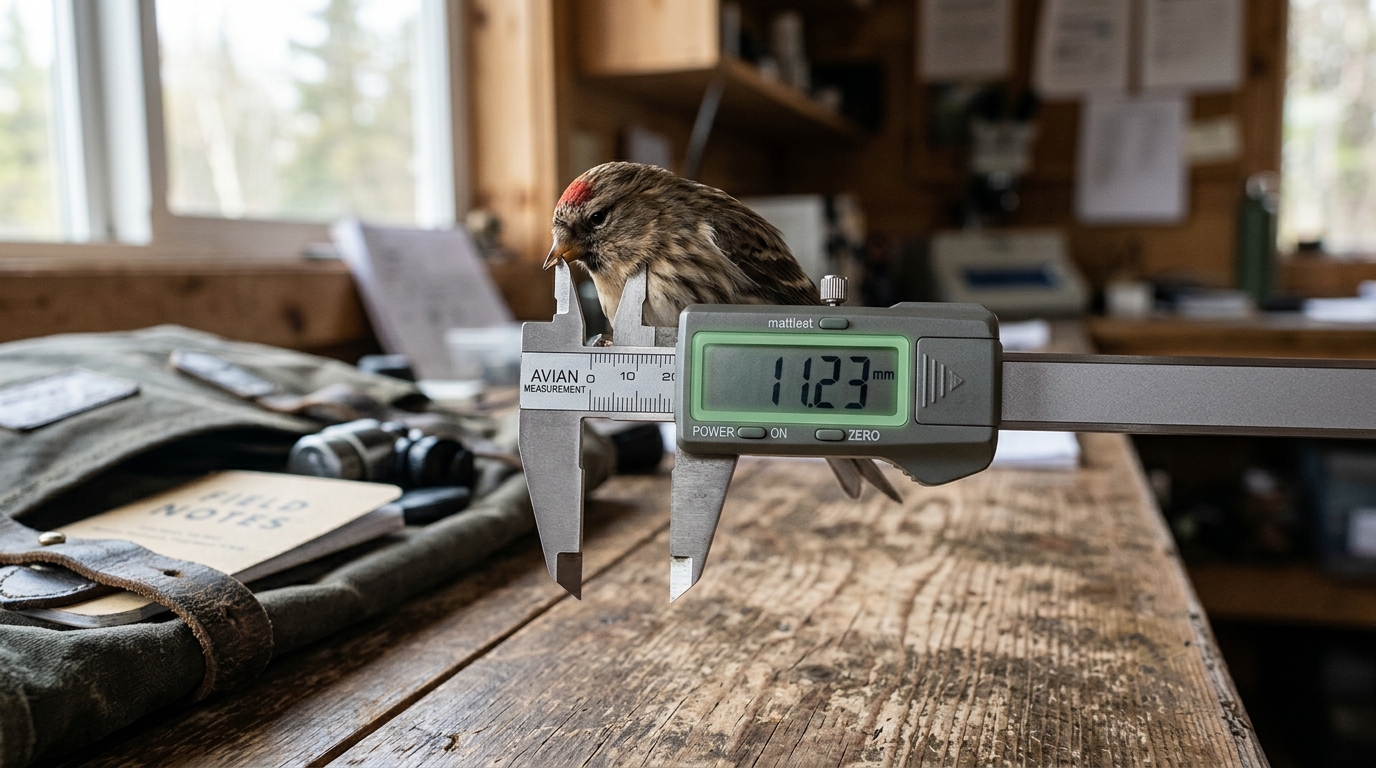
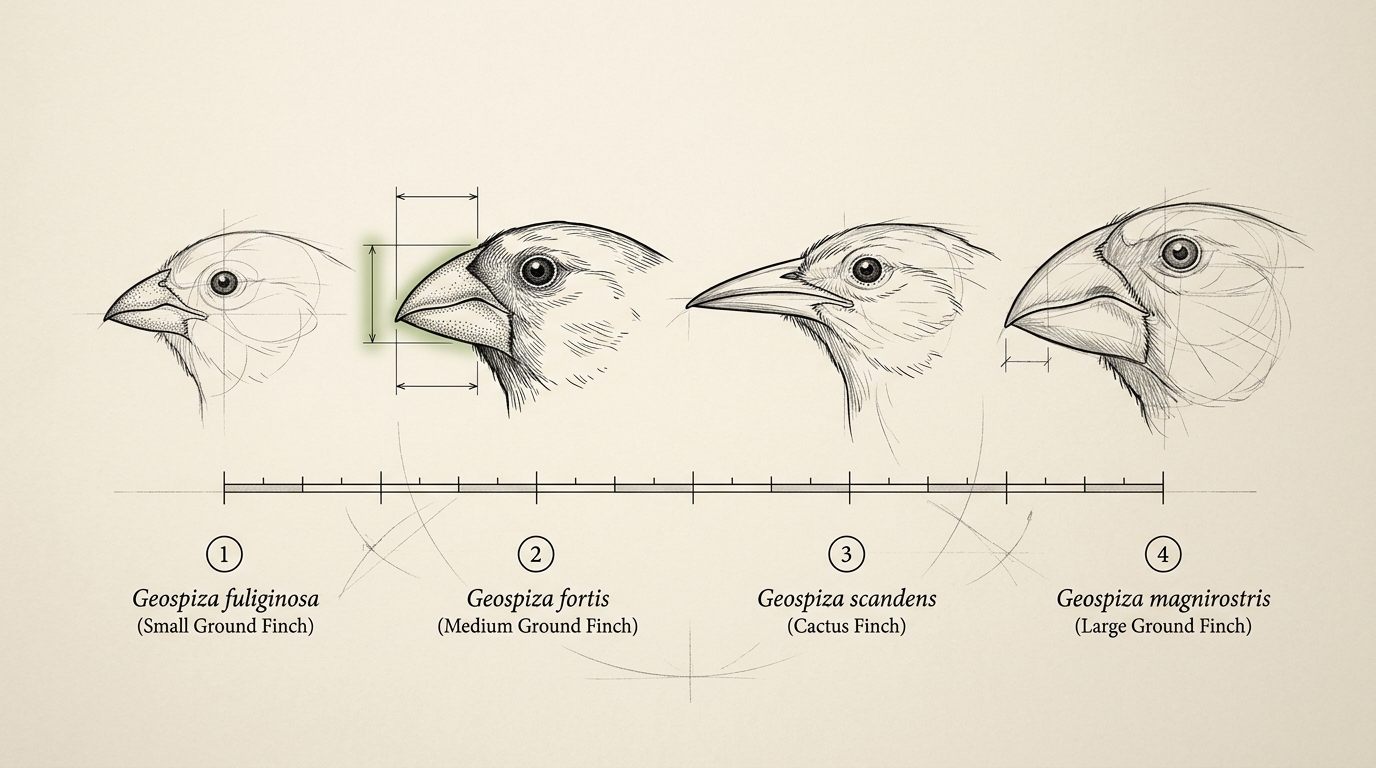
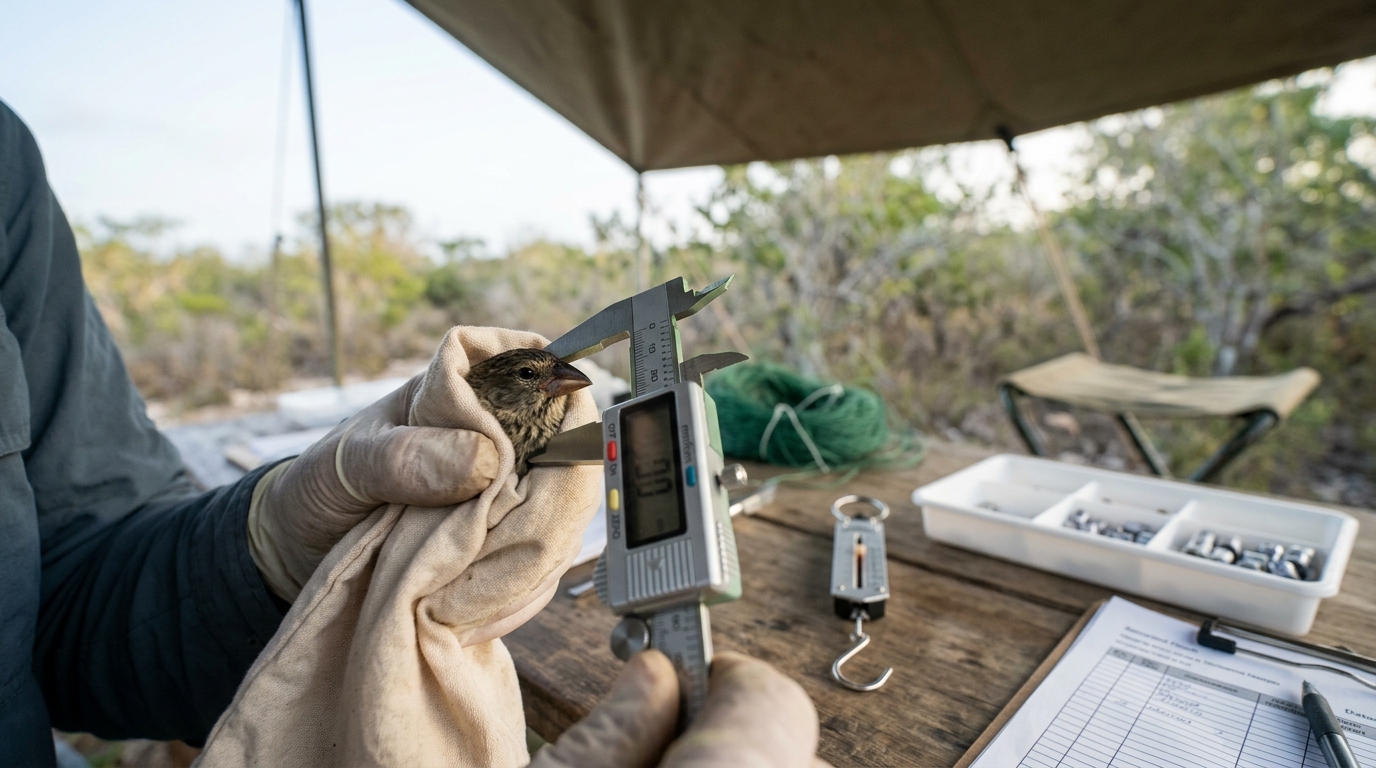
Natural selection is often narrated as though it invents the trait it favors. It does not — it samples from variation already standing in a population, and the clearest demonstration is a multi-decade census rather than a model. Peter and Rosemary Grant tracked two finch species, Geospiza fortis and Geospiza scandens, on the small Galápagos island of Daphne Major from 1972 to 2001, measuring beak depth, beak length, and body size on every bird they could catch, year after year [1].
A severe drought in 1977 collapsed the supply of small, soft seeds and left mostly large, hard ones. Birds with deeper, stronger beaks could crack them; birds with shallower beaks mostly could not. Average beak depth in the surviving population rose measurably within a single generation — not because deep-beaked birds mutated into existence during the drought, but because the drought changed which already-existing beak depths survived to breed. Fact, directly measured: mean beak depth shifted in a known direction after a known selective event, on a population of individually marked, repeatedly re-measured birds [1]. Analysis, not directly observed: the shift is attributed to differential survival acting on standing heritable variation, inferred from parent-offspring resemblance data rather than watched trait-by-trait in real time.
The Grants’ data also complicate the tidy textbook version. Beak shape reversed direction in wet years that favored small seeds again, and the two finch species’ fortunes were entangled through competition for food. Selection pressure fluctuated in direction and strength from year to year, which is why the paper’s own title calls the long-run trajectory “unpredictable” even though each short interval was consistent with measured selection and known inheritance [1]. Predictability at the mechanism level does not add up to predictability at the multi-decade level, because the environment that sets next year’s selection coefficient is not forecastable from this year’s.
Watching adaptation happen inside a human lifetime
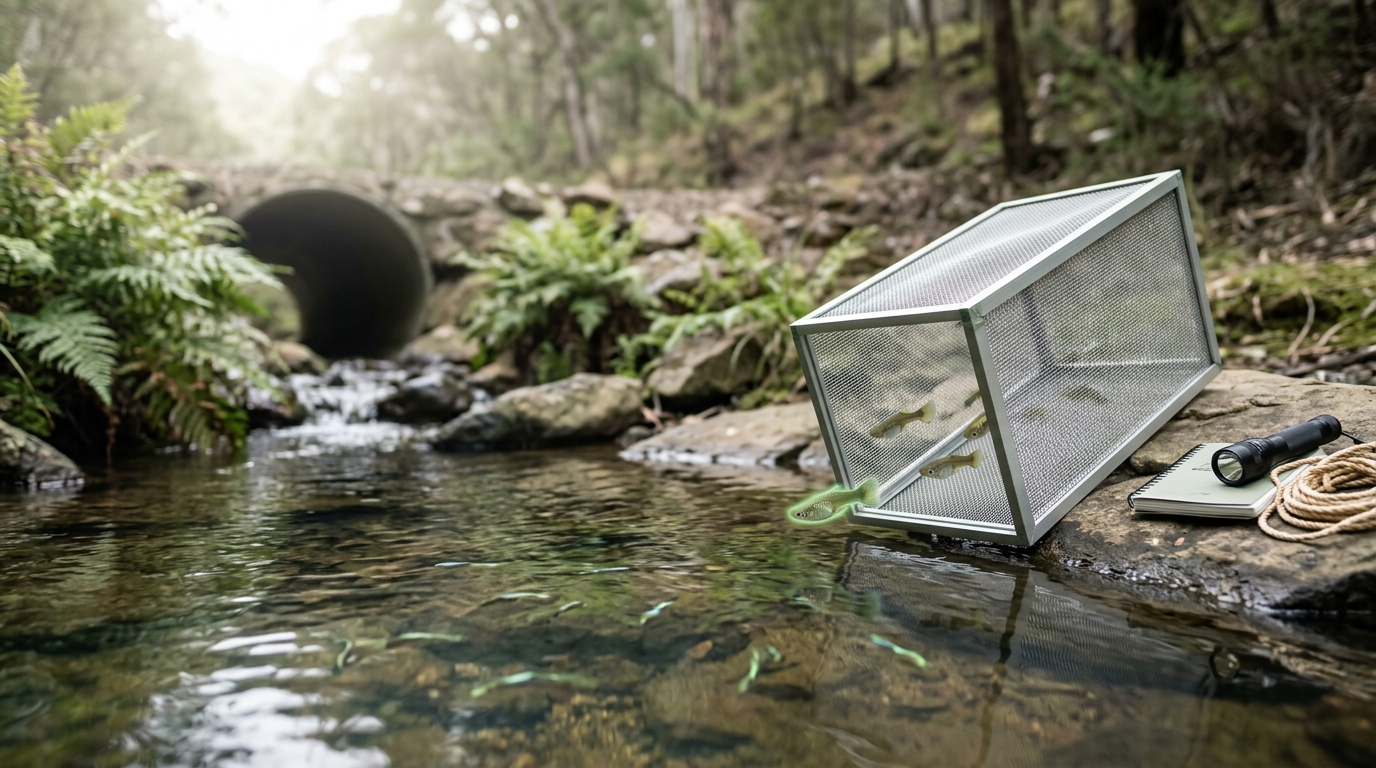
A common objection to selection as an explanatory mechanism is that it is too slow to observe. David Reznick and colleagues addressed this directly by moving wild Trinidadian guppies (Poecilia reticulata) from streams with intense predation, where fish that matured early and small had the best odds of reproducing before being eaten, into streams with little or no predation, where a fish that delayed maturity and grew larger before breeding did better [2]. This was a real transplant, not a simulation: living animals were physically relocated and their descendants sampled in the field over subsequent years.
Within roughly four to eleven years — a handful of guppy generations — the transplanted populations’ age and size at maturity had shifted toward the pattern favored by the new, safer environment. Fact: the measured rate of phenotypic change was similar to rates achieved under deliberate artificial selection in captivity, and up to several orders of magnitude faster than rates typically inferred from fossil lineages over geological time [2]. Analysis, not a new finding on its own: fossil-record rates average change over thousands to millions of years, smoothing over exactly the kind of rapid, reversible, environmentally triggered shift the guppy and finch studies caught directly — a process can be fast in the short interval and look slow averaged over geological time.
What drift does, and why it is harder to see directly
Selection has a directional signature: a trait changes because it affects survival or reproduction. Genetic drift has no direction at all — it is the random change in allele frequency that occurs simply because a finite number of individuals reproduce in any given generation, and chance sampling in who breeds and who does not always introduces noise, regardless of whether a variant is helpful, harmful, or neutral. Drift is real in every population, but its effects are only large enough to matter — large enough to fix a variant or lose it outright within a few generations — when the effective breeding population is small.
Richard Frankham’s review of conservation genetics assembled evidence, largely from managed and reintroduced wildlife populations where census records make the effect traceable, that small effective population size measurably erodes genetic diversity and elevates inbreeding depression, and that the genetic factor in extinction risk had historically been underweighted relative to purely demographic threats [5]. Fact: effective population size, the number that actually determines genetic behavior, is commonly only about a tenth of the visible census count, because not every counted individual breeds — the gap that lets drift bite even in populations that look numerically comfortable [5]. Analysis: this is why drift is the hardest of the three mechanisms here to show in one field snapshot the way selection was shown on Daphne Major — its signature is an absence, visible only by comparing diversity across many small populations against theoretical expectation, not by watching one population change in one dramatic season.
Speciation caught mid-split, without a mountain range in between
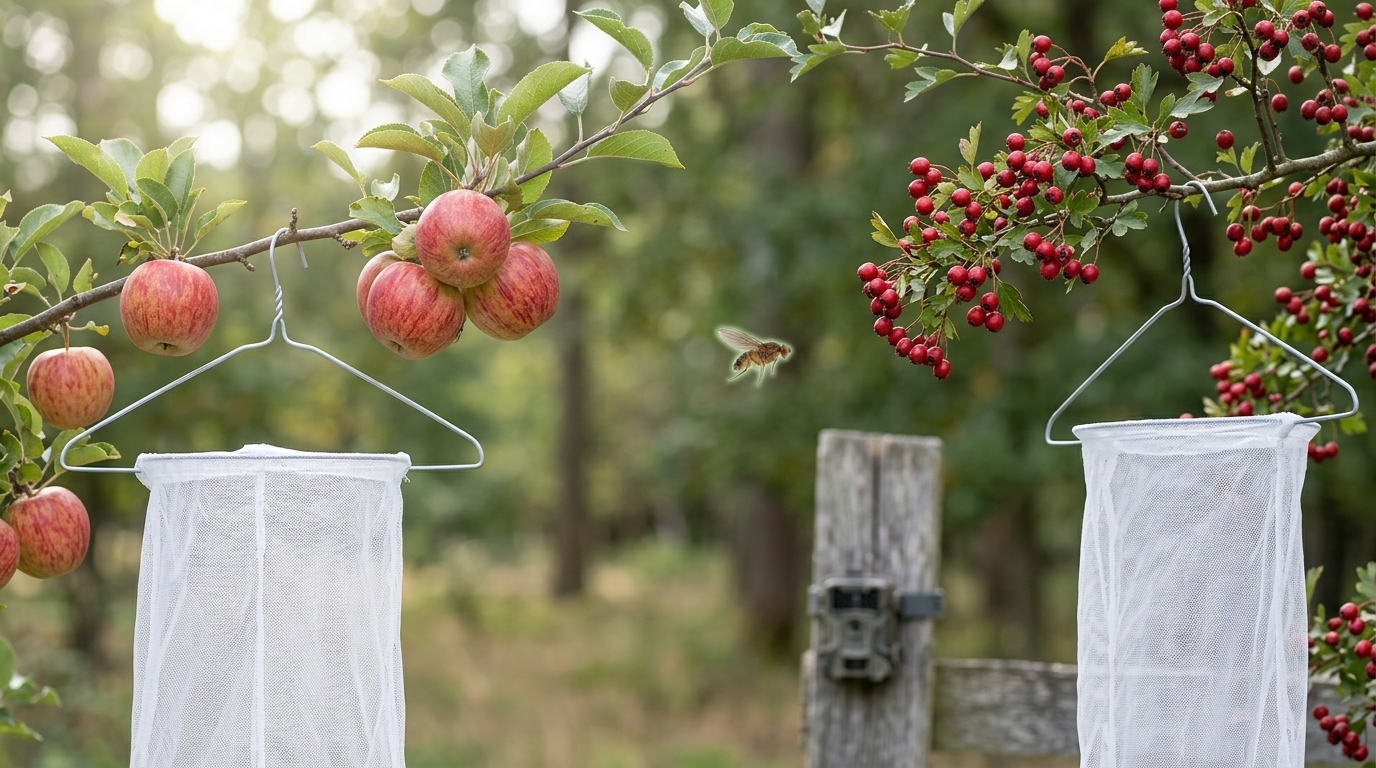
The oldest simple story of speciation requires geographic separation: a population is divided by a river, a mountain range, or an ocean, and the two halves drift apart until they can no longer interbreed. The apple maggot fly, Rhagoletis pomonella, is one of the best-documented cases of speciation proceeding without any such barrier. The fly’s ancestral population fed and mated exclusively on native hawthorn fruit in North America. Sometime after apple trees were introduced, some flies shifted to laying eggs in apples instead.
Because each fly’s larvae develop inside the fruit it hatched in, and adults preferentially court and mate on the same fruit type they emerged from, host choice itself became a mating filter — hawthorn flies mate mostly with hawthorn flies, apple flies mostly with apple flies, even where the two trees grow side by side [3]. Fact, measured directly: flies on hawthorn and flies on apple at the same sites differ at multiple allozyme loci, and these genetic differences persist across generations at levels greater than chance despite shared habitat and continued opportunity to interbreed [4]. Analysis: that persistence is what makes this a documented case of sympatric speciation in progress rather than divergence after physical isolation — host fidelity substitutes for a mountain range as the barrier to gene flow.
Caveat, stated explicitly: the apple and hawthorn races are not yet fully separate species by every criterion — some gene flow continues, and researchers differ on how much additional divergence would be needed before the split is complete. The case is strong evidence for the mechanism by which sympatric speciation can begin, not a claim that it has already finished.
Ecosystem context is not a separate topic from selection
None of the three field cases happen in isolation from the ecological web around them. The Grants’ finches respond to rainfall, seed hardness, and competition for food; guppies respond to a specific predator community; apple maggot flies respond to which fruiting trees are locally available and when. Selection pressures are ecological facts before they are evolutionary ones — a drought becomes a selective event only because it changes what food is available.
A population’s genetic diversity, sustained against the steady erosion of drift, is part of what lets it track a shifting environment the way Daphne Major’s finches tracked shifting rainfall — less standing variation means fewer options for selection to act on. Ecosystem-level biodiversity does the analogous job for whole communities: more species sharing a landscape make it more likely some group can track a given disruption.
The scale of the current disruption
The mechanisms above describe how populations track change that happens over years to millennia through ordinary ecological fluctuation. The IPBES global assessment, compiled by roughly 145 expert authors and reviewed against about 15,000 scientific and government sources, estimated that around one million species are currently at risk of extinction, more than at any prior point in human history, and that at least 680 vertebrate species have already been driven extinct since the year 1500 [6]. Fact, from the assessment itself: the report identifies changes in land and sea use, direct exploitation of organisms, climate change, pollution, and invasive species, in that descending order, as the primary direct drivers of the current extinction trend [6].
Where this briefing’s analysis stops and a scenario begins: whether a threatened population can adapt fast enough to persist depends on the same three variables covered above — standing genetic variation, effective breeding population size, and whether a viable alternate niche exists, the way apple maggot flies shifted onto a new fruit. A population that has already lost variation to drift has fewer evolutionary options left precisely when environmental change is fastest [5]. This is an inference from combining the two literatures, not a finding either study reports on its own, and it carries an explicit disconfirmation condition: if threatened populations with documented low genetic diversity are found adapting at rates comparable to Reznick’s guppies, that would weigh against treating drift-driven variation loss as a binding constraint [2].
What the three studies add up to
Selection, drift, and speciation are not three independent claims requiring three kinds of evidence — they are consequences of one fact: reproduction in any finite population is not a perfectly faithful copying process. The Grants’ finches show what happens when survival correlates with a measurable trait. The guppy transplants show this can happen fast enough to watch. The apple maggot fly shows enough divergence, sustained long enough, begins to look like a new species, even without a mountain in the way. None of the three studies required a rhetorical leap from data to conclusion — the leap the field usually gets accused of is in how confidently that mechanism gets extrapolated to systems, like a stressed modern ecosystem, that were never directly measured.