Three claims about the next decade of evolutionary biology and ecology are specific enough to be wrong. This article states them that way on purpose. Each scenario below names a horizon (2035), the assumptions it depends on, the observable indicators that would count as confirmation, and — the part usually missing from forecasts in this space — the single observation that would falsify it. Along the way it keeps four registers separate: established fact, vendor or advocacy claim, analytical inference, and forward-looking scenario. Collapsing those categories is the most common way popular writing about evolution and conservation goes wrong.
What is and is not already established
Start with what does not need a 2035 horizon because it is already measured. Species ranges are shifting poleward and upslope in response to warming, and this pattern is broad enough that a 2004 modeling study estimated 15–37% of a sampled set of species could be committed to extinction under mid-range 2050 warming scenarios, depending on dispersal assumptions and the warming pathway realized [1]. That figure is a model output conditioned on assumptions about dispersal ability and habitat availability, not an observed extinction count — a distinction the original paper itself stressed and that subsequent citation often drops.
A more recent analysis narrowed the question to what has actually happened rather than what a range-shift model projects. Looking at documented population extirpations and species extinctions already attributed to climate change, Román-Palacios and Wiens found that failure to shift phenology or thermal tolerance fast enough, rather than failure to shift geographic range, better predicted which populations were already being lost — an empirical result about mechanism, not a projection [2]. This matters for the first scenario below: the bottleneck may be physiological and phenological tracking, not just geographic range availability, which changes what an early-warning signal should look like.
Separately, forest ecosystems are documented to be undergoing structural shifts — changes in tree mortality, growth, and species composition — that a multi-author synthesis attributes to interacting drought, heat, and pest pressure across multiple continents [4]. And on the biodiversity-loss side more broadly, an analysis using conservative background extinction-rate assumptions found current vertebrate extinction rates far above historical baselines, a result the authors describe as consistent with the early phase of a sixth mass extinction — a strong claim that rests on how background rates are estimated, not a bare observation [3]. The IPBES Global Assessment, a policy-facing synthesis rather than a single primary study, aggregated much of this literature into a headline estimate that roughly one million species face elevated extinction risk this century [8]. That number is a synthesis judgment by an intergovernmental panel, not a direct field count, and it should be cited as exactly that.
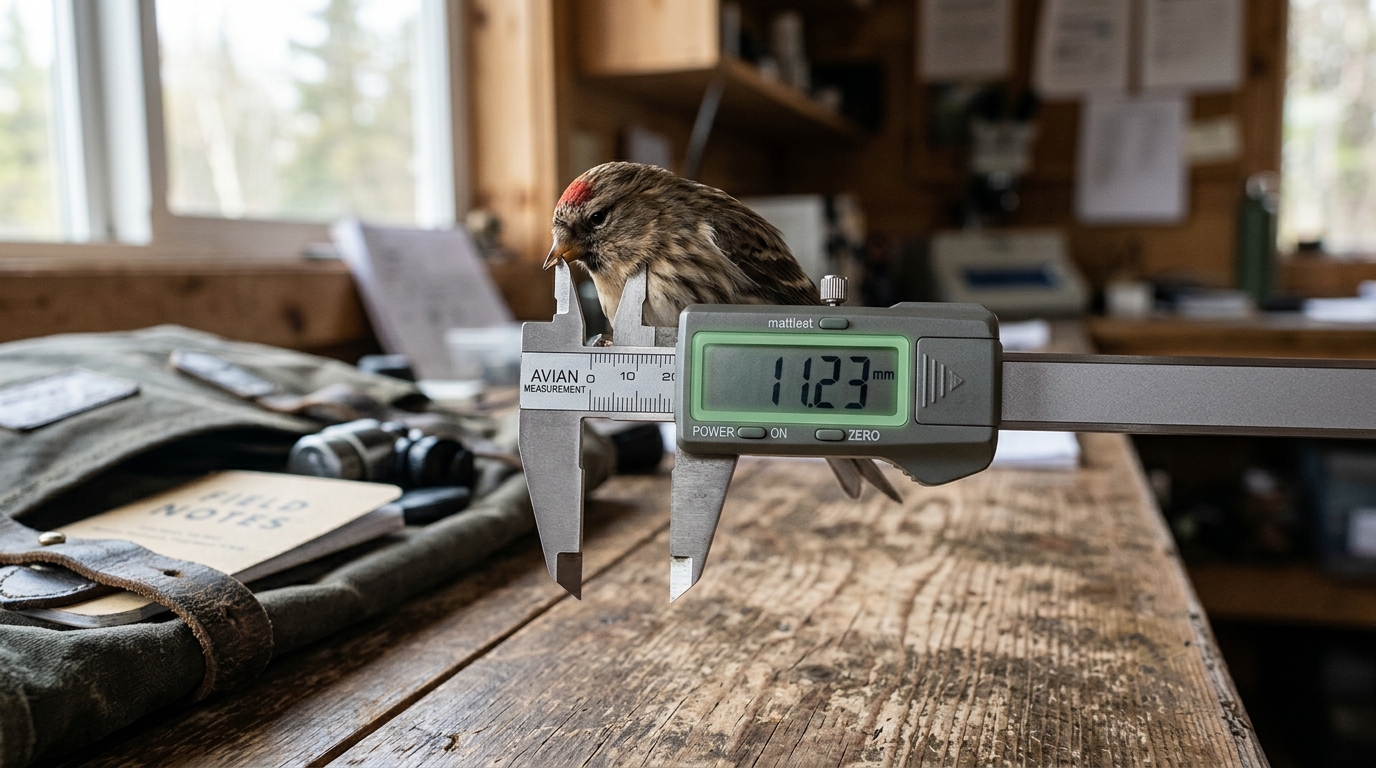
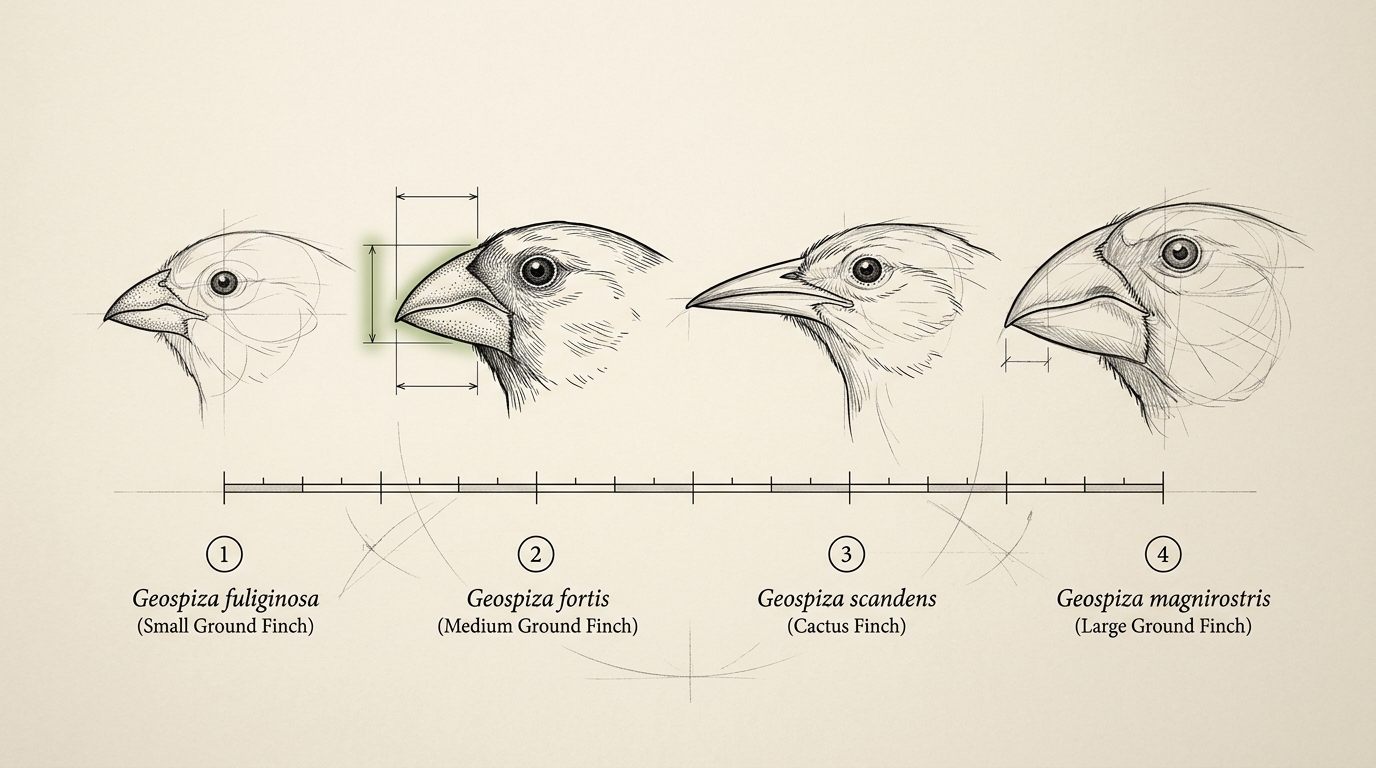
On the evolutionary side, two long-running field studies establish that wild populations already evolve on observable, sub-decadal timescales. The Grants’ multi-decade study of Darwin’s finches on Daphne Major documented reversals in beak-size and body-size evolution tracking drought and El Niño cycles, with directional selection sometimes reversing within a few years — evidence that “rapid evolution” is not a rhetorical flourish but a measured, repeated phenomenon in one well-instrumented population [5]. A long-term study of great tits at Wytham Woods found that earlier egg-laying dates tracking spring warming were substantially explained by phenotypic plasticity rather than genetic adaptation — an important qualification, because plasticity and genetic evolution have different long-run limits and are easy to conflate in popular accounts of “species adapting to climate change” [6].

None of this requires a 2035 frame. It is the baseline the three scenarios below build on.
Scenario one: documented climate-driven extinction cascades by 2035
Horizon: 2035. Claim: By 2035, at least one geographically bounded ecosystem (a named montane cloud forest, a coral reef system, or a similarly discrete unit) will have a peer-reviewed, field-verified documentation of a climate-driven extinction cascade — the loss of a keystone or foundation species followed by measured, attributable secondary population collapses in species dependent on it — as opposed to a model projecting that such a cascade is likely.
Assumptions this rests on: that current range-shift and phenological-mismatch trends documented by Román-Palacios and Wiens continue at a similar or accelerating pace [2]; that monitoring density in at least one vulnerable ecosystem is sufficient to attribute a secondary collapse to a specific antecedent loss rather than to confounded, simultaneous pressures (land use, disease, direct harvest); and that a “cascade,” as opposed to parallel independent declines, can be distinguished at all with the observational tools ecologists currently have.
Observable indicators that would count as early confirmation: a foundation species (a reef-building coral, a specific high-elevation tree, a keystone pollinator) showing local extirpation in a monitored site; subsequent, temporally-lagged decline in two or more dependent species at the same site with a mechanistic pathway specified (loss of nesting substrate, loss of a specific food resource, loss of thermal buffering); and a published attribution analysis, not merely a correlation in time.
Explicit disconfirmation condition: if, by 2035, monitored vulnerable ecosystems instead show compensatory dynamics — species turnover where new colonizers functionally replace lost ones, or documented range-tracking successful enough that local extirpations do not propagate into measurable cascades — the scenario is false, not merely delayed. A genuinely disconfirming observation would be a well-instrumented site (for example, a long-term forest or reef monitoring plot already reporting individual species declines under McDowell et al.'s framework [4]) that reaches 2035 with document species loss but no attributable secondary cascade, attributed instead to independent parallel stressors.
This is a scenario, not a prediction of certainty in either direction. The literature is genuinely split on how fast and how discretely cascades will become attributable versus how much ecological redundancy will absorb single-species losses without producing a documentable chain — and this article does not pick a winner between those camps.

Scenario two: real-time genomic and eDNA monitoring becomes standard conservation infrastructure
Horizon: 2035. Claim: By 2035, routine environmental-DNA (eDNA) sampling and genomic monitoring will be a standard, budgeted component of conservation management for a majority of actively managed protected areas in wealthy nations — not a research add-on used in publications, but line-item infrastructure comparable to camera traps or ranger patrols today.
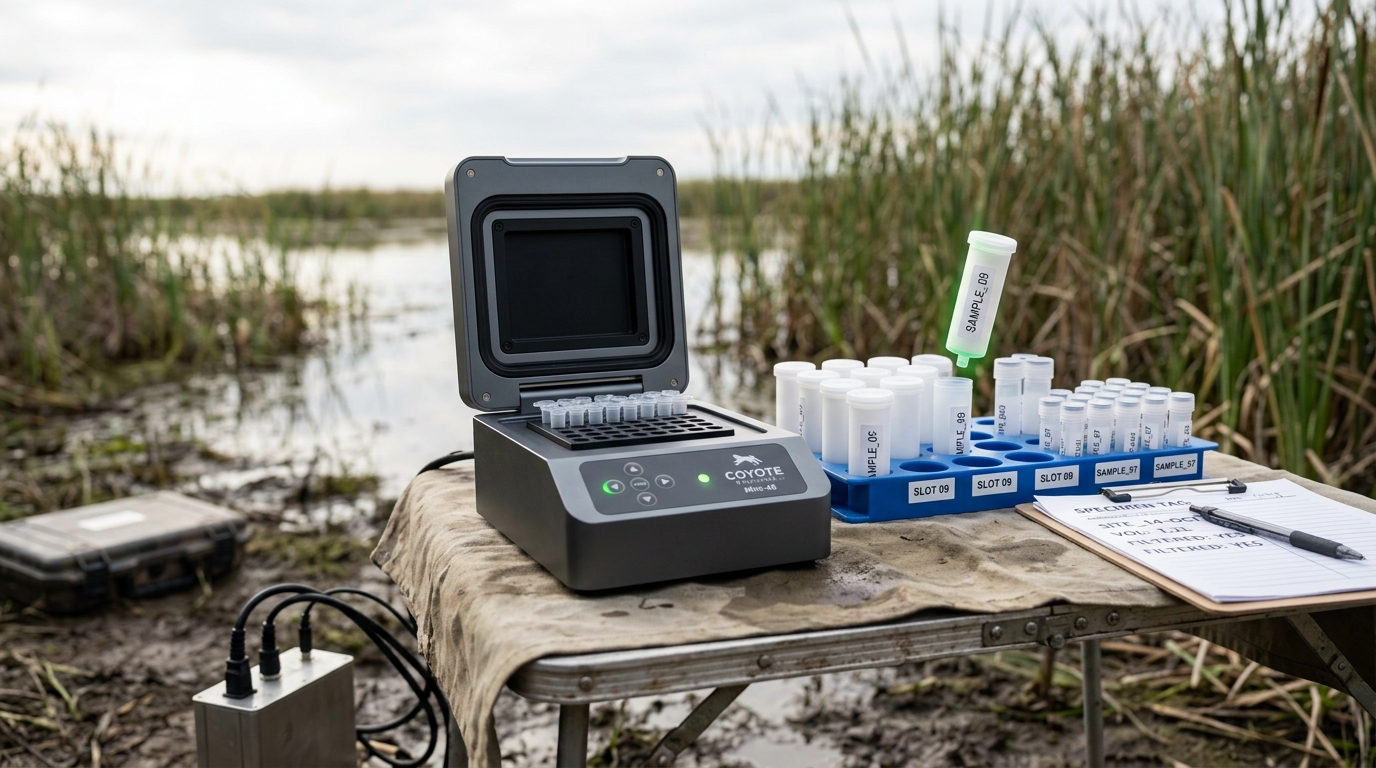
Fact currently established: eDNA metabarcoding is already validated for biodiversity surveying in specific contexts. A 2022 study used water-based eDNA sampling from tree hollows to detect vertebrate users of those hollows non-invasively, demonstrating the method’s sensitivity for cryptic, low-density species that traditional trapping under-samples [7]. This is a genuine capability, verified in a peer-reviewed field study, not a vendor claim.
Where analysis is needed, not just extrapolation: eDNA’s core physical limitation is degradation — traces in water typically persist from a few days up to about a week, which gives it strong presence/absence power but weak, currently unreliable, quantitative-abundance power without heavy method-specific calibration. That limitation does not disappear by 2035 just because sequencing gets cheaper; it is a property of nucleic acid chemistry in the field, not of instrumentation cost. So the honest form of this scenario is narrower than “eDNA replaces field biology” — it is “eDNA becomes a standard supplementary layer for presence, colonization, and local-extinction detection,” which is a real but bounded claim.
Observable indicators: national or regional conservation agencies publishing routine eDNA-based state-of-biodiversity reports as a standing program (not a pilot); commercial or academic eDNA-processing turnaround times short enough to inform in-season management decisions rather than only retrospective research; and cost per sample falling to a level competitive with traditional survey labor for the specific use case of rare-species detection.
Explicit disconfirmation condition: if by 2035 eDNA and genomic monitoring remain confined to research grants and pilot programs, without appearing as recurring line items in protected-area management budgets, the “standard practice” version of this scenario is false — even if the underlying science continues to mature. A weaker, still-true residual claim (“eDNA is a validated research tool”) would not rescue the stronger prediction; the scenario is specifically about institutionalization, not method validity.

Scenario three: genetic rescue reaches a verified, self-sustaining wild-population outcome
Horizon: 2035. Claim: By 2035, at least one genetic-rescue or advanced-reproductive-technology intervention — cloning, genome-informed captive breeding, or a comparable technique — will have produced a documented, multi-generation, self-sustaining population increase in an actual wild (not captive-only) setting, verified by an independent monitoring body, not solely asserted by the organization that performed the intervention.
What is already fact, carefully bounded: in December 2020, Elizabeth Ann, a black-footed ferret, became the first cloned individual of a U.S. endangered species, created from cryopreserved cells of a ferret that died in the 1980s with no living descendants, in a program led by the nonprofit Revive & Restore [9]. Elizabeth Ann herself could not breed, for reasons unrelated to the cloning process, and lived her life in captivity for research purposes; she died in 2025. But two further clones from the same genetic line, Noreen and Antonia, were born in 2024, and Antonia successfully bred and produced offspring in mid-2024, with additional litters reported into 2025 [9]. That is a real, verified, multi-generation reproductive success — but it remains a captive-breeding outcome. No cloned black-footed ferret lineage has yet been confirmed established and self-sustaining in the wild as of this writing.
Where a vendor claim needs to be labeled as such: Colossal Biosciences markets a woolly mammoth “de-extinction” program, describing an approach that would combine mammoth genetic material recovered from permafrost-preserved remains with Asian elephant genomes to produce cold-tolerant elephant-mammoth hybrids [11]. As of this writing this is a company’s stated research roadmap and funding narrative, not a peer-reviewed outcome, and no verified specimen exists. It belongs in this article as an example of the claims circulating in this space, explicitly flagged as unverified vendor assertion, not as evidence that de-extinction technology works.
Observable indicators that would count as confirmation: an independent conservation authority (a government wildlife agency or an IUCN-affiliated body, not the performing organization alone) documenting a genetically-rescued lineage breeding across two or more generations in situ, in a wild or minimally-managed setting, with population trend data rather than a single birth announcement.
Explicit disconfirmation condition: if by 2035 every genetic-rescue success remains confined to captive breeding programs — however many generations deep, however genetically successful — with no verified wild self-sustaining population, this scenario is false. The distinction matters because captive breeding success and wild reintroduction success are different technical problems (habitat availability, predator-prey dynamics, disease exposure, and learned behavior all intervene), and conflating them is the most common overstatement in de-extinction and genetic-rescue reporting.


How selection, drift, and cooperation complicate all three scenarios
It is tempting to treat “evolution” in these scenarios as a single dial that either turns fast enough to keep up with environmental change or does not. That framing skips over which evolutionary mechanism is actually doing the work, and the mechanism matters for how fast a response can plausibly arrive.
Directional selection on an existing polygenic trait — the kind the Grants documented in Darwin’s finches, where beak and body size shifted in response to seed availability during drought years — can move a population noticeably within a handful of generations if standing genetic variation is present and the trait is not too tightly linked to other, disfavored traits [5]. That is the fastest lane available to evolution by natural selection, and it is real, measured, and repeated across multiple drought cycles on Daphne Major. But it depends on variation already existing in the population before the pressure arrives. A population that has been through a recent bottleneck, or that lacks genetic diversity because it is already small and fragmented — exactly the populations most likely to need genetic rescue under scenario three — is the population least likely to have the standing variation that makes rapid selection-based adaptation possible. Selection cannot act on variation that is not there, and drift in small populations actively erodes what variation remains, independent of any selection pressure at all. This is why genetic rescue and rapid in-situ adaptation are not two independent bets; they interact. A population large and variable enough to adapt quickly by selection alone is, definitionally, less likely to need the kind of intervention scenario three describes.
Phenotypic plasticity is a second, faster-acting channel, and the Wytham Woods great tit study is the clearest long-term demonstration of it: earlier laying dates tracked warmer springs primarily through within-generation behavioral and physiological flexibility, not through a shift in the underlying gene pool [6]. Plasticity buys time. It does not remove the need for genetic adaptation if the environmental trend continues past what a flexible phenotype can cover, and it can mask an approaching limit — a population can look like it is “keeping up” right up until the plastic response saturates, at which point the apparent adaptation stops abruptly rather than gradually. Any monitoring program built for scenario two needs to distinguish these two signatures, because a population tracking change through plasticity and a population tracking change through genetic adaptation look identical in a single snapshot of phenotype data and very different in what they predict about resilience to further change. Genomic monitoring, not phenotype monitoring alone, is what can tell them apart, which is itself part of the case for scenario two’s more ambitious version rather than its weaker one.
Cooperation and community-level dynamics add a third complication that the ecosystem-cascade scenario depends on directly. A cascade requires that species be sufficiently interdependent that losing one measurably harms others — mutualisms, obligate pollination relationships, keystone engineering effects on habitat structure. But ecological communities also show compensatory dynamics: functional redundancy, where multiple species perform an overlapping role so that losing one does not remove the function, only the redundancy. McDowell et al.'s synthesis of forest dynamics documents both patterns occurring in different systems — some forests showing compounding, cascading structural decline under combined drought and pest pressure, others showing species turnover that maintains overall forest function even as specific species disappear locally [4]. Which pattern dominates in a given ecosystem by 2035 is an empirical question this article deliberately does not prejudge; it is the actual content of scenario one’s uncertainty, not a gap in the writing.
Speciation, adaptive radiation, and the limits of a decade-long window
A decade is short relative to most speciation timescales, and this constrains what scenario one and adjacent claims can honestly say about new species arising in response to environmental change. Reproductive isolation typically accumulates over many thousands of generations in sexually reproducing vertebrates, though it can proceed faster in organisms with short generation times, strong assortative mating, or ecological speciation driven by sharply divergent resource use. The Darwin’s finches system is again instructive here because it is one of the few documented cases where researchers have observed the early stages of this process directly: a single immigrant male finch of a different species that bred with local females founded a new, reproductively isolated “Big Bird” lineage within a few generations, a case genomically documented as among the fastest known instances of the origin of a new lineage in the wild [10]. That case involved an unusual founding event — a rare hybridization with strong assortative mating in the offspring — rather than a generalizable mechanism that most populations under climate pressure will pass through by 2035. It is evidence that rapid lineage formation is mechanistically possible, not evidence that it is a common or predictable outcome of current environmental pressure. None of the three scenarios above bet on new species arising within the horizon; the honest claim is narrower — that existing populations shift, adapt, persist, or fail, and that speciation, where it is even detectable on this timescale, will most likely be visible only as the earliest stage of divergence rather than a completed process.
What would make each scenario’s confirmation trustworthy, not just visible
A last methodological point applies across all three scenarios. Confirmation of any of them needs to come from a source structurally positioned to report disconfirming results, not only confirming ones. An extinction-cascade claim from the research group whose funding depends on that ecosystem being in crisis, an eDNA-adoption claim from a company selling eDNA sequencing services, or a genetic-rescue success claim from the organization that performed the rescue are each a legitimate data point but not sufficient confirmation on their own — precisely the reasoning behind labeling Colossal Biosciences’ mammoth program a vendor claim above rather than treating a company press release as equivalent to a peer-reviewed field result [11]. Independent replication, ideally by a monitoring body without a financial or reputational stake in the outcome, is what separates a scenario that has actually resolved from one that merely has a press release attached to it. This is not a cynical standard; it is the same standard the underlying field studies already meet — the Grant and Grant finch data, the Wytham Woods tit records, and the IPBES synthesis are all products of long-running, multiply-replicated, institutionally embedded monitoring rather than single-source announcements [5, 6, 8].
Why these three, and not others
These scenarios were chosen because each has a currently visible, quantifiable leading indicator — not because they are the most dramatic possible futures. A cascade-attribution paper either gets published in a specific monitored ecosystem or it does not; an agency budget either lists eDNA sampling as recurring infrastructure or it does not; an independent monitoring body either verifies a wild self-sustaining rescued population or it does not. Each of those is checkable by someone other than the person making the prediction, which is the actual point of writing predictions down this way.
It is worth being explicit about what this article is not claiming. It is not claiming that ecosystem collapse is inevitable, nor that it is being avoided; the extinction-risk and cascade literature genuinely disagrees on how much ecological redundancy will absorb range shifts before secondary effects propagate [1, 2]. It is not claiming eDNA will or will not scale into standard practice; the technology’s chemistry sets a real presence-detection ceiling regardless of adoption rate [7]. And it is not claiming genetic rescue is either a proven conservation tool or vaporware; one verified multi-generation captive success and one unverified commercial roadmap sit in the same field, and the difference between them is exactly the distinction this article insists on maintaining [9, 11].
The falsifiable core, restated
By 2035: a documented, mechanistically attributed extinction cascade in a named ecosystem, or its absence despite continued species loss at monitored sites. Routine, budgeted eDNA and genomic monitoring across a majority of managed protected areas, or its continued confinement to pilot and research use. An independently verified, self-sustaining wild population produced by genetic rescue, or the continued confinement of every such success to captivity. Each pair of outcomes is checkable against public records — agency budgets, peer-reviewed monitoring reports, IUCN or national wildlife-agency assessments — well before 2035 arrives, which is the whole reason to state predictions this way rather than as vaguer directional hopes about “the future of biodiversity.”