Ask a paleoanthropologist, an ancient-DNA researcher, and a stone-tool specialist what they know about a given moment in human prehistory, and you will get three different, only partly overlapping answers. That is not a sign that the field is confused. It is a sign that “human evolution” is not one line of evidence being read by three kinds of scientist — it is three separate instruments, pointed at the same deep past, that see different things and go dark at different depths. Comparing what each instrument can and cannot do is not a preamble to the science; it is most of what there is to understand about how confident any specific claim about human origins actually is.
This article compares three approaches — morphological analysis of fossils and skeletal remains, ancient-DNA genomics, and archaeological analysis of behavior (stone tools, pigments, engraved objects, cut marks) — on the dimensions that actually differ between them: what each can establish on its own, how far back in time each one functions at all, and what happens when two of them disagree. None of the three is a subset of another, and none has made the others obsolete. The current picture of human evolution — a braided network of overlapping, interbreeding populations rather than a tidy ladder from ape to human — is itself a product of needing all three approaches at once, because no single one of them could have produced it alone.
Approach one: morphology, the oldest and longest-reaching instrument
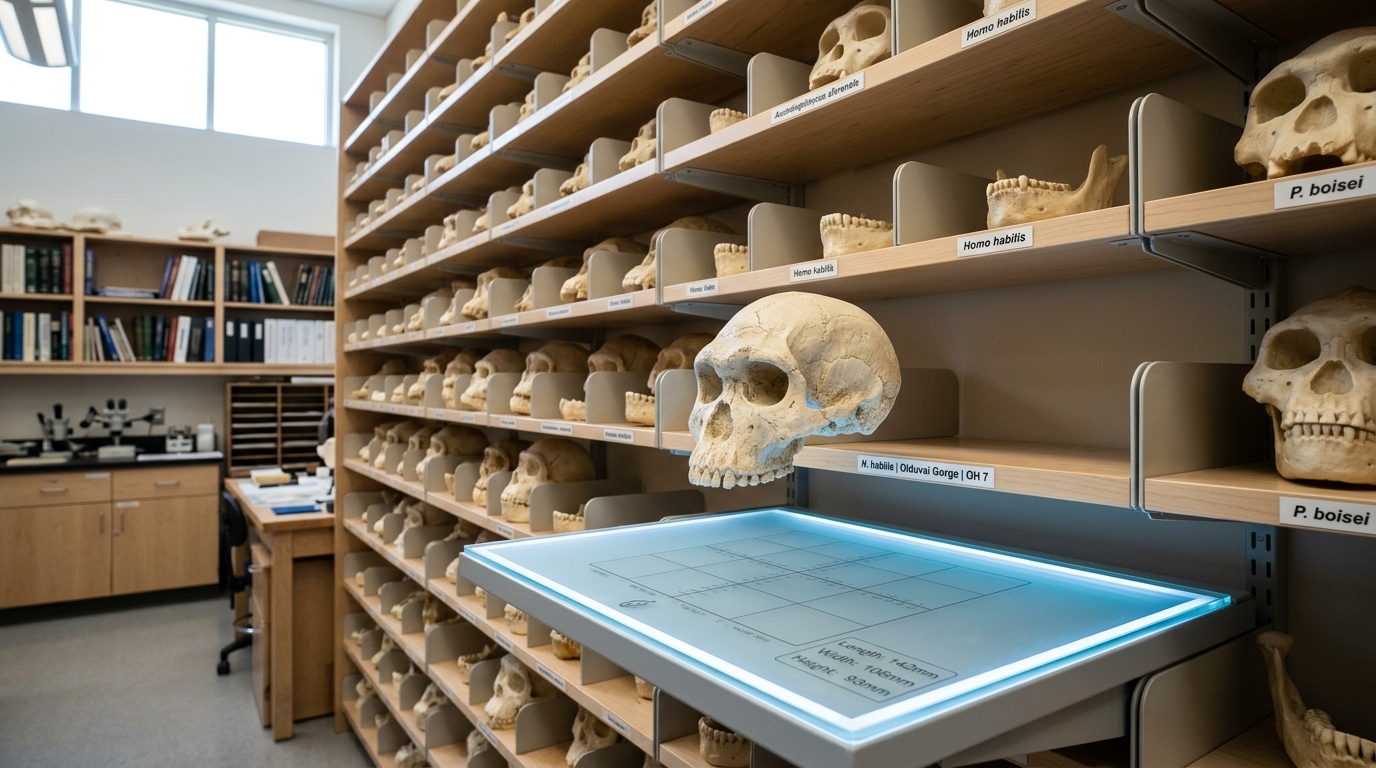
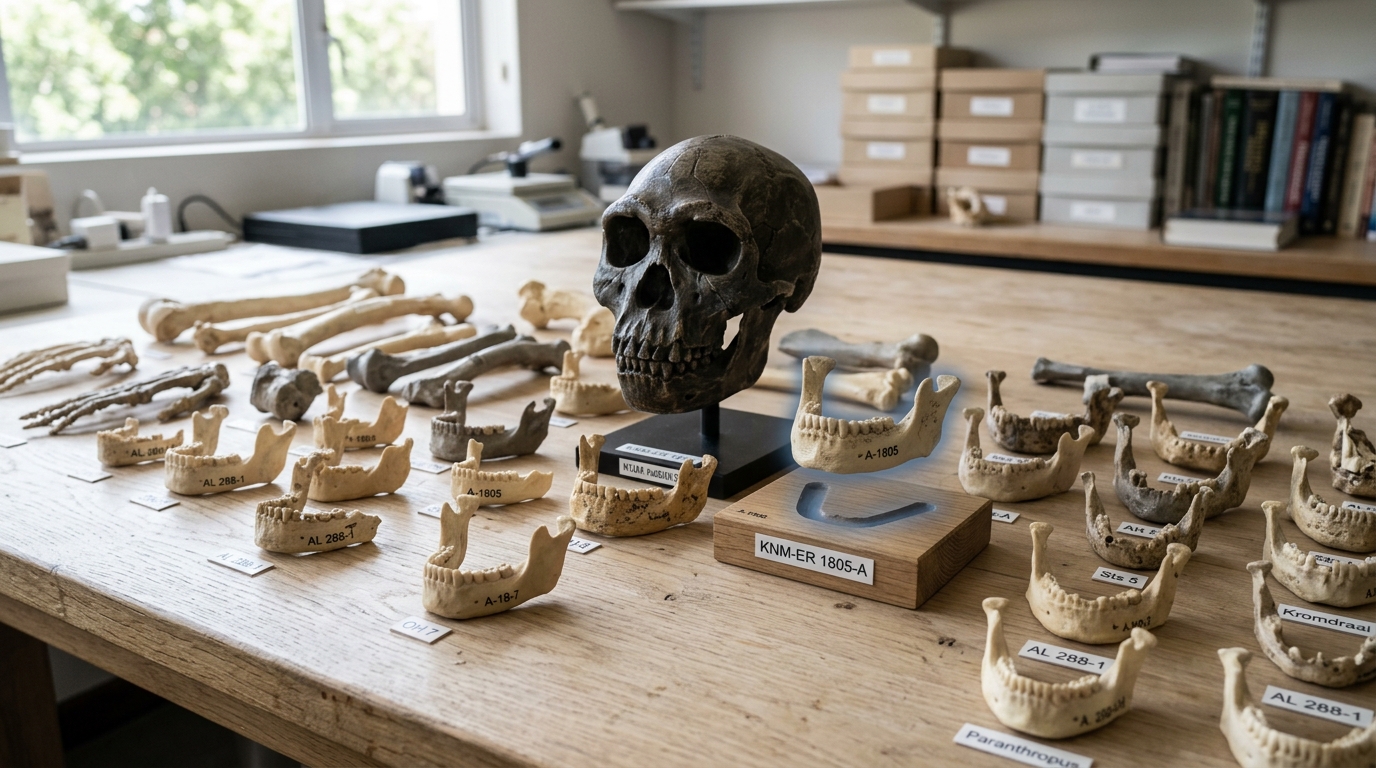
Fossil and skeletal morphology is the founding method of paleoanthropology and remains its longest-reaching one. A tooth, a cranium, a pelvis, or a single finger bone can be measured, compared to reference collections, and placed — with appropriate caveats — into a lineage on the basis of shape alone. Morphology is also the only one of the three approaches that works across the entire span of hominin evolution, from the earliest bipedal apes several million years ago through to fully modern humans. Ancient DNA and behavioral archaeology both have hard time limits; morphology, in principle, does not, because bone and enamel can fossilize and preserve gross shape for millions of years even where every organic molecule inside them has long since broken down.
That reach comes at a real cost, and the cost is legibility of relatedness. Shape converges. Two lineages can independently evolve similar skeletal features for similar reasons (a phenomenon called homoplasy), and a single lineage can vary enough across individuals, sexes, and growth stages that specimens genuinely belonging to one species can look like they belong to two. This is precisely the ambiguity at the center of one of the most disruptive discoveries in the field’s recent history. In 2013 and 2014, cavers and researchers recovered more than 1,550 fossil elements from at least 15 individuals deep in the Rising Star cave system in South Africa, a discovery formally described as a new species, Homo naledi [3]. The skeleton combined a strikingly small, australopith-sized braincase with a foot, wrist, and lower body closer to those of later Homo. Morphology alone could describe that mosaic in exhaustive anatomical detail — and it could not, by itself, say when this population lived relative to other hominins, because the fossils had been recovered without an accompanying absolute date. That question required a second, independent kind of evidence: geological dating of the cave sediments and flowstone surrounding the bones, which placed Homo naledi at 335,000 to 236,000 years old [4] — startlingly recent for a hominin with such a small brain, and squarely contemporary with the earliest known members of our own species. Morphology told researchers what the skeleton looked like; it took a geochronological method, not an anatomical one, to tell them when it lived, and knowing when changed how the anatomy was read.
That division of labor — morphology for form, independent dating methods for absolute time — runs through the entire field. Morphology alone cannot establish genetic relatedness between populations, cannot recover behavior beyond what is directly inferable from bone (diet from tooth wear and isotopes, some locomotion from joint surfaces), and cannot distinguish a true species boundary from a normal range of population variation without corroborating lines of evidence. It is a fact, not a criticism, that morphology is a science of shape, applied to an incomplete and unevenly preserved sample of skeletons, and that inference beyond shape requires leaving the method.
Approach two: ancient-DNA genomics, narrow reach but unique resolving power
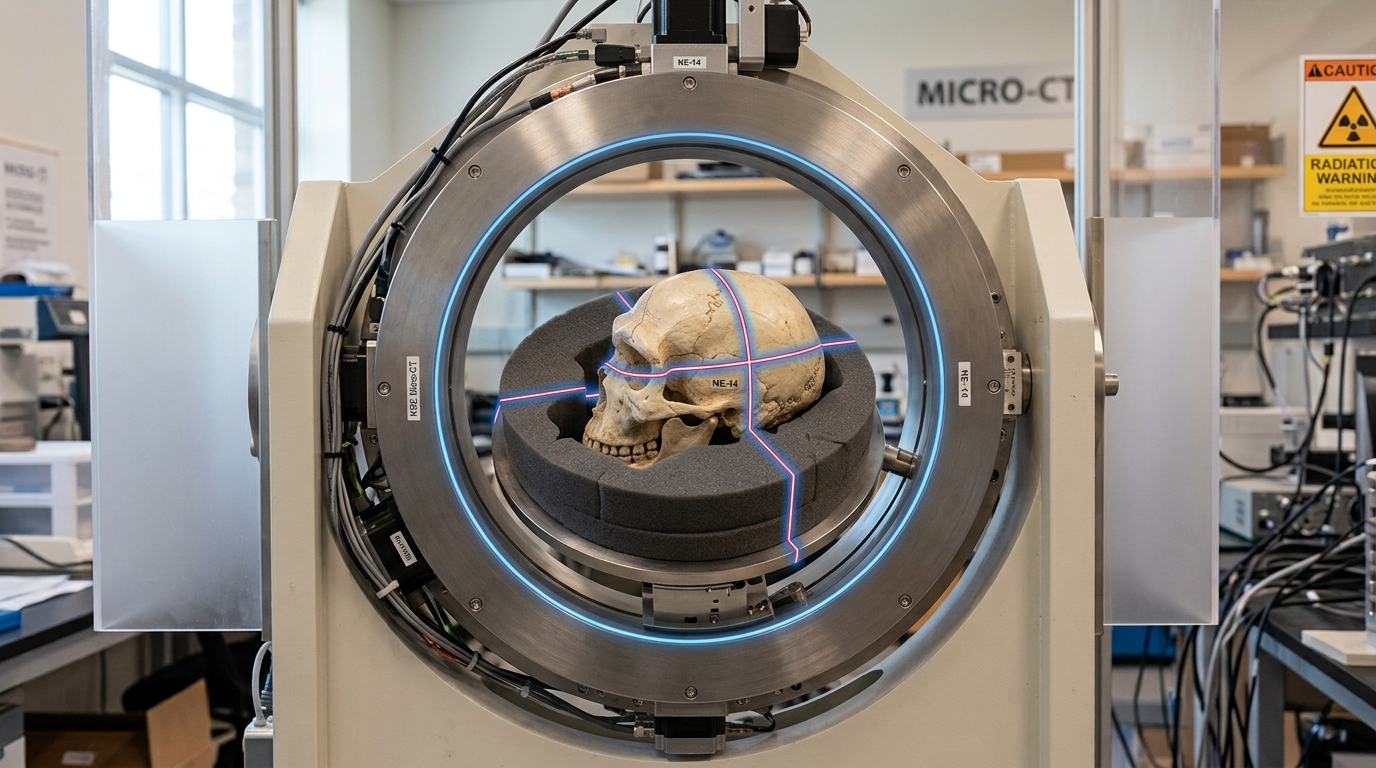
Ancient-DNA genomics answers a different question than morphology asks, and it answers it with a kind of precision no bone measurement can match: not what a specimen looked like, but how it is related, genealogically, to other populations, living and extinct. The method reconstructed its first full archaic-human genome from Neanderthal remains from Vindija Cave in Croatia, established that Neanderthals and non-African modern humans share stretches of DNA, and put a first number on it: roughly 1–4% of the genome of people outside Africa traces to Neanderthal ancestors [1]. That same year, a small fragment of finger bone from Denisova Cave in Siberia — anatomically almost uninformative on its own — yielded a genome revealing an entire previously unknown population, the Denisovans, known at first from molecules alone, before any diagnostic skeletal description existed [2]. That is the method’s signature achievement: it can identify and characterize an extinct human population that morphology had not yet named, purely from genetic content.
Subsequent, more detailed genomic work has refined rather than overturned that picture. Newer analyses using early modern human genomes narrow the Neanderthal admixture event to a comparatively short window around 45,000–49,000 years ago, and clarify that the many small Neanderthal-derived segments carried by non-Africans today largely stem from that shared pulse rather than many independent encounters [9]. Public science communication from the Smithsonian’s Human Origins Program restates the now-standard summary figure of roughly 1–2% Neanderthal ancestry in non-African genomes and situates it alongside Denisovan ancestry found at higher levels in some Melanesian and other Asian populations [10]. None of this — the existence of the Denisovans, the admixture percentages, the dating of the pulse — was recoverable from morphology. It required molecules.
The catch is depth. DNA is a chemically unstable molecule, and while cold, dry, low-oxygen environments dramatically slow its decay, they do not stop it. A comprehensive review of the chemistry and the current empirical record describes both the theoretical limits on DNA survival and the actual oldest recovered genetic material: reconstructed genomes from permafrost-preserved specimens now reach back roughly one to two million years, with isolated DNA fragments recovered from roughly two-million-year-old Greenland sediment, and a plausible outer boundary around the age of the oldest permafrost itself, some 2.6 million years [7]. That is a genuine frontier-pushing result — and it is still a small fraction of the roughly six-to-seven-million-year span of hominin evolution, and it depends entirely on exceptional cold-climate preservation that most African hominin sites, where much of human evolution actually happened, do not offer. In practice, the great majority of usable ancient hominin DNA comes from within the last 100,000 years, in cooler climates. For the deep hominin past — everything before roughly two million years ago, and almost everything in warm regions before roughly 100,000 years ago — genomics currently has nothing to say at all. This is not a temporary technical shortfall the field expects to fully solve; it is closer to a chemical floor, though the floor has moved substantially in the past decade and researchers are candid that it may move further.

Approach three: archaeological evidence, direct access to behavior, indirect access to species
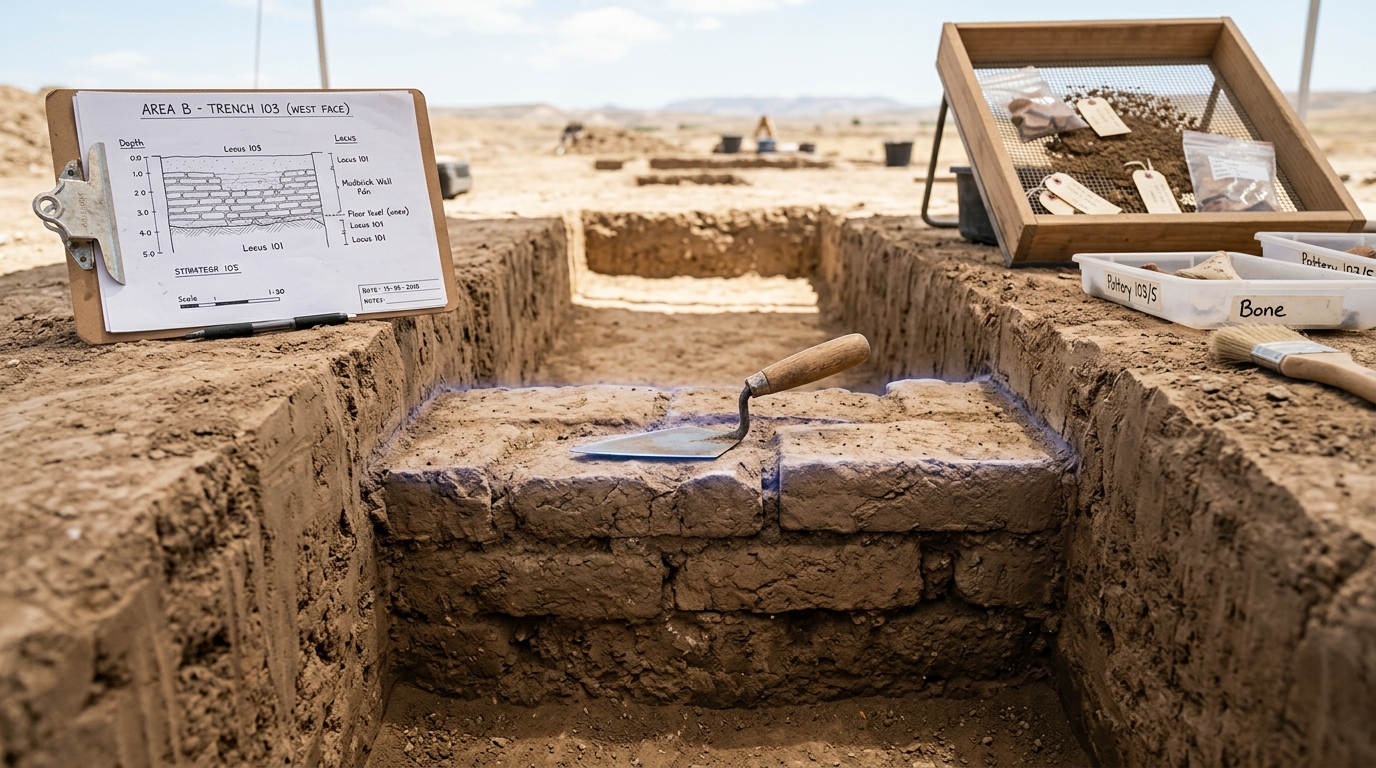
The third approach reads neither shape nor genealogy but behavior, from the material residue populations leave behind: knapped stone, cut-marked animal bone, pigments, engraved objects, hearths, shelters. Its most striking recent result pushed the origin of a defining human behavior — deliberate stone toolmaking — earlier and further from our own genus than expected. At Lomekwi 3 in northern Kenya, researchers recovered stone tools dated to 3.3 million years old, roughly 700,000 years older than the previously oldest known (Oldowan) tools, and old enough that they cannot have been made by any member of genus Homo, which had not yet evolved [5]. That is a fact about behavior — flaking a specific, patterned way — established with no genetic or, initially, even confidently identified skeletal maker attached to it. Archaeology can date and describe the behavior precisely without being able to say, on its own evidence, exactly which hominin species produced it.
The same asymmetry holds for evidence of symbolic behavior. At Blombos Cave in South Africa, pieces of red ochre bearing deliberately incised geometric cross-hatching were recovered from layers dated to roughly 100,000 to 75,000 years ago, alongside evidence for engraved bone, worked shell beads, and early pigment processing [8]. That is a well-established fact about what was done and roughly when. What it means — whether cross-hatched ochre implies symbolic communication, decoration for its own sake, or something in between — is a live interpretive disagreement among specialists, not a settled fact, and more recent re-analyses of similar engraved material have argued for more modest, non-symbolic readings of comparable marks. Archaeology is unusually good at establishing that a behavior occurred and when; it is comparatively weak at establishing why, and it generally cannot independently establish which species, in a genetic or morphological sense, performed the behavior unless skeletal remains are found in secure direct association with the artifacts — which happens far less often than popular accounts imply.

Where the three approaches meet: the origin of Homo sapiens
The dating of our own species’ origin shows all three approaches operating on the same question, contributing genuinely different and complementary pieces. Fossils from Jebel Irhoud, Morocco, described in 2017, combine a face and jaw close to modern human form with a more elongated, archaic braincase, and were dated by thermoluminescence to roughly 300,000–315,000 years old — pushing the fossil record of Homo sapiens back by about 100,000 years relative to the prior consensus and reframing our species’ emergence as a pan-African process rather than one confined to East Africa [6]. That is a morphological and geochronological result: a specimen’s shape and an independently measured age. Archaeological materials at the same site — a Middle Stone Age toolkit — establish associated behavior at that date. Genomics contributes a third, independent kind of estimate entirely: coalescent modeling of genetic diversity among living human populations, which produces its own, statistically derived estimates of when population lineages diverged, estimates that can be compared against, but are not the same measurement as, a fossil’s stratigraphic age. None of the three methods, alone, produced the current account of Homo sapiens’ origin; each supplied a piece the others structurally could not.
Why the family tree keeps changing shape
Popular writing about human evolution often frames new discoveries as corrections to a single evolving tree, as though there were one chart being redrawn as the data comes in. The comparison above suggests a better description: there are three trees, built from three kinds of evidence, and they are only forced into alignment where all three methods can be applied to the same population at the same time — which is rare. Genomic trees are trees of gene flow, and can show admixture (populations mixing after separating) in a way a strictly branching morphological tree cannot represent cleanly. Morphological trees are trees of shared derived anatomy, vulnerable to convergent evolution. Archaeological “trees,” to the extent the term even applies, are records of behavioral continuity and change that do not require, and often cannot supply, a species label at all.
Analysis, not established fact: the current preference among many researchers for a “braided stream” or reticulate model of hominin evolution — overlapping, sometimes-interbreeding populations rather than a single ancestor-to-descendant ladder — is best understood as a direct consequence of having ancient-DNA evidence for admixture (Neanderthal, Denisovan, and other introgression events) layered onto a morphological record that, read alone, would more naturally suggest cleaner species boundaries. Take away the genomic layer and the fossil record alone plausibly supports a more linear story in many regions; it is the molecular evidence specifically that forces the branching, mixing picture. This is an interpretive synthesis this article is drawing across the cited primary results, not a claim any single cited source makes in those terms.
What each approach cannot do, stated plainly
It is worth separating, explicitly, what each method is structurally unable to establish, independent of future data:
- Morphology cannot, by itself, establish absolute age (it requires geochronology), genetic relatedness, or most behavior beyond what bone directly records.
- Ancient-DNA genomics cannot function at all beyond the chemical limits of DNA preservation — in practice, almost nothing before roughly 100,000 years outside cold climates, and essentially nothing before the low millions of years anywhere [7]. It also cannot, on its own, describe appearance, locomotion, or most day-to-day behavior.
- Archaeological evidence cannot reliably assign artifacts to a species without directly associated, securely dated skeletal remains, and its interpretive claims about meaning or intent (symbolism, planning depth) are often genuinely contested among specialists rather than resolved.
None of these are failures of technique that better instruments will simply erase. The DNA preservation limit in particular is a matter of molecular chemistry, not funding or effort, and while the record of “oldest recovered DNA” has moved dramatically in the past decade, it moves within a hard theoretical ceiling, not toward removing one.
Scenarios and honestly bounded predictions
Scenario, not prediction: it is plausible that improved extraction chemistry and more sites with exceptional cold-climate preservation (permafrost, high-altitude caves) will push recoverable ancient-hominin DNA further back over the next decade, potentially yielding genetic data on populations currently known only from fossils, such as early Homo erectus material outside the tropics. This is a plausible direction of travel based on the trend documented in [7], not a specific claim about which site or species.
Prediction, with stated horizon, assumptions, and disconfirmation condition: over the next ten years (to 2036), expect at least one further instance in which a genomically identified population (in the manner of the Denisovans) is described from molecular evidence before, or without, a confident morphological species description — because sample recovery from cold, high-latitude, or high-altitude sites is expanding faster than the recovery of diagnostic skeletal material from those same contexts. This assumes continued investment in ancient-DNA field recovery at comparable or growing levels and no major disruption to the relevant clean-lab infrastructure. It would be disconfirmed if, over that period, every newly reported archaic human lineage arrives with an already-associated, unambiguous skeletal description rather than DNA preceding or outrunning the bones.
The comparison, not a ranking
None of this supports ranking the three approaches by importance. Each answers a question the others cannot: morphology reaches the furthest back in time and reads shape directly; genomics reaches relatedness and population history with a precision no other method can match, within a hard and largely non-negotiable time limit; archaeology reaches behavior directly, at the cost of only weak and indirect access to species identity. The discoveries that have most changed the picture of human evolution in the past fifteen years — the Denisovans, the redating of Homo naledi, the pre-Homo Lomekwi tools, the pan-African, earlier-than-expected origin of Homo sapiens — did not come from one method outperforming the others. They came from each method doing the one thing it does well, on a question the other two could not have answered alone, and from researchers being willing to hold the resulting picture as provisional rather than forcing early agreement between lines of evidence that were never going to converge cleanly to begin with.