A building that holds a claim
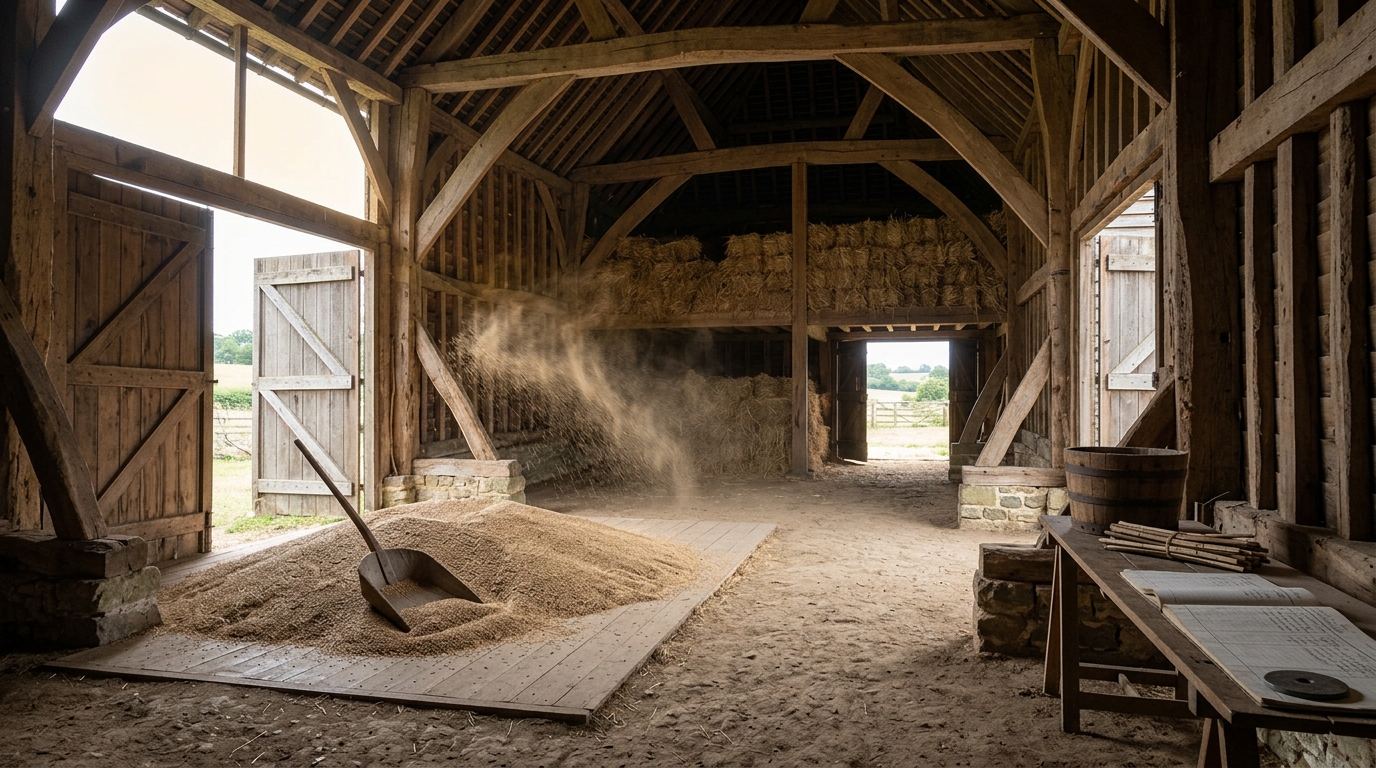
A tithe barn is not a farm building. It is a fiscal one. Its cruck frame, its opposed doors set to catch a cross draught, its raised floors and its single controlled entrance are the physical form of an obligation that had already been decided elsewhere. The barn exists because someone was owed a share of a harvest, because that share had to be gathered into one place to be counted, and because once gathered it had to survive until it could be used or moved. Every dimension in the building answers an administrative question rather than an agricultural one.
That is the argument this article makes about storage in general. A granary is usually described as a technology for holding food. It is more precisely a technology for holding a claim. Grain in a heap on a threshing floor is a quantity of calories. Grain measured, levelled, poured into a sealed store and recorded is a quantity that can be owed, demanded, defended, transferred, taxed, borrowed against and stolen. The transformation is not nutritional. It is institutional, and it is the transformation that the rest of this piece is about.
None of what follows is a story of progress. Storage did not make societies better, and the appearance of granaries is not evidence that anybody was eating more. Several of the strongest recent arguments in this area work in the opposite direction: they treat stored surplus as the thing that made certain kinds of domination possible, and they are contested by other researchers who think the evidence is thinner than its advocates claim. The disagreements are the interesting part, and this article attributes them rather than settling them.
Storability and appropriability, not productivity
The conventional account of state formation runs through surplus. Farming raised output, output above subsistence created surplus, surplus supported specialists who did not grow food, and hierarchy followed. Mayshar, Moav and Pascali summarise this as the productivity-and-surplus theory and trace it back to Adam Smith and earlier [1]. Their paper challenges it directly. Their proposal is that hierarchy arose from the shift to dependence on appropriable cereal grains, and that regional differences in land suitability for different crops explain the developmental disparities better than differences in land productivity do.
The mechanism they describe turns on the physical properties of the crop rather than its yield. Cereal grains are harvested seasonally and therefore have to be stored to provide subsistence through the year; they are dense in energy, durable, and comparatively easy to confiscate and to move. Roots and tubers are typically perennial, do not have to be reaped in a particular period, and once harvested are rather perishable; the paper notes that their roughly seventy percent moisture content makes their nutritional content expensive to transport [1]. The authors quote James C. Scott’s observation that history records no cassava, sago, yam, taro, plantain, breadfruit or sweet potato states, and note that in distinguishing storable from non-storable crops Scott follows earlier work by Taylor and Testart — Taylor having proposed that the Neolithic Revolution should be called the storage revolution.
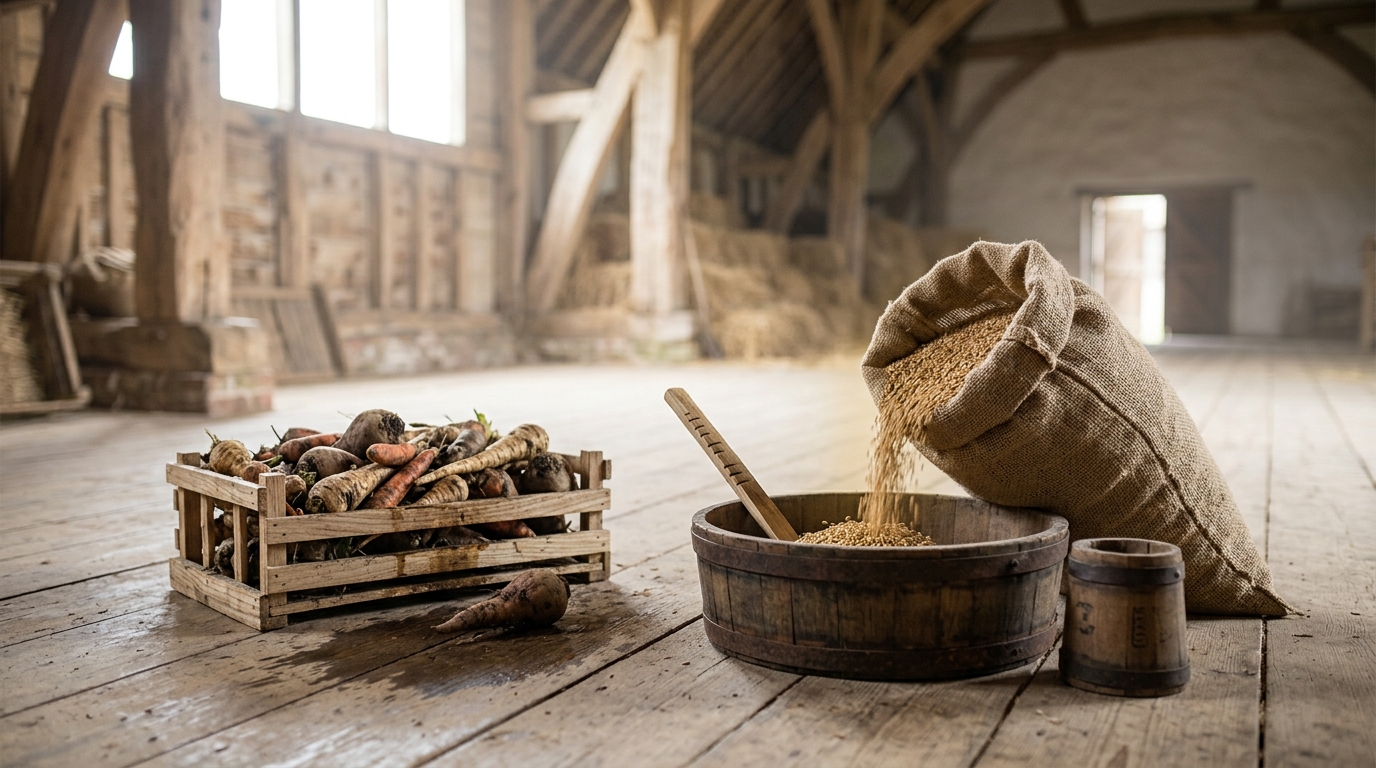
Two hypotheticals in the paper do the analytical work. In the first, a society grows cassava with output above long-term subsistence — a genuine surplus — but the crop rots shortly after harvest and cannot practically be moved to a distant elite. Surplus exists and hierarchy does not, so surplus is not sufficient. In the second, a society subsists on a cereal with no surplus at all; because the crop must be harvested in a short window and stored, a collector can take part of the store and move it. Ongoing confiscation reduces the farming population, diminishing average product of labour then leaves total output above the remaining farmers’ subsistence needs, and a surplus appears. Surplus is therefore not necessary either. The authors state the inversion plainly: rather than surplus generating the elite, the elite generate the food surplus on which it can flourish, once the opportunity to appropriate arises [1].
This is a claim about institutions, not about calories. It also explains something the productivity account struggles with. Hunter-gatherers became more productive over millennia through better technique and accumulated knowledge, and that productivity was absorbed by population rather than converted into durable surplus and hierarchy. The appropriability account attributes the difference to the form of the food rather than its quantity.
How strong is the evidence, and who disputes it
The empirical case is assembled from several imperfect tests rather than one clean design. Using Murdock’s Ethnographic Atlas, the authors instrument for cereal cultivation with the potential productivity advantage of cereals over roots and tubers computed from FAO land-suitability data. In their reduced form, a one standard deviation increase in the cereal productivity advantage raises the jurisdictional hierarchy index by 0.27, and once both regressors are included the effect of land productivity disappears; their baseline two-stage least squares estimates predict that cultivating cereals as the main crop raises the hierarchy measure by more than one [1]. Further tests use a half-century panel of 159 present-day territories, a dataset of wild relatives of domesticated crops built with the Global Crop Diversity Trust, the Columbian Exchange as a natural experiment, and radiocarbon-dated site counts in a difference-in-differences design. A separate result finds cereal cultivation associated with a heavier tax burden, though the authors flag that those regressions rest on only fifty-six observations.
The authors also name their own limitations, which is worth recording because it is easy to cite the headline and drop the caveats. The Ethnographic Atlas is not a random sample and is biased toward relatively isolated societies with lower hierarchy; most of its societies are observed in the nineteenth and twentieth centuries, long after the transition to farming; and cross-sectional results cannot exclude omitted geographic factors.
A published comment sharpens the objection. Cook, Duprey, Heyes and Pelli re-examine the instrumental-variables analysis across the roughly one thousand societies in the Ethnographic Atlas and report two problems: that the evidence for the appropriability channel holds for the transition from tribal to chiefly societies rather than across broader comparisons, and that the findings depend heavily on outliers, with standard trimming of between 1.2 and 2.1 percent of extreme cases eliminating statistical significance at conventional levels [2]. That is a claim about fragility rather than direction. It does not show that appropriability is irrelevant; it argues that this particular identification does not carry the weight placed on it. Readers should hold the appropriability thesis as one hypothesis with real evidence behind it and a live methodological challenge against it, not as an established finding.

Insurance first, extraction later — in the same building
Long before anything resembling a state, storage was a way of moving food across time. Kuijt and Finlayson report at least four circular structures at Dhra’ near the Dead Sea, dated to roughly 11,300 to 11,175 calibrated years before present, built with floors suspended on upright stones supporting wooden beams so that air could circulate beneath the stored crop and rodents were kept out [3]. These are pre-domestication granaries: purpose-built storage appearing before domesticated cereals and before large sedentary communities, in a period when wild cereals were being deliberately cultivated. The authors situate them in external locations between residential structures containing plant-processing installations, and describe a trajectory in which such granaries were used and owned communally, with later storage systems becoming household or individual based.
The functional logic here is variance reduction. Harvests fail unevenly; a store converts a good year into insurance against a bad one. Halstead’s reading of early modern Mediterranean farming, as summarised by Pullen, is that farmers left to themselves pursue mixed cropping to spread risk and normally aim for overproduction in order to secure a sufficient harvest in most years [8]. On that account, ordinary households generate a routine cushion — what Halstead calls normal surplus — as a matter of prudence, without anyone planning an economy.
The institutional question is what happens to that cushion. Pullen quotes Halstead’s formulation of the problem directly: when, and under what circumstances, did elite-sponsored extensive surplus production come to supplement or replace elite extraction of normal surplus from subordinate households [8]. That sentence contains the whole ambiguity of the granary. The same store that protects a household against a bad year is also the most legible, most concentrated and most confiscatable object that household owns. Insurance and extraction are not competing interpretations of storage. They are two descriptions of one building, and which one dominates is a question about who controls the door.
Scale gives one handle on this. Prats, Antolín and Alonso analyse storage features across prehistoric and protohistoric societies of the Western Mediterranean and distinguish household storage — private storage for daily use, typically under about 1,500 litres — from supra-household storage holding more than a household’s own yield, intended for collective use or accumulation [5]. Their reported figures show Neolithic silos averaging roughly 319 to 1,041 litres and Iron Age silos rising to roughly 1,234 to 2,942 litres, with exceptional Middle Iberian silos exceeding 40,000 to 80,000 litres. They argue that supra-household storage is intrinsically linked to political and institutional organisation, because part of the agricultural production of domestic units was remitted to another party. Capacity, on this reading, is a proxy for a social relation.
What makes stored grain administrable
A heap is not administrable. Three technologies convert it into something an office can act on at a distance: a standard measure, a seal, and a record.
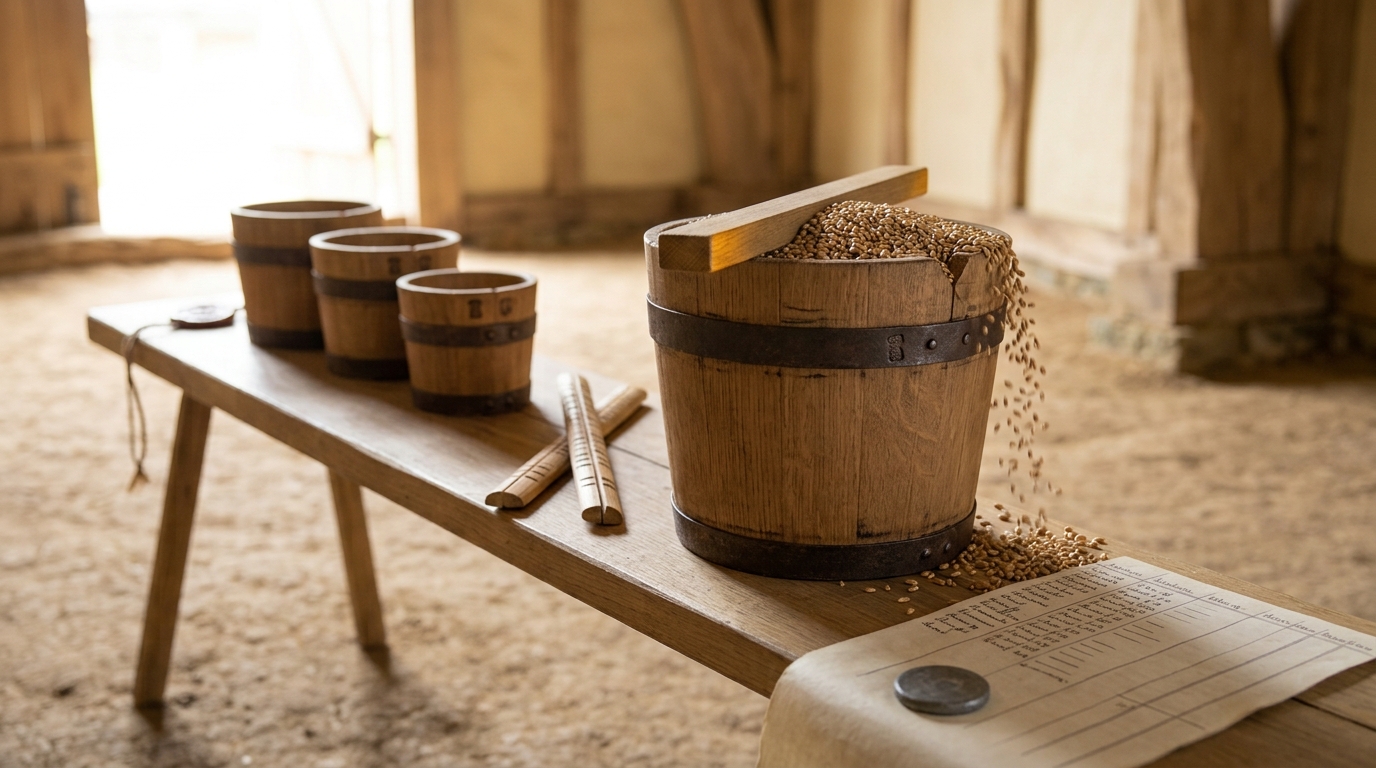
Measurement comes first because without it nothing else is possible. A claim to a share requires a unit in which the share can be expressed, and a unit requires a physical standard and a rule for using it — how full the vessel is, whether it is heaped or struck level, who holds the strickle. Englund’s study of grain accounting in archaic Mesopotamia describes proto-cuneiform administrative texts in which capacity notations for grain are tied to a rationing system, with the sign for a cereal ration deriving pictographically from the bevelled-rim bowl, a diagnostic ceramic form most common in the Late Uruk period [9]. He notes that a dependent labourer in central-administration service drew a ration in the order of a litre, and that the bookkeepers rounded when converting between grain accounts. Rounding is the point at which metrology becomes politics: someone decides which way the remainder goes.
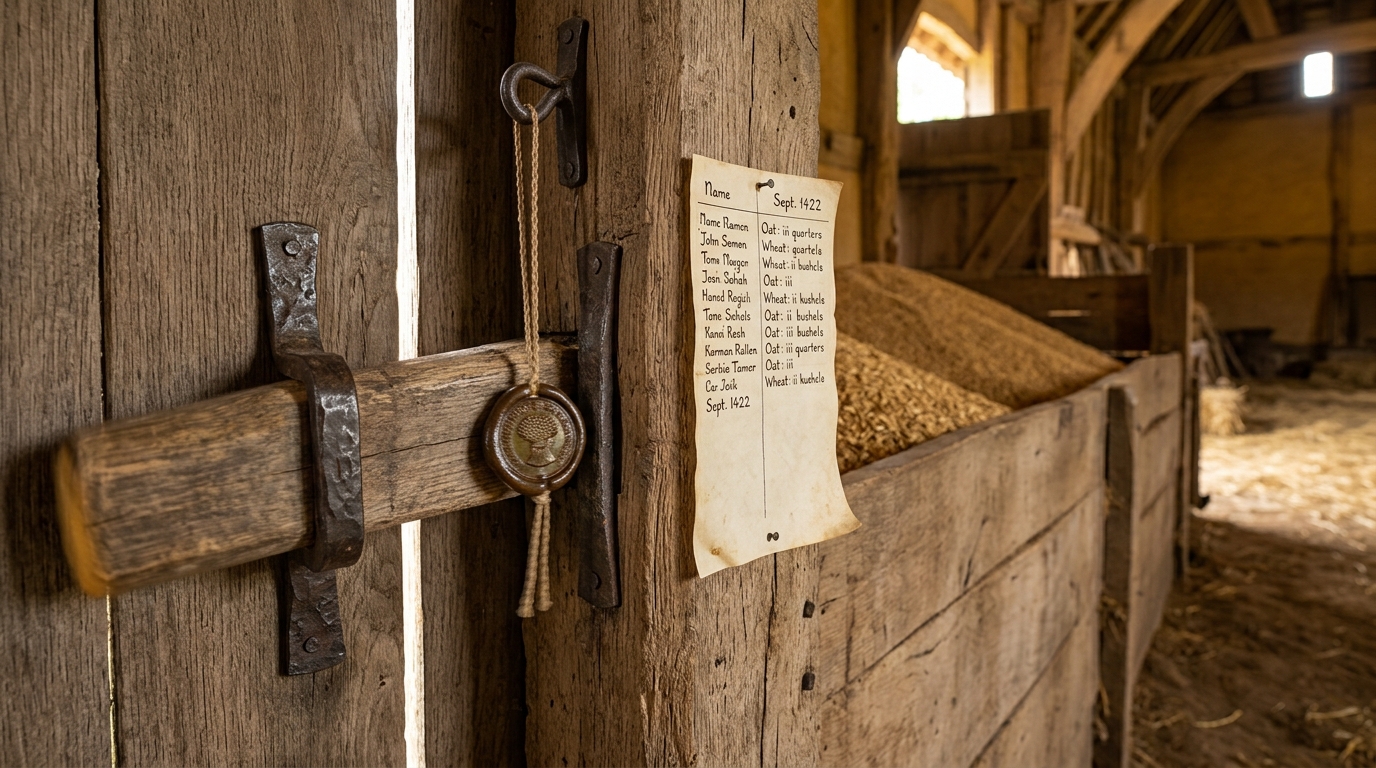
Sealing comes second because a measured quantity has to stay measured. The Early Helladic evidence Pullen reviews shows the practice in operation. At Petri, storage pithoi were repeatedly sealed and the broken sealings kept together with tableware on shelving; two hundred and fifty sealing fragments representing about one hundred different sealings were recovered, with twenty-six seal designs identified [8]. At Lerna, Room XI of the House of the Tiles yielded 143 sealings carrying impressions of seventy distinct seals, indicating control over a variety of small containers. Pullen reports Kostoula’s interpretation of a multistage administrative process — primary sealing, temporary retention of broken sealings, and possibly an ultimate archive — and notes that scholarly interpretation of these deposits still ranges from low-intensity non-bureaucratic use to a genuine archival function.
What a seal does is convert a container into a record of its own integrity. Once the seal is broken, the fact of access is undeniable even if the quantity is not recoverable. That is why sealing appears wherever storage becomes contested: it makes tampering visible without requiring surveillance. Record-keeping then extends the same property across time and distance, and the archaic Mesopotamian material is a reminder that the earliest writing sits inside grain administration rather than beside it.
Redistribution or extraction: an unsettled dispute
The most instructive live disagreement in this area concerns the great storage complexes of the Aegean Bronze Age, and it is unsettled in a way that is worth characterising precisely rather than resolving.
One position holds that the received label is wrong. Nakassis, Parkinson and Galaty argue that characterising Aegean political economies as redistributive is inaccurate and misleading, that a general model derived from Polanyi and applied by Finley has been conflated with a specific historical one, and that it is more fruitful to describe how particular social institutions organised and allocated goods and services than to sort economies into idealised types [6]. They quote Berdan’s judgement that characterising economies as redistributive or market is less fruitful than accepting a variety of exchange strategies and unravelling the relationships among them.
Halstead’s response accepts much of the critique and rejects its conclusion. He argues that redistribution in the sense used by Polanyi, Finley and Killen — centrally administered movements of goods and services without equivalence of value — retains considerable heuristic value for investigating both textual and archaeological evidence, and that the five papers in the forum do not all attack the same form of redistribution [7]. His discussion of Christakis’s storage evidence for Crete is a model of how to hold a question open. Christakis argues from pithos size, number and aggregation that staple storage did not exceed short-term domestic provision in the Prepalatial period and that elite management of surplus was of limited scale later, sufficient to sustain the elite and its dependents and to finance the ceremonial events underwriting elite power, but insufficient to relieve the wider population in bad years. Halstead accepts that the criticism of anachronistic extrapolation is justified but argues that Christakis overstates what storage evidence can prove, because storage takes archaeologically less visible forms than pithoi and because there is no compelling reason to expect elite surplus to be centralised in the palaces at all — Linear B indicates decentralisation of palatial grain production. His conclusion is explicit: the scale of elite staple storage, the uses to which it was put, and the importance of redistribution to the Minoan political economy must remain open questions [7].
The methodological lesson generalises. A granary’s capacity tells you what could be held, not who was fed from it. The redistributive and extractive readings frequently predict the same archaeology, and distinguishing them requires evidence about flows and entitlements that storage architecture alone does not supply. Halstead’s own observation that increasingly elaborate palatial magazines with rows of giant vessels were meant to impress points at a third possibility that is neither insurance nor extraction: storage as display, in which the visible fact of a stock is itself an instrument of power.
A surplus is only a surplus while it keeps

Everything above assumes the grain is still there. That assumption is the weakest link in the chain, and it is the reason granary design is so obsessive about draught, elevation and dryness. Kuijt and Finlayson’s suspended floors at Dhra’ are eleven thousand years old and already solving for airflow and rodents [3]; the staddle stones under an English granary solve the same problem in a different material.
The dynamics are simple enough to write down, and writing them down exposes an assumption that verbal accounts tend to hide. Let the stock carried into the next period be
where
The magnitudes are not small. In a controlled Kenyan trial, Mutambuki and colleagues report that after twenty-four weeks of storage, untreated polypropylene and jute bags reached 40.6 and 41.5 percent weight loss respectively, with roughly 96 to 98 percent of grain damaged, while hermetic triple-layer bags held weight loss to 2.4 to 2.9 percent and damage to 8.8 and 11.6 percent [12]. That is a single controlled comparison against two specific beetle pests and should not be read as a national loss rate. Aggregate estimates are much lower and much more contested: the World Bank reports FAO’s post-harvest handling and storage loss estimate for cereals at 8 percent and APHLIS at 10 to 12 percent, against self-reported on-farm losses from nationally representative surveys running from 1.4 percent in Malawi to 5.9 percent in Uganda, and notes that the higher figures extrapolate from purposively sampled and often older case studies while the survey figures are prone to measurement error [13]. The honest summary is that the loss rate is a range whose width reflects measurement method as much as physical reality.
Concentration changes the shape of the risk as well as its size. Bogaard’s account of the Hittite granary at Hattusha, excavated by a team led by Jürgen Seeher, describes an underground facility behind a defensive wall containing hundreds of tons of intact carbonised cereal grain, which at capacity would have stored enough to feed at least 20,000 people for a year on Seeher’s estimate [4]. Bogaard’s reading of it is pointed: the state’s effort to cache supplies against future emergencies failed spectacularly, because collecting many tons of cereal into one place made that production vulnerable to the destruction event that eventually occurred, and dispersed household management would have made catastrophic loss less likely. She also notes that the granary was planned together with the encircling postern wall as part of a building programme announcing the new capital’s status. Insurance, extraction and display again coincide in one structure, and centralisation trades many small independent risks for one large correlated one.
Famine as entitlement failure, and the argument about that claim
If storage is about claims, then hunger is about claims failing. Sen’s entitlement approach reframed famine analysis away from aggregate food supply toward the bundles of goods particular people can command. Devereux, reviewing the framework twenty years on, cites Sen’s definition of entitlements as the set of alternative commodity bundles a person can command using the totality of rights and opportunities they face, and the four categories to which Sen reduces legal sources of food: production-based, trade-based, own-labour, and inheritance and transfer [11, 10]. The consequence is that famine can occur where food is available and markets function, if identifiable groups cannot acquire it. Devereux quotes Sen’s own summary that the law stands between food availability and food entitlement, and that starvation deaths can reflect legality with a vengeance.
The debate about this thesis is worth characterising rather than flattening, because both the standard criticism and the standard defence are frequently misstated. Devereux argues that Sen created a confusion by presenting the entitlement approach as a general analytical framework while simultaneously deploying it against food availability decline as a rival theory of causation, which invited empirical refutation of a framework that was not supposed to be a hypothesis [11]. He describes two strands of attack — reinterpretation of the production, trade and price data for Sen’s four case famines, and counter-example from famines Sen did not examine — and considers both strands fatally flawed, on the ground that food availability decline is not a non-nested alternative to entitlement decline but is incorporated within the framework as failure of production-based entitlement.
Devereux’s own critique is different and, he argues, more serious. He examines four limitations Sen himself acknowledged — starvation by choice, disease-driven rather than starvation-driven mortality, ambiguity in specifying entitlements, and extra-legal entitlement transfers — and concludes that the approach is significantly weakened, both conceptually and empirically, by its methodological individualism and by privileging economic aspects of famine above sociopolitical determinants [11]. He proposes a taxonomic reconciliation instead: some famines triggered by availability decline, some by exchange entitlement decline, some by political crisis, with the trigger in every case distinguished from the underlying causes.
The extra-legal category is where storage returns to the argument in its harshest form. Devereux notes that famines characterised by looting, requisition and scorched-earth tactics — including the destruction of granaries — involve transfers that violate rather than operate through entitlement rules [11]. A granary is the single most efficient target in an agrarian economy for precisely the reason that made it administrable in the first place. Concentration serves whoever reaches it, and legality is not a property of buildings.
Public granaries, price stabilisation, and the limits of the instrument
Public grain reserves recur across societies with almost nothing else in common, which is itself evidence that the underlying problem is structural rather than cultural. The recurring design is the same: buy when prices are low and the harvest is heavy, sell or release when prices are high and supply is short, and hold a physical stock in between.
The recurrence should not be mistaken for demonstrated effectiveness. Bigman and Reutlinger’s simulation analysis of national buffer stocks and trade policies concluded that for most countries international trade would be a better route to stability in the domestic market than stockholding, because buffer stocks large enough to stabilise supplies can be very costly [14]. In their restricted-trade scenario an annual outlay of 45 million dollars for buffer stocks reduced the probability of a severe shortfall from roughly 8 percent to 5 percent, while a further outlay of the same magnitude bought only an additional 1.1 percentage points. They are equally clear that the trade option has its own costs in foreign-exchange volatility and reserve requirements. That paper is from 1979 and its parameters are of their moment; what survives is the structural point that stockholding has sharply diminishing returns and competing instruments, so the presence of a public granary is not by itself evidence of a well-chosen policy.
There is also a persistent governance problem that the physical framing obscures. A public store must be rotated or it degrades, its quality must be verified by someone who does not benefit from overstating it, and the incentive to hold it depends on who bears the cost when it is empty. The loss term in the identity above is not only physical: a granary that is nominally full and actually hollow is a familiar administrative failure, and it is invisible until it is needed.
A testable expectation, stated as a prediction rather than a finding. Over the next decade, to 2036, I expect the measured gap between aggregate post-harvest loss estimates and survey-based on-farm estimates to narrow substantially, and for the narrowing to come mostly from the aggregate figures falling. The assumptions are that nationally representative agricultural surveys continue to expand, that direct-measurement studies increasingly replace extrapolation from purposive case studies, and that hermetic and improved storage adoption keeps rising among smallholders. The observable indicators would be revised APHLIS and FAO cereal loss figures published alongside their measurement method, and convergence between survey and modelled estimates within a common country-year. The disconfirming condition is straightforward: if direct-measurement studies conducted on nationally representative samples return storage losses at or above the current 8 to 12 percent range, the prediction is wrong, and the discrepancy documented by the World Bank should be attributed to under-reporting by farmers rather than to over-extrapolation by modellers [13].
What the barn is for
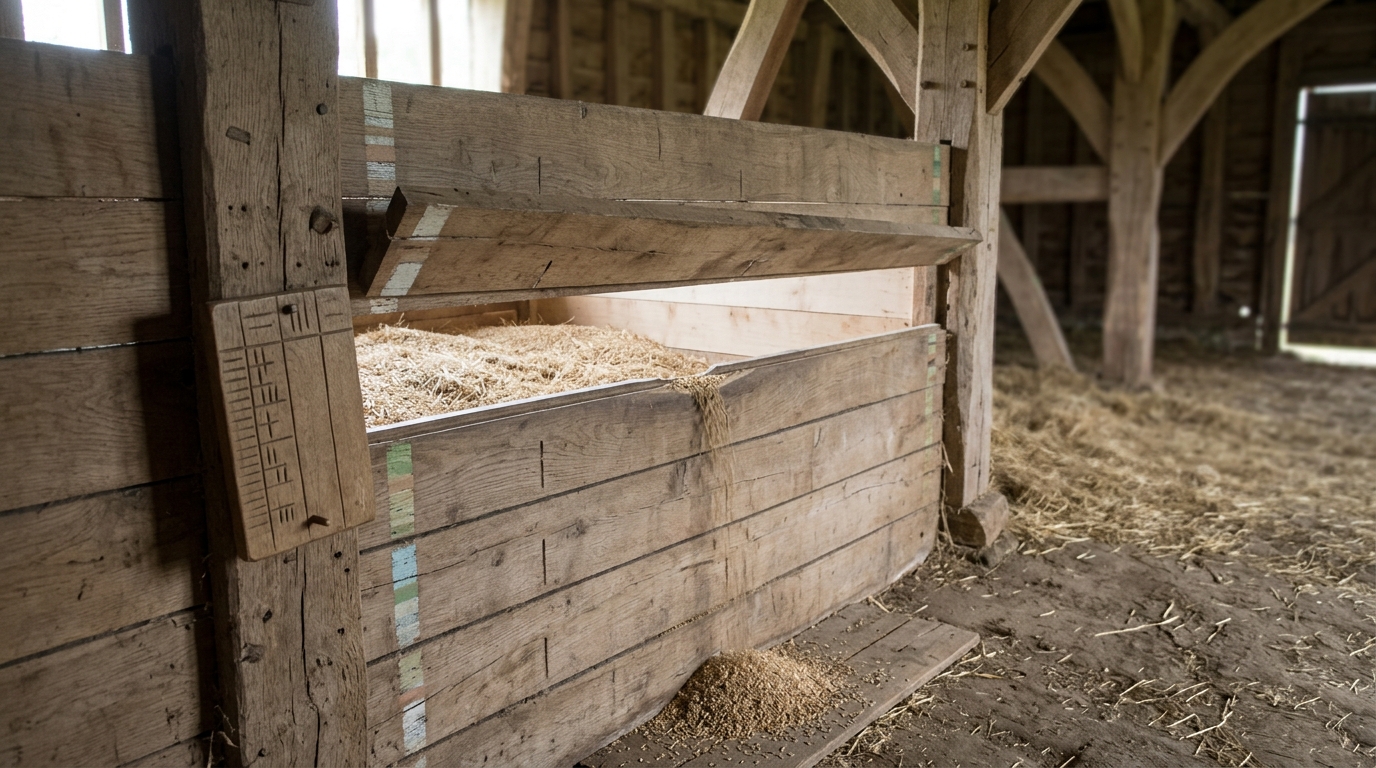
Return to the tithe barn. Its cross draught is a loss-control device; its raised granary is a loss-control device; its single controlled door is an appropriability device; its measures and seals are what let a claim be stated in units and checked later by someone who was not present. The building is a physical summary of every argument above, and it does not distinguish between the readings scholars argue over, because it was never designed to. It holds what was collected. Who collected it, on what authority, for whose benefit and against whose refusal are questions the timber cannot answer.
That is the useful thing about treating the granary as an institution rather than as a stage of development. It moves attention from how much was produced to who could claim it, from calories to entitlements, and from the fact of a stock to the rules governing access to it. The appropriability thesis of Mayshar and colleagues is one strong articulation of that shift and is under active methodological challenge [1, 2]. The Aegean redistribution dispute is another, and remains open by the explicit statement of its own participants [7, 6]. Sen’s entitlement framework applies the same move to the modern case and has generated two decades of argument about how far it reaches [10, 11]. What these literatures share is not an answer but a question: not whether a society had a surplus, but what kind of object that surplus was, and who was standing at the door.