Institutions do not announce their own turning points
A state’s capacity to tax, to deliver a service, to keep a court’s ruling enforceable, or to hold a treaty partner to a commitment rarely changes on a single dramatic date. It changes the way an s-curve changes — quietly for a long stretch, then visibly, then it is treated as though it had always been obvious. That makes governance a hard subject for forecasting and an easy one for overconfident narrative. This article tries to do something narrower and more checkable than “AI will transform government” or “the liberal international order is ending.” It picks three institutional trajectories that are already producing administrative records — enrollment counts, tax reconciliations, impact-assessment audits, ratification votes — and states what would have to be true in that record by 2035 for a specific claim to hold, and what would have to be true for it to fail.
The three trajectories are: whether digital-identity systems measurably improve tax collection and public-service delivery in developing states; whether AI-assisted administrative systems produce documented efficiency gains without a documented surveillance or legitimacy backlash; and whether international governance institutions adapt their enforcement mechanisms to a documented multipolar shift in power. Each section below separates fact (something already measured and published), vendor or promoter claim (an assertion made by the party selling or championing the system), analysis (this author’s interpretation of the fact base), scenario (a plausible but unconfirmed future path), and prediction (a falsifiable, dated claim). Readers should be able to disagree with the analysis while still checking the predictions against public records years from now.
Fact base: what digital identity has already done, and what remains unmeasured
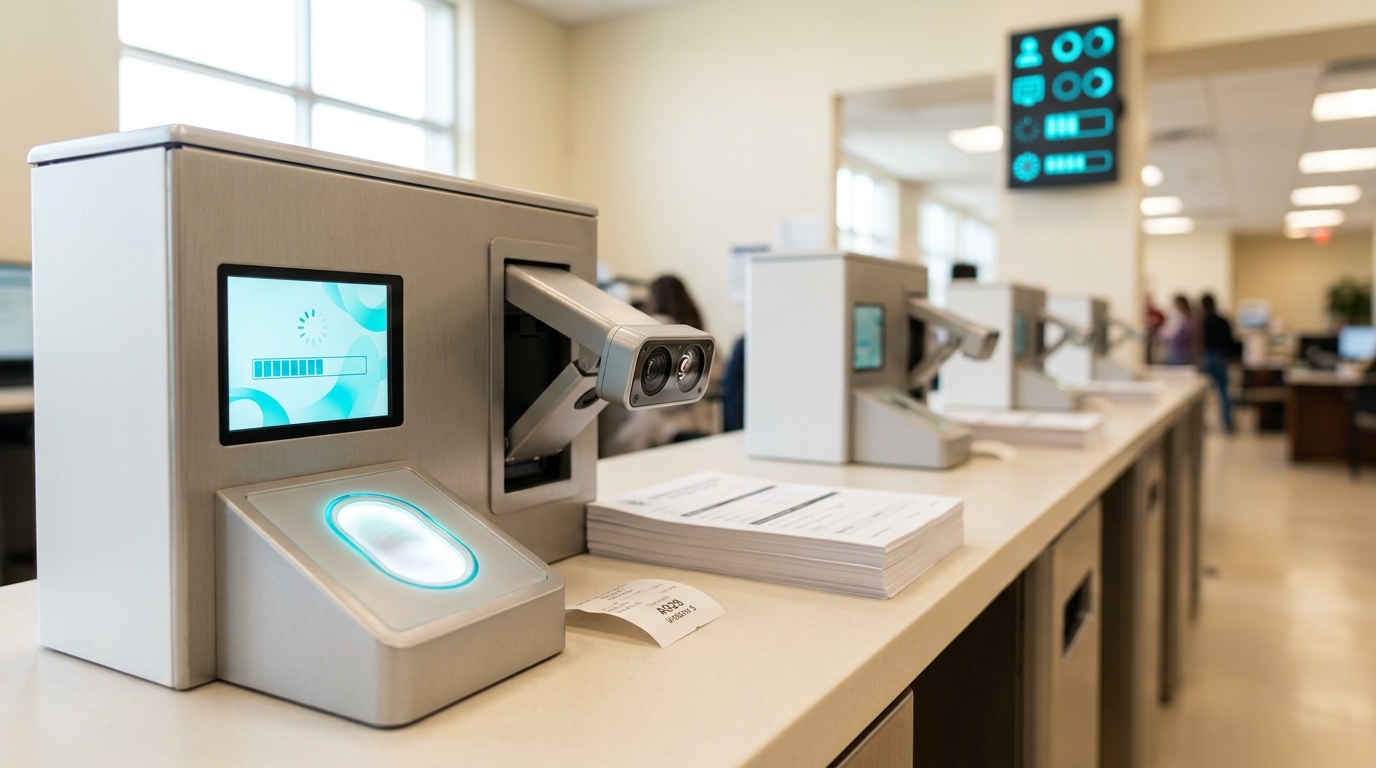
Roughly 2.8 billion people lack a government-recognized digital identity usable for online transactions, and about 800 million lack any official identification at all, according to the World Bank’s 2025 ID4D Global Dataset [1]. The World Bank’s ID4D and G2Px programs have supported more than 60 countries in issuing digital IDs to over 550 million people, framed explicitly as digital public infrastructure for benefit delivery, financial inclusion, and administrative efficiency [2]. That is fact: enrollment has scaled, and the institutions building these systems describe the goal in those terms.
Whether enrollment translates into measured revenue or service gains is a separate, harder question, and the evidence is mixed rather than uniformly positive. A 2025 Boston Consulting Group report estimated that Indian states linking Aadhaar-based biometric authentication to direct benefit transfers cut welfare-program leakage by roughly 12.7 percent, projecting up to ten billion U.S. dollars in annual savings from eliminating duplicate and fraudulent claims [5]. That figure should be read as an industry-consultancy estimate, not an independently replicated academic result — BCG has a commercial interest in digital-payments modernization work, and the report’s methodology for isolating leakage reduction from other concurrent reforms is not fully public. Contrast that with the peer-reviewed NBER working paper by Muralidharan, Niehaus, and Sukhtankar, which used randomized and natural experiments around Jharkhand’s Aadhaar-linked Public Distribution System rollout and found a more qualified picture: identity verification requirements reduced diversion in some contexts but also produced real exclusion of eligible beneficiaries who could not complete authentication, meaning the net welfare effect depends heavily on implementation quality, not on the technology’s existence [6]. Fact: at least one credible peer-reviewed study finds both leakage reduction and exclusion effects from the same policy. Vendor and promoter claims of clean, universal leakage reduction should be treated as unverified until an independent study of a comparable design replicates them outside India.

Fact base: administrative AI adoption is real, self-reported efficiency measurement is rare
The OECD’s 2025 “Governing with Artificial Intelligence” report, approved by its Public Governance Committee, documents roughly 200 real-world AI use cases across eleven core government functions in OECD member states, from service delivery to financial management to anti-corruption work [3]. That AI tools are being deployed inside public bureaucracies at meaningful scale is fact, not scenario. What is not yet fact is whether those deployments produce documented net efficiency gains: the OECD’s own finding is that only 10 of 36 member countries — about 28 percent — report having conducted any financial or non-financial impact-measurement study of their AI use cases in government [3]. A companion 2026 OECD brief on building an “AI-ready public workforce” treats workforce readiness, not measured output gains, as the current bottleneck, again without asserting an aggregate efficiency figure [4]. This is an important asymmetry for a 2035 forecast: adoption is outrunning evaluation. A claim that “AI is making government more efficient” is, as of 2026, mostly a vendor and adopter narrative rather than a documented finding, precisely because the measurement infrastructure to confirm or deny it barely exists yet in three-quarters of the countries that have already deployed the tools.

Fact base: legitimacy pushback against biometric and digital-ID systems already has legal precedent
The clearest documented instance of a surveillance-and-legitimacy backlash halting a state administrative-technology rollout is Kenya’s 2021 High Court ruling on Huduma Namba, the country’s national biometric identity system. The court found the government had proceeded with biometric data collection without conducting a required data protection impact assessment, and a related ruling held that the system could not lawfully advance without a legal framework addressing risks of discrimination, exclusion, and mass surveillance [7]. That is fact, not scenario: a national digital-ID program, backed by a roughly 95-million-dollar investment, was judicially paused specifically on data-protection and surveillance grounds. It establishes a real, checkable mechanism — courts, not only public opinion — by which a legitimacy backlash can materialize as an enforceable institutional check on an administrative-technology deployment, and it gives a 2035 forecast something concrete to look for: similar rulings, or their conspicuous absence, in other jurisdictions expanding biometric ID at similar or larger scale.

Fact base: multipolarity is documented in voting behavior and institutional negotiating position, not yet in enforcement mechanism redesign
Two things are separately documented and should not be merged into one claim. First, that a shift toward a more multipolar distribution of power is now widely treated as established fact by international-relations institutions themselves: the German Marshall Fund’s 2024 “Pivotal Powers” assessment and the UN’s own September 2024 “Pact for the Future,” adopted at the Summit of the Future, both explicitly frame Security Council composition as reflecting a 1945 settlement rather than a 21st-century multipolar reality, and call for reform toward a body that is “more representative, inclusive, transparent, efficient, effective, democratic and accountable” [10] [9]. That the diagnosis is now institutional consensus, not merely academic commentary, is fact. Second — and this is the part forecasters conflate too quickly — actual redesign of enforcement mechanisms (permanent-member composition, veto scope, sanctions-implementation authority) has not happened. Amending the UN Charter requires ratification by two-thirds of member states including all five permanent Security Council members, giving the current P5 a structural veto over any reform that would dilute their own status [9]. Diagnosis and reform are documented at very different stages: the former is settled, the latter is not.
Alongside this, the V-Dem Institute’s 2025 Democracy Report documents that autocracies (91 countries) outnumbered democracies (88 countries) for the first time in over twenty years, with backsliding now reaching Western democracies including Italy, the United Kingdom, and the United States [8]. This is relevant to state capacity because backsliding correlates with exactly the institutional functions this article tracks: V-Dem’s own breakdown finds that in a substantial number of countries, legislatures’ capacity to investigate executive overreach and the predictability of legal enforcement have both measurably worsened [8]. A multipolar-power argument and a democratic-backsliding argument are not the same claim, but they intersect in a single administrative fact: state capacity to enforce rules — domestically and through treaty commitments abroad — is moving in documented, opposite directions in different jurisdictions at the same time.

Analysis: three separate mechanisms, not one story of “governance transformation”
It is tempting to fold digital ID, administrative AI, and multipolar treaty enforcement into one narrative about technologically-enabled state modernization colliding with distributed global power. Resist that. They are mechanically distinct. Digital ID changes who can be uniquely identified and matched against a record, which affects fraud and duplication but says nothing about administrative competence elsewhere in the pipeline — a state can de-duplicate its beneficiary rolls perfectly and still fail to deliver the benefit, as the Jharkhand exclusion finding shows [6]. AI-assisted administration changes throughput and, potentially, consistency of case handling, but the OECD’s own data shows most adopting governments cannot yet say by how much, because few have built the counterfactual measurement needed to know [3]. And multipolar power redistribution changes which states can credibly threaten costs for treaty violation, which is a question about relative capability and coalition-building, largely orthogonal to either domestic technology adoption question. Treating all three as facets of one “governance disruption” story obscures that each has its own falsification conditions, and a forecaster who is right about one says nothing evidentially about the other two.
Scenario and prediction 1: digital ID and measurable tax-collection gains in developing states
Scenario. By 2035, a critical mass of developing-state tax and revenue authorities that have linked digital-ID enrollment to taxpayer or beneficiary registries will be able to point to independently audited, pre/post revenue or leakage figures attributable to the identity layer, not merely to enrollment counts.
Assumptions. This scenario assumes continued World Bank and bilateral technical-assistance funding for ID4D-style programs at roughly current or greater levels; that at least a handful of adopting states commission or permit independent (non-vendor) evaluation, following the NBER Jharkhand model rather than relying solely on consultancy estimates like the 2025 BCG figure [5] [6]; and that enrollment growth documented in the ID4D dataset continues on something close to its recent trajectory [1].
Observable indicators by 2035. (a) At least three developing-country revenue or social-protection authorities publish, or have commissioned, independently reviewed pre/post studies isolating the digital-ID variable’s contribution to collection or leakage reduction, comparable in design rigor to the NBER Jharkhand study. (b) The gap between World Bank-reported enrollment figures and any published, audited revenue-impact figures narrows — currently the enrollment count is fact and the revenue-impact figure is largely vendor estimate, and a 2035 confirmation requires that gap to close with independent evidence, not just more enrollment.
Disconfirmation condition. If, by 2035, the only published revenue or leakage figures attributable to digital ID remain vendor- or consultancy-produced estimates (in the mold of the BCG figure) with no independently replicated academic or government-audit study confirming a leakage reduction or revenue gain in any adopting developing state, the prediction fails. It likewise fails if independent studies that do exist mostly replicate the Jharkhand pattern of gains offset by exclusion, such that no clear net positive effect on delivery can be documented.
Horizon. 2035, checked against World Bank ID4D publications, national audit-office reports, and peer-reviewed development-economics literature current at that date.
Scenario and prediction 2: AI-assisted administration without a documented backlash
Scenario. By 2035, a majority of OECD member states will have both (a) closed the current measurement gap — moving well past the 28 percent of countries currently conducting any impact-measurement study [3] — and (b) avoided a Huduma-Namba-scale legal or regulatory reversal of a flagship administrative-AI system on data-protection, discrimination, or mass-surveillance grounds.
Assumptions. This assumes OECD countries continue the reporting and impact-evaluation push visible in the 2025-2026 OECD publication cycle [3] [4]; that data-protection litigation and regulatory review remain active and independent enough, as in the Kenyan Huduma Namba precedent, to actually block or roll back a poorly safeguarded system if warranted [7]; and that no major jurisdiction suspends its own data-protection enforcement capacity in the interim (a live risk given the V-Dem finding that legislative oversight capacity is worsening in a substantial number of countries [8]).
Observable indicators by 2035. (a) OECD’s own periodic “Governing with AI” survey series shows the share of member countries reporting completed impact-measurement studies rising from the 2025 baseline of 28 percent toward a clear majority. (b) No flagship national administrative-AI system among G20 states is judicially suspended, or subject to a formal supra-national regulatory finding of unlawful data processing, on grounds materially similar to the Huduma Namba ruling.
Disconfirmation condition. The prediction fails if, by 2035, either (a) the OECD’s own measurement-adoption figure has stagnated near or below its 2025 level of 28 percent, meaning the efficiency claim remains substantially a vendor and adopter narrative rather than a documented finding, or (b) at least one G20-level administrative-AI or biometric system has been judicially suspended or formally found unlawful on data-protection or mass-surveillance grounds, demonstrating that the “no documented backlash” half of the scenario did not hold. Either failure mode alone falsifies the joint prediction, since the claim is conjunctive by design — efficiency gains and the absence of a documented backlash, not one or the other.
Horizon. 2035, checked against OECD Digital Government Outlook and “Governing with AI” survey series, national and EU-level data-protection authority rulings, and G20 government AI-program audits.
Scenario and prediction 3: international enforcement mechanisms and the multipolar shift
Scenario. By 2035, at least one major international governance institution’s core enforcement mechanism — Security Council composition or veto scope, an international financial institution’s voting-share formula, or a sanctions-implementation authority — will have been formally amended in a way that measurably shifts decision rights toward previously underrepresented rising powers, beyond symbolic consultative gestures.
Assumptions. This assumes the diagnostic consensus documented in the 2024 Pact for the Future and in assessments like GMF’s “Pivotal Powers” continues to translate into actual negotiating pressure [9] [10]; that at least one P5 member calculates a reform is in its own interest rather than purely a loss of relative power (the U.S. signaling openness to text-based UN Security Council reform negotiations, as reported alongside the 2024 Pact for the Future, is the kind of signal this depends on continuing); and that the ratification threshold — two-thirds of UN member states including all five permanent Security Council members [9] — is not itself relaxed, since that would change the mechanism being forecast.
Observable indicators by 2035. (a) A UN Charter amendment altering Security Council composition, veto scope, or permanent membership is formally adopted and ratified under Article 108/109 procedures, not merely proposed or debated at another Summit-style gathering. (b) Absent full Charter amendment, a documented, binding procedural change to an international financial institution’s voting-share formula (IMF quota realignment or World Bank shareholding realignment) that materially shifts votes toward non-G7 states, verifiable against those institutions’ own published governance records.
Disconfirmation condition. The prediction fails if, by 2035, the record shows continued diagnostic consensus — further Pact-for-the-Future-style declarations, further “Pivotal Powers”-style assessments — without any ratified Charter amendment or binding voting-share realignment. A decade of proposals without an adopted amendment, given the P5’s structural veto over any change to their own status [9], would confirm the null hypothesis: that multipolarity is documented in relative capability and rhetoric well before it is documented in enforcement-mechanism redesign, because the amendment threshold itself is built to resist exactly this kind of change.
Horizon. 2035, checked against the UN Charter’s own amendment record, IMF quota review outcomes, and World Bank shareholding review outcomes as published by those institutions.

What would make this article wrong in a useful way
A forecast article earns its keep by being checkable, not by being right. The three predictions above are deliberately conjunctive and narrow rather than broad and hedged: prediction 1 requires independent (not merely vendor) evidence of a net revenue or delivery gain, not just continued enrollment; prediction 2 requires both a measurement-adoption threshold and the absence of a Huduma-Namba-scale reversal, so a partial success on either half is a failure of the joint claim; prediction 3 requires a ratified structural change to an enforcement mechanism, not another summit communiqué restating the diagnosis that a 2024 UN summit already restated. Each disconfirmation condition points to a specific public record — an audit report, an OECD survey wave, a Charter amendment register — that a reader in 2035 can check without needing this article’s cooperation. That is the standard state-capacity forecasting should be held to, and it is a higher bar than most governance commentary chooses to clear.