A 2011 Press Release Said a Robin’s Compass Outlasts the Best Man-Made Quantum Memory
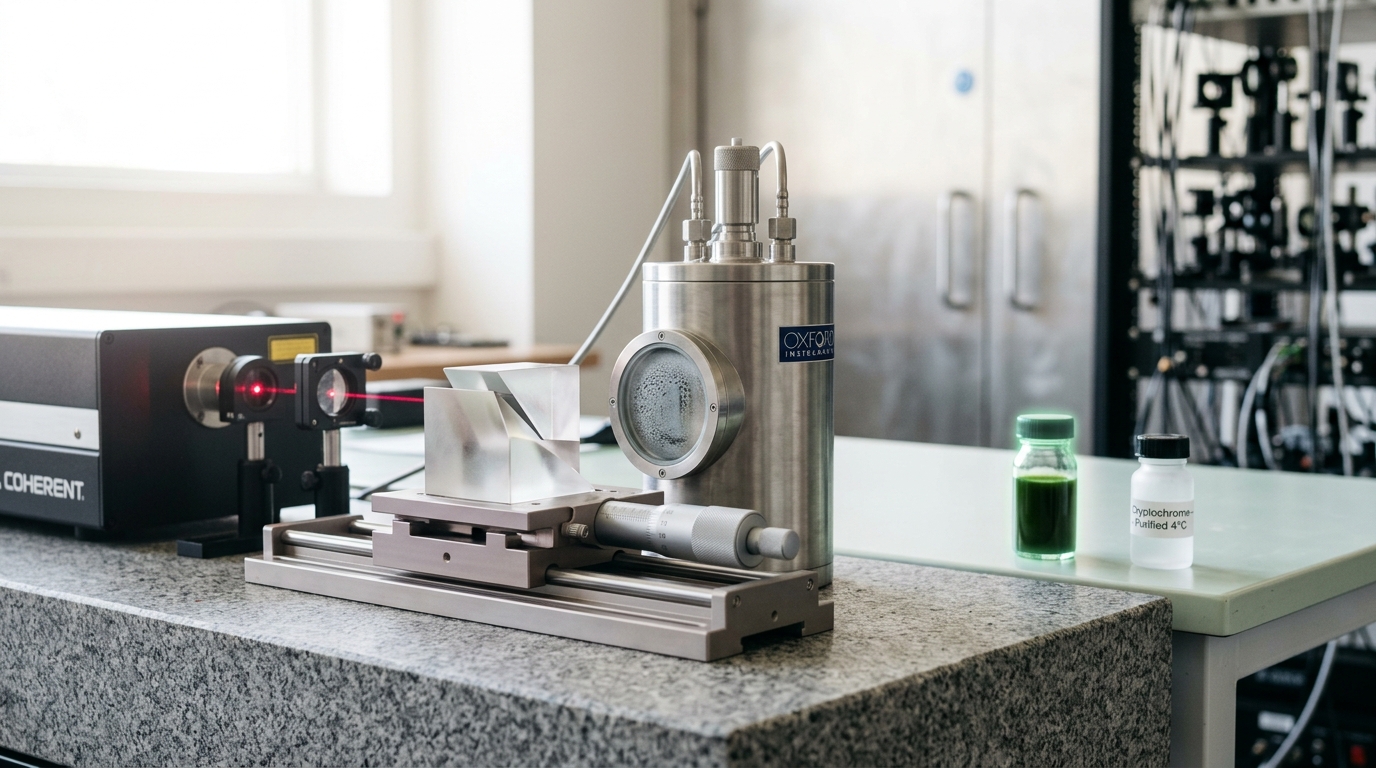
In January 2011, the University of Oxford’s own press office described a result from its physics and chemistry departments in language that would sound at home in a science-fiction pitch: a European robin’s internal compass, the office said, “can evidently keep these states alive for at least 100 microseconds, probably much longer,” and “the best comparable artificial molecules can only manage 80 microseconds at room temperature. And that’s in ideal laboratory conditions” [4]. The paper behind the release, by Erik Gauger, Elisabeth Rieper, John Morton, Simon Benjamin, and Vlatko Vedral, made a related but more careful claim in its own abstract: modeling the best available behavioral data, the authors found that “superposition and entanglement are sustained in this living system for at least tens of microseconds, exceeding the durations achieved in the best comparable man-made molecular systems,” a striking result set against the observation that “in artificial systems, quantum superposition and entanglement typically decay rapidly unless cryogenic temperatures are used” [3]. Warm, wet, jostled by thermal motion at every femtosecond — a bird’s eye is about as far from a dilution refrigerator as a chemical environment gets — and yet, on this reading, it was quietly out-performing the room-temperature quantum hardware in physics departments down the corridor.
That claim rests on a specific physical mechanism, not a metaphor: the radical-pair mechanism, in which a photon striking a protein called cryptochrome kicks one electron from a paired, spin-correlated pair onto a separate site, leaving two unpaired electron spins that continue to evolve quantum-mechanically — oscillating coherently between a spin-antisymmetric “singlet” configuration and three spin-symmetric “triplet” configurations — for as long as their entanglement survives the surrounding molecular chaos [1]. The Earth’s magnetic field, at the geomagnetic surface strength of roughly 50 microtesla, nudges that oscillation just enough to shift the eventual chemical fate of the pair, and the resulting change in reaction-product yield is, on this hypothesis, the raw signal a bird’s visual system reads out as a compass. It is real physics, published in Physical Review Letters, built on a real, textbook wave-mechanical property — electron spin superposition and coherent singlet-triplet interconversion — doing something no other confirmed biological sensor does: making a measurable difference to an animal’s behavior. The question this article asks is not whether the mechanism is real. It is whether the specific number attached to it in 2011 — tens of microseconds, “probably much longer” — survived contact with the one thing that had not yet existed when that number was published: a direct measurement of the actual candidate molecule.
What makes the coherence lifetime the load-bearing number, rather than a technical footnote, is how weak the underlying interaction actually is. The 2021 paper states the comparison in the same terms a chemist would use to explain why this should not work at all: proof-of-principle radical-pair systems are sensitive to an Earth-strength field “via magnetic interactions that are a million times smaller than the thermal energy, kBT” — the same thermal energy that, in an ordinary chemical system, would randomize a coherent quantum state long before a field a million times weaker could leave any trace on it [2]. Radical pairs get away with this because their two electron spins are, for a short window after formation, chemically isolated from that thermal bath rather than equilibrated with it — closer to a hot drink cooling inside a vacuum flask than one left on an open counter, in the review’s own analogy [1]. The coherence lifetime is, in effect, a timer on how long the flask stays sealed. Every number in this article is a version of the same question: how long does the seal actually hold, in the one molecule now thought to be doing the sealing.
The Molecule Making That Claim Possible Has a Name, a Structure, and Four Tryptophans
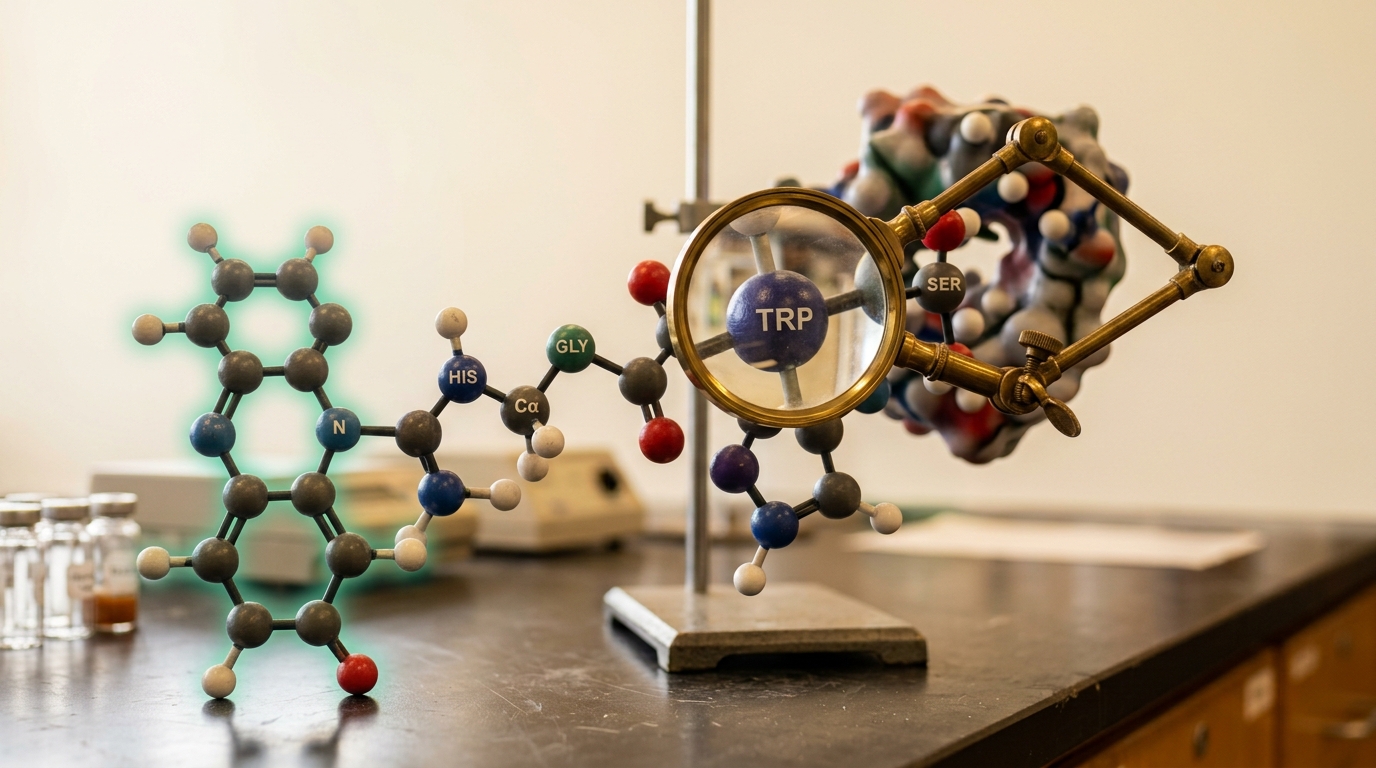
By 2021, it did. A 36-author list spanning Oxford, Oldenburg, Freiburg, and three other institutions — including several of the same physicists behind the 2011 coherence claim — published the first direct photochemical and magnetic characterization of cryptochrome 4 purified from actual European robin (Erithacus rubecula) tissue, the specific protein now considered the leading candidate for the sensor molecule itself, rather than a stand-in from a plant or a fly [2]. The protein, ErCry4, carries a bound flavin adenine dinucleotide (FAD) chromophore and, radiating out from it toward the protein’s surface, “a chain of four tryptophans,” each one a stepping stone an electron can hop along after the FAD absorbs light [2]. The authors built four mutant versions of the protein, each with one tryptophan in the chain swapped for a redox-inactive phenylalanine — labeled, in the paper’s own shorthand, TrpA, TrpB, TrpC, and TrpD, counting outward from the FAD — to isolate exactly which link in the chain the compass-relevant radical pair actually forms at [2].
The headline biological result is a comparison across species: ErCry4 from the night-migratory robin showed a substantially larger magnetic field effect on its radical yield than the same protein purified from two non-migratory birds, chicken and pigeon, run under identical conditions — the first direct evidence that the magnetic sensitivity of this specific molecule tracks with which species actually needs a magnetic compass [2]. That is a genuine, hard-won result, and it is not this article’s subject. This article’s subject is a quieter number buried in the same paper’s discussion section, arrived at by feeding the measured chemistry into a spin-dynamics simulation of the radical pair’s behavior in the Earth’s own field — a number that puts a very different frame around the 2011 press release than the release itself did.
Two Numbers From the Same 2021 Paper Do Not Match: A Hundred Nanoseconds Measured, One Microsecond Required
Here is the arithmetic, stated in the paper’s own words rather than paraphrased into vaguer language. Modeling the combinations of forward-reaction and back-reaction rate constants that best reproduce the magnetic field effect actually measured on purified ErCry4 at a laboratory-strength 30-millitesla field, the authors identify the specific rate-constant pair for which “the radical pair lifetime is approximately 100 ns” as the one matching the wild-type protein’s observed behavior [2]. Then, re-running the identical simulation at the Earth’s actual 50-microtesla field strength rather than the laboratory’s 30 millitesla, they state the requirement plainly: “to be sensitive to the Earth’s 50 µT magnetic field in vivo, a composite radical pair would need a minimum lifetime of 1 µs, i.e. an order of magnitude longer than the 100 ns observed here for purified ErCry4 WT in vitro” [2]. A hundred nanoseconds measured. A thousand nanoseconds — one microsecond — required. Not an order-of-magnitude estimate on my part: the paper’s own phrase is “an order of magnitude longer.”
This number is Observed in the strictest sense the epistemic ledger of this series allows: it is a direct measurement of a real, purified protein’s photochemistry, not a simulation of an idealized spin system and not an inference from behavioral data several steps removed from the molecule itself. It sits comfortably beside an independent theoretical constraint from the same broader research group: a molecular-dynamics simulation of AtCry1, the plant cryptochrome that has stood in as cryptochrome’s best-understood structural relative, concluded that “the optimal radical pair lifetime for detecting the direction of the Earth’s magnetic field is of the order of a microsecond” [5, 1] — the same figure Xu and colleagues arrive at independently from real ErCry4 chemistry. Two different methods, two different molecules, one converging number: roughly a microsecond is what the mechanism needs merely to register that the Earth’s field exists at all, and what has actually been measured, in the specific protein now thought to be doing the sensing, in a beaker, is ten times shorter.

None of this means the mechanism is broken, and the same 2021 paper is explicit about why. A purified protein floating in a cuvette is not the same physical system as a cryptochrome anchored inside a photoreceptor cell’s membrane, immobilized, oriented, and in contact with whatever signaling partners it evolved alongside; the authors propose specific, concrete ways the gap could plausibly close in vivo — protein-protein interactions restricting the radicals’ internal mobility, small shifts in the balance between two competing radical-pair pathways the protein can form, and scaled-down forward-reaction rates achievable through modest sequence changes, each of which their own simulation shows would push the effective lifetime and the field sensitivity in the right direction [2]. This is a Derived, testable engineering problem stated with a number attached — close a factor of ten through immobilization and rate tuning — not a mystery. It is also, notably, a substantially smaller and more precise claim than “the compass outperforms the best man-made quantum memories.” A tenfold shortfall that a plausible biochemical mechanism could close is a research program. A biological system quietly beating cryogenic laboratory hardware, unqualified, is a headline. The 2021 paper’s own arithmetic supports the former far more directly than the latter.
The same paper adds a second constraint that makes a single, simple radical pair an awkward fit for the job on its own, regardless of how the tenfold gap closes. A cryptochrome that senses magnetic fields cannot let its radical pair persist too long, either: “the sensing state cannot live for more than a few microseconds, otherwise any magnetic field effect on the singlet-triplet interconversion would be lost by spin relaxation” [2]. But turning a fleeting change in radical-pair chemistry into something a neuron can act on — a signaling cascade — needs the opposite: “a lifetime of milliseconds, seconds, or longer,” on a timescale no single microsecond-lived state could ever reach [2]. The paper’s own conclusion is blunt about the consequence: “no single state of the protein could fulfil both roles” [2]. Their proposed way out is a composite mechanism — two competing radical pairs the protein can form along the same tryptophan chain, one formed closer to the flavin and best suited to generating the magnetically sensitive signal, and a second, more surface-exposed pair better placed to persist and eventually settle into a longer-lived, stabilized state capable of triggering downstream signaling. It is a plausible division of labor, consistent with the measured chemistry, and it is exactly the kind of two-part solution a single-number “coherence budget” headline has no room to mention.
The Actual Disorientation Experiment Behind the 2011 Claim Demanded Even More — And May Not Be Real
The tenfold gap above is not, however, where the 2011 coherence claim actually came from, and this is the point at which the story gets more interesting rather than simply resolving. Gauger and colleagues were not modeling ordinary compass sensitivity to the 50-microtesla geomagnetic field. They were modeling a much stranger behavioral result: birds disoriented not by removing the Earth’s field, but by exposing them to a second, oscillating magnetic field vastly weaker than the Earth’s own — a field tuned to the “Larmor frequency,” the natural precession rate of an electron spin in the ambient geomagnetic field, which at 50 microtesla works out to about 1.4 megahertz, corresponding to a Larmor period of roughly 700 nanoseconds [1]. The original behavioral finding, from Thorsten Ritz and colleagues including Hore himself, reported that a Larmor-frequency field of only about 15 nanotesla — some 3,000 times weaker than the Earth’s own field — was enough to scramble the birds’ sense of direction entirely [7].
That result, taken at face value, poses a much harder problem than ordinary sensitivity to 50 microtesla, and Hore and Mouritsen’s own review states exactly how much harder in exactly one sentence: “for a time-dependent field 3000 times weaker than the Earth’s field, one would have to wait at least 3000 times longer (i.e. ~2 ms) before it could have a similar effect. It is extraordinarily difficult to imagine how the spin relaxation could be that slow” [1]. Two milliseconds is not a modest stretch past the microsecond figure this article has built around; it is roughly two thousand times longer, and it is the review’s own co-author, not a critic, calling it extraordinarily difficult to imagine. Gauger and colleagues’ “tens of microseconds” was already a Derived estimate — inferred by fitting a theoretical model to the Ritz behavioral data, not measured directly in any molecule — sitting somewhere between the microsecond floor a bare compass needs and the multi-millisecond ceiling a literal reading of the 15-nanotesla result would demand.
Here is the complication that neither the 2011 paper nor its press release could have anticipated. The same research group that reported the original 15-nanotesla disorientation effect later tried to replicate it under sharply tightened conditions — testing birds double-blind, inside a far more thoroughly electromagnetically screened chamber than the original experiments used — and, per Hore and Mouritsen’s own account, “failed to see specific effects on the birds’ magnetic compass orientation capabilities using fields oscillating at the Larmor frequency,” a result the two authors summarize bluntly: “these results seriously question whether the specific effects reported at the Larmor frequency are real” [8, 1]. The same stricter study did find that the birds’ compass could be disrupted by broadband electromagnetic noise across a wide frequency range — a real, separately troubling effect for a different reason — but the specific narrow-band, 15-nanotesla, Larmor-frequency result that had originally demanded an extraordinary multi-millisecond coherence budget did not hold up under more careful testing [8, 1].
This is worth sitting with precisely because of what it does and does not do to the 2011 claim. It does not mean quantum coherence plays no functional role in the robin’s compass — the roughly-one-microsecond requirement for ordinary geomagnetic sensitivity stands on its own, confirmed independently by the plant-cryptochrome simulation and the 2021 direct measurement alike. What the replication failure undercuts is the specific, far more extreme number — tens of microseconds, or, on a stricter reading, milliseconds — that made the 2011 result sound like it was beating human quantum engineering. That number was never measured in a molecule at all. It was inferred from a behavioral effect that a more careful version of the same experiment could not reproduce. A coherence budget built to explain a phenomenon that may not exist is not evidence the phenomenon exists; it is an estimate with its foundation currently unresolved, and the honest way to report it is exactly that unresolved, not settled in either direction.
What a Longer-Lived Coherence Would Buy a Bird, If It Existed
There is a third, more measured strand of this literature worth adding before the picture is complete, because it shows the field is not simply retreating from every ambitious coherence claim it has made. Migratory birds can apparently determine the direction of the Earth’s field to a precision better than five degrees, and for years theoretical treatments of the radical-pair mechanism struggled to explain how a simple singlet-triplet interconversion process could deliver angular precision that sharp [1]. Hannah Hiscock and Simon Worster’s subsequent modeling, using a more realistic simulation of the actual flavin-tryptophan radical pair rather than a simplified toy system, found something specific: “when the spin-coherence persists for longer than a few microseconds, the output of the sensor contains a sharp feature, referred to as a ‘spike,’” arising from avoided crossings between the radical pair’s quantum energy levels, and this spike “could deliver a heading precision sufficient to explain the navigational behaviour of migratory birds in the wild” [6, 1].

This is a different, more modest, and better-supported claim than either the tenfold-sensitivity gap or the disputed millisecond requirement. It does not depend on the contested 15-nanotesla result at all. It says only that a few microseconds of coherence — three to five times the roughly-one-microsecond floor, not three thousand times — would be functionally rewarded by natural selection if a lineage could achieve it, because it would sharpen an already-functioning compass rather than create sensitivity to Earth’s field from nothing. That is Proposed, not Observed — no measurement has yet shown a real cryptochrome sustaining coherence into that few-microsecond spike regime — but it is a coherent, falsifiable, and comparatively modest evolutionary target, worth distinguishing sharply from the extraordinary figure the 2011 press cycle attached to this system.
The Object Is a Retinal Protein, Not a Brain, and Not Yet the Confirmed Sensor
Two honest qualifications belong here before any verdict, because both bear directly on how much weight the numbers above can carry. First, the radical-pair mechanism, however well-supported, is not the only physical hypothesis for how birds sense magnetic fields, and Hore and Mouritsen’s own review devotes a full appendix to the leading rival: magnetite, a naturally magnetic iron mineral that can form nanometer-scale crystals “large enough that the particles can rotate into alignment with a ~50 µT magnetic field” [1]. The review is candid about where that hypothesis currently stands, and its own case history is a useful caution against over-trusting any single anatomical claim in this field: iron-mineral structures once reported at three specific locations in the upper beaks of homing pigeons, and widely cited for years afterward as the mineral-based compass, were later re-examined in detailed studies of more than two hundred pigeons and found to be “almost certainly macrophages rather than magnetosensitive neurons” — ordinary iron-recycling immune cells, not a sensory structure of any kind [1]. Chains of genuine magnetite crystals, magnetosomes, are real and do orient migratory bacteria in a magnetic field, proving cells can build the right kind of mineral — but, as the review states plainly, “so far magnetosomes have not been detected in the tissue of birds or any other vertebrate” [1]. The radical-pair mechanism is currently the better-evidenced candidate for light-dependent, directional magnetoreception specifically — the mechanism this article is about — but “currently better-evidenced” is not the same claim as “confirmed,” and every number above describes what the radical-pair hypothesis requires, not a settled fact about what a robin’s eye actually does at the moment it senses north.
Second, and worth stating precisely rather than assuming it is obvious: everything in this article concerns a retinal photoreceptor protein’s spin chemistry, not a claim about a bird’s brain, cognition, or any form of decision-making. The radical pair forms in cryptochrome molecules inside cone photoreceptor cells in the eye; whatever downstream neural processing turns that chemical signal into a heading a bird follows is a separate, still poorly understood question the primary literature treats as distinct from the sensing chemistry itself. A coherence budget for a peripheral sensory molecule is not evidence about quantum effects in thought, memory, or awareness, and nothing here should be read as touching that considerably more contested territory.
What the Actual Coherence Budget Says, Stated Plainly
Put the pieces back together and a precise, two-tier picture replaces both the breathless 2011 framing and a dismissive “it’s all overblown” reaction in equal measure. For ordinary sensitivity to the Earth’s own 50-microtesla field — the baseline function any compass needs before it can be useful at all — the primary literature states a real, quantified, and Observed gap: roughly a microsecond of coherence is needed, converging from two independent methods, and roughly a hundred nanoseconds is what has actually been measured in the purified candidate molecule, in the paper’s own words “an order of magnitude” short [2, 5]. That gap is real, it is specific, and its own discoverers have proposed concrete, checkable biochemical routes — immobilization, rate-constant tuning, protein partnerships — by which an intact, evolved, in vivo system could plausibly close it. It is a research problem with a stated falsifier, not an unresolved mystery.
For the far larger and more sensational number that made the 2011 headlines — tens of microseconds to multiple milliseconds, framed as beating the best man-made quantum memories — the honest state of the evidence has moved since that press release ran. The behavioral result that number was built to explain, a bird’s disorientation by a 15-nanotesla field oscillating at precisely the Larmor frequency, failed to reproduce under a more rigorously controlled repeat of the same experiment, by an overlapping team including one of the original mechanism’s own architects [8]. A coherence budget inferred from an effect that a stricter test could not confirm is not a number this series can report as established, in either direction; it is a number whose empirical foundation is currently unresolved, and Speculative until either the disorientation effect is confirmed independently or a more direct spectroscopic measurement of coherence lifetime in an intact system settles the question on its own terms. What can be reported as fact, in the meantime, is smaller than the 2011 press release, more interesting than a simple debunking, and fully sourced to the same laboratories that made the original claim: a robin’s actual candidate compass molecule, measured directly for the first time in 2021, needs to hold a quantum coherence about ten times longer than it has so far been shown to — and the extraordinary claim that it already does so, for far longer than that, currently rests on a behavioral experiment its own field can no longer confirm.
The general lesson travels further than this one bird. A coherence-time claim in quantum biology comes from one of three places, and only one of them is a direct measurement: a spectroscopic reading of an actual molecule’s photochemistry, an inference worked backward from a behavioral result through a theoretical model, or a press office’s own gloss on either. This article’s numbers sort cleanly into all three bins — a hundred nanoseconds and one microsecond are the first kind, tens of microseconds is the second, and “beats the best man-made quantum memories” is the third — and only by keeping the three apart does the actual, checkable science stay visible underneath the more exciting sentence written about it.