Chemistry Is Already Quantum; the Interesting Question Is Narrower
Every enzyme active site, every absorbed photon, every base pair holding its shape long enough to be copied is a quantum-mechanical event. Covalent bonds are quantized electron distributions; a photoreceptor’s chromophore isomerizes because a wavefunction was pushed over a conical intersection; DNA’s hydrogen bonds hold their length because of the same electrostatics and exchange interactions quantum mechanics assigns to every chemical bond on Earth. In that sense “quantum biology” is close to a tautology — there is no other kind of chemistry available at the scale of a bond, and no one seriously disputes it.
That is not the claim under audit here. Since 2007 a specific cluster of proposals has argued for something narrower and considerably more interesting: that natural selection has additionally exploited non-trivial quantum effects — coherent superposition sustained across multiple chromophores, spin dynamics sensitive to a field weaker than a refrigerator magnet, or tunneling probabilities so evolutionarily tuned that they reshape reaction rates beyond anything a classical transition-state picture predicts — and that these effects are not incidental byproducts of ordinary quantum chemistry but functionally load-bearing: remove them and photosynthesis gets less efficient, a bird’s compass gets less accurate, or a smell becomes indistinguishable from its isotopic twin. Lambert and colleagues drew this distinction cleanly in their 2013 Nature Physics review: a trivial quantum effect is one required for any chemical description whatsoever; a functional one has to be shown, specifically, to influence a biological outcome in a way no incoherent classical model can reproduce [13].
That is a testable claim, and it carries an evidentiary bar well above “quantum mechanics is involved somewhere.” Four things have to be true together. The effect must be measured directly, not inferred backward from an efficiency number that has other explanations. It must persist on a timescale relevant to the function it is credited with, rather than vanishing before the process it supposedly assists has any chance to use it. It must be shown, against a coherence-free alternative, to actually change the outcome. And there must be a plausible account of how selection could find and tune it at all, given that mutation acts on protein sequence and lipid composition, not on a decoherence time directly. This article works through four cases against that bar — photosynthetic light harvesting, avian magnetoreception, olfactory receptor pharmacology, and enzymatic hydrogen transfer — and the four verdicts are not identical. One is a textbook case of a real signal that turned out to mean something else. One survives contact with a second, independent line of evidence and is taken seriously by physicists who are professionally allergic to quantum hype. One has a positive result on one side of a species divide and a null result on the other, in a dispute neither side has closed. And one has quietly been solid quantum biology since before the phrase existed, without ever asking for the attention the other three received.
A 2007 Beating Signal Was Read as a Coherent Quantum Walk
In April 2007, Gregory Engel, Graham Fleming, and coworkers at Berkeley reported two-dimensional electronic spectroscopy measurements on the Fenna-Matthews-Olson (FMO) complex, the pigment-protein antenna that funnels absorbed light toward the reaction center in green sulfur bacteria [1]. Held at 77 kelvin, the complex produced oscillating cross-peaks — beating signals in the amplitude of specific exciton transitions — that persisted for more than 660 femtoseconds, roughly an order of magnitude longer than the vibrational and electronic dephasing times textbook photochemistry predicts for a chromophore embedded in a disordered protein environment. Engel and colleagues read the beating as a signature of long-lived electronic coherence spread across the seven bacteriochlorophyll pigments of the complex: not population hopping between discrete exciton states, as the semiclassical Förster picture would have it, but a coherent superposition evolving across the whole pigment network at once.
The paper’s own framing, and the coverage that followed it, drew a specific mechanistic conclusion from that persistence: a coherent superposition would let the exciton sample multiple energy-transfer pathways simultaneously rather than hopping stochastically down an energy gradient, and could therefore help explain why photosynthetic energy transfer in FMO approaches close to unit quantum efficiency. The phrase that stuck in wider circulation was “quantum walk” — an algorithmic search through configuration space, borrowed wholesale from quantum computing, standing in for what a chlorophyll network was supposedly doing on its way to the reaction center. It was an unusually clean story: a rigorously measured signal, a textbook-defying lifetime, and a mechanism that mapped onto a concept already generating enormous excitement in an entirely different field. Over the following decade researchers reported comparable beating signals in other light-harvesting complexes, in some cases at physiological rather than cryogenic temperature, and “photosynthesis as nature’s quantum computer” became one of the most widely repeated claims to emerge from experimental biophysics.
None of this required anyone to have made an error. The oscillations were real, measured with an instrument capable of resolving processes on the tens-of-femtosecond scale, and the interpretation offered — long-lived electronic coherence — was the most natural reading available given the theoretical toolkit of the time. What eventually built up against it was not a flaw in the original measurement but a decade of increasingly careful attempts to determine whether “long-lived oscillation in a two-dimensional spectrum” and “long-lived electronic coherence” were actually the same statement, or only looked like it.
The Long-Lived Beats Turned Out to Be Vibrational, Not Electronic
The first serious crack came from theory. Pure electronic-dephasing calculations for a chromophore network embedded in a fluctuating protein bath consistently predicted coherence lifetimes of tens of femtoseconds, not hundreds — an environment noisy enough to explain efficient, dissipation-tolerant transfer at all should also be noisy enough to destroy electronic coherence almost immediately. That tension sat unresolved through the early 2010s while further beating signals accumulated in other complexes. The re-analysis that closed it came from Hong-Guang Duan, R. J. Dwayne Miller, and colleagues in 2017, who reran two-dimensional photon-echo spectroscopy on the FMO complex at ambient temperature in aqueous solution — closer to a physiologically relevant condition than the original 77-kelvin measurement — and combined the experimental spectra with theoretical modeling able to separate an electronic coherence signature from a vibrational one on the same beating trace [2]. Their conclusion was stated with little hedging: electronic decoherence occurs within 60 femtoseconds, “in agreement with typical dephasing times” expected for a chromophore network coupled to a warm, disordered protein bath, and the resulting spectra “do not provide evidence of any long-lived electronic quantum coherence.” The long-lived oscillations that had anchored a decade of “quantum walk” language were, on this account, vibrational coherence: coherent nuclear wavepacket motion on the vibrational potential surfaces of the pigments themselves, a well-understood, thoroughly ordinary phenomenon in ultrafast spectroscopy that happens to produce an oscillating signal with a similar visual signature in a two-dimensional spectrum.
The 2020 consensus review in Science Advances, coauthored by eighteen researchers across the field, including several who had produced the original coherence claims, made the correction close to unanimous. Cao, Cogdell, Coker, and colleagues wrote that “interexciton coherences are too short lived to have any functional significance in photosynthetic energy transfer,” and that “the observed long-lived coherences originate from impulsively excited vibrations, generally observed in femtosecond spectroscopy,” rather than from any coherent superposition among electronic exciton states [3]. This was not a minority dissent published against the field’s wishes; it was a field-wide reassignment of what its own flagship signal had been measuring for a decade, authored in significant part by people who had built early careers on the original interpretation.
The distinction matters because it changes what kind of physics is doing the explanatory work. A vibrational coherence is a shared, textbook feature of any molecule struck by a pulse shorter than its vibrational period: the nuclei ring at a well-defined frequency for a while before the ringing damps out, exactly as a plucked string does, and this happens whether or not the molecule sits inside a biological system doing anything interesting with the energy afterward. It requires no special account of evolution “engineering” coherence into a light-harvesting complex, because it is a generic consequence of ultrafast excitation that would appear in a dilute solution of isolated pigment molecules in a test tube with no protein scaffold at all. The 2007 signal was genuine, careful ultrafast physics. The specifically biological, specifically electronic, specifically evolution-relevant story built on top of it did not survive the re-analysis, and most of the field that built it now says so in print.
Efficient Transport Survives Without the Wavelike Story
What the correction did not do was make photosynthetic energy transfer less efficient, or less worth explaining. FMO still moves absorbed energy to the reaction center at close to unit quantum yield, funneling excitation across roughly a hundred angstroms of protein in a few picoseconds. Cao and colleagues’ own resolution was that nature is not straining to avoid dissipation in order to preserve some fragile coherent state; the exciton-bath coupling is instead structured to move energy efficiently, using dissipation as a design feature rather than a defect to be minimized [3]. Modified Redfield theory and hierarchical equations of motion — frameworks that treat the vibrational bath as a dynamical partner rather than as pure noise a system must be coherence-shielded against — reproduce the observed transfer rates and efficiencies without invoking sustained electronic coherence at all. Vibronic mixing, in which specific vibrational modes sit resonant with electronic energy gaps and momentarily blur the distinction between a vibrational and an electronic excitation, does appear to matter for shaping transfer pathways; that remains a live, still-interesting research question, but it is a considerably narrower and more mundane claim than “biology runs a quantum algorithm.”
This is the shape a correction takes when a field is working the way it is supposed to, rather than when a headline result is being quietly discredited. The 2007 measurement was not wrong; the mechanistic story wrapped around it was underdetermined by the data available at the time, and a decade of follow-up — better temperature control, sharper theoretical separation of electronic from vibrational signatures, replication across multiple light-harvesting complexes from different organisms — narrowed the interpretation to something the original authors and their critics alike now largely accept in common. Photosynthesis remains an outstanding natural machine for moving absorbed energy without losing much of it to heat along the way. It never needed a quantum walk to be outstanding; it needed one, briefly, only as a popular explanation for a real and unusually clean measurement whose actual physical origin turned out to be more pedestrian than the metaphor it inspired.
The Radical-Pair Mechanism Is Magnetoreception’s Strongest Case
Migratory birds orient using the Earth’s magnetic field, a field with an intensity of roughly 25 to 65 microtesla — on the order of a hundredth the strength of a refrigerator magnet — and the mechanism by which any biological tissue could detect a field that weak has been disputed since the behavioral phenomenon itself was first established. Klaus Schulten proposed in 1978 that the answer might be photochemical: light absorption creates a pair of radicals with correlated electron spins, and the pair interconverts between a spin-singlet and a spin-triplet configuration at a rate that depends on the local magnetic field, through the hyperfine coupling between each unpaired electron and nearby nuclear spins. Because the singlet and triplet channels of a radical pair typically lead to chemically distinct products, an external field too weak to meaningfully change the reaction’s overall thermodynamics can still shift the ratio between those products — turning a magnetic field into a measurable chemical signal, provided the radical pair survives long enough for the field to act before the spins decohere or the radicals simply recombine [4].
The proposal remained a curiosity for two decades until cryptochrome, a blue-light photoreceptor flavoprotein found in the vertebrate retina, emerged as a plausible host: cryptochrome’s photocycle generates flavin-tryptophan radical pairs with spin-coherence lifetimes in roughly the right range, and the well-documented light-dependence of magnetic-compass orientation in birds — the compass stops working in darkness and under some wavelengths — matches a photochemical trigger far better than it matches a passive mechanical or mineral sensor. Behavioral evidence has been probing the radical-pair hypothesis specifically since Ritz, Thalau, Phillips, and the Wiltschkos exposed European robins to a weak oscillating radiofrequency field superimposed on the static geomagnetic field [5]. Radical-pair spin dynamics predict that resonant radiofrequency fields, tuned near the electron Zeeman or hyperfine splittings involved, should disrupt the coherent spin evolution the compass depends on, whereas a magnetite-based mechanical sensor has no comparable resonance to disrupt. Ritz and colleagues found exactly that: a broadband 0.1-to-10-megahertz field, or a single 7-megahertz tone, disoriented the robins when aligned at an angle to the geomagnetic field, with the degree of disorientation tracking that angle in the pattern the radical-pair model predicted in advance. It is one of the few places in sensory biology where a specific, quantitative quantum-mechanical prediction — resonant disruption at a stated frequency range, with a stated angular dependence — was written down before the behavioral test rather than fitted to it afterward.
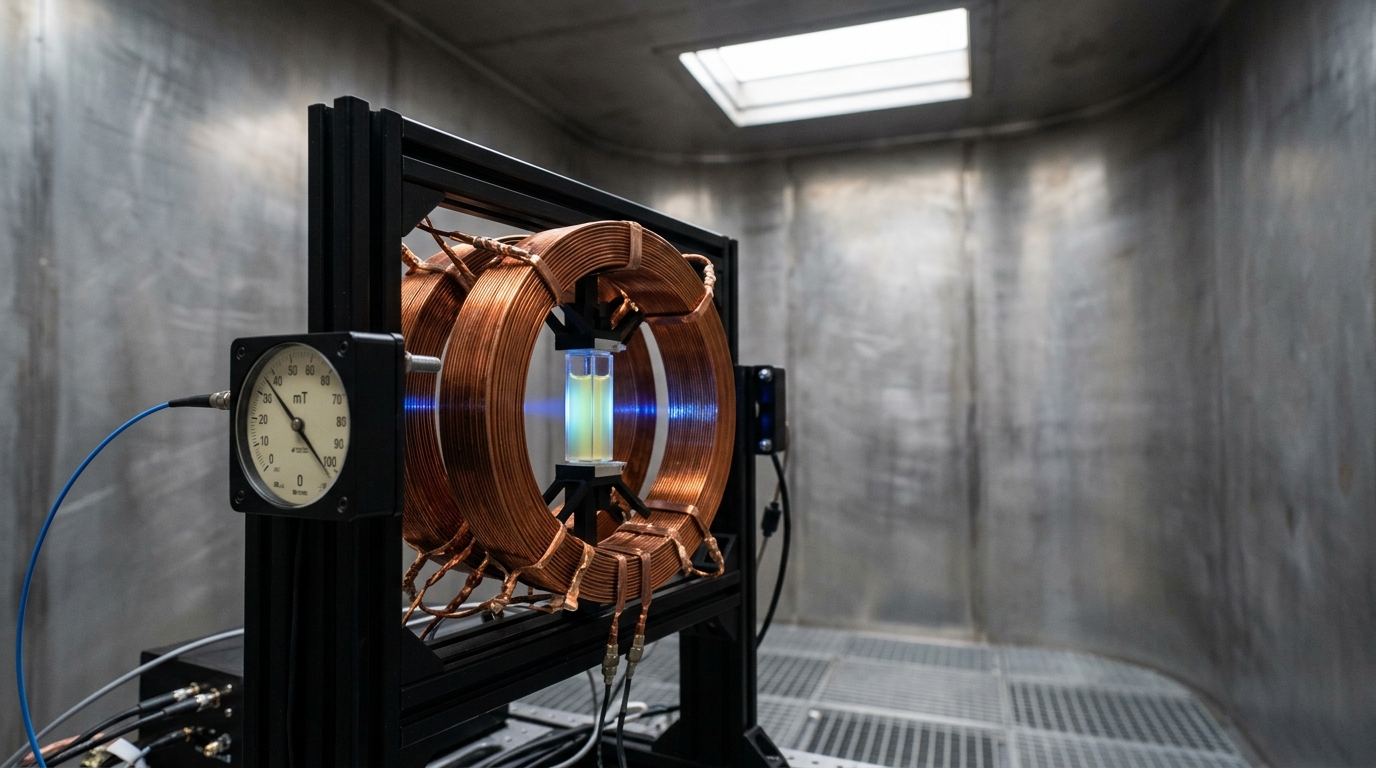
Physicists who are otherwise unsentimental about “quantum biology” as a marketing phrase take this particular case seriously for a structural reason: spin chemistry of exactly this kind — radical-pair recombination yields modulated by magnetic fields at or below Earth strength — has already been demonstrated directly in solution-phase model chemical systems built with no biology involved at all, so the mechanism is not something invented specifically to rescue an otherwise unexplained biological anomaly. Hore and Mouritsen’s 2016 Annual Review of Biophysics survey lays out the chemistry for biologists and the biology for physicists side by side, precisely because the radical-pair mechanism sits on genuinely interdisciplinary ground: it requires spin dynamics good enough to survive a magnetically noisy, warm cellular environment for microseconds at a time, a demand synthetic radical-pair systems built explicitly to test the underlying physics have already met [4].
Xu et al.'s 2021 Result Is Real, but It Is In Vitro, Not a Solved Compass
The strongest direct evidence that a bird’s own cryptochrome is the sensor, rather than merely a structurally plausible candidate, arrived in 2021. Jingjing Xu, Lauren Jarocha, Tilo Zollitsch, and colleagues purified cryptochrome 4 (CRY4) from the European robin, a night-migratory species, and compared its photochemistry directly against CRY4 purified from chicken and pigeon, two non-migratory species that do not rely on a light-dependent magnetic compass in the same way [6]. Robin CRY4 showed magnetic sensitivity in its radical-pair photochemistry — a measurable dependence of the flavin-tryptophan radical pair’s yield on an applied magnetic field — and did so more strongly than the CRY4 variants purified from either non-migratory bird. Site-directed mutagenesis further identified four successive tryptophan residues along an internal electron-transfer chain, each contributing a sequential radical pair, in a pattern that let the researchers begin to separate the protein’s magnetic-sensing role from the signaling state it has to reach afterward.
This is a substantially stronger result than a decade of “cryptochrome is a plausible candidate” commentary, because it is a measured difference between species with a known behavioral difference, in the actual candidate molecule, using the actual physical mechanism the theory specifies. It is also, on its own terms, a narrower result than the coverage around it sometimes suggested. The magnetic sensitivity Xu and colleagues measured was in vitro: purified protein, in solution, in a laboratory magnetic field, with no retina, no neuron, no bird attached to any of it. It demonstrates that the molecule has the photochemical property the radical-pair hypothesis requires, and that migratory and non-migratory species’ versions of that protein differ in exactly the direction the hypothesis predicts. It does not by itself demonstrate that this photochemistry, running inside an intact retinal photoreceptor cell, produces a neural signal a bird’s brain can actually read as compass direction, and it does not identify the downstream signaling pathway by which a shift in radical-pair yield would ever reach the optic nerve.

That in-vivo chain — molecule to cell to circuit to whole-animal behavior — remains the genuinely open part of the strongest case in this article. Behavioral radiofrequency-disruption experiments in the Ritz tradition show the compass depends on something with a radical pair’s characteristic resonance signature; the 2021 in vitro result shows CRY4 has that signature and that migratory birds’ version of it is unusually sensitive to begin with. Neither experiment, nor the two considered together, demonstrates the causal pathway connecting the molecule’s measured photochemistry to the whole animal’s measured behavior, and no published experiment has yet closed that gap directly. That is a genuinely different epistemic status from “unresolved” or “speculative”: the chemistry is measured, the behavior is measured, and the missing piece is the physiological wiring between the two, which is a hard but entirely ordinary kind of problem in sensory biology rather than a crisis for the underlying physics.
Turin’s Vibration Theory Predicts a Real Effect the Receptor Assay Doesn’t Show
Luca Turin’s vibration theory of olfaction proposes that odorant receptors detect not only a molecule’s shape but its molecular vibrational spectrum, sensed through inelastic electron tunneling across the receptor-bound odorant — a mechanism modeled on the same broad class of physics, electron tunneling gated by vibrational energy loss, used elsewhere to study single molecules by tunneling spectroscopy. The theory’s cleanest experimental test exploits deuterium substitution: replacing hydrogen with its heavier isotope leaves a molecule’s shape and most of its ordinary chemistry essentially unchanged while shifting its vibrational frequencies substantially, most notably moving the carbon-hydrogen stretch from around 2900 down to around 2150 wavenumbers. A shape-only receptor should be unable to tell a deuterated odorant from its normal counterpart; a vibration-sensing receptor should not be fooled so easily.
Maria Franco, Luca Turin, Andreas Mershin, and Efthimios Skoulakis ran that test behaviorally in Drosophila melanogaster in 2011, training flies to associate an odorant with an aversive or rewarding stimulus and then testing whether the association generalized to the deuterated isotopologue [8]. The flies discriminated: they could be conditioned to selectively avoid either the normal or the deuterated form of an odorant, and flies trained against a deuterated compound also avoided an unrelated molecule that happened to share a vibrational mode near the carbon-deuterium stretch frequency — a specificity the authors argued a pure-impurity or pure-shape account could not easily explain. Taken alone, it is a striking positive result for a mechanism that mainstream olfactory pharmacology, built around lock-and-key shape recognition by G-protein-coupled receptors, does not predict at all.

The result that has not reproduced at the level the theory ultimately needs sits at the receptor itself, in a mammalian system. Eric Block, Victor Batista, Hiroaki Matsunami, and fourteen coauthors tested the human musk-recognizing olfactory receptor OR5AN1, expressed in cultured cells, against deuterated and normal isotopomers of musk odorants that had previously been reported to smell different to human subjects in their deuterated form [7]. The receptor did not discriminate: “the human musk-recognizing receptor OR5AN1 … fails to distinguish isotopomers of these compounds in vitro,” across every labeled and unlabeled odorant-receptor pair tested, including a mouse receptor examined alongside it. Because the prior human behavioral reports of deuterium-distinguishable smell were not themselves in dispute, Block and colleagues argued the discrimination people report must arise somewhere other than the primary receptor-binding event — trace chemical impurities from deuterated synthesis, a downstream perceptual process, or some other perireceptor event — concluding that the vibration theory is implausible absent compelling receptor-level evidence to the contrary.
Both results are real; they are simply not measuring the same link in the causal chain. Franco and colleagues demonstrated whole-organism behavioral discrimination in an insect; Block and colleagues demonstrated no discrimination at an isolated human receptor protein in a dish. It remains possible that insect and mammalian olfaction differ in this respect, that some other receptor class carries a vibrational signal Block’s assay did not happen to test, or that the fly result reflects something occurring upstream or downstream of the receptor’s own binding pocket. What is not disputed is that the specific, falsifiable prediction the vibration theory makes at the primary molecular-recognition site — the exact point where the theory’s own proposed mechanism is supposed to act — failed a direct test in the system where humans’ own reported deuterium sensitivity would need to originate. Mainstream, shape-based receptor pharmacology remains the field’s working model for precisely that reason, pending a receptor-level positive result the theory has not yet produced.
Enzymes Quietly Tunnel Hydrogen Through Barriers Evolution Can Tune
The best-established non-trivial quantum effect in biology generates none of the excitement the other three cases have attracted, largely because it never needed a correction: enzymatic hydrogen transfer has been recognized as a quantum-tunneling phenomenon, not a classical over-the-barrier reaction, since kinetic isotope effect measurements in the 1980s and 1990s began returning numbers no classical transition-state theory could accommodate. A classical reaction’s kinetic isotope effect — the rate ratio between a protium-substituted and a deuterium-substituted substrate — is bounded by the difference in zero-point vibrational energy between the two isotopes, which caps the semiclassical prediction at roughly seven for carbon-hydrogen bond cleavage near room temperature. Numerous enzyme systems return isotope effects of ten, of fifty, in a handful of documented cases well over a hundred, and show a temperature dependence — sometimes strong, sometimes nearly flat depending on the system — that a purely classical Arrhenius picture cannot reproduce without ad hoc patching. A light particle passing through, rather than over, an energy barrier is the standard explanation, because tunneling probability depends exponentially on both particle mass and barrier width, so hydrogen tunnels far more readily than the heavier deuterium, or than either isotope’s shared classical over-the-barrier pathway:
The mass dependence sitting inside that exponential is what makes the isotope effect diagnostic rather than incidental: roughly doubling the tunneling particle’s effective mass, which is approximately what substituting deuterium for hydrogen does, sharply suppresses the transmission probability. The enzyme’s job, as Sutcliffe, Scrutton, and colleagues have argued from kinetic isotope effect measurements across flavoprotein and quinoprotein systems including methylamine dehydrogenase and morphinone reductase, is to compress the donor-acceptor distance through thermally driven protein motions that gate the tunneling event, rather than to lower the reaction’s classical activation energy the way an ordinary catalyst does [10]. That gating role is exactly why the effect is temperature-dependent at all: a rigid, static barrier would produce a temperature-independent tunneling probability, but a real active site fluctuates, and how strongly the isotope effect changes with temperature reports on how much these “promoting motions” have to compress the barrier before tunneling becomes likely.

Klinman and Kohen’s 2013 Annual Review of Biochemistry synthesis frames the accumulated evidence as showing “a hierarchy of thermodynamically equilibrated motions that control the H-donor and -acceptor distance and active-site electrostatics, creating an ensemble of conformations suitable for H-tunneling” [9]. That is a claim with genuine evolutionary content, stated far more conservatively than “evolution built a quantum computer”: natural selection, acting on an enzyme’s amino acid sequence, can tune the width and shape of the barrier a hydrogen nucleus tunnels through, by adjusting the geometry and flexibility of the active site surrounding it, and a narrower or more responsive barrier converts directly into a faster catalyzed rate through the tunneling probability’s own exponential sensitivity to width. No one needed a “quantum walk” metaphor to make this case, no popular deflation followed a decade of hype, and no unresolved in-vitro-versus-in-vivo gap remains, because kinetic isotope effect measurements are made on the actual catalytic step, inside the actual folded enzyme, under near-physiological conditions. It is, by a wide margin, the most boring of the four cases in this article to describe, which is exactly why it has survived scrutiny that sank the more exciting one.
DNA Mutation by Proton Tunneling Is a Model, Not Yet a Measurement
The oldest specific proposal in this article’s whole subject predates every other case here by more than a decade. In 1963, Per-Olov Löwdin argued that spontaneous point mutations could arise from proton tunneling along the hydrogen bonds holding DNA base pairs together: a proton normally bonded to one base can, with some small but non-zero quantum probability, tunnel across to the paired base, producing a rare tautomeric form that mispairs during replication and gets copied as though it were the standard base [11]. It was a genuinely quantum-mechanical account of a core biological process — the spontaneous mutation rate, in this telling, has an irreducibly quantum floor — proposed while molecular biology was still assembling its basic vocabulary, and it went largely untested for want of any method able to calculate or measure a proton-transfer rate along a real, solvated, thermally busy hydrogen bond with any confidence at all.
Modern computational chemistry has only recently made that calculation tractable enough to revisit Löwdin’s conjecture on something like its own terms. Louie Slocombe, Marco Sacchi, and Jim Al-Khalili modeled proton transfer in the guanine-cytosine base pair using an open quantum systems approach, treating the transferring proton not as an isolated particle but as a system continuously coupled to, and losing coherence into, its surrounding molecular and solvent environment, and reported that “the quantum tunnelling contribution to the process is several orders of magnitude larger than the contribution from classical over-the-barrier hopping,” with the resulting tautomeric state occupied often enough that the mechanism could plausibly contribute to the spontaneous mutation rate at a biologically relevant level [12].
That result belongs in this audit labeled precisely for what it is: a theoretical model, run against a specific and well-motivated set of assumptions about how the proton couples to its environment, not a direct measurement of a tunneling-mediated mutation occurring inside a living cell, or even inside isolated DNA in a test tube. Modeling a mechanism as dominant is not the same evidentiary category as clocking it directly — the enzyme kinetic isotope effect case earlier in this article is a measurement, made on the actual reaction, with a directly observable and falsifiable numerical signature attached to it. Slocombe and colleagues’ tunneling contribution is a calculation whose reliability depends on how faithfully the model captures a real base pair’s coupling to a real, wet, thermally busy nucleus — a question their own open-systems framework was built specifically to take seriously, but cannot fully settle without an experimental proton-transfer rate to check it against. Sixty years after Löwdin’s conjecture, DNA point mutation via proton tunneling remains a live and increasingly well-modeled hypothesis rather than an established fact, a meaningfully different status from either extreme this article’s other cases occupy.
The Audit’s Shape Is What a Healthy Field Looks Like
Lay the four main cases side by side and a pattern emerges that has less to do with quantum mechanics specifically and more to do with how empirical claims about biology are supposed to behave under scrutiny. Photosynthetic coherence was a real signal, an overreaching interpretation built on top of it, and a decade-long, largely amicable correction carried out in public by many of the same researchers who made the original claim — precisely the self-correcting behavior a healthy experimental field is supposed to exhibit, and precisely the opposite of the popular narrative in which the coherence claim is either still simply true or was fraudulent from the start. Avian magnetoreception’s radical-pair mechanism made an advance quantitative prediction — resonant disruption at specific radiofrequencies, with a specific angular dependence — that behavioral experiments then confirmed, and later produced direct in vitro molecular evidence distinguishing migratory from non-migratory birds’ own candidate sensor protein; it remains open only where almost any sensory-biology mechanism linking molecule to behavior tends to stay open, in the unglamorous physiological wiring between the two. Olfactory vibration theory made a comparably specific, falsifiable prediction and got a genuine positive result in one organism alongside a genuine null result at the analogous receptor in another, a live dispute rather than a resolved one, with the weight of mainstream receptor pharmacology sitting on the null side for now. And enzymatic hydrogen tunneling has been measured, replicated, and mechanistically dissected for three decades without ever generating a popular headline, because “isotope effects exceed the classical limit, and the excess is temperature-dependent in a diagnostic way” does not compress into a viral sentence the way “photosynthesis is a natural quantum computer” once did.
None of the four verdicts required treating “quantum” as either a magic word or an automatic target for reflexive skepticism. The deflation of photosynthetic coherence does not need to be read as evidence that quantum biology in general is bunk, any more than the strength of the radical-pair case needs to be read as vindication of every quantum-biology claim currently in circulation, olfactory vibration theory included; each case turned entirely on its own specific, checkable evidence, exactly as the audit standard set out at the start of this article demanded. What survives four billion years of selection acting blindly on whatever chemistry happened to work is not “quantum weirdness” as evolution’s secret weapon — a framing that was never precise enough to be properly tested in the first place. What survives, case by case, is a narrower and considerably more defensible claim: that a handful of genuinely non-trivial quantum effects — measured spin dynamics gating a chemical product yield, measured tunneling probabilities steepened or flattened by an evolvable active-site geometry — sit inside real biological systems doing specific, checkable work, directly alongside at least one celebrated effect that, on closer and more careful measurement, was never there in the biologically interesting form it was first reported to have. That is not a disappointing place for a field to land. It is what an honest four-claim audit was always going to produce, once every claim on the table was actually checked against the standard it was supposed to meet, rather than against the standard its best headline implied.