Reversible laws do not forbid an egg unscrambling — a boundary condition does
Every fundamental equation of motion physics has ever confirmed is time-reversal invariant. Newton’s laws, Hamilton’s equations, the Schrödinger equation, even the microscopic collision dynamics inside a gas: run any of them with every velocity flipped and the system retraces its own history exactly. Nothing in the underlying mechanics prefers a direction for time. And yet an egg breaks and does not unbreak, a scent diffuses through a room and does not regather in the bottle, and a lineage accumulates variants without spontaneously reverting them. Evolution’s entire mechanism assumes this asymmetry as a working premise: a mutation that persists, a selective death that stays dead, a population that cannot un-adapt back to its ancestral state by the reverse of the process that produced it. If the laws underneath are symmetric, the asymmetry has to be coming from somewhere else, and locating that somewhere else turns out to be one of physics’ oldest unresolved arguments.
Ludwig Boltzmann tried to derive the asymmetry outright. His 1872 H-theorem modeled a dilute gas as colliding hard-sphere molecules and showed that a quantity he called H, essentially the negative of entropy, decreases monotonically toward its equilibrium value as collisions randomize the velocity distribution — apparently deriving the second law of thermodynamics from reversible Newtonian mechanics. Josef Loschmidt’s 1876 reversibility objection punctured the “apparently.” If a gas trajectory drives H downward over some interval, the time-reversed trajectory — every molecule’s velocity flipped at the endpoint — is equally permitted by the same reversible dynamics, and it must drive H back upward. Since the underlying equations cannot tell forward from backward, any argument that concludes entropy always increases has smuggled in an asymmetric assumption somewhere, because a genuinely symmetric derivation cannot output an asymmetric answer for every initial condition.
Boltzmann’s own reply, refined over the following decades, split the claim into two more defensible pieces: the H-theorem was never a claim about every trajectory, only an overwhelmingly probable one, because the vast majority of a system’s accessible microstates simply look like they are heading toward equilibrium; and it depended on an assumption — the Stosszahlansatz, or molecular chaos, the premise that incoming particle velocities are uncorrelated just before a collision — that itself is not symmetric in time and is not derivable from Newtonian mechanics alone. It has to be imposed, and once you ask why it is safe to impose it going forward but not backward, you are asking exactly the question Loschmidt raised.
The modern formulation of the answer, developed across the twentieth century and summarized for philosophers of physics by Craig Callender in the Stanford Encyclopedia of Philosophy, keeps Boltzmann’s statistical move and adds a second ingredient explicitly: a special initial condition on the universe, sometimes called the “past hypothesis” in the form given to it by the philosopher David Albert. The universe, on this view, began in an extraordinarily improbable, extremely low-entropy macrostate — not because dynamics required it, but as a brute boundary condition — and essentially every subsequent instant of apparent entropy increase is nothing more than the overwhelmingly likely relaxation away from that atypical starting point [1]. Coarse-graining, the grouping of microscopically distinct states into macroscopically indistinguishable bins, does the statistical work Boltzmann needed; the past hypothesis supplies the one-directional boundary condition that a time-symmetric dynamics cannot supply on its own. Together they resolve Loschmidt’s objection without claiming the underlying laws are anything but reversible: the laws permit an egg to unscramble exactly as often as they permit it to break, but almost none of the universe’s actual histories start from an unscrambled egg looking for a low-entropy past to relax out of, because a low-entropy past is already sitting a finite distance behind almost every point we can occupy.
This matters for evolution more directly than it first appears. “Variation that does not un-vary” and “selection that dissipates” are not biological axioms; they are borrowed thermodynamic capital. A lineage inherits the past hypothesis’ arrow the same way a diffusing gas does — not because heredity itself demands a direction, but because heredity operates inside a universe already committed, by its boundary condition, to one. Strip the arrow out and natural selection’s logic does not become false; it becomes underspecified, because “retained” and “purged” stop being different from each other without a fact about which direction memory persists in.
A quantum record becomes a fact only after decoherence writes it redundantly, and erasing it always costs heat
Quantum mechanics inherits the same problem one level down. The Schrödinger equation is unitary and, up to the antiunitary operation of time reversal, symmetric; nothing in it singles out measurement as special or picks a preferred basis in which outcomes become definite. What actually happens when a quantum system interacts with a large, uncontrolled environment — a measuring apparatus, a thermal bath, the air in a room — is decoherence: the environment becomes correlated with the system in a way that suppresses interference between macroscopically distinct outcomes and, more specifically, redundantly imprints information about one particular (“pointer”) basis into many independent environmental degrees of freedom. Wojciech Zurek’s synthesis of this process, environment-induced superselection or “einselection,” is the standard account of why a measurement outcome behaves like a fact rather than a superposition once enough of the environment has a copy of it: not because interference has been logically forbidden, but because reconstructing it would require controlling an environment of astronomical size, making the loss of coherence irreversible for all practical purposes [2]. This publication’s companion treatment of decoherence develops einselection in full; the relevant point here is narrower: decoherence is where the quantum layer hands off to the classical, trajectory-based physics that fluctuation theorems and evolutionary dynamics both live in, and it does so by writing records, not by erasing indeterminacy at the level of fundamental law.
Writing a record redundantly is one thing; erasing one is a different, and thermodynamically cheaper to state, act. Rolf Landauer’s 1961 analysis established that any logically irreversible operation — one whose output does not determine a unique input, such as resetting a one-bit memory from either of two states to a single standard state — must, in an isothermal environment at temperature
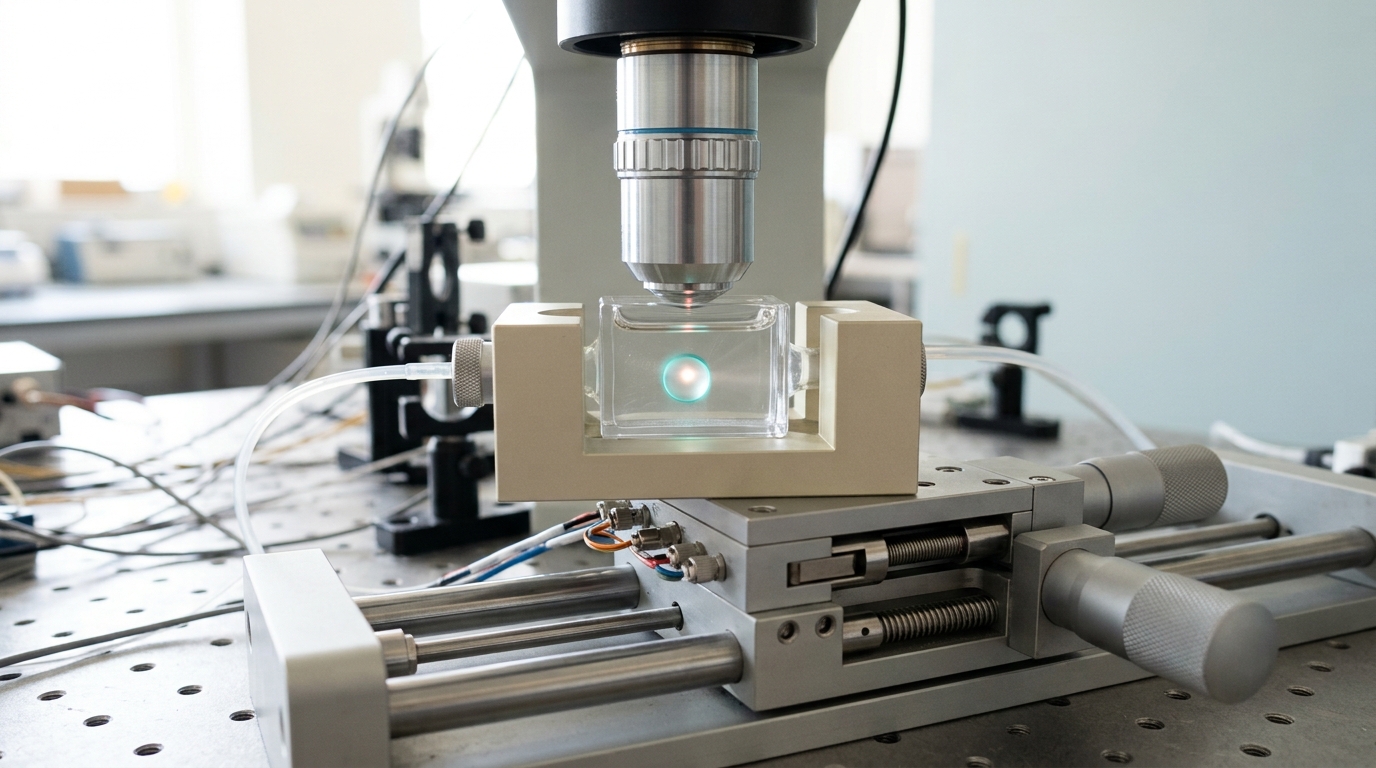
per bit erased [3]. The bound follows from Liouville’s theorem: the phase-space volume corresponding to distinguishable logical states cannot be compressed into fewer accessible microstates without exporting the corresponding entropy somewhere, and the only place available is heat expelled to the bath. It is a floor, not a typical value — Landauer’s own paper is explicit that real switching devices of his era dissipated many orders of magnitude more than this — but the floor is real and has since been demonstrated experimentally in isothermal single-bit erasure using exactly this publication’s kind of apparatus: a colloidal particle held in a modulated double-well potential.
Charles Bennett used Landauer’s bound to close a hole that had troubled physicists since Maxwell first imagined a demon who could sort fast and slow molecules without doing work. Bennett’s 1982 review argued that a demon can, in principle, measure a molecule’s state without inevitable dissipation — measurement per se can be made close to thermodynamically reversible if implemented carefully. What the demon cannot do is remember indefinitely: with a memory of finite capacity, a demon that keeps operating must eventually erase old records to make room for new ones, and it is that erasure, governed by Landauer’s bound, that generates the entropy needed to save the second law [4]. Bennett’s same 1982 paper makes a striking, and often overlooked, quantitative aside relevant to biology directly: he estimated that the cellular machinery of DNA replication, transcription, and translation behaves like nature’s closest real approximation to a “Brownian computer” — a device that lets thermal noise drive it through its operations rather than forcing them ballistically — and that this machinery dissipates on the order of 20 to 100
The Crooks ratio turns the arrow of time into a number a laser can measure
At the scale of single molecules, the second law’s certainty dissolves into a probability statement, and stochastic thermodynamics exists to make that probability statement exact rather than qualitative. A companion piece in this publication develops the full trajectory-level formalism — path probabilities, entropy production as a log-likelihood ratio between a forward process and its properly defined time-reverse, the integral fluctuation theorem that recovers the ordinary second law as an ensemble average. The present argument borrows that apparatus for a different purpose: not to characterize a molecular motor for its own sake, but to make precise the claim that “selection dissipates” is not a metaphor. It is a statement with a measured exponent.
Christopher Jarzynski’s 1997 equality was the opening result. For a system beginning in thermal equilibrium and then driven away from it by an arbitrarily fast, arbitrarily far-from-equilibrium protocol, the exponential average of the work
[5]. The result does not say average work equals
Gavin Crooks sharpened this two years later into a statement about entire probability distributions rather than a single average. If
[6]. Where
The theorem’s most direct experimental confirmation, and the reason this section belongs in an article about evolutionary physics rather than only about physics, came from mechanically unfolding and refolding single RNA molecules. Collin and coworkers used optical tweezers to repeatedly stretch and relax a P5ab RNA hairpin, gathered separate work distributions for the pulling (forward) and relaxing (reverse) protocols, located their crossing, and recovered the hairpin’s folding free energy from that crossing point — a free energy independently checkable against bulk thermodynamic measurements [7]. The agreement is a laboratory demonstration that the arrow of time, at molecular scale, is not qualitative. It is a number you can pull out of a pair of histograms built from a few hundred single-molecule pulls, and it is exactly the number the Crooks relation predicts. What it does not show, and what the theorem never claimed, is that reverse-favoring trajectories are forbidden — rare unfolding events that look like spontaneous refolding do occur in these datasets, precisely as the theorem’s exponential tail requires; the arrow of time in this framework is a statement about relative frequency across an ensemble, not a prohibition on any single event.
A replicator cannot copy itself for free, and England’s 2013 bound says exactly how little it can get away with
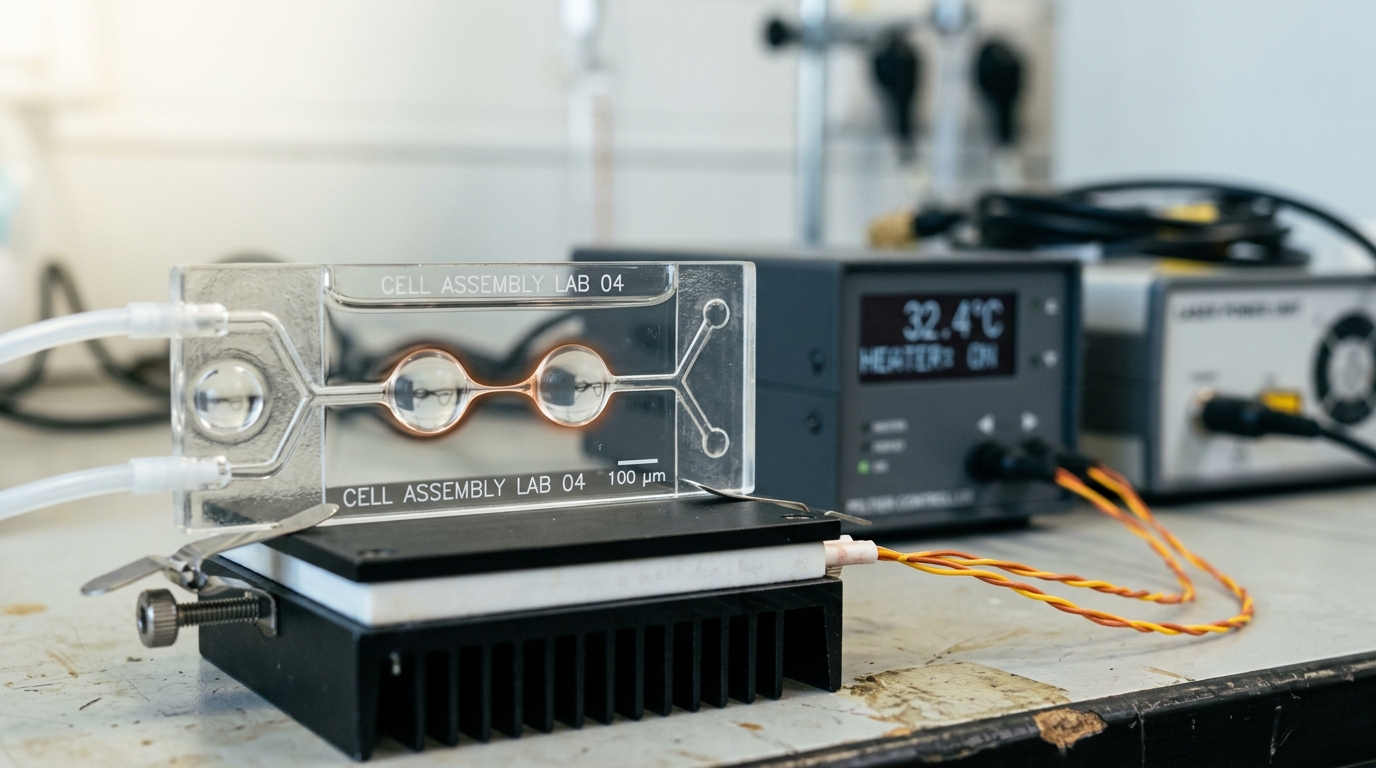
Jeremy England’s first contribution to this literature was narrower and more defensible than the theory that later made him famous. His 2013 paper in the Journal of Chemical Physics starts from an observation close to common sense — self-replication is a statistically irreversible process, since it is far likelier for one organism to become two than for two to spontaneously revert to one — and asks what that irreversibility costs in heat, using the same detailed-balance and fluctuation-theorem machinery developed in the previous section. The result, stated plainly in the paper’s own abstract, is a derived lower bound: the minimum physically allowed rate of heat production during a process of self-replication in a system coupled to a thermal bath is set by the replicator’s growth rate, its internal entropy, and its durability — how resistant its particular configuration is to being erased by thermal fluctuations relative to the alternatives available to it [8]. England discusses the implications for bacterial cell division and for the pre-biotic emergence of self-replicating nucleic acids, and, importantly, frames the result as a floor rather than a mechanism: it constrains what any self-replicator coupled to a heat bath must dissipate at minimum, the way a Carnot bound constrains what any heat engine can extract at maximum, without claiming that dissipation is what drives replicators to replicate or explains why any particular replicator exists.
That distinction — a hard inequality on what is thermodynamically permitted, as opposed to a causal story about why anything organizes itself to approach that permission — is the difference between England’s 2013 result, which is uncontroversial physics, and the more ambitious theory built on top of it two years later, which is not. The 2013 bound is compatible with, and in fact numerically consistent with, Bennett’s independent estimate that real biological replication machinery dissipates on the order of tens of
Dissipative adaptation is a real bias in driven matter that critics say has been asked to explain too much
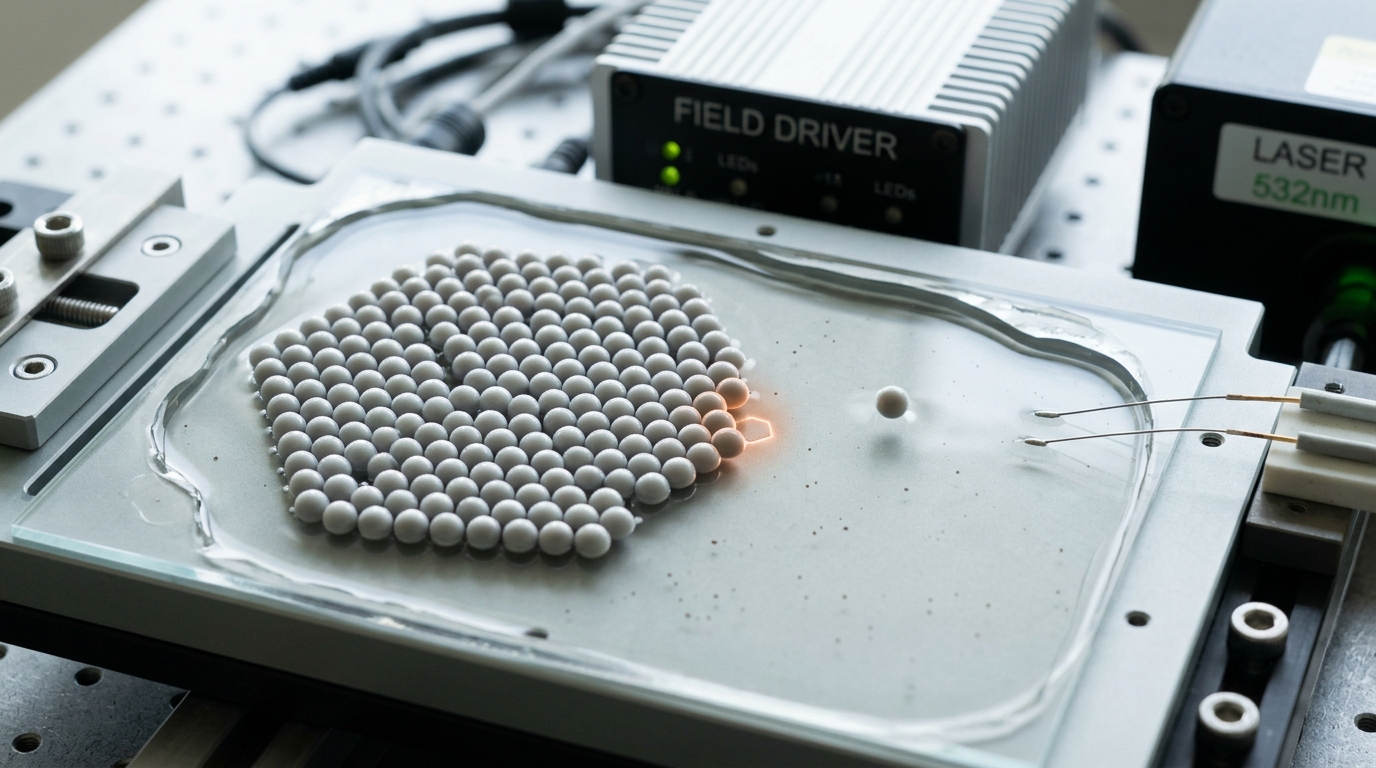
In 2015, England published a Nature Nanotechnology Perspective proposing “dissipative adaptation”: in a system of particles driven away from thermal equilibrium by an external work source, the states that come to dominate the system’s long-run behavior are not simply those of lowest energy, as ordinary Boltzmann statistics would predict at equilibrium, but disproportionately those with a history of absorbing unusually large amounts of work from the drive and then dissipating it efficiently as heat to the environment [9]. England frames the idea explicitly as a generalization of established nonequilibrium statistical mechanics — tracing back through Onsager’s reciprocal relations and Prigogine’s work on dissipative structures — rather than as a wholly new physical principle, and states the paper’s purpose plainly as outreach: an attempt to give experimentalists working on driven self-assembly a theoretical handle on why some driven configurations persist and others do not. A year later, England and coworkers Nikolai Perunov and Robert Marsland formalized the mechanism considerably more rigorously in Physical Review X, deriving statistical-mechanical conditions under which a driven system’s steady-state distribution provably favors dissipation-maximizing configurations, connecting the result to the broader family of precision-versus-dissipation tradeoffs — the thermodynamic uncertainty relations — that the same research group helped establish for steady-state currents more generally [10].
The physics in these two papers is not, on its own terms, seriously disputed; David Ruelle’s 2015 technical response offers an alternative derivation of the same detailed-balance relation, one Ruelle argues is more natural and extends more cleanly to quantum systems, but explicitly states that either version supports England’s underlying mathematics, while adding that England’s biological discussion — the leap from a statement about driven matter in general to a story about the emergence and evolution of life in particular — “deserves further scrutiny” [11]. That is the fault line the field’s harsher critics were more direct about. Reporting on England’s work for Quanta Magazine in early 2014, Natalie Wolchover quoted Eugene Shakhnovich, a Harvard biophysicist, as unconvinced by the extrapolation to biology specifically: “Jeremy’s ideas are interesting and potentially promising, but at this point are extremely speculative, especially as applied to life phenomena” [12]. The same reporting noted that other physicists found England’s underlying formalism sound while remaining skeptical that it explains anything about life’s origin that a general theory of driven dissipative structures — applicable equally to Bénard convection cells and hurricanes, neither of which is alive or evolves — does not already cover.
The sharpest version of the skeptical question, stated plainly: what has dissipative adaptation actually predicted about biological evolution that population genetics and natural selection did not already predict? The honest answer, on the evidence available, is that it has not yet made a distinctively biological prediction at all — its confirmed successes are in non-living driven matter, including RNA enzyme-selection experiments and colloidal self-assembly, systems with no heredity, no genome, and no natural selection in the Darwinian sense of differential reproduction of variants. That is not a failure of the theory so much as a mismatch of registers: dissipative adaptation is a claim about a superset of systems that includes some living ones, not a replacement for or a rival account of what makes living systems specifically evolve. It supplies a physical bias toward persistence of dissipation-favorable configurations in any sufficiently driven stochastic system; it does not supply a code, a copying mechanism, or a way to decouple “what the drive happened to favor this cycle” from “what gets passed reliably to the next generation,” which is precisely the job heredity does and which no thermodynamic bias, however real, performs on its own. The sober reading, consistent with both England’s own more careful papers and his critics’ strongest objections, is that dissipative adaptation is a genuine thermodynamic constraint and tendency for driven systems generally — a companion fact sitting underneath natural selection, not a substitute mechanism competing with it.
The biosphere runs on a measured photon gradient, and most of the free energy in it is thrown away by design
Zoom out from single molecules to the whole planet and the same accounting applies at a scale large enough to put actual numbers on. The Earth system is, in the language Axel Kleidon’s 2023 review in Earth System Dynamics uses to formalize the picture, a heat engine driven by one overwhelmingly dominant thermodynamic process: solar radiation arrives from the Sun’s photosphere at very high temperature and short wavelength, confined to the narrow solid angle the Sun’s disk subtends in Earth’s sky, and it leaves again as terrestrial infrared radiation emitted at Earth’s much colder radiative temperature — near 255 kelvin — spread across the entire sky. Converting a flux of photons from a hot, narrow source into the same energy flux re-radiated from a cold, wide one is, in Kleidon’s words, “by far the largest contribution to the entropy budget” of the Earth system, a fact he traces to an 1886 essay of Boltzmann’s making essentially the same point about the biosphere and the Sun [13]. The temperature drop that matters for this argument is real and specific: roughly 5,800 kelvin in in the visible, roughly 255 kelvin out in the infrared, a factor of more than twenty in absolute temperature standing behind every joule of free energy the biosphere will ever have available to spend, with an even colder sink — the few-kelvin cosmic background — waiting further downstream to absorb Earth’s own emitted photons at a still lower entropy cost to the universe as a whole.
Kleidon’s framework treats this temperature drop the way an engineer treats any heat engine’s hot and cold reservoirs: the Carnot limit sets an absolute ceiling,
This is the planetary version of the same ledger the rest of the article has traced at ever-smaller scales: a photon gradient supplies free energy; a biochemical mechanism intercepts a small, thermodynamically bounded fraction of it before it thermalizes; and everything built with that captured fraction — every metabolism, every act of growth, every replication event with its England-bounded heat cost — is drawn down against the same account, ultimately re-radiated to space as still more entropy exported at 255 kelvin and below. There is no separate energy source for biology. There is one photon gradient, one small tapped fraction of it, and a very large amount of downstream bookkeeping.

A mutation is a thermal fluctuation that replication’s one-way ratchet makes permanent
Return, finally, to the smallest scale and the oldest evolutionary evidence for irreversibility as a mechanism rather than a metaphor. Salvador Luria and Max Delbrück’s 1943 fluctuation test settled a live dispute about whether bacterial resistance to bacteriophage infection arose through mutations that pre-existed the phage’s arrival, at random times during ordinary growth, or through some directed adaptive response triggered by exposure to the phage itself. Their logic was purely statistical: if resistance were induced by exposure, every parallel culture exposed to phage should yield roughly the same, Poisson-distributed number of resistant survivors, since each culture would be responding independently to the same challenge at the same rate. If resistance instead arose from spontaneous mutations occurring at random points earlier in each culture’s independent growth history, the variance across replicate cultures should be far larger than Poisson, because a mutation that happens to occur early in one culture’s growth gets amplified by every subsequent doubling into a large clone of resistant descendants — a “jackpot” — while a culture in which the mutation never happened, or happened only just before plating, would show few or none. Luria and Delbrück observed exactly this excess variance, jackpots included, and concluded that resistance-conferring mutations arise randomly, before selection acts on them, rather than being called into existence by the selective pressure itself [15].
Restated in the thermodynamic vocabulary this article has built, a spontaneous copying error during DNA replication is a thermal fluctuation: a rare, energetically costly departure from the overwhelmingly likely, error-corrected copying trajectory, of exactly the statistical character that a fluctuation theorem would describe as exponentially suppressed but never strictly forbidden. Nothing about the fluctuation itself is special or directional — Crooks’ relation guarantees that a molecular-scale error of a given size is simply less probable than getting the copy right, by a factor set by the free-energy cost of the mismatch, not that it is impossible. What makes a single thermal fluctuation permanent, rather than a transient departure that relaxes back to the correct sequence, is that DNA replication is a physical ratchet: once a mismatched base has been copied forward into a new strand and that strand has itself been used as a template for further copies, there is no dynamical pathway back to the original sequence short of another independent, equally improbable reverse error. This is the same read-write asymmetry Bennett located in Maxwell’s demon, run in biology’s own currency: replication is logically closer to an irreversible write than to a reversible measurement, each successful round commits a new record, and heredity is precisely the mechanism that lets a single molecular-scale thermal fluctuation, almost always washed out and forgotten in an ordinary equilibrium system, become instead a permanent new initial condition for every descendant lineage. Selection does not need to steer the fluctuation. It only needs to sample, after the fact, a population in which the ratchet has already made a particular accident irreversible.
The arrow of time is not evolution’s backdrop; it is what evolution spends
Every layer examined here supplies a piece natural selection needs and none of them supplies on its own. The past hypothesis licenses a preferred direction for the whole enterprise, without which “retained” and “purged” are not even distinguishable outcomes [1]. Decoherence explains how a fact about the world — a measurement outcome, eventually a base pair — becomes a redundant, effectively permanent record rather than a reversible superposition [2], and Landauer’s and Bennett’s information thermodynamics prices exactly what it costs to erase or overwrite one [3, 4]. The fluctuation theorems of Jarzynski and Crooks turn that pricing into an exact, laboratory-verified statistic rather than a qualitative asymmetry, at a precision single RNA molecules have already confirmed [5, 6, 7]. England’s 2013 bound shows that even the simplest possible act of heredity, copying, has a nonnegotiable thermodynamic floor [8], and the dissipative-adaptation literature that followed it, read with its critics rather than around them, shows where that physics runs out and where the distinctly biological work of heredity has to begin [9, 10, 11, 12]. The planetary ledger supplies the actual free energy every one of these processes draws against, measured in real kelvin and a measured, disappointingly small percentage captured [13, 14]. And Luria and Delbrück’s fluctuation test shows the whole stack operating in a real organism: thermal noise, made permanent by a one-way copying ratchet, sampled afterward by selection that never had to reach into the noise and steer it [15].
None of this derives Darwin from physics, and it does not need to. Natural selection is a logically separate claim — that heritable variation plus differential reproduction produces adaptation — that would remain true in a hypothetical universe with a different thermodynamic arrow, or none at all, provided that universe still somehow supported heredity. What the physics in this article supplies is the reason no such universe was ever going to get the chance: without a low-entropy past there is no preferred direction for anything to accumulate in; without decoherence and Landauer’s bound there is no such thing as a record that stays written; without fluctuation theorems there is no exact meaning to “forward is likelier than back” at the molecular scale where mutation actually happens; without England’s bound a replicator could not exist as a thermodynamic object at any cost; and without a real, measured photon gradient between a hot Sun and a cold sky there is no free energy for any of it to spend. The arrow of time is not a metaphor standing in for evolution’s engine. Measured in kelvin, in