NICER turned a neutron star’s surface into a number you can calculate, not just observe
For forty years, finding a spectral line from a neutron star’s surface has meant hunting for a redshift. A transition of known laboratory energy, seen shifted in a star’s spectrum, hands back the compactness of the star that produced it — in principle a clean way to weigh an object no telescope can resolve. In practice the hunt has returned almost nothing usable, and the reason is not that neutron stars lack the physics to produce such lines. It is that a line was always being asked to do two jobs at once: measure the star and, if anyone wanted to push further, test the gravity that bends its light. A new paper, “A Neutron Star Is a Redshift Standard,” argues that a different measurement — NASA’s Neutron star Interior Composition Explorer, or NICER — has quietly split those two jobs apart, and that splitting them is what makes a confirmed line valuable for the first time.
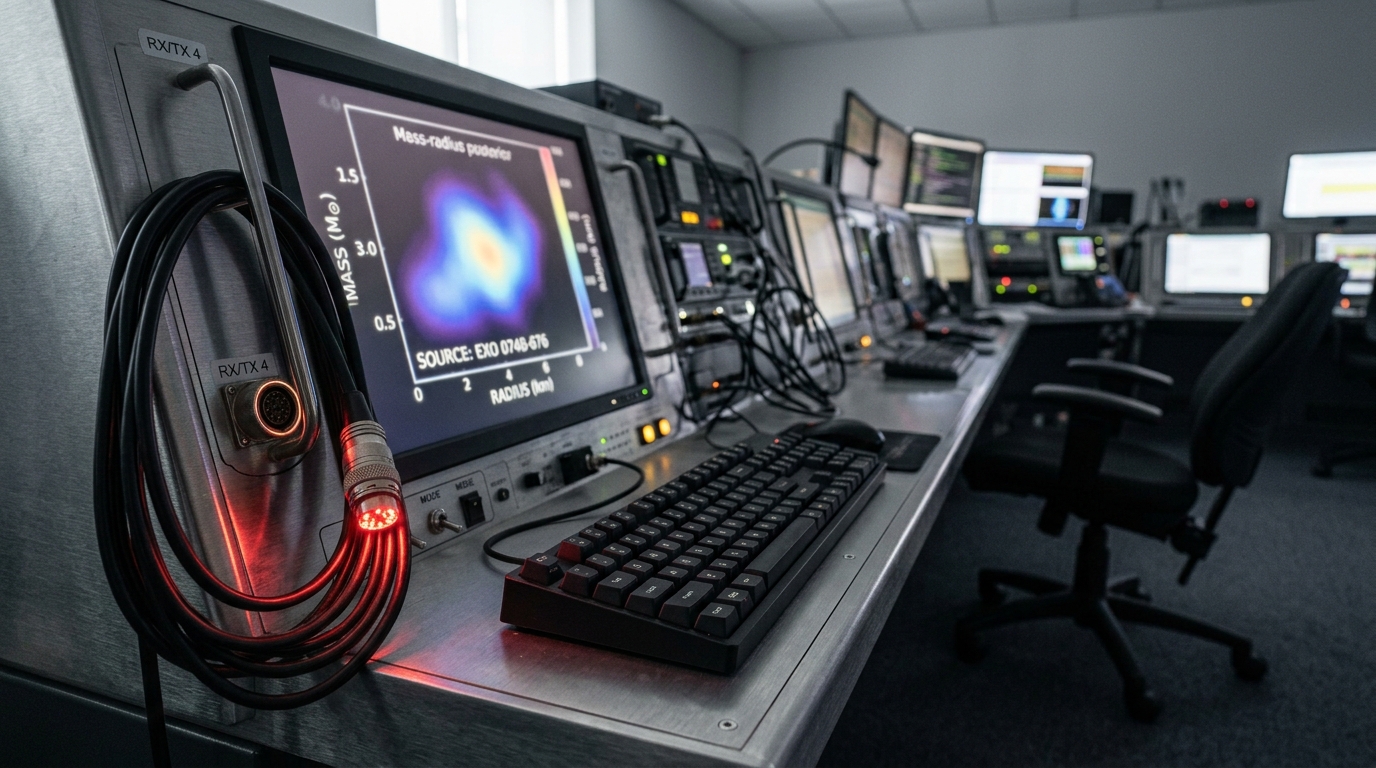
NICER does not read a spectral line at all. It times the arrival of soft X-ray photons from the hot spots on a rotating millisecond pulsar’s surface to better than a hundred nanoseconds, and a Bayesian model of that rotating waveform — how the visible hot-spot area changes shape as light bends around the star, how the pulse brightens and dims with the star’s spin — returns the star’s mass and radius together, as a single measurement with no line involved anywhere in the chain [1, 2]. Feed that mass and radius into general relativity’s exterior solution and the star’s surface redshift falls out as an exact consequence of the geometry, known to a precision set entirely by how well NICER measured the waveform. A star’s surface redshift, in other words, has become something a mission can calculate rather than something a rare absorption feature has to reveal.
The formula is exact once mass and radius are known, and two pulsars mark its range
The relation itself is old and simple. For a spherical, non-rotating exterior, the surface redshift
— a function of the star’s compactness alone, so that whatever fraction of a percent of uncertainty NICER puts on
For forty years the order of operations ran backward, and NICER reverses it
Before NICER, there was no way to get
That test would not be a marginal addition to existing equivalence-principle work. The emitting atoms on a neutron-star surface sit in a gravitational potential
The line that was supposed to prove this already: 2002’s redshift in EXO 0748-676
The closest anyone came to this measurement, decades before NICER existed, was Jean Cottam, Frits Paerels, and Mariano Mendez’s 2002 analysis of the bursting neutron star EXO 0748-676. Stacking twenty-eight thermonuclear X-ray bursts observed with the Chandra grating spectrometer, they reported narrow absorption features matching iron and oxygen transitions, all consistent with a single redshift of
It did not survive. A deeper 2003 XMM-Newton observation of the same source, by the same authors, gathered roughly two orders of magnitude more burst counts and did not reproduce the original features at anything like the claimed strength — a non-detection reported by the very team that made the original claim. The more decisive blow came from an entirely different measurement: Duncan Galloway, Jinrong Lin, Deepto Chakrabarty, and Jacob Hartman’s 2010 discovery of a 552-hertz burst oscillation in EXO 0748-676’s X-ray timing data, fixing the star’s spin at roughly ten times faster than the forty-five-hertz upper limit that had been assumed when the original line claim was made [6]. A star spinning that fast smears any surface line by simple rotation, and Lin, Feryal Özel, Chakrabarty, and Dimitrios Psaltis showed in a dedicated follow-up that the smearing implied by the measured spin is quantitatively incompatible with the narrow line widths originally reported — not a subtle tension, but a direct contradiction between two measurements of the same star [7]. The line was not falsified by a flaw in the 2002 spectra. It was falsified by a later, independent measurement of the one quantity — spin — that the original analysis had to assume rather than measure.
A measured spin killed the line, and the number is bigger than people assume
The mechanism behind that contradiction is simple enough to state in one line, and the paper’s authors compute it carefully because the commonly quoted version understates it by an order of magnitude. Surface rotation Doppler-broadens any spectral line by a fraction of its energy equal to the star’s equatorial velocity over the speed of light,
Evaluated at a fairly typical burster spin of 500 hertz and a 12-kilometre radius, that formula gives a fractional smearing of about thirteen percent — not the roughly one-percent figure often casually quoted for rotational broadening, but an order of magnitude larger. At EXO 0748-676’s actual measured spin of 552 hertz, the smearing works out to roughly fourteen percent, meaning the star’s own rotation blurs any surface line across nearly a seventh of its own energy. No spectrometer resolution, however good, recovers a narrow feature from that: the line was defeated by the star’s rotation, not by any instrument’s limitations, decades before anyone built the calorimeter that could have resolved it if the star had been slower. That is the wall the paper’s audit keeps running into. Rotational broadening formalism for exactly this kind of feature was worked out in full general relativity by Peter Chang, Sharon Morsink, Lars Bildsten, and Ira Wasserman, who showed even before the 552-hertz spin was measured that a star spinning near 300 to 600 hertz would statistically be expected to show a feature as deep as the one originally claimed only five to twenty percent of the time [8].
The obvious fix — find a slow rotator — runs into a second wall
If rotation is the problem, the obvious answer is to look at neutron stars that barely rotate at all. The arithmetic supports this completely: a star spinning at roughly one hertz smears a surface line by only a few parts in a hundred thousand, and several real, slowly rotating accreting neutron stars sit far below any spectrometer’s resolution floor purely from the rotation term. The trouble is that the slowest rotators in the observable population are almost all magnetically confined accretors, and the same magnetic field that has spun them down over their lifetime also displaces any line they show by an amount that swamps a gravitational-redshift signal outright. Her X-1, spinning at a leisurely 1.24 seconds, clears the rotational wall by three orders of magnitude — and shows a proton-cyclotron line at 37.4 keV that implies a surface field near
The narrow exception the paper’s authors point to is a specific, unglamorous class of object: central compact objects, the so-called anti-magnetar remnants left behind in some supernova remnants, whose dipole fields are inferred to be unusually weak despite showing reported surface absorption features. The archetype, 1E 1207.4-5209, is a slow rotator by the same rotational-smearing arithmetic as Her X-1 and 4U 1626-67, but without the strong-field problem that disqualifies them — the one class in the current shortlist that plausibly clears both the rotational wall and the magnetic-contamination floor at once, though its detailed parameters are adopted from the literature rather than independently re-derived in the paper. It is a short list for a specific reason: slow rotation and a weak field are almost never found in the same star, and the sources where they are both true are correspondingly rare.
Today’s bottleneck is the standard, not the spectrometer
Here the paper reaches its least comfortable conclusion. Modern X-ray calorimeters are already far more precise than the equivalence-principle test needs. XRISM’s Resolve instrument delivers an energy resolution near 4.5 eV at 6 keV in orbit — a fractional precision of about
That inverts the obvious instinct that a line-search program is primarily an instrument problem. It is, instead, substantially a mass-radius problem: the fastest realistic route to a stronger bound is not building a sharper calorimeter, since XRISM and NewAthena-class instruments already outperform what today’s standard can use, but tightening the NICER radius measurement of whichever source eventually shows a credible line — continuing exactly the observational program the NICER collaboration is already running for equation-of-state reasons on sources like PSR J0437-4715 [3]. A calorimeter proposal that does not also secure a better mass-radius measurement of its target is, on this accounting, proposing half of the necessary experiment.
2026’s nearest attempt does the inversion backward, and that is the point
The clearest illustration of why the ordering matters arrived while the paper was being finished. Roberto Iaria and collaborators reported, in data taken hours after a carbon superburst on the ultracompact binary 4U 1820-30, an absorption feature at
That last point is the one worth sitting with. Because 4U 1820-30 has no independent NICER pulse-profile mass-radius measurement, Iaria and collaborators had no external redshift standard to check their line against — so the single feature had to supply both the redshift and the compactness at once, exactly the circular construction that undid the EXO 0748-676 claim two decades earlier. It is not a counterexample to the paper’s argument; it is close to a live demonstration of it, showing that even with a modern instrument and a highly capable team, the historical order of operations — let the line measure the star — persists whenever an independent standard does not exist for the source in question. A NICER-class mass-radius measurement of 4U 1820-30, run before or alongside any deeper follow-up of this feature, would convert the same line from a compactness estimate into the kind of physics test the rest of this paper is built to make possible.
The measurements underlying that redshift standard belong to the NICER collaboration — Miller, Lamb, and colleagues; Riley, Watts, and colleagues; Choudhury, Salmi, and colleagues — and the equation-of-state machinery built on top of them belongs to the wider nuclear-astrophysics community. The EXO 0748-676 story, from Cottam, Paerels, and Mendez’s original claim through Galloway and collaborators’ spin measurement to Lin, Özel, Chakrabarty, and Psaltis’s incompatibility argument, is the field’s own hard-won verdict, not a retrospective judgment imposed by this paper. A structurally similar redshift-as-test logic already exists for white dwarfs — Sirius B’s gravitational redshift, measured differentially against its companion star to