A commitment that kept growing
TSMC’s Arizona investment did not arrive at $265 billion in one announcement. It escalated in stages: an early commitment widely reported around $165 billion for a multi-fab “gigafab” cluster [4], then a further $100 billion pledge covering at least four additional 2-nanometer fabs [2], arriving at a total of $265 billion following TSMC’s fifth consecutive record quarterly profit as of the mid-2026 report [1]. Each increase followed strong results, not weak ones — this is a company reinvesting record profit into US capacity, not one being pressured into an unprofitable concession.
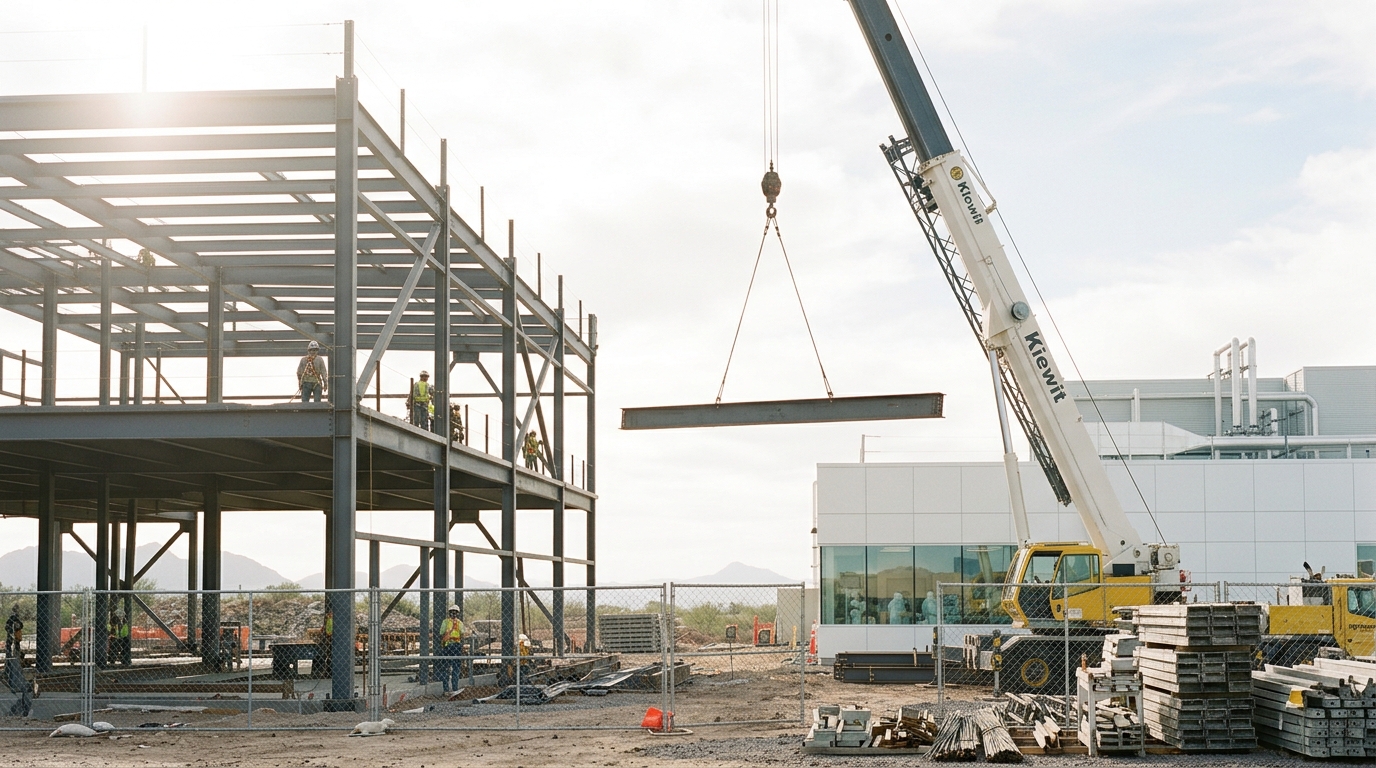
What “reshoring the frontier node” actually means
For most of the industry’s history, moving the newest, highest-yield-risk process node outside Taiwan would have been considered close to unthinkable. Leading-edge fabs cluster near TSMC’s existing engineering base, its supplier ecosystem, and decades of accumulated process knowledge that does not transfer cleanly across a factory relocation. Arizona is TSMC choosing to pay the cost of breaking that clustering effect deliberately, at enormous scale, rather than treating US capacity as a token gesture built around a trailing-edge node.
Why now, and why this much
Three separate pressures point the same direction at once, which is unusual and worth naming individually rather than collapsing into a single “geopolitics” explanation. First, customer proximity: TSMC’s largest customers — Nvidia, AMD, Apple — are US companies whose own government has made onshore semiconductor capacity an explicit policy priority, backed by CHIPS Act incentives. Second, packaging strategy: the Arizona buildout explicitly targets an “AI packaging bottleneck,” meaning some of this capacity is aimed specifically at advanced-packaging capability, not just wafer fabrication, so that a complete wafer-to-package supply chain can exist on US soil for the first time [1]. Third, risk diversification: concentrating nearly all leading-edge capacity on one island carries a geographic risk that both TSMC and its customers have every incentive to reduce, independent of any specific policy pressure.
| Milestone | Reported commitment |
|---|---|
| Initial Arizona “gigafab” cluster | ~$165B |
| Additional pledge, four more 2nm fabs | +$100B |
| Total, following fifth consecutive record quarter | $265B |
| Projected Arizona share of global 2nm+ capacity | ~30% |
The cost this doesn’t erase
None of this makes reshoring free. Building and staffing a leading-edge fab outside Taiwan carries a persistent cost premium — different labor markets, different regulatory permitting timelines, and the simple fact that TSMC’s most experienced process engineers are concentrated in Taiwan and cannot be duplicated instantly anywhere else. TSMC’s own N2 ramp is already unprecedented in pace, spanning five fab phases within the node’s first year; replicating that pace in a second country adds execution risk on top of execution risk [3]. The $265 billion figure is best read not as evidence the premium has disappeared, but as evidence TSMC has decided the premium is worth paying at a scale large enough to matter, for reasons that have as much to do with keeping its largest customers close as with any single government’s policy goals.
What to watch
The number that will actually validate this bet is not the dollar total, which is an input, but the output: how much of Arizona’s eventual capacity ships qualified, high-yield wafers at a cost and cycle time competitive with Taiwan-based production. TSMC has not yet had to answer that question at full scale, because most of the announced capacity, as of this briefing, is still under construction rather than running production wafers. The gap between commitment and completion is where this story’s real uncertainty lives.
The comparison that puts the number in context
$265 billion is large enough that it helps to compare it against something concrete rather than treat it as an abstract headline figure. It exceeds the entire 2026 capital expenditure of every other individual company covered in this cohort’s foundry track combined, and it is being spent by a single company on a single country’s fab buildout, over a period of years rather than decades. That scale is itself informative about how central US-based capacity has become to TSMC’s own strategic calculus — not as a hedge or a minor diversification, but as a core pillar of where the company expects a meaningful share of its future leading-edge output to come from. Whether that expectation is realized on the timeline implied by the announcements is the question every subsequent TSMC earnings report through the rest of the decade will keep answering, one quarter at a time.