The end of the spear nobody photographs
Accounts of organised force almost always begin at the sharp end, because that is where the visible events happen. The analytically useful question is duller and older: what quantity of matter can be delivered to a given place, at what rate, for how long, and what does the delivery system itself consume in the process. Every other question about force is downstream of that one. A formation that cannot be fed, fuelled and rearmed is not a weaker formation; after a computable interval it is not a formation at all.
This article treats sustainment as an engineering and institutional problem. The engineering part concerns flows, capacities, transfer points and consumption rates. The institutional part concerns who decides, years in advance, what will exist to flow. Neither part is well served by narrative history, which tends to attribute outcomes to decisions taken at the moment of crisis rather than to capacity established long before it. The claims below are separated deliberately: where something is a documented figure it is attributed to a specific study; where something is my own analysis it is marked as such; where authorities disagree, the disagreement is described rather than resolved.
A ratio that will not hold still
The conventional shorthand for the size of the sustainment problem is the tooth-to-tail ratio: combat personnel set against everyone required to keep them in the field. It is a genuinely useful intuition and a poor measure, and it is worth being precise about why.
The measurement problem is definitional, not statistical. Write the ratio as
and every term is a boundary dispute. Does the denominator include contractors, and if so only those deployed forward or also those in depots at home? Does it include host-nation labour, coalition-provided support, base life support, medical evacuation, theatre engineering, or the transport crews of another service moving the force into theatre? Does an artillery unit that never leaves a fire base count as tooth? Does a signals detachment embedded in a manoeuvre battalion? Because these choices are made differently by different authors and rarely stated at the same level of detail, two published ratios for the same force in the same year can differ substantially without either being wrong.
The best-known systematic attempt to trace the trend is John J. McGrath’s study for the Combat Studies Institute, published as Occasional Paper 23 in 2007. In a summary of that work, James M. Berry reports McGrath’s figures that combat troops formed about thirty-nine per cent of the United States Army in the 1945 European Theater of Operations, against about twenty-eight per cent of the force in Iraq in 2005 [10]. Berry is careful with what those numbers can carry: he notes that any apparent association between a higher combat share and military success “could be a coincidence” and states explicitly that he is not suggesting the ratio is the only reason the Army won some wars and not others [10].
That caution is the right register. My analysis is that the ratio is best used as a diagnostic within one consistently defined accounting frame — tracking one force’s own composition over time, on stable definitions — and is close to useless as a cross-national or cross-era ranking. A publication that ranks armies by tooth-to-tail is almost certainly comparing incompatible denominators. The underlying phenomenon it gestures at is real: the support requirement per combatant has grown. The specific number is an artefact of where the analyst drew the line.
The transport that ate its cargo
Before mechanised traction, the dominant tonnage in any army was not food for people. It was fodder for animals, and the animals in question were largely those carrying the fodder.
Bret Devereaux, working through a standard Roman consular army of roughly 19,200 soldiers with about 5,000 mules and 4,800 horses, arrives at a total daily consumption near 61,850 kilograms, of which animal feed accounts for approximately 32,850 kilograms — a little over half the whole logistical burden [4]. The per-head figures behind that are unremarkable individually and brutal in aggregate: roughly a kilogram of grain-based ration per soldier per day, about 2.25 kilograms of barley per pack mule plus several kilograms of hay where grazing is unavailable, and on the order of seven kilograms of barley per cavalry mount [4].

The structural consequence is a hard radius rather than a gradual decline. Consider a schematic model, offered to expose an assumption rather than to reproduce any historical campaign. A transport team departs a base carrying load
Beyond
Martin van Creveld’s Supplying War is the work that made this constraint central to how military historians read operations, and its influence is hard to overstate [1]. Its most contested claim is a continuity thesis. As John A. Lynn characterises it, van Creveld argues that the continuity of methods of supply between 1625 and 1914 overshadowed what change there was — that armies across those three centuries remained fundamentally dependent on what they could gather where they stood [2].
Later historians have not overturned the underlying physics, but they have disputed the specifics and the reach of the thesis. Lynn’s assessment is that van Creveld “makes a good point, but then he stretches it and in doing so forgets other important logistic needs of a modern army,” and he notes the book’s exclusion of naval and amphibious warfare and of the American Civil War — the largest and longest conflict between Napoleon and 1914 [2]. A separate critique in the same direction observes that the book is not a quantitative work at all: “numbers are sprinkled through the text as ornaments, not presented systematically,” and that its archival base was constrained by what was accessible to a Western scholar during the Cold War, producing a focus on Germany, Italy, France, Britain and the United States that leaves non-European provisioning systems out of the argument entirely [3]. Devereaux, likewise, leans on Donald Engels for the Macedonian case while describing that work as dated and not without problems [4].
The honest position is that the fodder constraint is well established and the periodisation built on it is open. Treating van Creveld’s continuity thesis as settled fact, rather than as an influential and partially contested interpretation, is the most common error in secondary writing on this subject.
The rails, and the joint in the rails
Railways broke the radius. A locomotive burns coal or oil rather than the cargo it hauls, so the self-consumption term that produced
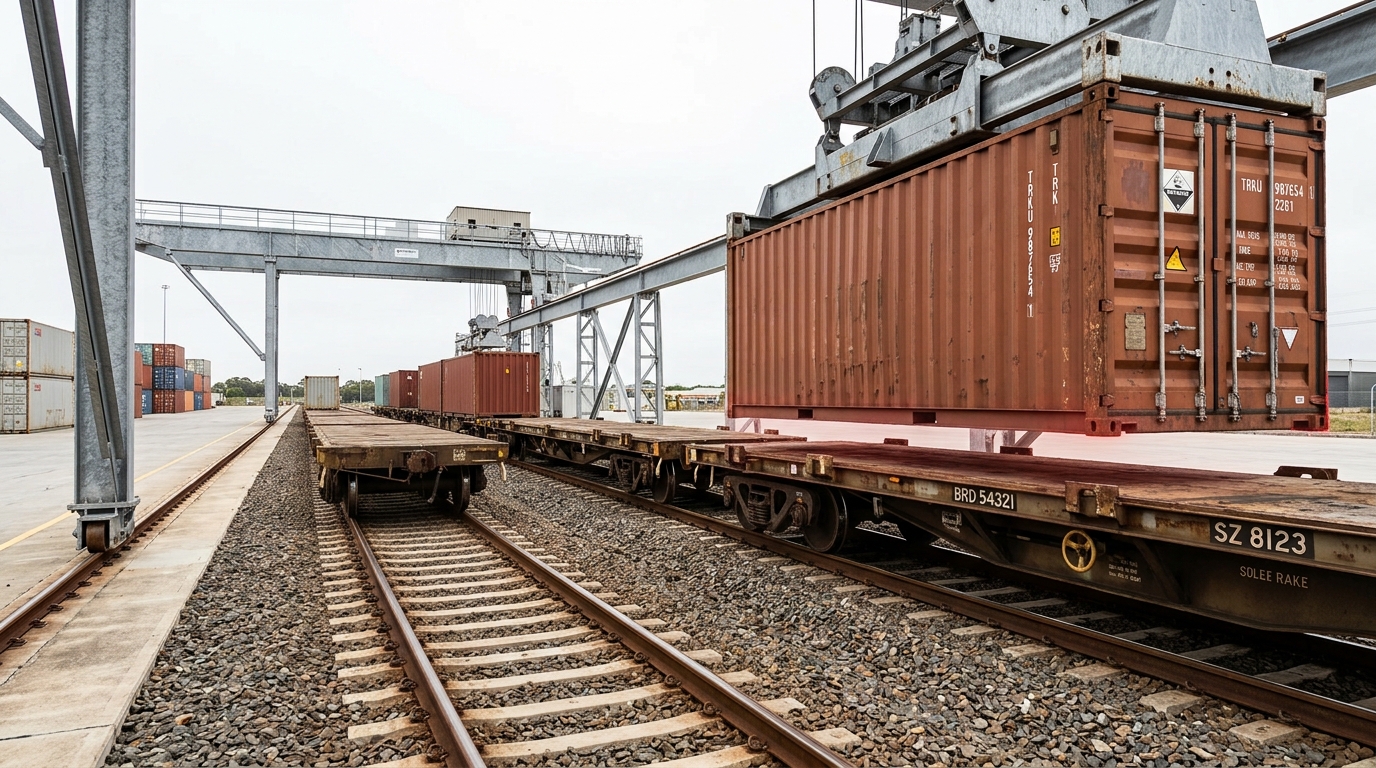
Douglas Puffert’s study of North American gauge standardisation shows how a network arrives at those points. Early railways selected gauges partly from differing engineering traditions and partly for compatibility with the neighbours they expected to interchange with, producing nine distinct common-gauge regions by the 1860s; the growth of interregional traffic then created the incentive to resolve that diversity, and the specific regional pattern of existing gauges — not any technical superiority of the dimension itself — led to the selection of four feet eight and a half inches as the continental standard [5]. This is a path-dependence result with a direct operational reading: the location of gauge breaks is a historical residue, and it constrains what any later user of the network can move.
That residue is still binding. The European Commission’s Solidarity Lanes action plan describes Ukraine’s 1,520 millimetre network meeting the European Union’s 1,435 millimetre standard, so that “goods have to be transhipped from wagons running on the wide gauge to ones on the EU standard gauge” [6]. The Commission’s assessment of the resulting choke is blunt: existing transhipment capacity, including bogie exchange, “is by far insufficient,” and average wagon waiting time at the border stood at sixteen days, rising to as much as thirty days at some crossing points [6].
Note what those delays are not. They are not a shortage of track, wagons or cargo. They are the throughput of a joint. My analysis is that transfer capacity is the most consistently underestimated variable in sustainment planning, because it is invisible in any measure that counts route capacity or fleet size. Ports, railheads, gauge breaks, and the crossing from rail to road are all instances of the same object: a place where the flow rate is set by handling equipment and yard space rather than by anything upstream or downstream of it.
What the tonnage became
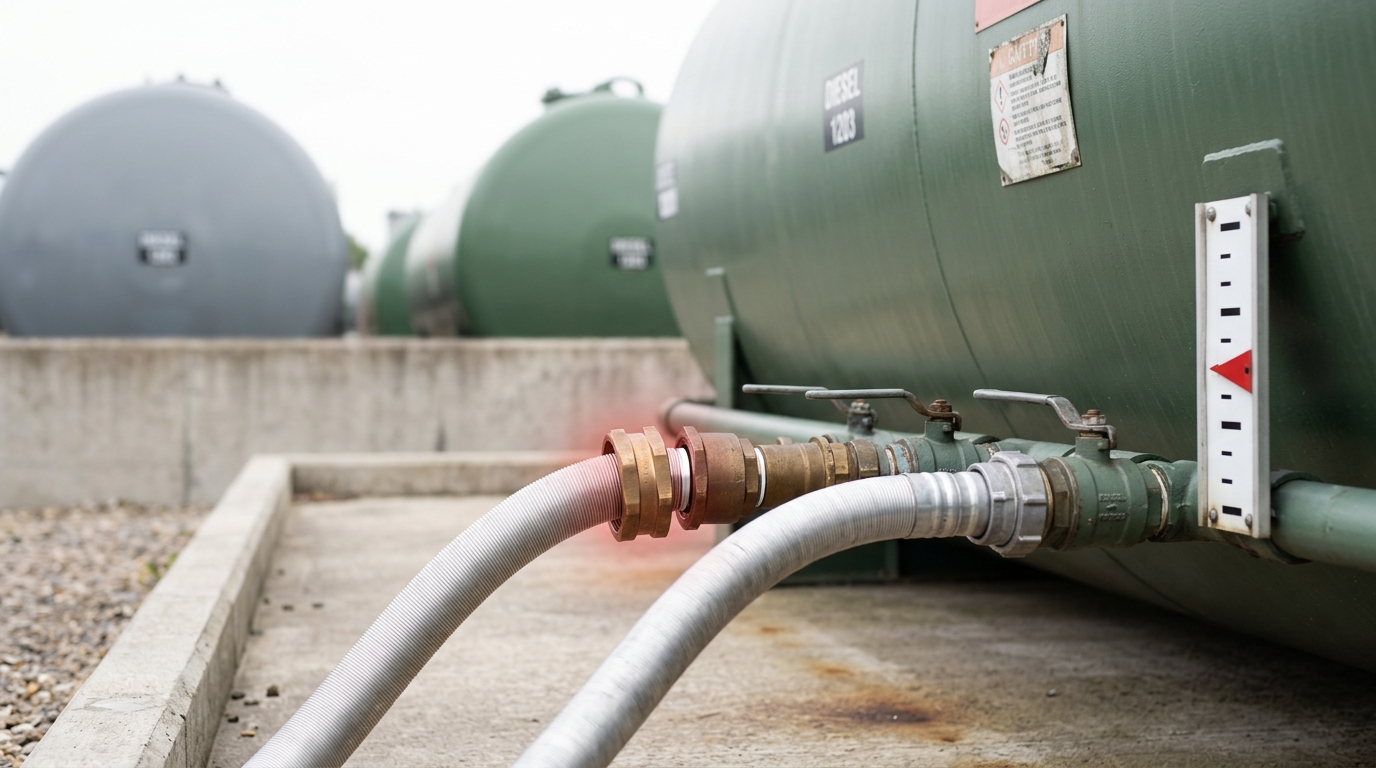
Mechanisation changed the composition of the flow as thoroughly as the railway changed its geometry. Once vehicles rather than animals do the moving, fodder disappears and fuel takes its place — and fuel scales with engine hours rather than with mouths.
The direction of that shift is documented, though the precise share depends on theatre and period. The Government Accountability Office reports Army officials’ estimate that about seventy per cent of the tonnage required to position forces for battle consists of fuel and water, and records that in 2008 the Department of Defense supplied on average more than sixty-eight million gallons of fuel each month to support forces in Iraq and Afghanistan, including roughly 1.7 million gallons of jet fuel per day into Iraq and about 300,000 gallons per day into Afghanistan [8]. A National Research Council study of logistics technologies gives a finer breakdown for the initial phase of Operation Iraqi Freedom: water accounted for 51.1 per cent of the tonnage moved to theatre and bulk fuel for 38.6 per cent, and it identifies fuel, ammunition and water as the largest continuing demands [9].
Two details in that study deserve emphasis because they are where the intuition usually fails. About half of the fuel delivered to forward operating bases went to generators, cooking and supply trucks rather than to combat platforms, and about half of convoy trucks in Iraq were carrying water [9]. The tail, in other words, is substantially engaged in sustaining itself — the same recursion that governed the fodder problem, appearing again in a different substance. The mechanism that limited an ox train is not historically superseded; it is structurally identical and merely runs on a longer radius.
Food, meanwhile, has become a rounding error in tonnage terms while remaining an absolute requirement. This is the general shape of the change: the dominant mass moves from the thing consumed by people to the thing consumed by machines, and the binding constraint moves with it.
Culmination is an accounting identity
Clausewitz named the phenomenon that all of this produces. In the culminating point of victory he describes an attacker growing weaker as it advances, “removing further away from our resources, whilst the enemy is drawing nearer to his,” and offers the image that has outlived the argument: “A conquering army is like the light of a lamp in this respect; the more the oil which feeds it sinks in the reservoir and recedes from the focus of light, the smaller the light becomes, until at length it is quite extinguished” [7].
The concept is routinely taught as a matter of judgement. It is more usefully written as an identity. Let
Culmination is the radius
The analytical payoff is that culmination is not a surprise that occurs at the front. It is a property of the whole system, computable before departure, and located where the transfer capacity is — not where the fighting is. The judgement that remains is about
Years, not weeks: the industrial base
Everything above concerns matter already in existence. The prior constraint is what was built, and that is decided on timescales that have nothing to do with the tempo of events.
A CSIS assessment of the United States industrial base reports that manufacturing lead times for critical munitions range from twenty-five to fifty-one months, and describes production expansion targets across several programmes: PAC-3 MSE interceptors from roughly six hundred toward two thousand per year by 2030, THAAD interceptors from ninety-six toward four hundred annually, the Precision Strike Missile increasing roughly fourfold to about 550, Tomahawk toward more than a thousand, and AMRAAM toward more than 1,900 [12]. Read as an engineering statement rather than an advocacy one, a lead time between two and four years means that the inventory available in any given month was determined by contracting decisions taken one to two administrations earlier.
An earlier CSIS report set out the consequence starkly: in a series of war games, the United States would likely run out of some munitions — particularly long-range precision-guided ones — in less than a week in a Taiwan Strait conflict, and revitalising the industrial base “will not happen overnight” [11]. It is worth flagging the epistemic status of that claim precisely. It is a wargame output from a policy institute that also advocates for expanded procurement; the depletion estimate depends on assumptions about expenditure rates, target sets and campaign duration that a reader cannot independently audit from the published summary. The direction of the finding is well corroborated by the lead-time data; the specific interval is a modelled result, not an observation.
Stockpile against just-in-time
That brings the argument to its live policy end, where the two positions are genuinely unresolved and both are costed.
The case against holding inventory is that inventory decays, occupies capital and frequently turns out to be the wrong inventory. The medical analogue is the clearest public record of those costs. The Congressional Research Service notes that replacing expiring Strategic National Stockpile supplies “incurs a significant cost,” which is precisely why the programme developed vendor-managed inventory arrangements in which the stockpile pays vendors to store and manage product that they can rotate through commercial sale before it expires [14]. That mechanism has a hard precondition — a commercial market large enough to absorb the rotation — and it is not politically stable: all vendor-managed inventory contracts were terminated in 2017 and reissued during the COVID-19 response [14].

The case against not holding it is the failure mode. The Government Accountability Office found that while the stockpile generally contained most recommended countermeasure types, it often held them in less than the recommended quantities; officials attributed the gaps to budget constraints and acknowledged that the gaps present risks, and the department lacked a documented approach for managing and communicating those inventory risks [13]. Between fiscal years 2015 and 2021 nearly five billion dollars were obligated from non-COVID appropriations for medical countermeasures, with a further 6.1 billion dollars in COVID relief funding for stockpile supplies [13]. Those figures are the price of the position that was actually taken, which was neither a full stockpile nor pure reliance on commercial supply.
The defence framing of the same argument is that lean, just-in-time manufacturing practices are incompatible with wartime demand and that the department needs a plan balancing efficiency against surge capacity [11]. My analysis is that this is usually posed as a false binary. The real decision variable is not stock level but time-to-first-additional-unit, and that quantity is set by warm production lines, qualified sub-tier suppliers, tooling, and workforce continuity rather than by the number of finished items in a shed. A modest stockpile behind a warm line is a different asset from the same stockpile behind a cold one, and only the second is genuinely a bet that nothing will happen. Where the two camps actually differ, on my reading, is in their estimate of warning time: stockpile advocates assume the warning is shorter than the lead time, and efficiency advocates assume it is longer. That is an empirical disagreement about a single parameter, and it is stated far less often than it is argued about.
Predictions, with the conditions attached
The following are conditional forecasts, not scenarios, and each is stated so that it can fail.
Horizon: 2026 to 2031. Prediction: the binding constraint on European rail-borne resupply to Ukraine will remain transfer capacity rather than route capacity or rolling stock. Assumptions: the gauge discontinuity persists on the main corridors, and standard-gauge extensions proceed at the pace of large infrastructure projects rather than emergency works. Observable indicators: published wagon waiting times at EU–Ukraine crossings, the number of commissioned transhipment terminals and bogie-exchange facilities, and kilometres of 1,435 millimetre track laid east of the border. Disconfirmation: if average wagon waiting times fall below roughly two days while volumes hold or rise, the constraint has moved elsewhere and the prediction is wrong [6].
Horizon: 2026 to 2030. Prediction: announced munitions capacity expansions will lag their stated targets by a margin larger than the shortfall in appropriated funding, because the binding constraints are sub-tier supply, tooling and skilled labour rather than money. Assumptions: no change in the statutory acquisition framework large enough to alter qualification timelines. Observable indicators: actual against planned annual deliveries for the programmes named above, and reported lead-time movement within the twenty-five to fifty-one month band. Disconfirmation: if delivery rates meet or exceed published targets on schedule while lead times compress materially, the constraint was contractual rather than industrial and the prediction fails [12].
I would also expect the tooth-to-tail literature to remain non-comparable across studies over the same horizon, for the definitional reasons given above. That would be disconfirmed by the adoption of a published, audited taxonomy of support categories that multiple national defence ministries actually report against.
The building is the argument
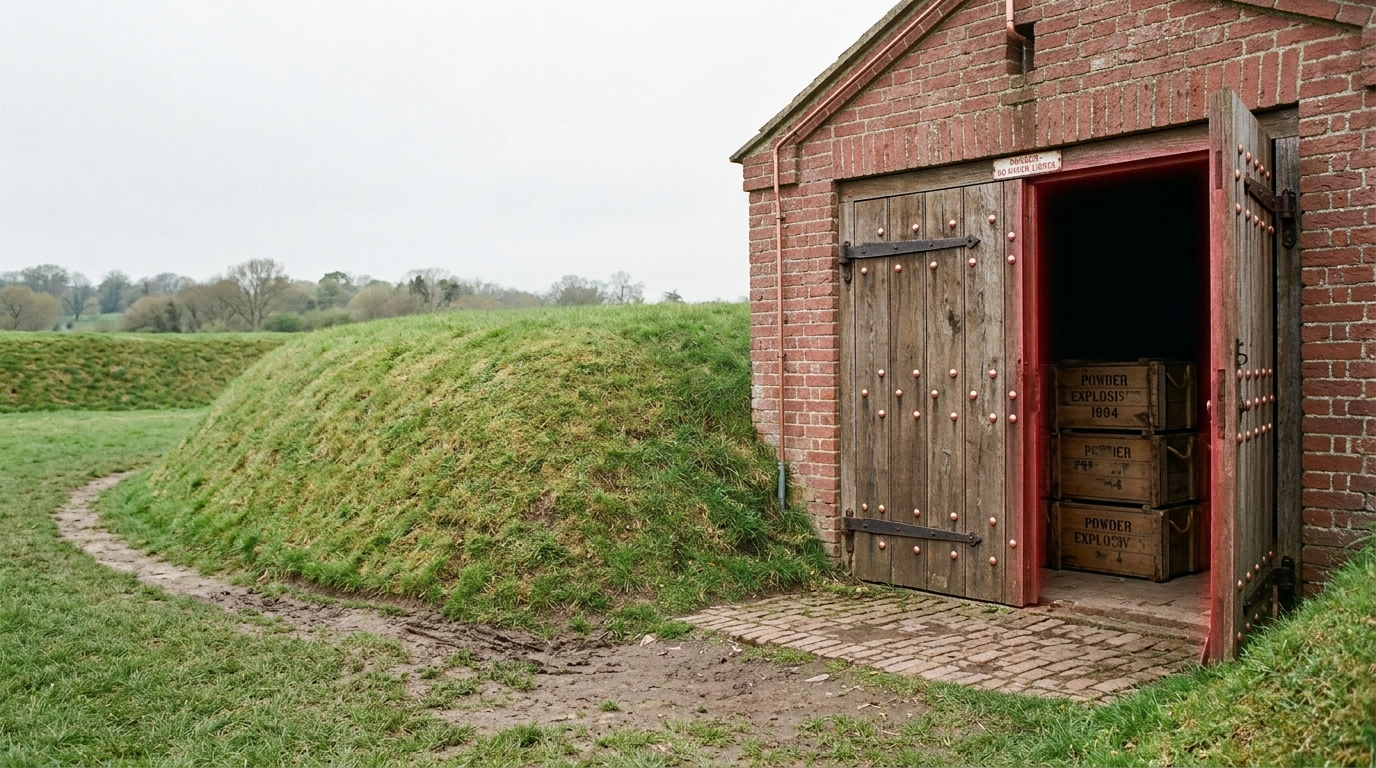
A powder magazine is the whole subject rendered in brick and turf. Nothing in its design concerns the use of what it holds. The earth traverse, the copper nails that cannot spark, the ventilation cowl, the lightning conductor and its earthing strap, the barrow track worn through the grass by routine inspection — every feature answers the cost of holding material safely until some later moment, and every one of them has to be maintained during years in which nothing happens.
That is the honest description of sustainment as a discipline. It is the continuous, unglamorous, expensive business of keeping a flow possible, decided by transfer capacity, consumption profiles and production lead times that were fixed long before anyone knew what they would be needed for. The tail is not overhead attached to the tooth. It is the mechanism that determines whether there is a tooth at all, and for how long.