One company, two unrelated competitions
“Samsung” appears in semiconductor coverage constantly, and the word is doing two completely different jobs depending on context. Samsung’s memory division sells DRAM and HBM in direct competition with SK hynix and Micron — a story told in this cohort’s memory-track briefings. Samsung Foundry manufactures other companies’ chip designs at advanced process nodes, in direct competition with TSMC and, less directly, Intel Foundry. The two divisions share a parent company, a stock ticker, and very little else. This briefing is about the foundry side only.
The yield trajectory
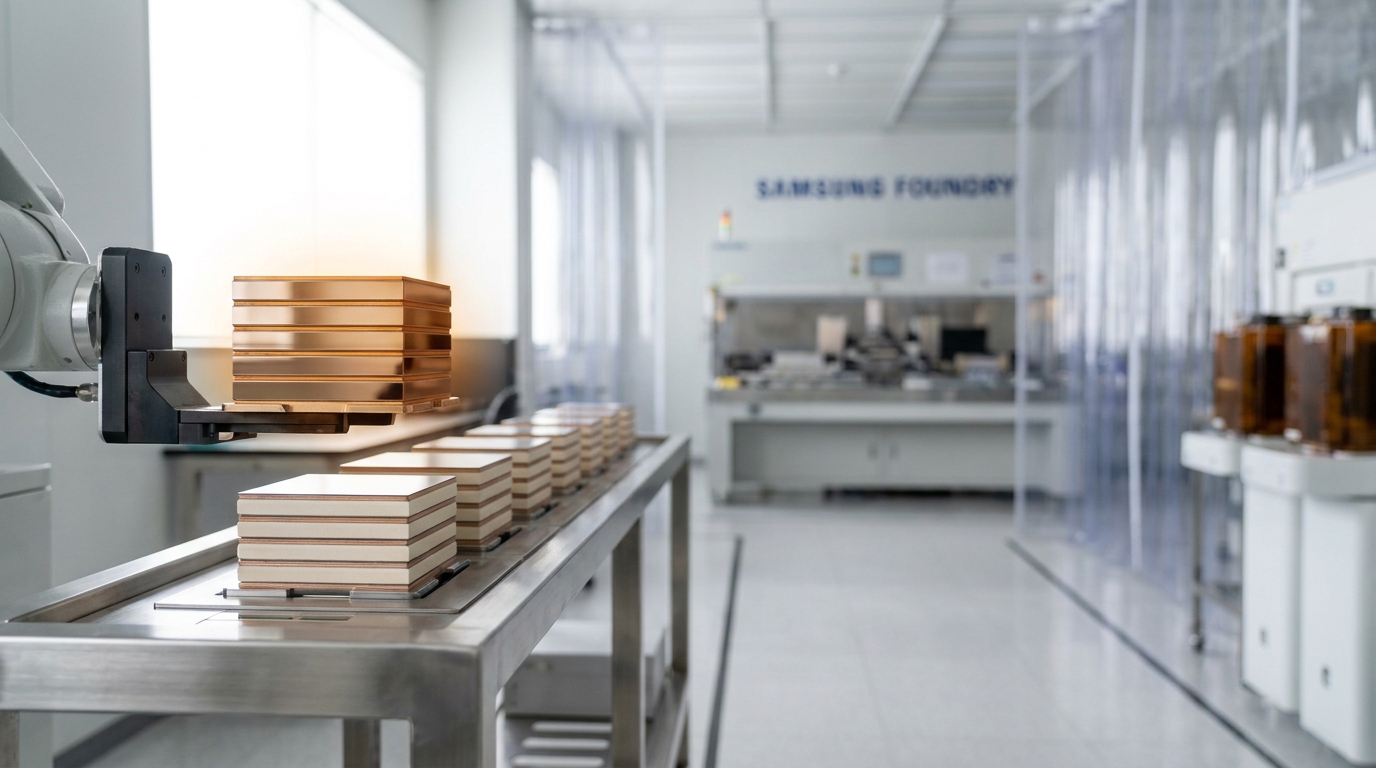
Samsung Foundry’s central 2026 story is a gate-all-around (GAA) yield climb. When Samsung began mass production of its own Exynos 2600 on 2nm GAA in September 2025, yields were estimated around 30-50%, with an internal target of 70% [2]. By late 2025, industry tracking placed yields at an estimated 55-60% — real, measurable progress [1]. Samsung has since sent design-partner guidelines promoting its second-generation 2nm GAA process, SF2P, expected to be adopted for the next Exynos generation [4].
Who is actually buying
The customer list, as reported, is real but not yet the top-tier win Samsung needs to be treated as a peer to TSMC. Samsung Foundry has signed 2nm GAA deals with MicroBT and Canaan, two of the largest cryptocurrency-mining ASIC manufacturers, and holds a multibillion-dollar agreement with Tesla [1]. Reporting also describes discussion of a 2nm chip for Qualcomm, though explicitly not the flagship Snapdragon 8 Elite line that would represent the clearest possible validation [3]. Mining-ASIC and automotive-adjacent customers are legitimate, revenue-generating business; they are not, on their own, the signal that a hyperscaler or a top-tier mobile flagship vendor has chosen Samsung over TSMC at the leading edge.
Why profitability is still ahead, not behind
Samsung Foundry is expected to become profitable around 2027, contingent on its Taylor, Texas plant — set to begin operations in 2026 — ramping to volume [1]. That timeline places Samsung Foundry roughly one to two years behind where its yield numbers alone might suggest, because yield is only one input to foundry profitability; utilization of expensive new capacity is the other, and a new US fab ramping from zero drags on margins for several quarters regardless of how well the process itself performs.
| Metric | Samsung Foundry, as reported |
|---|---|
| 2nm GAA yield (late 2025 estimate) | ~55-60% |
| Named advanced-node customers | MicroBT, Canaan (mining ASICs), Tesla; Qualcomm in discussion |
| Taylor, TX fab | Beginning operations 2026 |
| Foundry-segment profitability | Targeted ~2027 |
The honest comparison
Samsung reaching TSMC-competitive yield is a meaningful technical achievement and should be reported as one. It is a separate question from whether Samsung Foundry becomes TSMC’s peer as a business, which depends on winning the handful of customers — Apple, Nvidia, AMD, Qualcomm’s flagship line — large enough to fill a leading-edge fab at the volumes those fabs need to be profitable. As of this briefing, none of those customers has moved its primary advanced-node volume to Samsung. The yield gap is closing; the customer gap, which is the one that actually decides the business outcome, is closing more slowly.
Why Samsung’s dual identity is a structural advantage TSMC does not have
One point worth making explicitly, because it rarely gets stated plainly: Samsung’s foundry business, whatever its standalone struggles, is backed by a parent company whose memory division is independently one of the most profitable semiconductor businesses in the world. TSMC has no equivalent internal cash engine outside its own foundry operations; every dollar of TSMC’s massive capex has to be justified by foundry economics alone. Samsung Foundry, by contrast, can in principle be subsidized through a difficult multi-year yield-and-customer-acquisition period by profits generated entirely outside the foundry business — an option Intel Foundry has partially exercised too, through Intel’s product-group revenue, but that GlobalFoundries and UMC, both standalone pure-play foundries, do not have available at all. Whether Samsung’s leadership chooses to spend that flexibility patiently on foundry share-building, rather than redirecting capital toward the memory division’s own HBM expansion, is itself a live strategic question — and arguably the more interesting one to watch over the next several years than the yield curve alone, since yield curves are public and legible while capital-allocation decisions inside one of the world’s largest conglomerates are not.