The order of operations
The textbook sequence is tidy. A theory poses a question, an instrument is built to answer it, and the answer confirms or refutes. Knowledge flows from the study to the workshop, and the workshop returns a verdict.
A large part of the historical record runs the other way. A trade acquires a capability for reasons that have little to do with any research programme. The capability produces something nobody was looking for. Explanation then arrives late, under pressure, and has to be rebuilt around a phenomenon that was not predicted and often was not wanted. The spectacle-makers of the Low Countries produced the first telescopes before there was an optical theory adequate to explain why they worked, and the priority disputes and diffusion routes of that invention have been reconstructed in detail from the surviving documents [8]. A Delft draper ground single lenses better than any natural philosopher of his generation and used them to find organisms no existing account of life had room for [7]. The graduated scales on which quantitative astronomy and navigation ran were cut by a machine invented in a London workshop [11].
This article makes that pattern explicit and then tests it. The claim is not that theory never leads. It is that instrument-making capability has repeatedly preceded and enabled theoretical advance rather than following from it, and that this ordering is common enough to be the default expectation rather than the exception. The claim is a tendency, not a law, and the final sections state what would count against it — including the fact, developed at length below, that instruments themselves embed theory, which blunts the priority claim without dissolving it.
Three things need separating throughout. There is what happened, which is a matter of evidence. There is what historians have argued it means, which is contested and in some cases sharply so. And there is what I am claiming follows, which is analysis and is labelled as such.
The instrument as a material argument
An instrument does not simply reveal. It has to persuade. Before an observation counts as a fact it must survive a set of demands that are partly technical and partly social: that the apparatus works as described, that it works in more than one pair of hands, that the effect is not an artefact of the apparatus, and that the people reporting it are the kind of people whose reports are accepted.
The most influential single treatment of that problem is Shapin and Schaffer’s study of the dispute between Robert Boyle and Thomas Hobbes over Boyle’s air-pump in the 1660s. On their account Boyle promoted the pump as a device for producing reliable, reproducible facts that could be collectively witnessed, and built around it a set of conventions — the apparatus itself, the reporting style that let distant readers act as virtual witnesses, and the rules governing who could speak and how disputes ended. Hobbes rejected the whole arrangement, treating experimental effects as artificial and unreliable products of an exclusive guild and preferring demonstration from natural law. Shapin and Schaffer argue that the disagreement was not a technical quarrel with a philosophical veneer but a contest over what kind of knowledge could hold a fractured polity together, and that the politics were bound up in what the natural philosophers did rather than in what they said [1].
The book became a founding text for a way of doing history of science, and it is important to present it as a thesis rather than as a finding. A survey of its early reception, published in Isis three decades later, counts no fewer than thirty-one reviews in the years immediately after publication and identifies the recurring objections [2]. The most common was that the authors generalise too confidently from a single case: one instrument, one dispute, one decade of one country, carrying a claim about the constitution of experimental knowledge as such. Critics also pressed the book’s central formula — that solutions to the problem of knowledge are solutions to the problem of social order — as something asserted rather than argued. Notably, the criticism did not come from one direction. Much of it objected that the account gave too much weight to social determinants of knowledge; some of it objected that the social analysis did not go far enough.
I take the durable part of the thesis to be narrower and better supported than the general formula: that an instrument’s output becomes a fact only through practices of witnessing, replication and reporting, and that those practices are historically specific and can be described. That narrower claim is what the rest of this article uses. The stronger claim — that the shape of knowledge is always downstream of the shape of social order — remains genuinely disputed, and nothing here depends on it.
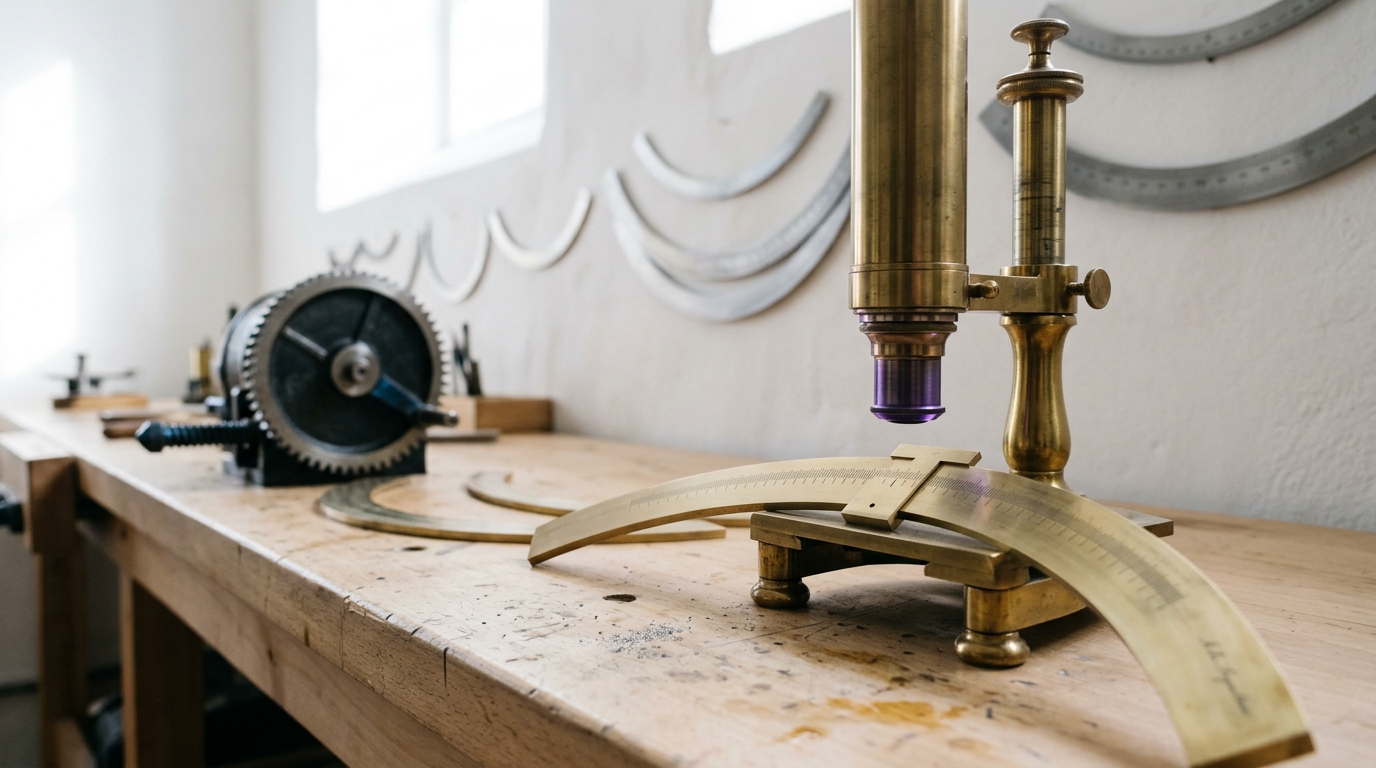
The telescope produced phenomena that theory had to accommodate
The instrument that opened the seventeenth century did not come from a research programme. It came from the glass and spectacle trades, and the reconstruction of its invention shows a device diffusing through Europe as a commercial curiosity within months [8]. Galileo’s contribution was to improve the magnification and then, decisively, to point the thing at the sky and treat what it showed as evidence about the world rather than as a novelty. A museum catalogue of the resulting book puts the shift plainly: Galileo used the telescope “for the first time as a scientific instrument rather than a curious toy” [9].
What came back was not an answer to a question anyone had posed. It was a set of objects: an irregular Moon, a Milky Way resolved into stars, and four bodies moving around Jupiter. The same catalogue states the consequence directly — the new discoveries “invalidated some of the so-called proofs of the Earth’s immobility proclaimed by the advocates of the Aristotelian-Ptolemaic system” [9]. That is the pattern in its clearest form. The instrument did not confirm a prediction. It generated phenomena that an existing cosmology had no place for, and the accommodation had to be built afterwards.
It also generated the acceptance problem immediately. If a device shows things the unaided eye cannot see, the natural first hypothesis is that the device is making them. There was no optical theory in 1610 that could rule out multiple images or coloured fringes as artefacts of the glass, because the theory of the instrument came later than the instrument. What settled the matter was not analysis but replication by others with comparable apparatus and standing. The phenomena were accepted because independent observers with their own telescopes saw them too — which is the same criterion the air-pump controversy turned on, arrived at by a different route.
The microscope and the problem of the credible witness
The microscope repeats the pattern with the acceptance problem raised to its sharpest. Hooke’s Micrographia of 1665 presented a world of magnified detail — the compound eye, the flea, the structure of cork in which he named the cell — as observations to be inspected rather than as evidence for any thesis about life [6]. It sold. It also established that a competent maker with a good instrument could find structure wherever he looked.
Antonie van Leeuwenhoek went further with less. His instruments were single lenses, made by melting Venice glass and mounting the resulting bead against a needle hole in a thin brass plate — deceptively simple devices that later reconstruction has shown achieved a resolution of less than one micrometre [7]. With them he reported, in a letter published by the Royal Society in 1677, living things in rainwater, in seawater, in snow water and in water in which pepper had been infused. No theory predicted them. No account of generation or disease required them.
The reception is the instructive part. The Royal Society did not simply accept the reports; Henry Oldenburg withheld several letters, and Leeuwenhoek himself wrote that he suffered “many contradictions and oft-times hear it said that I do but tell fairy tales” [7]. Nehemiah Grew was asked to reproduce the observations and failed. Robert Hooke also failed, twice; on the third attempt with pepper-water he succeeded, and demonstrated the animalcules before the fellows. Lane’s assessment is that without Hooke’s verification Leeuwenhoek might easily have been dismissed as a charlatan [7].
Note what the successful verification actually required. Not a better theory of what the little animals were — that took two centuries. It required someone with sufficient standing in the community to acquire comparable making capability and reproduce the effect. The instrument’s output became a fact when a second instrument, in credentialed hands, produced it again.
Precision is a trade achievement before it is a scientific one
Quantitative astronomy and celestial navigation both rest on the ability to read an angle accurately, and an angle is read off a scale that somebody had to cut. Until the late eighteenth century that was hand work: an instrument-maker stepped off divisions with beam compasses and cut them by eye, over weeks, and the resulting instrument’s accuracy was the accuracy of that particular craftsman on that particular day. The scale was not reproducible, which meant that observations made on different instruments could not be straightforwardly compared.
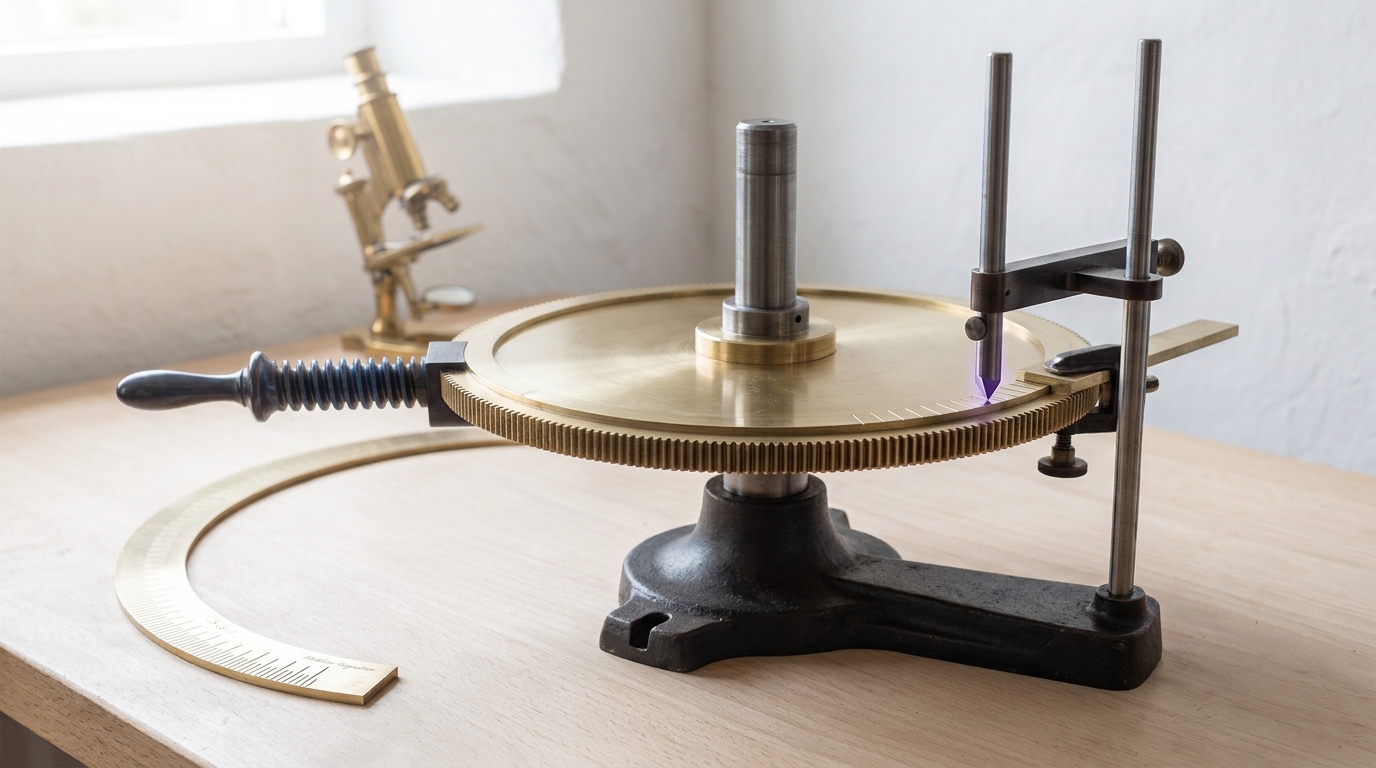
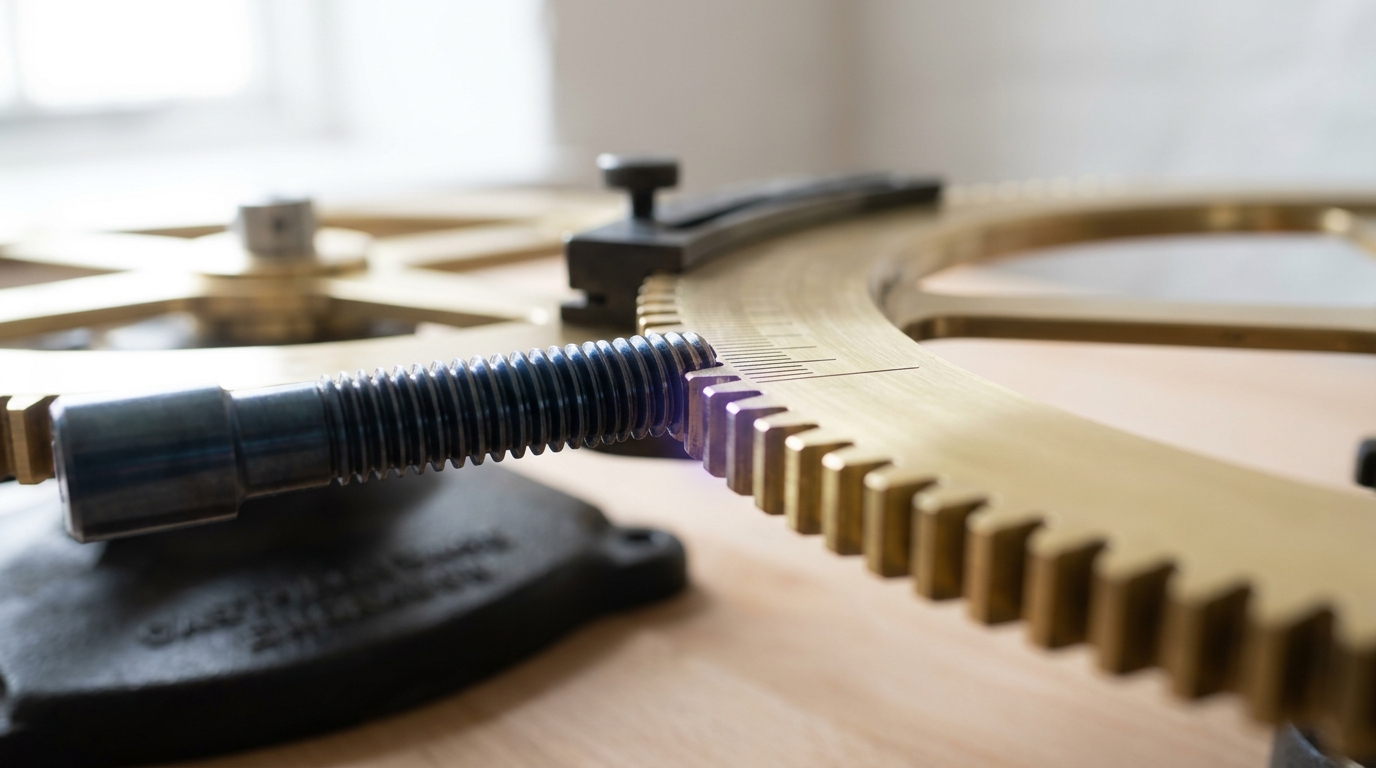
Jesse Ramsden’s circular dividing engine, developed in the 1770s, changed the economics and the epistemics of that problem at once. It let makers of sextants, theodolites and observatory circles divide a circle into 360 degrees and then subdivide those degrees into minutes with a consistency no hand division could match; the Board of Longitude subsequently awarded Ramsden £615 for the contribution, second only to what it paid John Harrison [11]. A surviving engine of the Ramsden pattern in the Whipple Museum shows the mechanism: a large wheel carrying 2,160 precisely spaced teeth around its edge, engaged by an endless screw so that the wheel can be advanced by precise fractions of a degree, with an adjustable cutter frame riding above to mark the instrument clamped to the plate [10]. Work that had taken weeks by hand could be done in hours — and the museum record notes that this particular machine was still dividing sextants during the Second World War, roughly a century and a half after it was built [10].
The recursion in that machine is the whole argument in miniature. The accuracy of every scale it cuts is inherited from the accuracy of one master wheel and the screw that drives it. Making the master wheel accurate was itself the hard problem, solved by iterative correction in the workshop rather than by calculation. The engine does not create precision; it copies precision, from one carefully made circle into an indefinite number of instruments. That is a manufacturing insight, and it belongs to a trade.
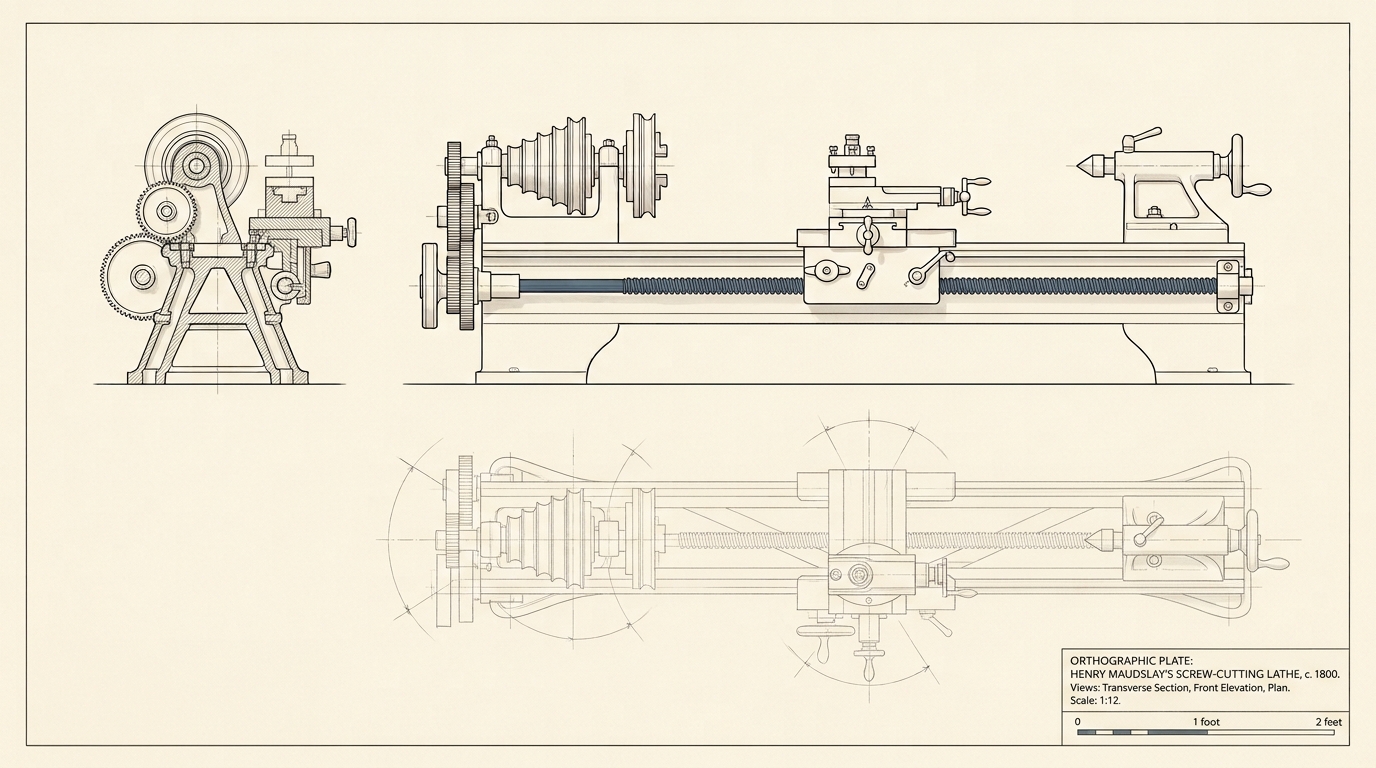
The same problem in linear form was solved a generation later. The Science Museum holds the lathe with which Henry Maudslay pioneered accurate screw threads around 1800; before it, the museum’s record states, threads were crudely manufactured by hand [12]. The machine’s significance lies in its slide rest, carrying a tool holder with screw feed and a micrometer dial to regulate depth of cut, and a leadscrew geared to the mandrel by change wheels so that a thread of a given pitch could be reproduced rather than approximated [12]. A reproducible screw is the precondition for a reproducible dividing engine, a reproducible micrometer and a reproducible measuring machine.
Analysis: none of this was downstream of physics. Screw-cutting and circle-dividing were solved inside a trade, for commercial reasons, by people whose published output was mostly instruments. Quantitative astronomy and precision navigation then proceeded on the capability those trades supplied. It is difficult to construct a version of nineteenth-century observational astronomy that does not depend on the dividing engine, and impossible to construct one in which the dividing engine was built because a theory demanded it.
Making a result portable
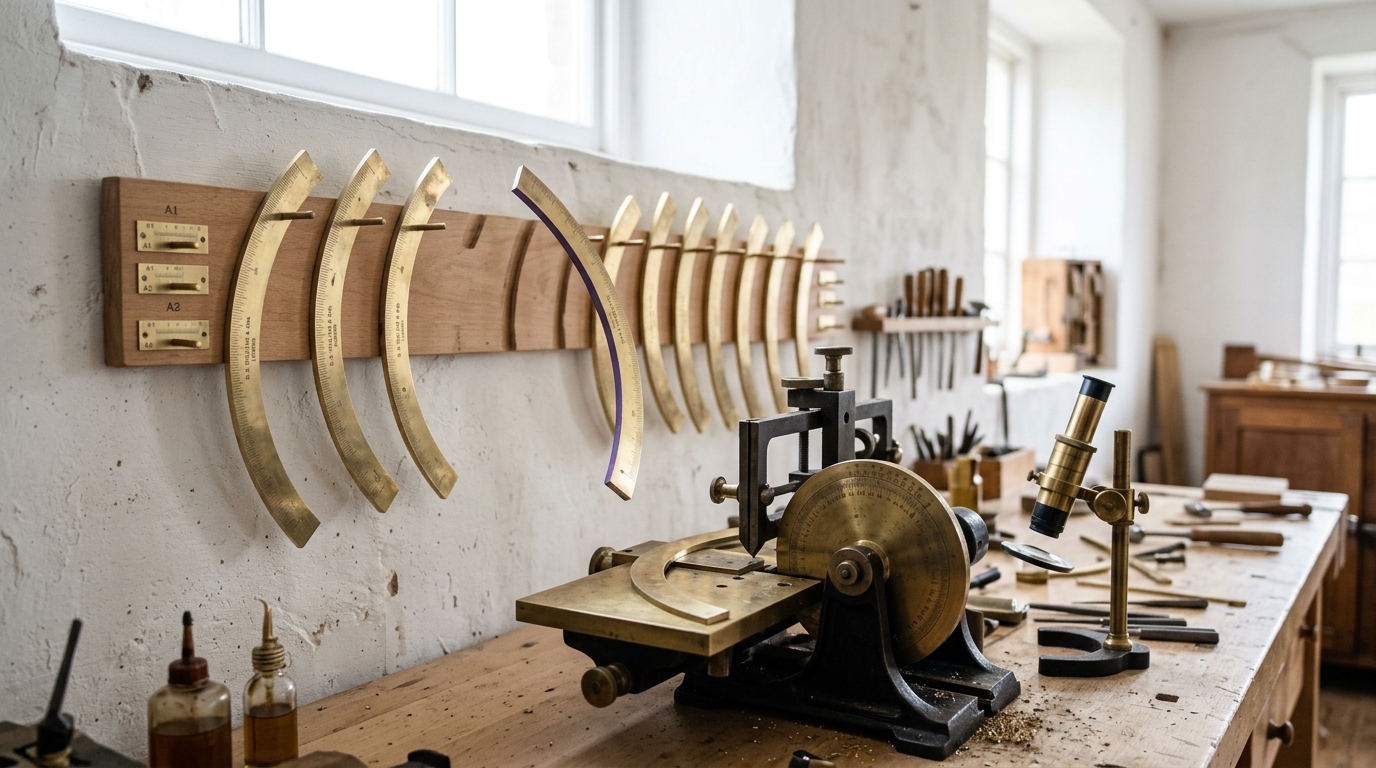
Accuracy in one workshop is not yet science. What science requires is that a measurement made at one site can be compared with a measurement made at another, which is a much harder problem than it looks, because the comparison fails for reasons that have nothing to do with the instruments.
Nineteenth-century astronomy discovered this in the form of the personal equation: the systematic differences between the transit times recorded by different observers watching the same event with the same apparatus. Schaffer’s study of the episode argues against reading it as a simple story of quantification advancing over subjectivity. The response of observatory directors was managerial and mechanical rather than psychological — a division of labour inside the observatory, a network of observing sites to cross-check one another, and progressive mechanisation of the act of observation itself [13]. His broader claim is that measurement takes its meaning from the specific work context and institutional setting that produces it, and that disciplines resist outside attempts to redefine their measurement practices [13].
That is worth stating as analysis rather than as a slogan: transferability is manufactured. It is the product of standard artefacts, agreed procedures, calibration chains and institutions willing to enforce them. The modern form of that machinery is metrology. The current definition of the international system of units, in the ninth edition of the BIPM brochure, rests on a set of fixed defining constants adopted by resolution of the General Conference on Weights and Measures in 2018, with a separate appendix devoted to the practical realisation of those definitions — the procedures by which an abstract definition becomes something a laboratory can actually do [14]. The stated purpose of the arrangement is the global comparability of measurements [14].
The historical continuity is exact. Ramsden’s engine made one workshop’s accuracy copyable into many instruments. Calibration and standardisation make one laboratory’s result comparable with another’s. Both are transfer problems, and both were solved by building apparatus and institutions rather than by improving theory.
Longitude as the worked case
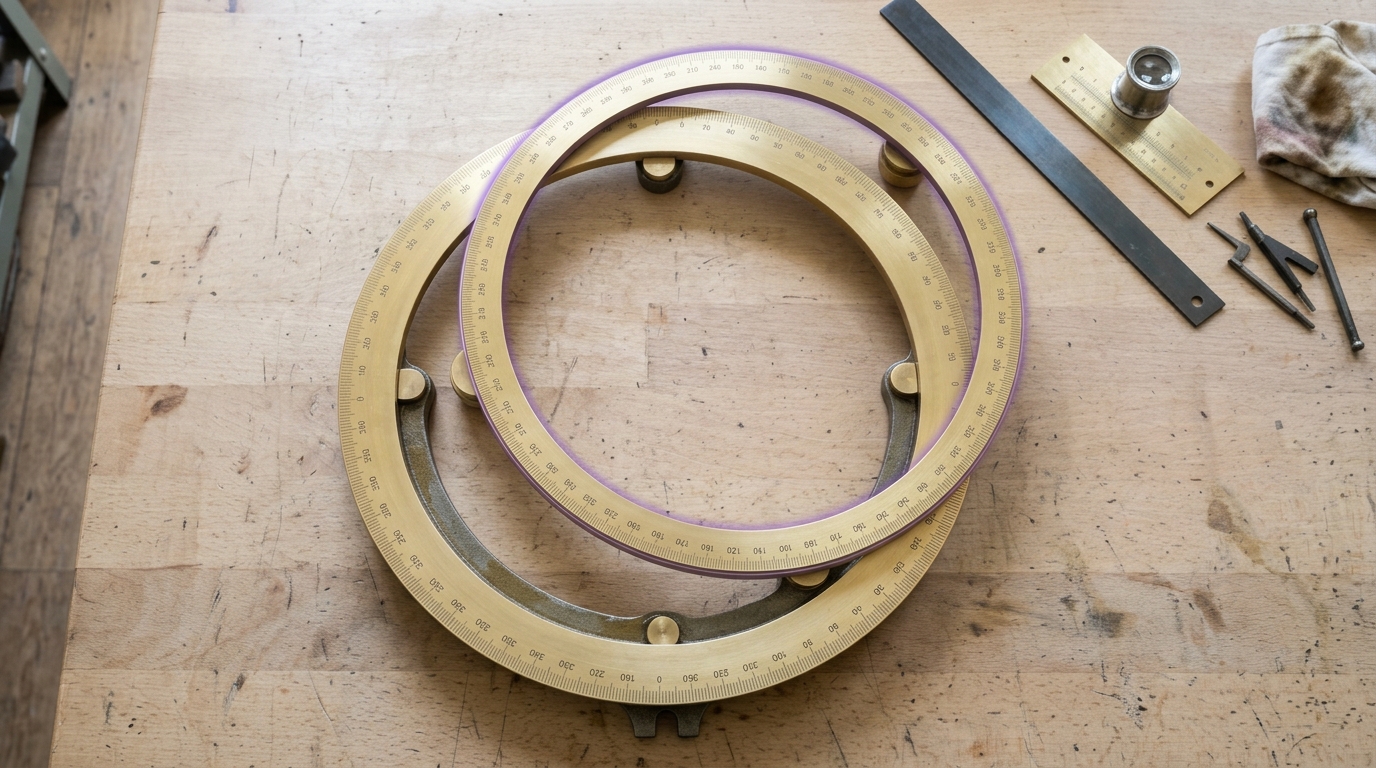
The longitude problem is the case where an instrument settled a question that had defeated every other approach, and it is also the case where the popular story most needs correcting.
The fact pattern: in 1714 the British government offered a reward of £20,000 for a device or technique that would let a navigator at sea determine longitude to within thirty nautical miles [15]. John Harrison answered with a sequence of sea clocks culminating in H4, a large watch. On its 1761 voyage to Jamaica it arrived two months later five seconds slow, corresponding to a longitude error of about two miles; a second trial in 1764 produced an error of about ten miles [15]. Both results are inside the Act’s most demanding threshold by a wide margin.
The instrument did not immediately settle anything, and the reason is the argument of this article. The Board’s objection was that a single watch performing once might be a fluke, and that the method was not established until other makers could produce comparable timekeepers. Harrison was eventually paid £8,750 by act of Parliament in 1773, and the official prize was never awarded [15]. Recent scholarship on the Board treats what followed as the substantive story rather than as an epilogue: under the revised terms of the 1774 Longitude Act the Board ran trials of marine timekeepers at the Royal Observatory at Greenwich and on selected voyages, and over the following half-century the chronometer became an established technology through disputes with the watchmaking trade — a controversy over Thomas Mudge’s claims that weakened the Board’s authority, and a protracted quarrel between Thomas Earnshaw and the Arnolds that ultimately strengthened it [16].
Two things follow, and they pull in different directions. First, the instrument really did resolve the question in a way that no amount of theoretical work could have. The rival lunar-distance method was not wrong; it rested on genuine astronomy. But at sea, the timekeeper’s error budget was easier to certify. Second, the resolution required exactly the transfer machinery described in the previous section: an instrument settles a question only when it can be made by more than one maker, tested against a common standard, and judged by an institution with the authority to say so.
The heroic version of this story — a lone artisan of genius obstructed by jealous astronomers — should be treated with care. The scholarship that has come out of the digitisation of the Board’s own papers reframes the Board as a working administrative body managing a technical trade over decades, which makes Harrison one episode in a longer institutional history rather than its protagonist [16]. Historians differ on how much of the traditional narrative survives that reframing. The disagreement is live, and I do not think the priority argument here depends on which way it settles.
The complication: instruments embed theory
The honest objection to everything above is that the distinction between instrument and theory does not hold cleanly, because instruments are theoretical objects.
The philosophical statement of that point is now standard. The Stanford Encyclopedia’s treatment of theory and observation notes that scientific observation is rarely unaided perception and usually employs sophisticated instrumentation, and that all observations and uses of observational evidence are theory-laden in the sense that they depend on assumptions about how the equipment responds. Its example is deliberately mundane: a number written in a notebook does a scientist no epistemic good unless she can recruit the background assumptions needed to recognise it as a temperature reading at all [5]. The entry also records a shift in how philosophers treat this — from a problem to be neutralised toward a question about why theory-ladenness was thought to be a defect in the first place [5].
Ian Hacking’s argument cuts in the direction this article needs while conceding the point. His claim is that experimentation often has a life independent of theory, and that taking experimental practice seriously supplies better grounds for realism about entities than theory-centred accounts do [3]. The independence at issue is from high theory — the grand explanatory structures an instrument might overturn — not from theory of every kind. Peter Galison’s studies of how experimenters decide that an experiment has ended, worked through the measurement of the electron’s gyromagnetic ratio, the discovery of the muon and the discovery of weak neutral currents, show the same thing from the laboratory side: instrument, background theory and argument are entangled in the process by which a result becomes accepted [4].
So the priority claim has to be stated in a weaker and more precise form. What arrives first is making capability, and the theory embedded in a new instrument is typically older, lower-level and less contested than the theory the instrument’s output goes on to disturb. The lens-grinder’s working knowledge of glass is not the cosmology the telescope broke. The screw-cutter’s feel for a leadscrew is not the celestial mechanics that graduated circles served. That asymmetry is what the argument rests on, and it is a tendency rather than a rule: theory does sometimes lead, most obviously where an instrument is designed to a specification a theory dictates in advance, and where the phenomenon sought has no other way of showing up.

What the pattern predicts, and what would refute it
Analysis first. If the tendency is real, it implies a reallocation of attention. Fields where the binding constraint is fabrication, sample preparation, detector sensitivity or calibration should be expected to produce conceptual surprises at a rate set by their instrument-making capability, not by the productivity of their theorists. It also implies that the instrument trades are not a support function. The historical record here shows the trades supplying the conditions of possibility for entire research programmes while remaining largely invisible in the published literature of those programmes.
Now a prediction, stated so it can fail. Horizon: ten years, to 2036. Assumptions: that current funding structures continue to separate instrument development from hypothesis-driven programmes, and that fabrication and metrology remain the binding constraint in the fields concerned. Claim: in measurement-limited fields, the majority of results that force revision of an accepted account will be traceable to a prior improvement in instrument capability — a new detector, a new fabrication tolerance, a new calibration chain — rather than to a theoretical prediction that motivated the instrument. Observable indicators: whether the enabling capability in such cases is documented in the instrumentation literature before the result appears, and whether the capability was developed for a purpose other than the result it produced. Disconfirmation: if, across those fields, the enabling instruments are predominantly built to specifications set by the theories they go on to test, and improvements in capability follow theoretical demand rather than preceding it, the tendency does not hold and the ordering described in this article is a feature of the early modern period rather than a general one.
That is a scenario about how discovery is organised, not a forecast of any particular discovery, and it should not be read as one.
Coda
The instrument-maker’s workshop is a strange place to locate the origins of modern knowledge, which is presumably why it took so long for historians to look there. It contains no arguments. It contains a wheel with teeth cut around its edge, a hardened screw that engages them, and a frame that holds a cutter over a blank piece of brass.
What that machine does, though, is precisely what the whole enterprise requires. It takes accuracy achieved once, painfully, in one place, and makes it copyable. Everything downstream — comparable observations, transferable results, an argument that survives the journey from one site to another — depends on something like it having been solved first. Theory could not have asked for the dividing engine, because until it existed, there was no way to know what having it would make possible.