Two teams proposed the same experiment on the same day, and neither has run it yet
On 19 July 2017, two papers landed on arXiv within hours of each other. One, from Sougato Bose and eight coauthors spanning London, Groningen, Warwick, Southampton, Belfast and Chicago, proposed watching two nearby masses, each held in a spatial superposition of two locations, and reading out the spin correlations that build up between them as gravity alone mediates an interaction [1]. The other, from Chiara Marletto and Vlatko Vedral at Oxford, argued the same physical setup from the opposite direction: if any two systems become entangled, whatever mediated that entanglement cannot itself have stayed classical the whole time, so measuring entanglement between two gravitationally coupled masses would certify that gravity is not a classical field [2]. Two groups, working independently, arrived at essentially the same proposal on the same day — which is as clean a piece of evidence as physics offers that an idea’s time has come. The protocol now carries both names: BMV, for Bose–Marletto–Vedral.
Nobody has run it. Marletto and Vedral’s own paper says why in one line: gravity is roughly 43 orders of magnitude weaker than electromagnetism, so any gravitationally mediated effect between two laboratory-scale masses is correspondingly faint [2]. Tanjung Krisnanda and coauthors, mapping out exactly how much entanglement a real BMV-type setup would generate under realistic trapping and free-fall configurations, open their own analysis by stating plainly that “no experiment to date has provided evidence for quantum features of the gravitational interaction” — everything so far is proposal, simulation and incremental hardware progress, not data [3]. This new paper, the third in the Quantum–Relativity series and the landing page for it, is not that data either. It is a piece of theory that sharpens what the data, whenever it arrives, would and would not mean — by asking the BMV protocol a question nobody had put to it carefully before: what does “entangled” mean once you admit that different observers, in a strict technical sense, can disagree about who is entangled with whom?
What the experiment actually asks two masses to do
Strip away the spin-witness bookkeeping and the BMV protocol is a single sentence: take two masses, each briefly held in a superposition of two spatially separated positions, let them sit near each other for an interaction time so that gravity alone couples the two superpositions together, and then check whether the joint state that results is entangled. If it is, no classical, unentangling channel could have produced that joint state — Marletto and Vedral’s argument turns on exactly that general principle, borrowed from quantum information theory, that entanglement between two systems requires a nonclassical mediator connecting them [2]. Bose and coauthors give the principle a concrete readout: prepare each mass’s superposition as a spin-dependent path splitting, so that after the interaction time the two masses’ spins carry the entanglement, and a spin-correlation measurement at the end becomes the actual witness a detector can register [1].
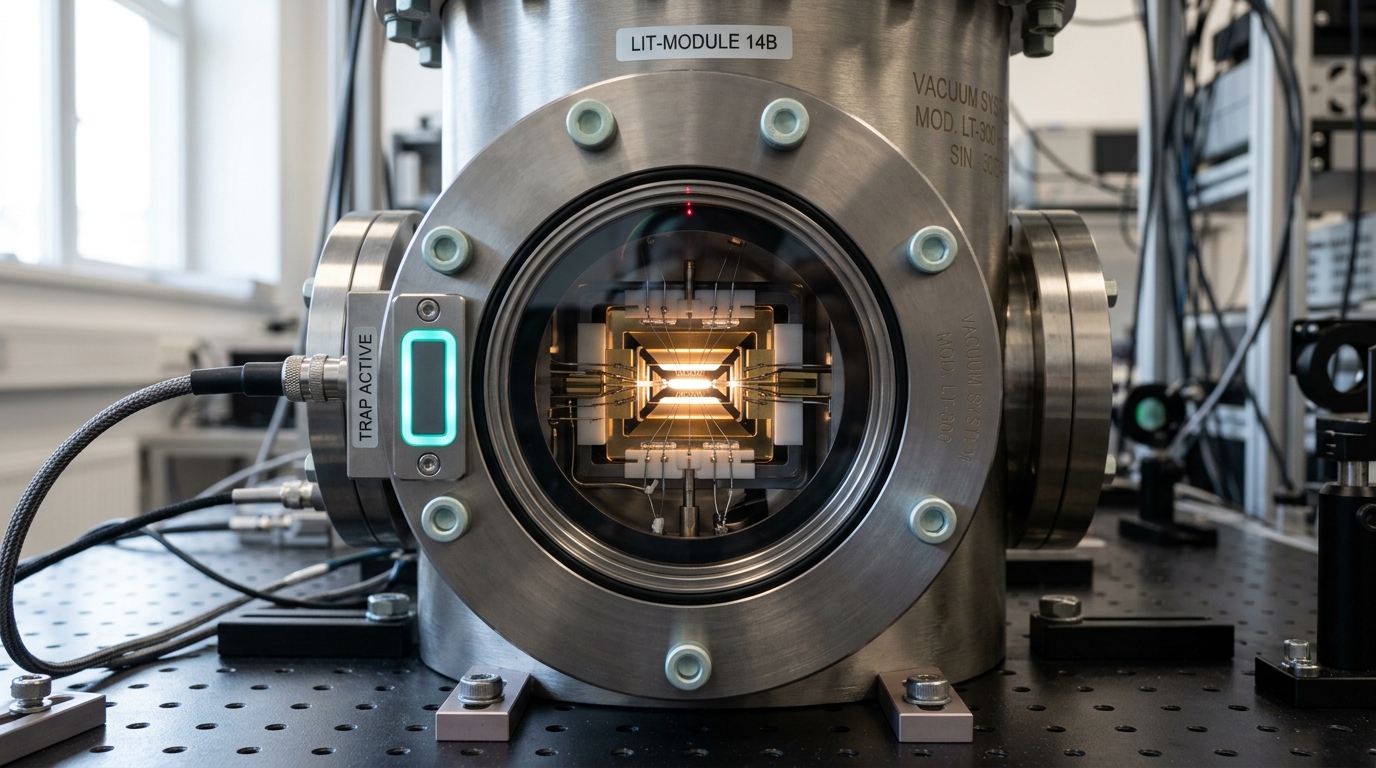
None of this is close to a tabletop demonstration yet, and the honest gap is worth stating in the same breath as the proposal. Krisnanda and coauthors’ systematic study finds that letting the two masses fall freely during the interaction, rather than holding them in traps the whole time, produces more accumulated entanglement for realistic parameters than the optomechanical-trap version of the protocol — a genuinely useful piece of engineering guidance, and also a reminder that the “simple” thought experiment hides real design choices with real consequences for feasibility [3]. Building toward either version means clearing two separate technical bars at once: holding a solid, massive object’s centre-of-mass motion in something close to its quantum ground state, and controlling the gravitational field of a nearby source mass precisely enough that its coupling to the trapped object is not swamped by every other force in the room. Neither bar has been cleared for the BMV protocol itself, but both have been cleared separately, on the way there. Uroš Delić and six coauthors in Vienna cooled a 143-nanometre levitated silica nanoparticle’s centre-of-mass motion down to an average occupation of about 0.43 phonons, starting from room temperature, using cavity-mediated scattering rather than any cryostat — a reduction of more than seven orders of magnitude in motional energy, with a measured coherence time of 7.6 microseconds [11]. And in a separate experiment from the same broader collaboration, Tobias Westphal and coauthors measured the gravitational attraction of two 90-milligram gold spheres, roughly a millimetre in radius, directly in a torsion balance, recovering a gravitational acceleration signal at separations down to 400 micrometres with non-gravitational forces contributing less than a tenth of what was measured — the first time gravity’s pull between such small, laboratory-scale masses had been measured at all [12]. Neither experiment entangled anything. Together, they are the two separate capabilities BMV needs braided into one setup: a mass quiet enough to be superposed, and a gravitational coupling clean enough to trust the number it reports.
The frame idea, in plain English: who is asking changes what “entangled” means
Here is the piece of the argument that is genuinely unfamiliar even to readers comfortable with the BMV protocol itself. Ordinary quantum mechanics is written down from a fixed, unquestioned vantage point — “the laboratory” — and every textbook statement about entanglement between two particles implicitly assumes that vantage point never moves. Flaminia Giacomini, Esteban Castro-Ruiz and Časlav Brukner asked what happens if you refuse that assumption and instead let one of the physical systems in the experiment serve as the reference frame, treating the transformation between “the laboratory’s description” and “mass A’s own description” as a quantum operation in its own right rather than a classical relabeling [4]. Their central technical move, and the one that matters here, is that this quantum reference frame transformation is not innocent: quantities that look fixed and objective from the laboratory’s frame — including, centrally, which two subsystems are entangled with each other — can come out different once you transform into the frame of one of the particles doing the entangling. Augustin Vanrietvelde, Philipp Höhn, Giacomini and Castro-Ruiz then rebuilt the same idea on more careful foundations, constructing a single “perspective-neutral” structure that contains every frame’s perspective at once, with jumping to any one frame amounting to fixing a symmetry redundancy inside that structure rather than performing some ad hoc transformation from outside it [5].
Put in the plainest terms the physics supports: asking “is A entangled with B” already presupposes a frame from which A and B are separately identifiable objects, and the BMV setup has no privileged frame of that kind built into it — mass A’s own frame is exactly as legitimate a vantage point as the laboratory bench’s. The paper takes this formalism, which had previously been worked out mostly for toy translation-invariant models, and applies it directly to the BMV state itself, asking what a switch of quantum reference frame does to the specific entanglement structure the protocol is built to detect. This general worry — that entanglement is not an observer-independent property once frames are allowed to be quantum systems — is not new to gravity. Asher Peres and Daniel Terno’s review of quantum information under relativity had already established, for ordinary Lorentz boosts between inertial observers, that entanglement measures computed by different observers moving relative to each other need not agree, because the reduced states each observer traces over depend on how that observer slices up spacetime [7]. And well before quantum reference frames were formalized for gravity specifically, Stephen Bartlett, Terry Rudolph and Robert Spekkens had already shown, in a much broader review of reference frames as a quantum-information resource, that plenty of “obviously true” statements in quantum mechanics are secretly relative to an implicit classical reference frame the physicist forgot to mention — direction, phase, time origin — and become false, or simply meaningless, once that frame is treated honestly as another quantum system [8]. The paper’s contribution is to carry that lineage all the way into the one experiment currently closest to testing quantum gravity in a laboratory.
What every frame agrees on, computed explicitly, and what they do not
The paper’s central piece of new mathematics is a direct computation, not a general argument: take the BMV state exactly as Bose and coauthors and Marletto and Vedral wrote it down, and work out its entanglement in three different reference frames — the laboratory frame, the frame in which mass A is definite, and the frame in which mass B is definite — using the Giacomini–Castro-Ruiz–Brukner machinery to perform each transformation. In the laboratory frame, both masses are in superposition and the entanglement sits, as the original proposals assumed, between A and B. But jump into A’s own frame, and A becomes the fixed, definite reference point the whole description is built around; what was “A’s superposition” from the laboratory’s point of view becomes, from A’s own point of view, a superposition of the relative position of everything else — including the laboratory itself, treated here as a third body, C. The paper computes the resulting bipartite entanglement for every pairing in all three frames and finds that the entanglement the laboratory frame located between A and B does not simply vanish in A’s frame — it reappears, in part, as entanglement between B and the laboratory body C. Which specific pair of parties is entangled, and how much, is not the same question in every frame; it is, in a precise sense the paper works out algebraically rather than asserts, a frame-covariant quantity. Marios Christodoulou and Carlo Rovelli’s independent, covariant reading of the same BMV proposal anticipated part of this: they argued that describing the effect in a fully general-covariant way reveals the invariant content to be a superposition of proper times between the two branches rather than a frame-fixed statement about which particles hold which correlations, addressing objections in the literature by relocating what the effect actually is [6].
None of this makes the experiment ambiguous, and this is the paper’s second and sharper result. The branch separations that enter the gravitational phase each mass’s superposition picks up are relational quantities — distances between mass A’s branches and mass B’s branches — and relational quantities do not change when you change which system you have designated the reference frame. Write
and the paper’s core theorem is that both the entanglement quantifiable in the state and the actual spin-correlation witness a detector reads out are functions of
What a positive result would prove, and what it would still not prove
This is the split the whole paper is built to state precisely, and it resolves cleanly once the invariant and the covariant pieces are kept separate rather than run together. The frame-invariant content of a positive BMV result — the witness disagreeing with what any classical-channel model of gravity predicts, in every frame simultaneously because the witness is the same number in every frame — is that no local-operations-and-classical-communication process between the two masses’ branch sectors can reproduce the observed correlations. That is a real, substantive, frame-independent statement about gravity: whatever mediated the correlation was not behaving as a classical field the whole time it was doing so. The frame-dependent content is any sentence of the shape “gravity entangled mass A with mass B specifically” — that sentence names a particular bipartition, and which bipartition carries the entanglement is exactly the quantity the paper shows changes from frame to frame. A positive result supports the first sentence unconditionally. It supports the second only as a description from the laboratory’s own particular, entirely legitimate, but not privileged vantage point.
This split is not merely a formal nicety; it bears directly on a real published disagreement. Michael Hall and Marcel Reginatto examined the general principle both original proposals lean on — that entanglement between two systems is impossible without a nonclassical mediator — and showed it fails for a broader class of models than the proposals had considered: specifically, “configuration-ensemble” models in which the mediator stays classical in a well-defined sense yet can still generate entanglement between two quantum systems coupled to it, at least under certain interaction structures [9]. Hall and Reginatto’s conclusion is not that a positive BMV result would prove nothing; it is that the inference from “we observed entanglement” to “therefore the mediator was nonclassical” requires more care about which class of classical models has actually been excluded than the original proposals stated. The paper being introduced here does not resolve that specific debate — it is a different question from the frame-covariance question — but it does show that Hall and Reginatto’s objection and the frame-covariance result attack two logically separate parts of what a BMV result would claim: one is about whether any classical model, of any frame, can reproduce the witness; the other is about whether “which masses” is a frame-free question at all. Conflating the two is, the paper argues, exactly how the debate has occasionally talked past itself.
There is a second honest boundary, and it is about time rather than interpretation. Every real experiment runs for a finite duration in a real environment, and
What belongs to whom
The BMV protocol belongs to Bose and eight coauthors, and to Marletto and Vedral, who proposed it independently on the same day in 2017 [1, 2]. The quantum-reference-frame formalism used throughout belongs to Giacomini, Castro-Ruiz and Brukner, refined onto perspective-neutral foundations by Vanrietvelde, Höhn, Giacomini and Castro-Ruiz, with the general principle that entanglement is frame-relative traceable further back to Peres and Terno for relativistic observers and to Bartlett, Rudolph and Spekkens for reference frames as a quantum resource more generally [4, 5, 7, 8]. Christodoulou and Rovelli’s covariant reading of what the BMV effect actually is belongs to them [6]; the parameter study of how much entanglement realistic BMV variants generate belongs to Krisnanda and coauthors [3]; the qualification that a classical mediator can, under specific models, still produce entanglement belongs to Hall and Reginatto [9]; the black-hole decoherence result belongs to Danielson, Satishchandran and Wald, and the ground-state cooling and millimetre-mass gravity measurements that mark real progress toward BMV’s two technical prerequisites belong to Delić and coauthors and to Westphal and coauthors respectively [10, 11, 12]. What this paper adds, and claims as its own, is the explicit three-frame computation of the BMV state’s entanglement, the exact theorem that the measured witness reduces to the single invariant