Strain already writes a three-hundred-tesla field into graphene, and no magnet did it
Scan a strained graphene nanobubble with a tunnelling microscope and the electrons inside it behave as though they were sitting in a magnetic field of more than 300 tesla — a field with no coil, no current, and no magnet anywhere near the sample. Nalini Levy and collaborators reported the effect in 2010, reading pseudo-magnetic fields in excess of 300 tesla out of bubbles only a few nanometres across, with theory placing the peak curvature regions at 200 to 400 tesla, against a strongest sustained laboratory magnet at the time of roughly 85 tesla [1]. The comparison is not close. The strained sheet of carbon beats the best magnet physics can build by a factor of three to five, and it does so because of a fact about graphene’s electrons rather than any exotic material: strain, in a material whose low-energy electrons obey a Dirac equation, enters that equation exactly the way a gauge field would. Bend the lattice and the electrons cannot tell the difference between the lattice distortion and an honest magnetic field.
A new paper, “A Strained Crystal Is a Designer Spacetime,” the fourth entry in The Crossed Fields Papers, takes that fact and asks how far it goes. The 300-tesla record is not a laboratory curiosity that happened once: architected nanopillar substrates push strain-free monolayer graphene to pseudo-fields near 800 tesla at room temperature over a scalable area [14], and heteroepitaxial silicon-carbide nanoprisms produce a uniform 41-tesla field, wafer-scale, with its pseudo-Landau levels resolved by photoemission at room temperature rather than deep cryogenic cooling [13]. When the object being distorted is the electron’s own dispersion relation, geometry is not a metaphor for the physics — it is the largest effective field condensed-matter physics has ever produced, and it is designed rather than discovered. The paper’s project is to take that same strain-to-geometry mapping into three dimensions, where a different class of material and a different feature of the electron’s motion — not its magnetic response but the tilt of its energy cone — turns an engineered strain profile into something closer to a curved spacetime than a magnetic field.
A tilted Dirac cone is a curved spacetime for the electrons that live in it
Graphene’s electrons obey a two-dimensional Dirac equation with an upright cone: plot energy against momentum near the point where the bands touch, and the result is a symmetric cone, tip down, identical in every direction. A three-dimensional Weyl semimetal has the same kind of cone, but a strain field acting on it does two things at once rather than one. It shifts the cone’s tip sideways in momentum space — a chiral gauge field, the direct three-dimensional cousin of graphene’s pseudo-magnetic field — and it also tilts the cone, leaning it over in a particular direction the way a Dirac cone in flat graphene never leans. A cone that leans far enough stops looking like a cone at all: instead of a closed surface of constant energy around the tip, the surface opens into a hyperboloid, and the material has crossed from what the field calls a type-I Weyl phase into a type-II one, a transition Alexey Soluyanov and collaborators predicted theoretically for the layered semimetal tungsten ditelluride in 2015 [2].
The tilt is where the geometry stops being a figure of speech. Once the tilt varies smoothly from place to place across a crystal, an electron propagating through it is, at leading order in the standard low-energy expansion, equivalent to a particle moving through a curved effective spacetime of the same mathematical form — a Painlevé–Gullstrand metric — that describes an object falling into a black hole, with the tilt itself playing the role of the metric’s off-diagonal, “flow” components. The paper writes the whole statement as a single Hamiltonian, fixing the Fermi velocity
The first term is ordinary tilted-free Weyl physics, shifted by the strain-induced gauge field. The second term is the one that matters here: it multiplies the momentum by the tilt and by the identity matrix, so it does not distinguish between the electron’s two internal states the way the first term does — it simply drags the whole cone in one direction, by an amount that depends on position through
Bend a near-critical crystal until the tilt crosses one, and the crossing is a horizon
Turning that mathematics into a device means choosing a crystal whose tilt sits close to the critical value already, at rest, so that an achievable amount of strain can push it the rest of the way across. Push too little strain onto a crystal whose tilt starts far below 1 and the crossing never arrives before the crystal’s elastic limit does; start from a crystal whose tilt is already far above 1 and the crossing needs a strain the lattice cannot survive. The paper’s candidate is the tungsten ditelluride and molybdenum ditelluride family, sitting close enough to the type-I/type-II boundary that density-functional calculations already show strain can drive the transition, with the tungsten-doped compound Mo
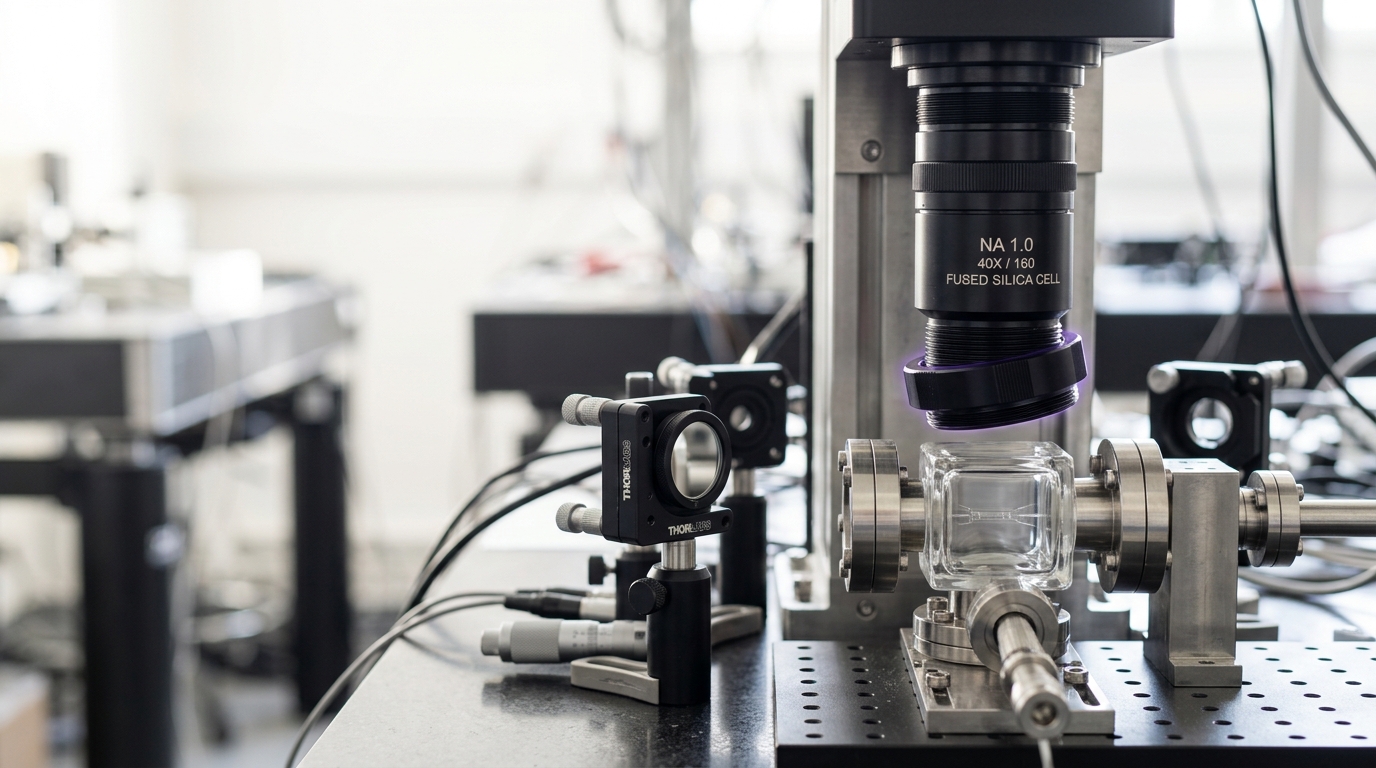
The device geometry is a bending-beam flexure cell: clamp a thin slab of the crystal at its ends, bend it to a controlled radius of curvature, and the resulting surface strain varies smoothly along the beam, sweeping the local tilt through the critical value across a channel roughly a hundred nanometres to a micrometre long. The line where the tilt crosses 1 is the horizon, with an analog surface gravity set by how fast the tilt changes along the channel and an analog Hawking temperature that follows from it in the same way a real event horizon’s surface gravity fixes its radiation temperature. At the paper’s chosen design point — a Fermi velocity of
The number nobody has measured yet: how hard strain actually tilts a real cone
Here the paper states its first honest limitation before drawing another line of the device. Every strain-to-tilt sensitivity that goes into the temperature above is computed, not measured — no experiment between 2016 and 2026 reports a tilt parameter under strain in any real type-II material. The most recent attempt is the same Mo
Because that sensitivity is unmeasured, the paper computes it instead, anchoring the calculation to the density-functional strain sensitivities already published for this material family and to a Grüneisen-type estimate relating the tilt to the same electron-lattice coupling that fixes graphene’s own strain response, and reports the result as a band spanning roughly a factor of six rather than a single number. That spread propagates directly into the temperature: sweeping the computed sensitivity across its conservative-to-optimistic range moves the analog Hawking temperature by roughly the same factor of six the sensitivity itself carries. The paper does not treat that spread as a flaw to explain away. It treats measuring
A horizon is a race against disorder, and today no material wins it
A tilted cone crossing 1 on a band diagram is not automatically a horizon an electron experiences. For the crossing to be a physical event rather than a line on a chart, a carrier has to travel across it ballistically — without being scattered by disorder — for at least as long as the horizon takes to act on it. Turning that single requirement into arithmetic sets a minimum mobility: too dirty a crystal, and disorder buries the horizon under ordinary resistive scattering before any carrier gets close enough to feel the tipped cone. At the paper’s design point, a tenth-of-a-kelvin horizon demands a mobility on the order of
Measured against real crystals, that bar splits the shortlist cleanly in two, and neither half clears it whole. The near-critical type-II hosts that actually carry the tilt — tungsten ditelluride, molybdenum ditelluride, and the strain-tunable tungsten-doped compound — sit at measured mobilities in the low thousands to low tens of thousands of square centimetres per volt-second, with tungsten ditelluride’s magnetotransport mobility around
That is not, on the paper’s own reading, a wall that closes the project. Because the required mobility falls as the horizon warms, a design aimed at a few kelvin rather than a tenth of a kelvin needs roughly two orders of magnitude less mobility than the sub-kelvin design does — pulling the target down toward what today’s type-II crystal growth can plausibly deliver rather than what it delivers today. The honest first target, on this accounting, is not a sub-kelvin horizon in today’s tungsten ditelluride, but a few-kelvin horizon in a demonstrably cleaner type-II crystal — a growth problem stated as a number, rather than a physics problem stated as an obstacle.
What “analog” buys here, and what it forbids
None of this is a claim about gravity, and the paper is explicit about exactly where the line sits. A companion paper in the same series, “What a Bathtub Can and Cannot Know About a Black Hole,” draws the general version of that line: an observable in an analog-gravity system is kinematic when it is fixed by the wave equation on an effective metric, the field’s quantum state, and the dispersion relation alone, and dynamic when its black-hole counterpart depends on the Einstein field equations, their matter sources, or the area-entropy law that ties a horizon’s size to its entropy [16]. This device sits entirely on the kinematic side of that line, by construction. The tilted-cone Hamiltonian above is a statement about the electrons’ dispersion and nothing else, so everything it can produce — an emission spectrum, a transmission probability, a dissipation pattern — is a genuine analog of the corresponding black-hole quantity in exactly the narrow sense the partition allows. What it cannot produce is anything that depends on spacetime actually responding to the electrons: there is no Bekenstein-Hawking entropy here, because that quantity comes from the area law and the field equations, not from a dispersion relation; there is no evaporation lifetime or Page curve, because those are histories of a dynamical spacetime; and the device’s own “back-reaction” is the crystal’s ordinary elasticity and electronic screening, not spacetime evolving under Einstein’s equations. The paper engineers a designer band-geometry for its electrons. It does not, at any point, claim to have built a piece of gravity.
Three ways to see it, at three very different prices
Assume, for the sake of the argument, that the mobility bar above is eventually cleared in a cleaner type-II crystal at a warmer design point. Three measurements would then distinguish a genuine horizon from an ordinary strained resistor, each kinematic in the sense just fixed, and each computed by the paper at magnitudes rather than merely asserted to exist. The most direct, and the most demanding, is shot noise across the crossing: charge quantization makes current noisy in a way that carries a temperature, and the horizon should add an excess noise temperature set by the analog Hawking temperature itself rather than by the cryostat’s bath, visible once the bath is cooled to roughly that same temperature or below — a dilution-refrigerator measurement, not merely a cold one.
The cheapest of the three needs no such cooling at all. Christophe De Beule and collaborators showed that a slowly varying tilt horizon transmits carriers through Hawking-like thermal channels, and that the effect shows up as a peak in the ordinary two-terminal differential conductance, of order
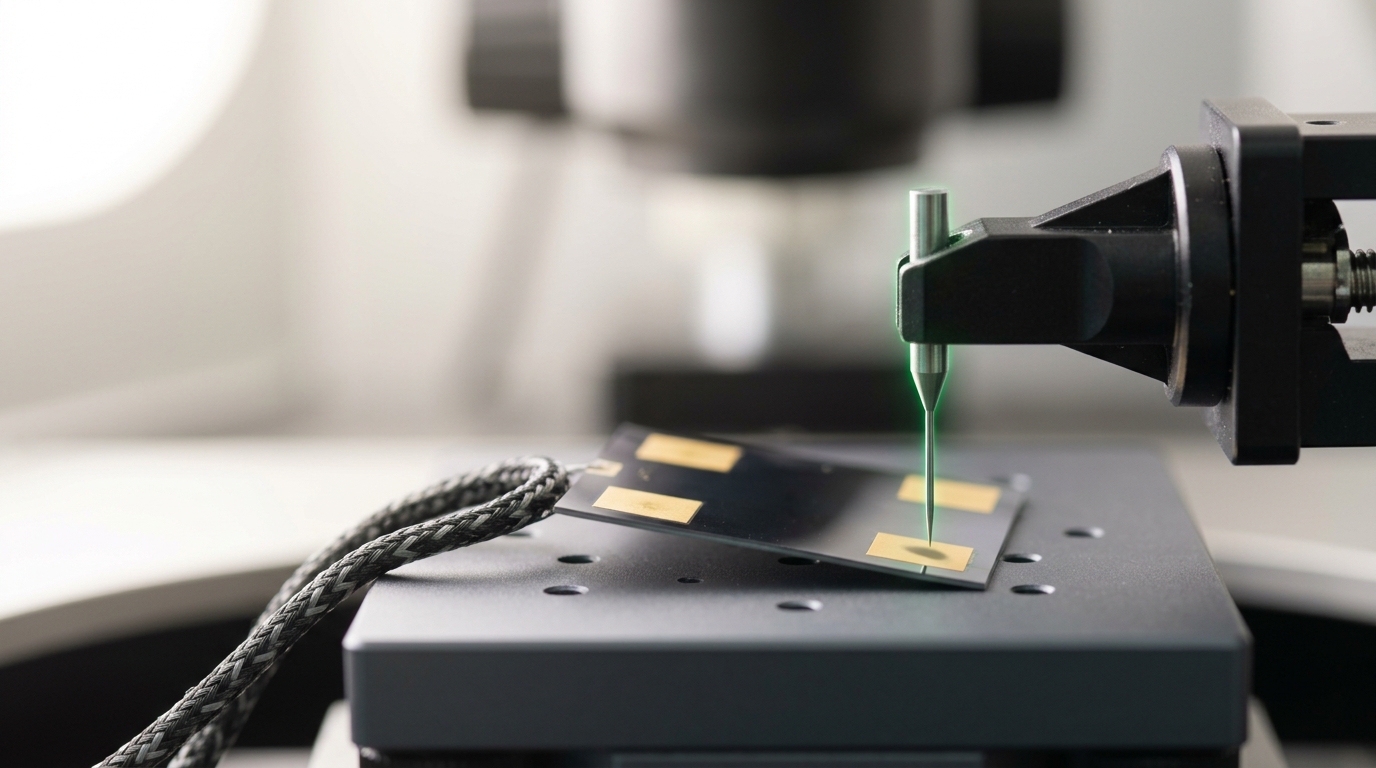
The third sits exactly at its own instrument’s limit. A scanning SQUID-on-tip thermometer, a probe with a sub-50-nanometre diameter capable of imaging where power is actually dissipated in a device, has already resolved individual atomic-defect dissipation in graphene and reports a minimum detectable continuous power of about 40 femtowatts [9]. The horizon’s computed dissipation at the paper’s design point comes out to roughly half that floor — a signal the instrument can only just miss rather than comfortably clear, which the paper reports as the honest number rather than rounding it toward either a clean pass or a clean failure. No one of the three signatures is decisive by itself: a conductance peak can come from ordinary disorder, an excess noise temperature can come from stray heating, and a dissipation hot spot can come from a leaky contact. Together, tracking one strain-set channel at once, they are the argument the paper is actually proposing to run.
The strain-to-geometry mapping this paper works from belongs to the graphene community that built it over two decades, and the 300-tesla record that opens this story belongs to Levy and collaborators [1]; the type-II Weyl phase belongs to Soluyanov and collaborators [2]; the idea that an over-tilted cone reproduces a black-hole horizon traces back through Grigory Volovik [15] to William Unruh’s founding 1981 proposal that a sonic horizon in a moving fluid should radiate the same way a black hole does [11]; and the conductance-peak signature belongs to De Beule and collaborators [4]. What the new paper adds to that inheritance is the engineering: a quantitative strain-to-geometry table across named materials, a concrete device geometry with a temperature computed from real material parameters rather than left as a symbol, a disorder threshold stated as a mobility number rather than a caveat, and three signature magnitudes computed at one design point rather than asserted in the abstract. A verified audit of eighteen prior horizon proposals spanning 1998 to 2023 found no earlier paper combining even two of those four pieces. Strain already writes a designer field into graphene strong enough to embarrass every magnet on Earth; this paper’s contribution is showing, honestly and with the failure modes stated in the same breath as the design, what it would take to make the three-dimensional version of that field show an electron its own horizon.