Three mechanisms, one precondition
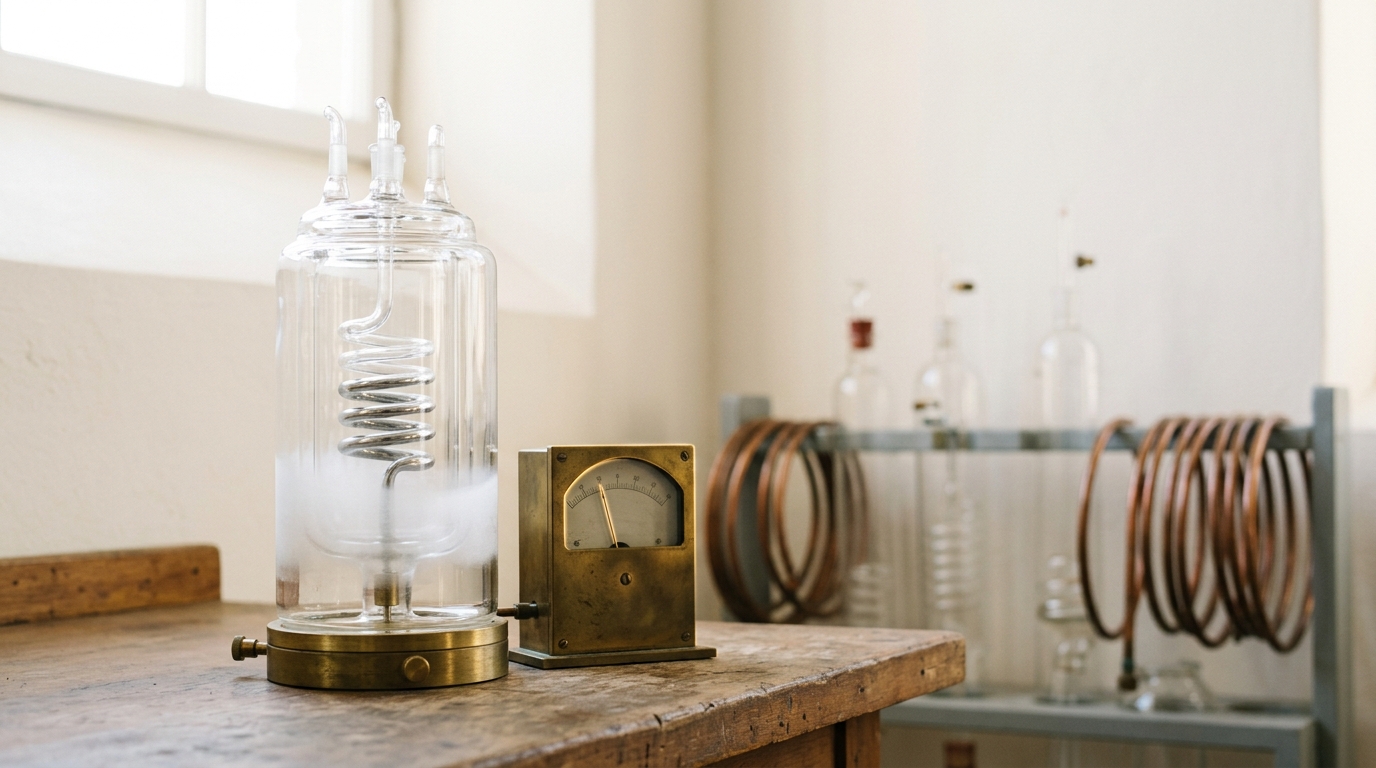
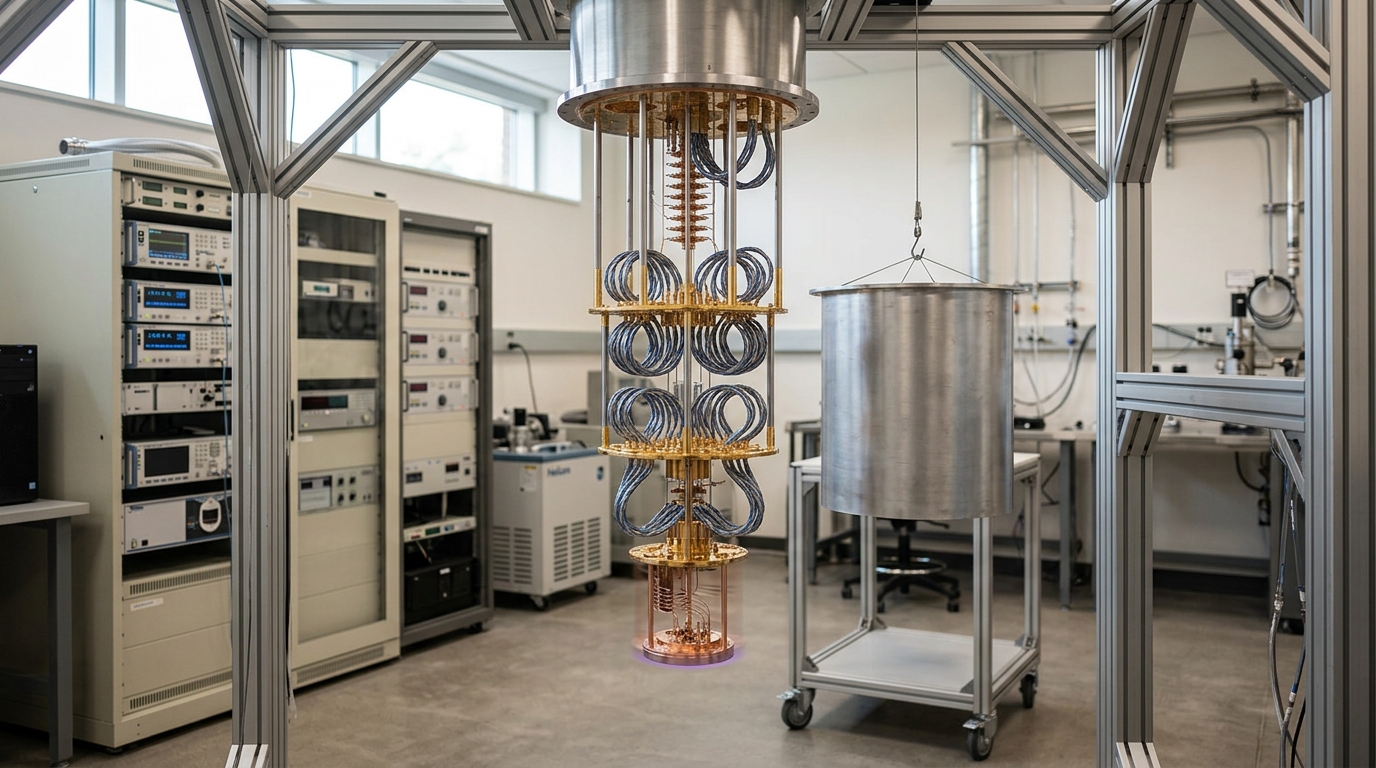
Quantum coherence in a solid is not a permanent background fact; it is a fragile condition that a real piece of apparatus has to manufacture and hold. A dilution refrigerator pumping a helium-3/helium-4 mixture toward millikelvin temperatures, an ARPES chamber holding ultrahigh vacuum around a cleaved crystal, a closed-cycle cryostat clamping a sample against thermal drift — these machines exist because the phenomena below depend on getting thermal and electromagnetic noise low enough that a correlated quantum state can dominate over disorder. This briefing works through three specific mechanisms that only become visible once that precondition is met: topological protection, Cooper pairing, and the quasiparticle.
Fact: what actually makes a topologically protected state robust
“Topological protection” is often described loosely as a quantum state that is somehow immune to noise. The concrete mechanism is narrower and more specific than that phrasing suggests. In models such as Kitaev’s toric code and related anyon models, the ground-state degeneracy that encodes quantum information is a global property of the system’s topology — for example, the number of ways a loop operator can wind around a torus — rather than a property of any local patch of the material [2]. A local perturbation, by construction, acts on a small number of nearby degrees of freedom. To flip the encoded information, an error operator must connect distant regions in a way that respects the global topology, which for a local noise process requires either a very high-order process or a physical excitation (an anyon) to be created, transported, and annihilated across the system.
The protection is therefore a statement about which errors are exponentially suppressed, not a claim that all errors are impossible. Nayak and coauthors’ review of non-Abelian anyons is explicit that the robustness is asymptotic: it improves as the system size grows and as the energy gap protecting the ground-state manifold stays large compared to the temperature, and it can be defeated by processes — thermally activated anyon pairs, for instance — that are simply rare rather than forbidden [3]. Braiding non-Abelian anyons around one another implements a quantum gate whose outcome depends only on the topology of the braid, not on the precise path or timing, which is the source of the fault tolerance claimed for the scheme [2].
Vendor-style overclaim to flag: marketing language sometimes describes topological qubits as “error-proof” or “immune to noise.” Neither source supports that. The protection is against a specific, restricted class of local errors below a threshold set by the gap and the temperature; it does not exempt a device from calibration drift, leakage out of the protected subspace, or errors correlated across a large enough region.
Fact: what a Cooper pair concretely is and how BCS pairing works
A Cooper pair is not two electrons attracting each other directly — Coulomb repulsion between electrons is never switched off. The BCS mechanism instead relies on an indirect, retarded interaction mediated by the crystal lattice: one electron slightly displaces nearby positive ions as it passes, and a second electron arriving shortly afterward is attracted by that transient distortion before the lattice relaxes back [1]. Because the lattice responds on a slower timescale than the electrons’ bare Coulomb repulsion acts, this phonon-mediated attraction can, for electrons near the Fermi surface with opposite momentum and spin, outweigh the direct repulsion and produce a net effective attraction.
Bardeen, Cooper, and Schrieffer showed that an arbitrarily weak net attraction of this kind causes the normal Fermi sea to be unstable: electrons near the Fermi surface spontaneously form bound pairs, and the many-body ground state becomes a coherent superposition of these paired configurations [1]. This pairing opens an energy gap at the Fermi level — a minimum energy required to break a pair and create two unpaired quasiparticle excitations. Because breaking any single pair costs at least this gap energy, the paired condensate cannot lose momentum through the small, individual scattering events that produce ordinary electrical resistance, which is the microscopic origin of dissipationless current flow in a BCS superconductor.
Where this account is incomplete: BCS theory as originally formulated describes phonon-mediated, s-wave, weak-coupling pairing, and it matches conventional low-temperature-critical superconductors well. It does not by itself explain the higher transition temperatures or different symmetry of the pairing gap observed in cuprate and other unconventional superconductors, where the pairing glue is still actively debated rather than settled [4]. Citing BCS as a complete theory of superconductivity in general is an overclaim; it is a complete theory of one well-understood mechanism.
Fact: what a quasiparticle concretely is once correlations are strong
In a weakly interacting metal, Landau’s Fermi-liquid picture holds that low-energy excitations behave like nearly free electrons dressed by interactions — a quasiparticle carries the same charge and spin as a bare electron but an effective mass and a finite lifetime shaped by scattering off other electrons. Angle-resolved photoemission spectroscopy (ARPES) tests this picture directly: it ejects an electron from a crystal with a photon of known energy and measures the emitted electron’s angle and kinetic energy to reconstruct the momentum and binding energy of the state it came from, producing a spectral function that shows a quasiparticle as a sharp peak at well-defined momentum and energy [4].
In strongly correlated materials such as the cuprates, ARPES measurements show that this sharp-peak picture partially breaks down. Spectral weight is transferred from a coherent quasiparticle peak into a broad incoherent background, the peak width (inverse lifetime) scales anomalously with energy and temperature rather than following the simple Fermi-liquid form, and a “pseudogap” — a partial suppression of spectral weight above the superconducting transition — appears in the normal state of underdoped cuprates without a full symmetry-breaking transition to explain it [4]. Complementary optical-conductivity measurements across correlated oxides, organic conductors, and heavy-fermion compounds show the same qualitative story from a different probe: a Drude-like coherent response at low energy coexists with substantial incoherent spectral weight, and the coherent fraction shrinks as correlations strengthen [5].
Analysis: a quasiparticle in this regime is best understood as a limiting concept rather than a universally applicable object. It remains well defined wherever the coherent spectral peak carries most of the weight and has a lifetime long compared to its energy; it becomes a poor description exactly where correlations push weight into the incoherent background, which is also where the most interesting physics — pseudogaps, non-Fermi-liquid transport, unconventional pairing — tends to live. Both review sources are explicit that no single accepted microscopic theory yet accounts for the full phenomenology of the pseudogap or the anomalous quasiparticle lifetimes across all cuprate families and doping levels [4] [5]; where they and other researchers disagree is on which competing framework (preformed pairs, competing orders, or strong short-range correlations) is closest to correct, and that disagreement should be reported as live rather than resolved.
Scenario and prediction: where instrumentation is pushing next
Scenario, not fact: next-generation ARPES beamlines and cryostat-integrated transport probes are being combined with time-resolved pump-probe techniques to watch pairing gaps and quasiparticle coherence form and collapse on femtosecond-to-picosecond timescales, rather than only in equilibrium. If this combination matures, researchers could distinguish competing pairing mechanisms by how fast the gap responds to a perturbation, not only by its equilibrium size and symmetry.
Prediction, with horizon and disconfirmation condition: over roughly the next five to ten years, expect incremental narrowing (not resolution) of the debate over pseudogap origin in cuprates, driven by higher-resolution ARPES combined with complementary probes rather than by ARPES alone. Assumption: beamline energy and momentum resolution keep improving at their recent historical rate and sample quality (surface cleanliness, homogeneity) keeps pace. Observable indicator: convergence of results from ARPES, optical conductivity, and quantum oscillation experiments on the same materials and doping levels. Disconfirmation condition: if instead these techniques continue to disagree qualitatively on the same samples after this window, that would indicate the disagreement is about physics rather than instrumental limitation, and the prediction should be treated as wrong.
Why the mechanism, not the slogan, is the point
None of these three ideas is well served by a one-line slogan. “Topological protection” is a statement about which local errors are suppressed and by how much, not a claim of immunity. A Cooper pair is a specific, lattice-mediated, retarded attraction between two electrons, not a vague “quantum pairing.” A quasiparticle is a well-defined object only in the regime where spectral weight stays coherent, and strongly correlated materials are interesting largely because they sit outside that regime. Reading the underlying peer-reviewed mechanism, rather than the popularization of it, is what actually distinguishes a real claim about robustness, pairing, or emergent excitations from marketing language borrowing the same words.