A quick palate cleanser after ninety-nine articles about AI chips
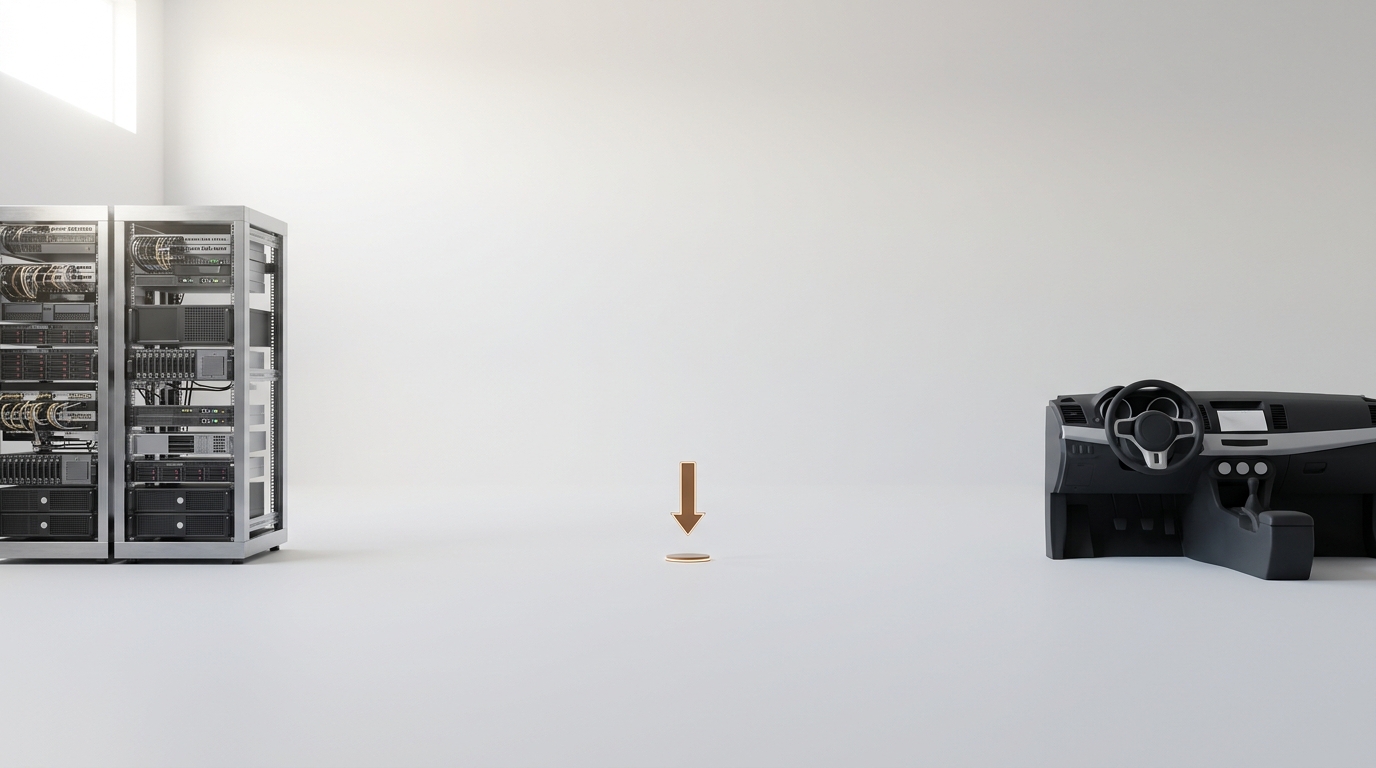
If this cohort’s other ninety-nine briefings have left an impression that “the semiconductor industry” means GPUs, hyperscaler capex, and gigawatt datacenters — fair enough, that is where most of the dollars and most of the headlines currently concentrate. This one exists to correct the impression, quickly and without excessive hedging: a huge share of the semiconductor industry, by company count and by unit volume, runs on a completely different clock, and always has, long before anyone was writing hundred-article cohorts about it.
The chip in your dashboard doesn’t know what a GPU is
The small power-management chip regulating your car’s headlight circuit, the analog part converting your factory equipment’s AC power to stable DC, the microcontroller in your washing machine — none of it cares whether Nvidia’s next architecture ships on schedule. These chips are designed to decade- long automotive qualification cycles, sold through relationships built over years, and priced according to a completely separate supply-and-demand logic than the one driving GPU headlines.

The clearest proof: a company raising prices for its own reasons
Texas Instruments raised analog chip prices by up to 85% in April 2026 [1] — a massive move by any measure, and one that had almost nothing to do with the AI story dominating this cohort’s other tracks. It happened because TI is the dominant supplier in a market where switching suppliers is expensive and slow, and it could. That is old-fashioned pricing power, the kind that predates the AI boom by decades and will almost certainly outlast whatever the current AI news cycle is about by the time anyone reads this.
Even where AI shows up, it’s a guest, not the host
To be fair to the AI story: this cohort’s Infineon briefing documents real AI-linked upside showing up in a company whose core business is automotive power electronics [3]. And NXP’s 2027 recovery narrative genuinely does intersect, at the margins, with AI-adjacent “physical AI” industrial demand [2]. But in both cases, AI is a guest appearance in a much longer-running show — automotive and industrial demand cycles that were setting these companies’ strategies years before “AI boom” became a headline phrase, and will keep setting them long after.
The EV and grid boom that owes nothing to AI
Wide-bandgap power semiconductors — the gallium nitride and silicon carbide chips covered in this cohort’s companion briefing — are projected to grow from $6.8 billion in 2026 to $31.81 billion by 2035 [4], driven almost entirely by electric vehicles and grid electrification. That growth curve would look almost identical in a hypothetical world where the current AI boom had never happened.
A quick myth-check for anyone tempted to fold every chip story into the AI story
Myth: every semiconductor company’s stock chart moves on AI news. Reality: analog and automotive suppliers largely move on automotive production schedules, industrial capex cycles, and their own multi-year pricing actions. Myth: slower AI spending would hurt the whole chip industry equally. Reality: it would barely register for a company like TI, whose largest customers are car manufacturers and factory-equipment makers who were never spending on GPUs in the first place. Myth: “chipmaker” is basically a synonym for “AI company” now. Reality: most of the world’s chipmakers, by headcount and by factory floor space, have never designed anything that goes anywhere near a datacenter, and most of them are not particularly bothered by that fact either.
The one-sentence takeaway
The AI-accelerator story this cohort spends most of its ninety-nine other articles on is real, large, and genuinely reshaping parts of the semiconductor industry — but it is not the whole industry, and the analog and automotive chipmakers quietly running the rest of it are doing just fine on their own separate, older, less headline-friendly clock, thank you very much, and they will most likely still be doing just fine on that same clock long after whatever the current AI headline of the week happens to be has been forgotten entirely.