An Ear Bone Gives Away What the Skeleton Denies
In 1977, an American-French field team led by Philip Gingerich was hunting for Eocene land mammals in Pakistan’s North-West Frontier Province when they collected a block of red conglomerate near the village of Chorlakki. The following year, back at the University of Michigan, colleague Jean-Louis Hartenberger broke the block open and exposed a well-preserved braincase, which the team catalogued at first as a “creodont skull” — the braincase of an ordinary land carnivore [8]. Once it was cleaned, two things became clear: the braincase was small for the size of the animal, and the bony capsule enclosing its middle ear, though small, was conspicuously dense — whale-like in a way no wolf-sized land mammal’s ear has any business being [8]. Colleagues Ewan Fordyce and Lawrence Barnes confirmed the identification from one further, diagnostic detail on that same ear capsule, a raised ridge called the sigmoid process, found nowhere outside Cetacea [8]. The animal was named Pakicetus inachus, and the case for it was laid out the following decade in a Science paper describing the oldest and most primitive cetacean then known: a skull whose teeth still resembled those of carnivorous mesonychid land mammals, recovered from fluvial river sediment alongside ordinary land-mammal fauna at the shrinking eastern edge of the ancient Tethys Sea [2].
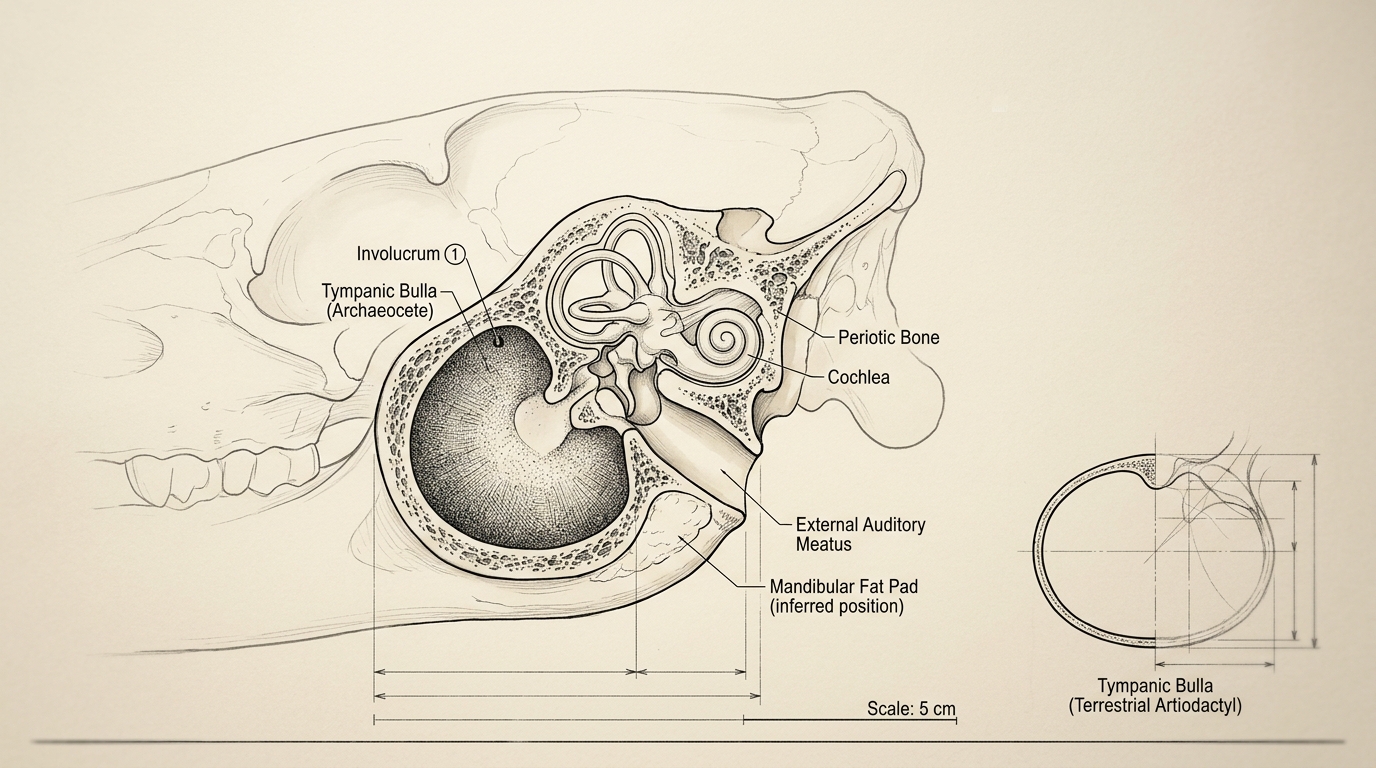
That one bone is still how the identification gets made, decades of subsequent fieldwork later, and long before the rest of a skeleton has offered an opinion. The tympanic bulla of every cetacean, living or fossil, carries a uniquely thickened, unusually dense inner lip called the involucrum — a structure entirely absent in every terrestrial artiodactyl, intermediate in mineral and amino-acid composition between tooth enamel and ordinary skeletal bone, and closely similar in its underlying chemistry to the corresponding structure in hippos [15]. It develops unusually fast relative to the bone around it, and researchers studying its biochemistry treat that density as the functional key to the whole structure: a heavy, acoustically isolated lip is what lets a directional-hearing organ work underwater, where sound conducted through soft tissue would otherwise overwhelm an ordinary land-mammal middle ear [15]. The same study found the involucrum’s amino acid profile — low in glycine and hydroxyproline, unlike most bone but similar to the hippo’s own tympanic and to the pachyostotic ribs of manatees — consistent with unusually rapid bone deposition, the kind of fast, dense construction a structure needs if it is going to mineralize into something functional before an animal’s hearing comes to depend on it [15]. Pakicetus’s own ear had not yet acquired the further refinements that hearing underwater requires — its describers were explicit that the otic region still lacked the specializations needed for efficient directional hearing in water — which is consistent with an animal still wading rather than swimming, in a river valley rather than a sea [2].
A second, independent ear structure sharpens the same point a few million years further on. The three semicircular canals of the inner ear, which sense head rotation and stabilize gaze during locomotion, sit within a narrow, conserved size range relative to body mass across land mammals generally; across every cetacean examined, living or fossil, that canal arc is roughly three times smaller — a change that would degrade balance intolerably on land, but suits an animal built for the fast body rotations of swimming [14]. Fred Spoor and colleagues found this shift already complete in Eocene fossils as soon as a species is associated with marine environments, appearing abruptly rather than accumulating gradually the way limb reduction does — a change they describe as a functional “point of no return” into a sensory regime incompatible with any return to competent life on land [14]. The rest of the early-whale skeleton tells a gradual story of retooled limbs and lengthening trunks. The inner ear tells a story of early, rapid commitment.
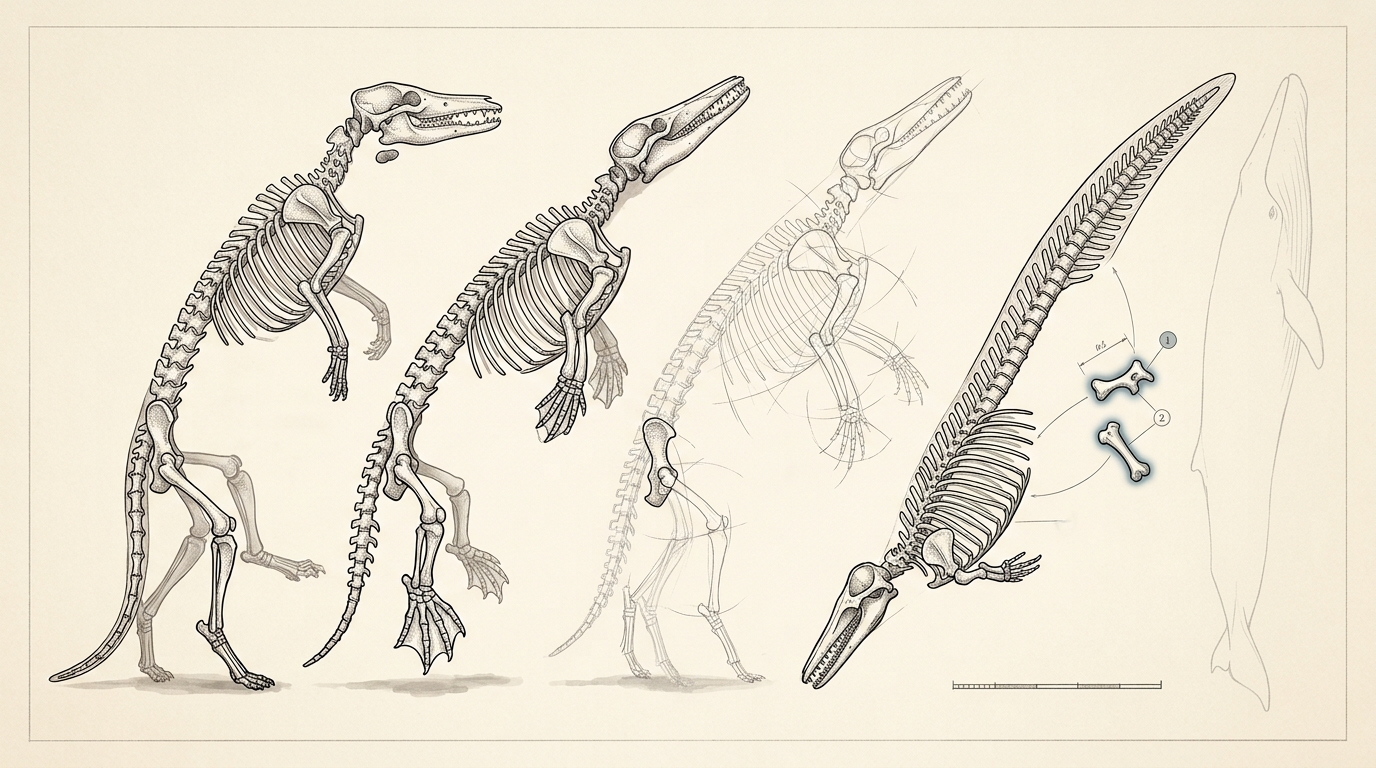
This is worth stating plainly before the parade of names begins, because it is the article’s central trap. Darwin himself sensed the difficulty a species-level transition like this one poses. In the first edition of On the Origin of Species, he offered, as an argument that no obstacle of principle stood in the way of a terrestrial mammal drifting toward an aquatic existence, the observation of a black bear seen “swimming for hours with widely open mouth, thus catching, like a whale, insects in the water,” and reasoned that under sustained selection a lineage of such bears might become “more and more aquatic in their structure and habits, with larger and larger mouths, till a creature was produced as monstrous as a whale” [1]. The passage drew enough ridicule that later editions cut the extrapolating sentence; by the sixth edition the bear still swims, but Darwin softened even the simile, now catching insects only “almost like a whale,” with no promise of a whale at the far end [1]. Darwin’s instinct — that a claim this large needed a documented mechanism, not a plausible-sounding image — was the right one, and supplying what he could not is the work of the next hundred and sixty years: an actual, dated, located sequence of animals, not a rhetorical one. What follows is that sequence. The trap is treating it as a single, tidy chain running in order from a land mammal to a blowhole. It has never been that, and the density of the actual record — several overlapping families, not one lineage — is itself the strongest evidence in the whole case.
Four Names Span Twenty Million Years and At Least Five Overlapping Families
The first archaic whale anyone described came in 1832, when the Philadelphia naturalist Richard Harlan presented a fossil from the Eocene of Louisiana to the American Philosophical Society and, mistaking it for a giant sea serpent, named it Basilosaurus — “king lizard” [8]. A century later, Remington Kellogg’s 1936 Review of the Archaeoceti was so exhaustive a summary of everything then known that it effectively halted new research on early whales for the next fifty years; Kellogg himself read archaeocetes as descendants of an insectivore-creodont stock, collateral relatives of living whales rather than their direct ancestors [8]. The density of dated, located specimens that follows in the rest of this section did not exist until fieldwork restarted in Pakistan in the late 1970s.
Pakicetus is better described as a documented relative caught at the earliest known moment than as a whale ancestor in any strict sense: early-to-middle Eocene, roughly 48 million years ago, in the Kuldana Formation near Kohat, Pakistan, found among ordinary land mammals in river sediment [2, 8]. Its own family, Pakicetidae, is not the oldest entry even at that depth: Himalayacetus subathuensis, from the early Eocene of India, is dated to roughly 53 million years ago, five million years earlier still, which means whatever process produced this lineage was already under way before Pakicetus itself existed [8].
The next name usually taught is Ambulocetus natans — “the walking and swimming whale” — described in 1994 from a skeleton recovered from the Kuldana Formation of Pakistan and dated to roughly 48 to 47 million years ago [3, 8]. Its describers, J. G. M. Thewissen and colleagues, could reconstruct an actual mode of locomotion rather than merely infer one existed: the skeleton indicates the animal swam by undulating its spine so that its hind feet drove up and down through the water in the manner of a modern otter, and that it likely moved on land the way a sea lion does, protracting and retracting abducted limbs rather than running with the parasagittal gait of a wolf [3]. Ambulocetus belongs to its own family, Ambulocetidae — and this matters for what comes later — which Gingerich’s own synthesis of the record places, together with the ear-specialized Remingtonocetidae, as a specialized side branch rather than a step on the direct line to living whales [8].
The family that does sit close to that main line is Protocetidae, and its best-documented member supplied the fact that eventually settled an argument about where whales belong in the mammal tree at all. During the 2000 field season in eastern Balochistan Province, on the very first day in the field, graduate student Iyad Zalmout found one fragment of an unusual ankle bone and Pakistani geologist Munir ul-Haq found the matching piece; fitted together, the two fragments formed a complete astragalus with a grooved, pulley-shaped joint surface at both ends — a “double-pulley” astragalus [8]. That bone belonged to the skull and partial skeleton later named Artiocetus clavis. About a week later, Munir ul-Haq found much of the skeleton of a second protocetid, Rodhocetus balochistanensis, this one with virtually complete fore and hind limbs and an astragalus of the identical double-pulley design [4, 8]. Both animals date to the early Lutetian, roughly 47 million years ago [4]. A third protocetid from the same fieldwork, the 2.6-metre Maiacetus inuus, preserved something rarer still: a female skeleton with a near-term fetus positioned for head-first delivery, the presentation typical of land mammals rather than the tail-first birth of every living cetacean — direct physical evidence that even a foot-powered, part-time swimmer like Maiacetus still came ashore to give birth [13].
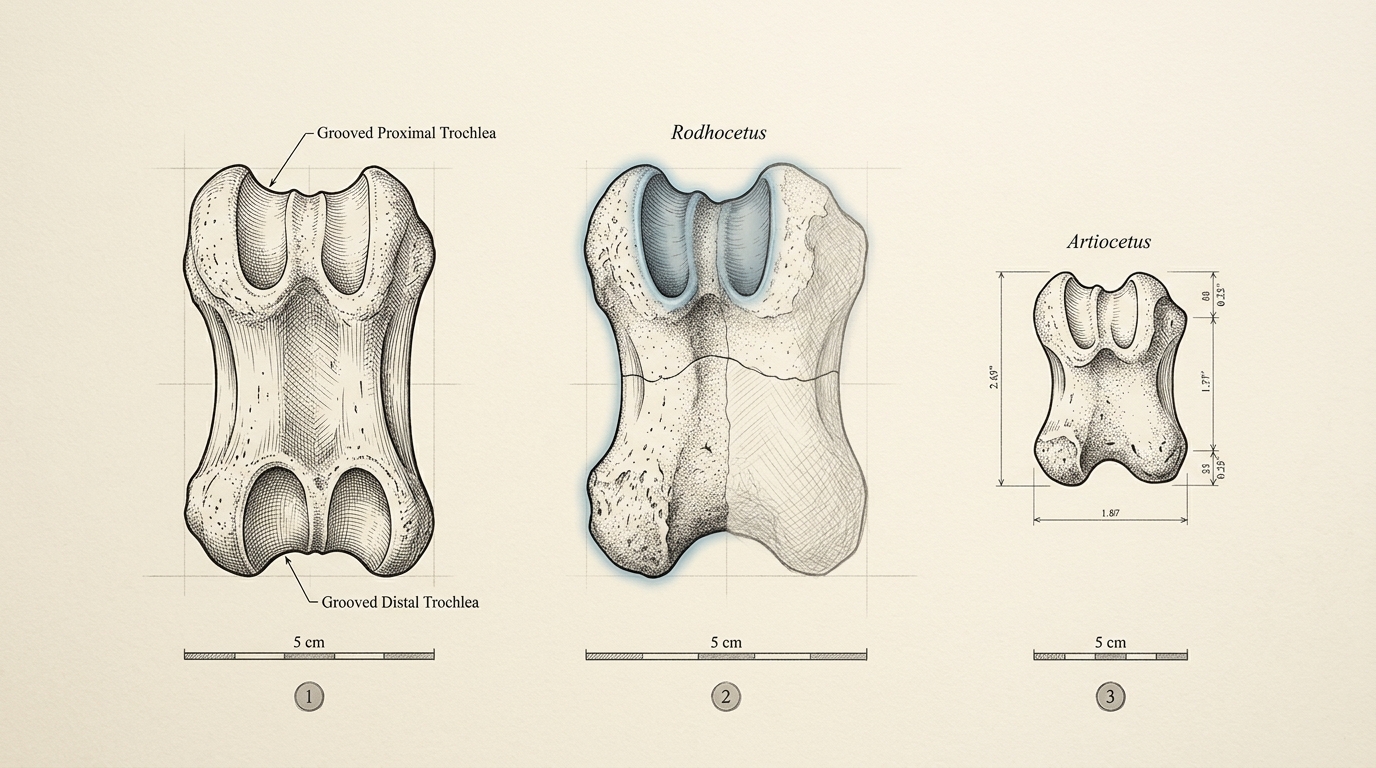
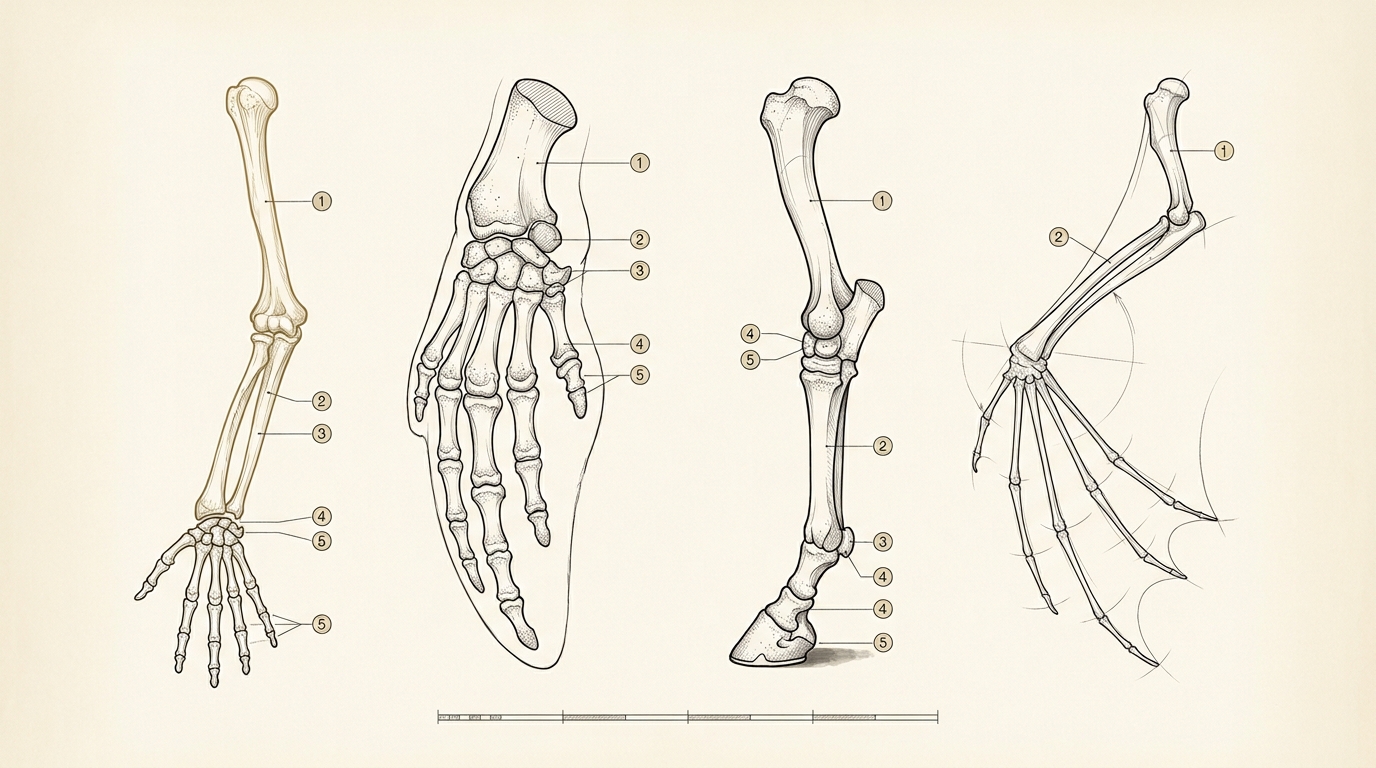
A double-pulley astragalus — a grooved trochlea for the shinbone at one end of the bone and a second grooved trochlea for the foot at the other — occurs in no mammal outside Artiodactyla, the order that includes cattle, deer, pigs, and hippos [8]. Finding one in the ankle of an early whale settled, at the level of the physical fossil record itself, a dispute that had been running for years between two different kinds of evidence — a dispute the next section takes up directly, because how it was settled matters as much as that it was.
By the time the record reaches Dorudon atrox and Basilosaurus isis, both from the late Eocene of Egypt’s Wadi Al Hitan — “Zeuglodon Valley,” now a UNESCO World Heritage Site — roughly 37 million years ago, the hind limb has become a curiosity rather than a working mechanism [8]. The first evidence of a knee in any whale turned up by chance at the site in 1989; once the team knew what to look for, they went on to recover a complete pelvis, leg, ankle, foot, and toe bones from Basilosaurus isis, reported the following year [12].
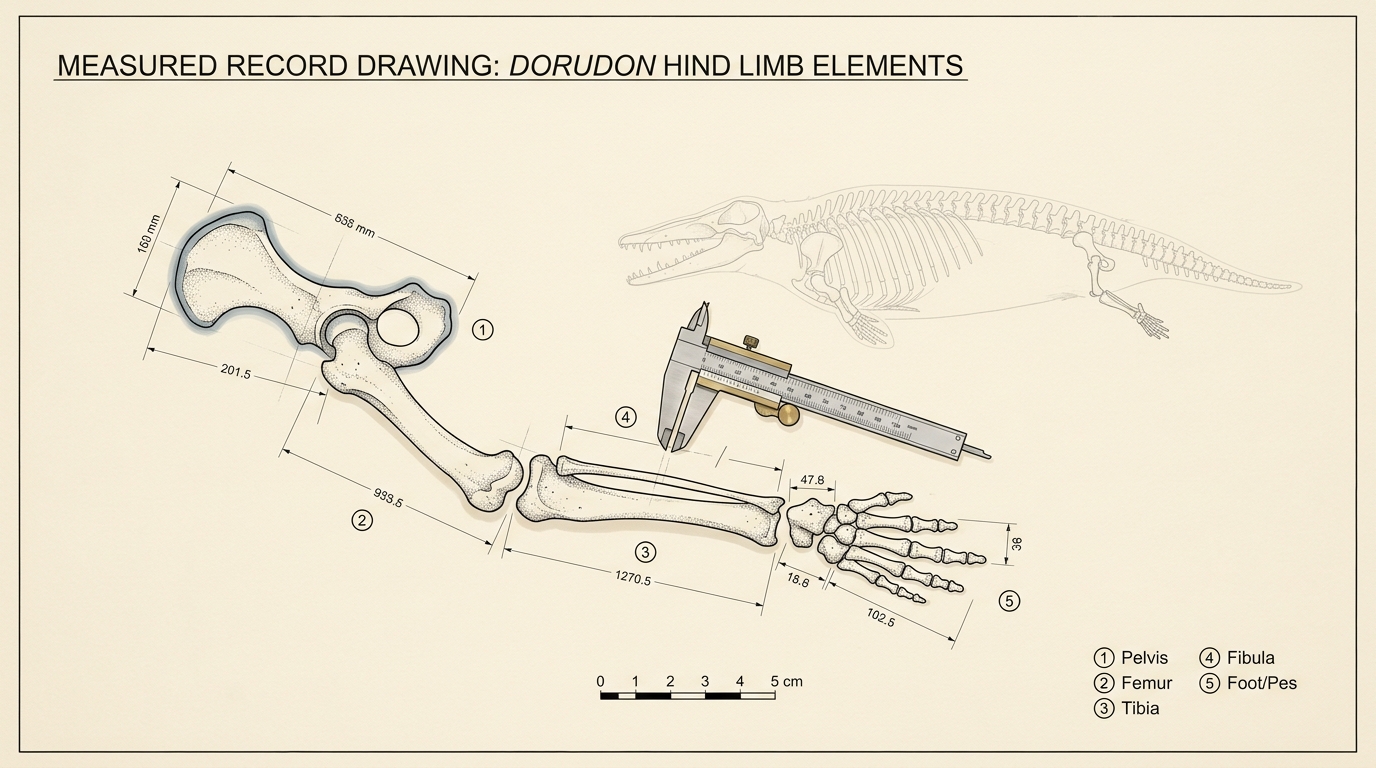
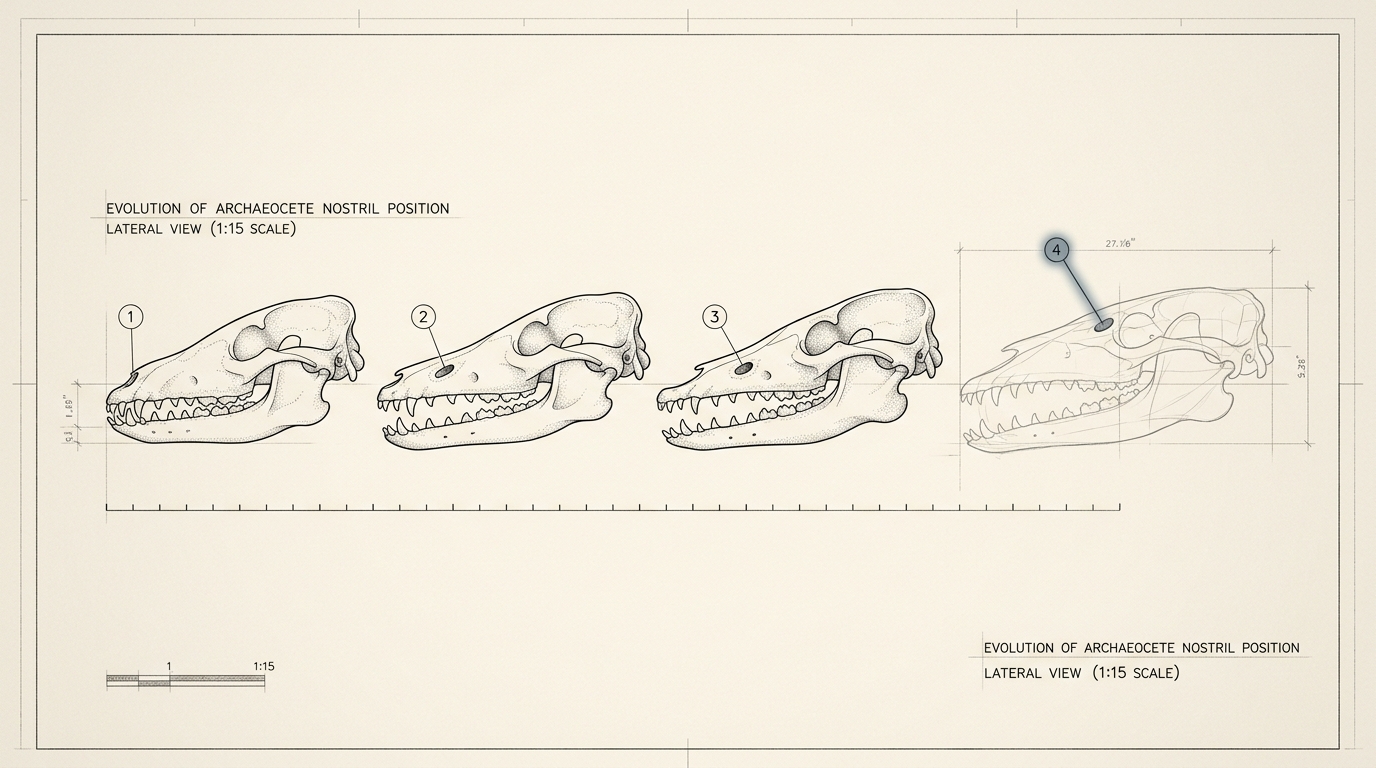
The pelvis no longer connects to the spine. The legs are small relative to an animal that reached an estimated fifteen metres in length, and the describing team’s own reading of the anatomy is that these tiny, disconnected hind limbs served no locomotor function at all, functioning at most as “copulatory guides” during mating [12]. Dorudon atrox, a smaller, roughly 4.9-metre contemporary described from complete skeletons collected in 1991 and 1993, supplies the complementary evidence in its tail: its terminal caudal vertebrae are flattened top-to-bottom in exactly the way that supports a fluke in living whales, marking Dorudon as a fully aquatic, tail-powered swimmer, in contrast to the foot-powered swimming inferred for the leggier, earlier protocetids Rodhocetus and Maiacetus [8]. Laid nose to tail across this same span, the lineage’s external nostril tracks backward along the skull with each named stop — from the tip of the snout in the earliest forms, to partway up the muzzle in the swimming intermediates, to near the top of the skull by the time the tail carries a fluke — the visible, external correlate of the same shift that sealed the whole hearing apparatus inside a pressurized capsule.
A separate, quantitative line of evidence converges on the same three-stage structure without leaning on any single specimen’s anatomy in isolation. Gingerich compared fourteen measured proportions of trunk, forelimb, and hind limb across fifty species of living semiaquatic mammals, then plotted the fossil archaeocetes into the same statistical space built entirely from those modern species; a terrestrial artiodactyl body plan, a semiaquatic foot-powered plan resembling Rodhocetus and Maiacetus, and a fully aquatic tail-powered plan resembling Dorudon separate as three structurally distinct clusters, with the fossils falling, in strict chronological order, along the path connecting them [8]. The three-stage pattern was not built into the comparison; it fell out of proportions measured on fifty modern species that were never used to calibrate the fossils in the first place.
Morphology and Molecules Disagreed for Years, Then an Ankle Bone Sided With the Molecules
The astragalus story only has its full force once the argument it settled is stated honestly, because both sides of it were serious science, not one side of evidence against wishful thinking on the other.
Paleontologists working from the fossil record of skulls and teeth had long argued, following Leigh Van Valen’s 1966 treatment, that whales descended from Mesonychia, an extinct group of carnivorous condylarths related to, but standing outside, Artiodactyla proper — meaning whales and true even-toed ungulates would share only a more distant common ancestor, converging independently on similar predatory adaptations rather than one group nesting inside the other [8]. In 1999, a molecular study by Masato Nikaido, Alejandro Rooney, and Norihiro Okada directly contradicted that reading. Using the presence or absence of twenty independent SINE and LINE retroposon insertions — a class of mutation so unlikely to occur twice, independently, at the same genomic site that a shared insertion is close to unambiguous evidence of shared ancestry — they found that hippopotamuses and cetaceans form a monophyletic group that excludes ruminants entirely, a result flatly inconsistent with the standing morphological classification that grouped hippos with pigs and peccaries in the suborder Suiformes [5]. For two years, the strongest fossil evidence and the strongest molecular evidence pointed in different directions, and neither side had decisive standing over the other.
The double-pulley astragalus in Rodhocetus and Artiocetus, described in 2001, is what closed that gap, and it closed it in the molecular evidence’s favor. A bone diagnostic of Artiodactyla, sitting in the ankle of an archaeocete whale, is not compatible with an independent origin from Mesonychia; it is direct anatomical evidence that Cetacea nests inside Artiodactyla, precisely where the SINE insertions had already placed it. Gingerich’s own account of the discovery states the outcome without qualification: finding double-pulley astragali in the skeletons of protocetid whales “ended a long debate with molecular biologists,” because paleontologists working from morphology alone had inferred a much more distant relationship than the fossil evidence, once it existed, actually supported [8]. This is a genuinely instructive episode, and not because one side turned out to be right and the other wrong — the morphological classification of hippos had been reasonable given the specimens available in 1966, and the molecular result was itself provisional until a fossil could test it directly. It is the sequence that matters: an independent line of evidence generated a specific, falsifiable prediction, and a specific fossil discovery, made for unrelated reasons, tested and confirmed it.
The story does not end there, and telling it as though it does would be its own kind of dishonesty. Once the raoellid Indohyus entered the analysis in 2007 as a candidate sister group to Cetacea, Thewissen and colleagues built a new morphology-based cladistic analysis to place it, and that analysis recovered Raoellidae as the full sister group to whales while placing Hippopotamidae elsewhere among the pig-like Suina — a topology inconsistent with the molecular studies it was meant to reconcile with the fossil record [6]. Jonathan Geisler and Jessica Theodor’s 2009 reanalysis, built on a modified version of the same character matrix but retaining molecular characters alongside the morphological ones, recovered Hippopotamidae — not only Raoellidae — as the extant family closest to Cetacea, restoring the topology the SINE studies had found eight years earlier and implying that the aquatic adaptations shared by hippos and whales are more plausibly inherited from a common ancestor than independently evolved [11]. The order-level question — Artiodactyla or Mesonychia — was settled in 2001. The finer, family-level question — which living lineage sits nearest the whale branch, and whether morphology alone or a combined analysis gets there — was still being actively argued in a major journal as late as 2009. Both facts are true, and a reader should walk away holding both.
The Water Left in the Teeth Tracks Where the Animal Actually Lived
If the astragalus settled where whales sit on the mammal tree, the animal that reframed when the walk into the water actually began is Indohyus, a raccoon-sized raoellid artiodactyl from the Eocene of Kashmir, roughly contemporary with Pakicetus. Thewissen and colleagues identified it in 2007 as the closest known relative of Cetacea, closer than any other artiodactyl family, on the strength of several independent lines of evidence converging on the same animal: the structure of its ear region and its premolars resembles that of early whales and no other artiodactyl; the density of its limb bones is unusually high, a trait associated in living mammals with slow, deliberate movement through water rather than running; and the stable-oxygen-isotope composition of its tooth enamel is likewise unlike that of other artiodactyls [6].
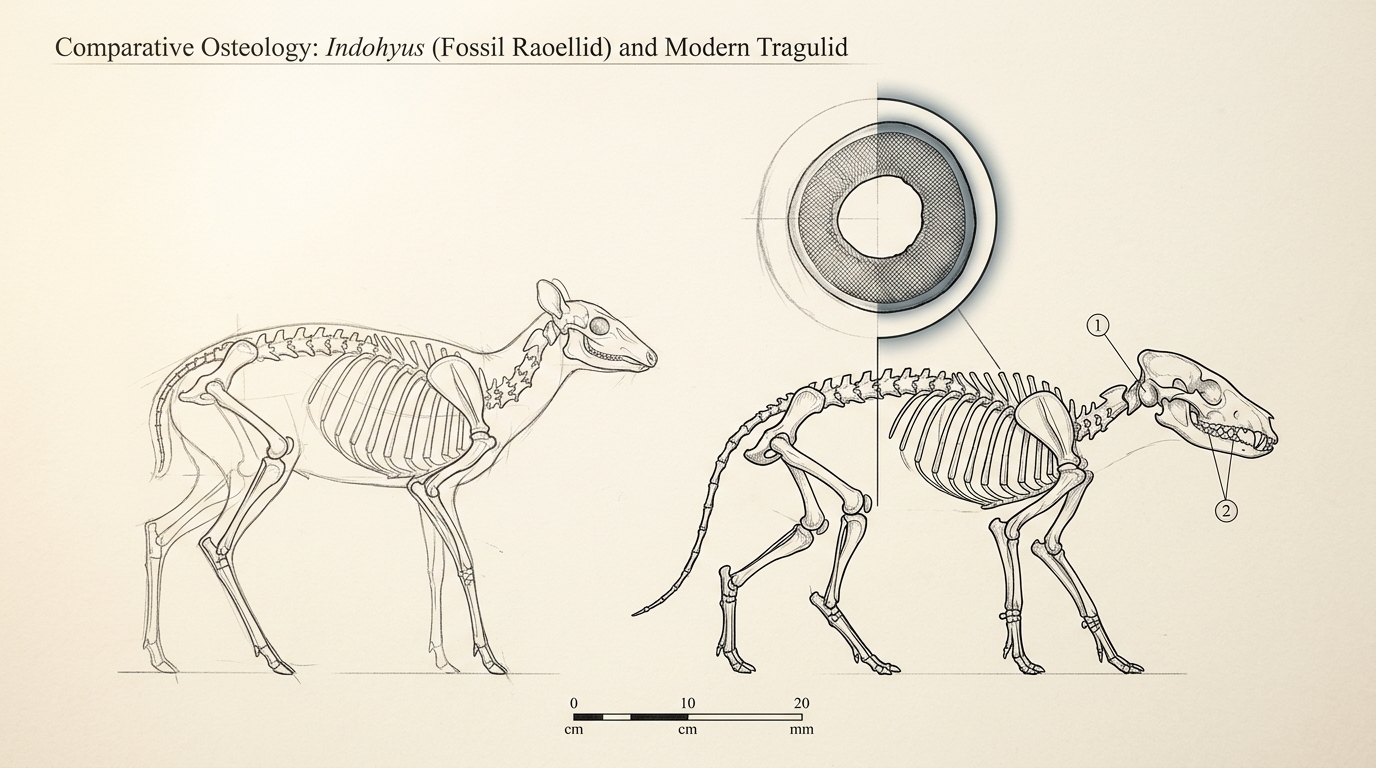
The isotope method itself is straightforward in principle. Oxygen isotope ratios in the mineral portion of teeth and bone reflect the isotopic composition of the water an animal drank and lived in during life, and that composition differs measurably between fresh, meteoric water and seawater; because tooth enamel is chemically stable over tens of millions of years, that signature survives into the fossil record largely intact. Applied to Indohyus, the isotope evidence pointed the same direction as the bone density and the ear structure: this was an animal that waded in water rather than one that ran across open ground, and its authors were explicit that a major dietary shift accompanied the artiodactyl-to-whale transition [6]. The claim that follows from this evidence is the one worth sitting with, because it inverts the usual mental picture of how a lineage takes to the water: Indohyus was not a specialized predator that started hunting fish and gradually became more aquatic. It was a small, plant-eating or omnivorous artiodactyl that was already partly aquatic in habit, and the paper’s own conclusion states the implication directly — aquatic life in this lineage predates the origin of the order Cetacea itself [6]. Whatever pushed this group into shallow water happened to an animal that was not yet, by any definition, a whale. Indohyus is also not a lone anomaly within its own family: Raoellidae comprises several described genera, all restricted to Eocene South Asia, and it is the family as a whole, not one exceptionally preserved species, that the 2007 analysis identifies as the whale lineage’s closest known relatives [6].
The same dense-bone strategy is not unique to Indohyus among semiaquatic mammals — modern hippos and manatees independently thicken their own skeletons for the same functional reason, added mass acting as ballast against the buoyancy of lungs and blubber and helping hold a slow-moving wader down against the water’s push [15]. Finding that same solution in an animal from an entirely different branch of the mammal tree is unremarkable on its own. Finding it specifically in the one artiodactyl family that also carries whale-like ear structure and whale-like tooth chemistry is what turns a coincidence into a data point.
Pakicetus itself supplies a complementary, if less isotopically precise, piece of the same picture: it was recovered from fluvial river sediment among ordinary land-mammal fauna at the fringe of the retreating Tethys Sea, an environment consistent with a semiaquatic existence near fresh or brackish water rather than the open ocean that Dorudon and Basilosaurus would later inhabit [2]. The general trajectory the two lines of evidence sketch together — a wading, freshwater-adjacent existence at the base of the sequence, a fully marine one by its end — is exactly what a gradual transition predicts and what a single discontinuous leap into the ocean would not.
Living Whales Still Grow the Limbs Their Ancestors Lost
The fossil sequence documents legs shrinking and then disappearing over roughly twenty million years. What a living dolphin does in its mother’s womb, every single gestation, is compress that same process into a few weeks and then reverse it before birth.
Thewissen and colleagues showed in 2006 that dolphin embryos initiate hind-limb development in the ordinary way: a bud forms, an apical ectodermal ridge appears at its tip, and that ridge begins expressing Fgf8, the same signal that drives limb outgrowth in any other mammal [7]. Then the process stops. Neither the ridge nor the Fgf8 expression is maintained, the bud arrests and degenerates by roughly the fifth gestational week, and the proximate cause is traceable to a single missing upstream signal: without the transcription factor Hand2, the limb bud never establishes a zone of polarizing activity, and without that zone, Sonic hedgehog — the gene chiefly responsible for patterning a limb’s far end — is never switched on [7]. The authors propose that reduced Shh expression evolved roughly 41 million years ago, with complete loss of Shh signaling arriving closer to the Eocene-Oligocene boundary, around 34 million years ago, near the origin of the modern whale suborders [7]. That estimate lines up, independently, with the fossil sequence’s own timeline: Rodhocetus and Maiacetus, with functioning if modest hind limbs, date to roughly 47 million years ago; Dorudon and Basilosaurus, with tiny, disconnected, non-locomotor hind limbs, date to roughly 37 million years ago; and the genetic switch that finally silences limb outgrowth entirely appears to complete its work only after the anatomy had already stopped using the limb for millions of years. Genotype, in this case, visibly lagged phenotype — the fossils show a limb losing its job before the genome finishes retiring the machinery that builds it.
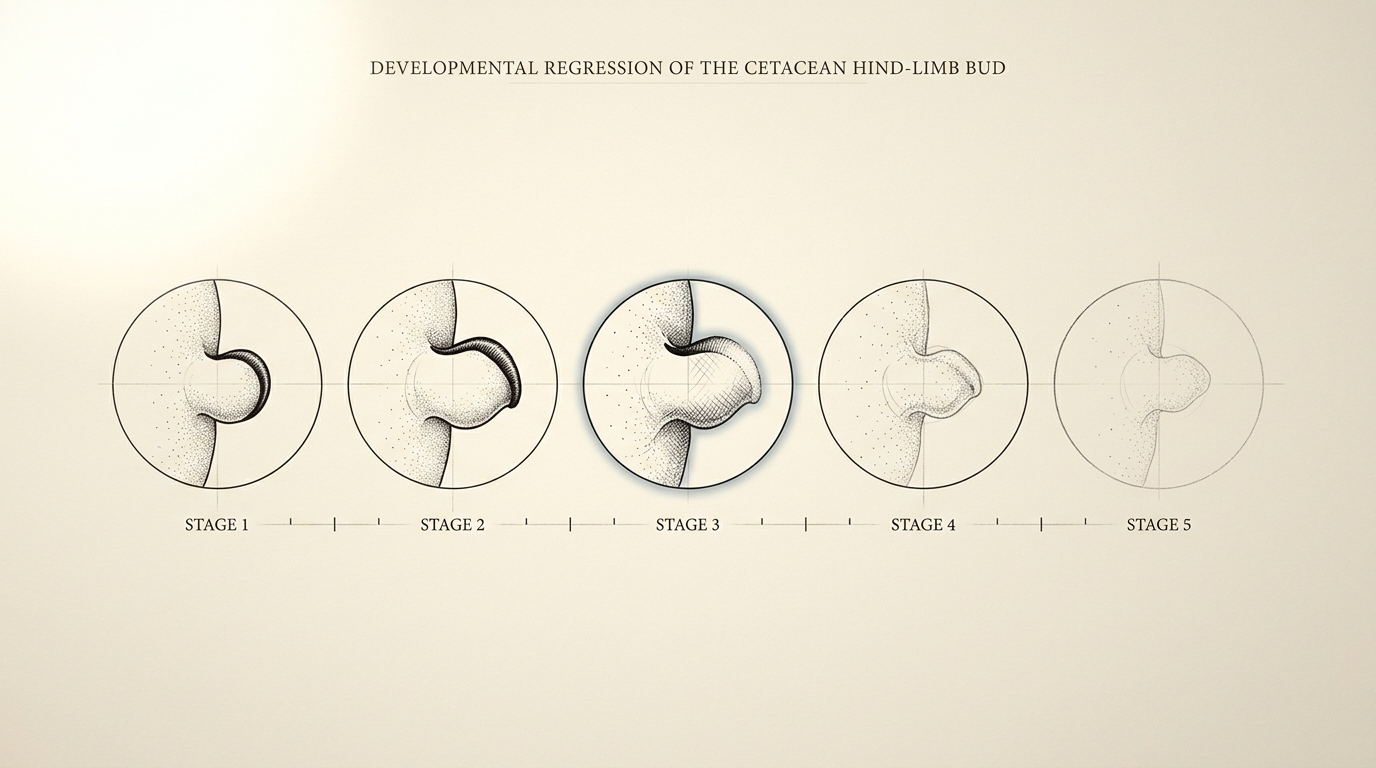
That machinery’s persistence is not merely a theoretical inference from embryos. In July 1919, a female humpback whale taken by a whaling vessel operating out of Kyuquot Station on Vancouver Island was found to carry two external protrusions on the ventral surface of her body, each roughly four feet two inches long in life and sheathed in about half an inch of blubber [10]. Dissection recovered a true bone tibia and metatarsal inside one protrusion, alongside a cartilaginous femur and tarsal element, reconstructing to a limb some thirty-one inches long; one specimen was preserved and delivered to the Provincial Museum in Victoria, British Columbia, where the naturalist Roy Chapman Andrews examined and described it the following year as “a clear case of partial reversion to a primitive quadrupedal condition” [10]. Cases this developed are rare — most dolphins and whales carry only the small internal splints of pelvis and femur that never break the skin — but their rarity is itself consistent with what the developmental genetics predicts: the instructions for building a hind limb are still present in the genome, ordinarily halted partway through execution by a single failed signal, and on the rare occasion that signal fails to fail, the old construction proceeds further than it should.
A second, independently degenerating system tells a parallel story through simple loss rather than arrested construction. Kishida and colleagues compared olfactory receptor gene repertoires across marine tetrapods in 2007 and found that the proportion of pseudogenized — non-functional — olfactory receptor genes in fully aquatic cetaceans (a minke whale, a dwarf sperm whale, and a Dall’s porpoise) was significantly higher than in their terrestrial relative, cattle, and higher again than in a Steller’s sea lion or a loggerhead sea turtle [9]. Tellingly, the sea lion’s own pseudogene proportion was not significantly elevated relative to its terrestrial relative, the dog [9]. The pattern the authors draw from this is that degree of genomic decay in a sensory gene family tracks degree of aquatic commitment: animals that still haul out onto land, like sea lions and turtles, retain a functional sense of smell, while animals with no terrestrial phase left in their life cycle at all have let an entire gene family rot into pseudogenes. Two unrelated mechanisms — one a developmental program halted mid-construction, the other a gene family accumulating disabling mutations unopposed by selection — point at the same underlying fact from two different directions: living whales are not passively carrying leftover anatomy. Their genomes are still actively, if incompletely, in the process of finishing the job their fossil ancestors started.
The Record Documents a Bush, and a Bush Is What Descent Predicts
Return to Gingerich’s own classification of the fossils discussed above, because it states the article’s central caution more precisely than any summary can. Archaeoceti comprises at least five families — Pakicetidae, Ambulocetidae, Remingtonocetidae, Protocetidae, and Basilosauridae — spanning from Himalayacetus at roughly 53 million years ago to Dorudon and Basilosaurus at roughly 37 million years ago, and Gingerich is explicit that only some of them sit on the line leading to living whales: Pakicetidae, Protocetidae, and Dorudon within Basilosauridae are, in his words, “generalized enough to lie on the main line of cetacean evolution,” while Ambulocetidae, Remingtonocetidae, and the genus Basilosaurus itself — in the same family as Dorudon — are “specialized side branches” [8].
That single classification does more work than a paragraph of argument could. The tidy textbook chain — Pakicetus to Ambulocetus to Rodhocetus to Dorudon — is a curated path through a much denser thicket of contemporaneous, overlapping relatives, several of which are demonstrably not ancestral to anything alive today. Ambulocetus, in particular, evolved its distinctive otter-like undulatory swimming in parallel with, not on the way to, the lineage that eventually produced Dorudon’s tail-powered fluke. This is not a weakness in the record. It is the single strongest thing about it. A model of independently created, discrete kinds gives no reason to expect five overlapping, dated, located families clustered in a twenty-million-year window, several of them evolutionary dead ends, exhibiting exactly the transitional traits — an involucrum thickening by degrees, an ankle bone converging on the artiodactyl form, a hind limb shrinking on a schedule the embryology later confirms, a nostril migrating stepwise up the skull, isotope chemistry shifting from fresh water toward the sea — that a branching process radiating from a common ancestor would be expected to leave behind. Descent with modification predicts a bush, mostly dead twigs, with a few branches continuing forward. That is precisely the shape of the fossil and molecular record recovered from Pakistan, India, and Egypt over the past four decades.
Darwin’s bear was a plausible story standing in for evidence he did not have. What replaced it is not a better story. It is a dated, located, cross-checked set of specimens and genomes that converge, independently, on the same twenty-million-year window — and an ear bone, still carried by every whale alive today, that gives the whole history away.