Evolutionary nuclear physics is this publication’s coinage, and the mapping is graded, not assumed
“Evolutionary nuclear physics” is not a field. No department teaches it, no journal is named for it, and nothing below claims otherwise. The phrase is coined by this publication as a deliberate fusion: it takes the formal apparatus that evolutionary theory built to describe populations under constraint — a landscape of possible states, a narrow channel that all future variety must pass through, a distinction between a mechanism that shapes outcomes and a bias that merely shapes which outcomes get observed — and asks how much of that apparatus actually does useful work when the “population” in question is not organisms but nuclei, and the “landscape” is not a fitness surface built from reproduction but a map of what a set of physical constants lets a star manufacture. The wager of the coinage is that some of this vocabulary transfers cleanly onto real nuclear physics and some of it does not, and that saying precisely which is which is more useful than either accepting the analogy wholesale or dismissing it as cute wordplay. Every use of borrowed vocabulary below is graded on that basis: exact where the underlying mathematics is genuinely the same structure, marked broken where it is not, never left to imply more than the physics supports.
The nuclear physics carrying all of this is not metaphorical. It is a single measured energy level in the carbon-12 nucleus, close to 7.65 MeV above the ground state, without which the universe would still fuse hydrogen and helium inside stars but would essentially fail to build anything heavier — no carbon, and downstream of no carbon, none of the oxygen, nitrogen, iron, or anything else that eventually depends on stellar carbon production. That level was argued into existence from measured stellar abundances by Fred Hoyle, confirmed experimentally well before his own full paper reached print, has had its exact energy and structure re-measured across seven decades, and is, as of the last five years, the subject of open, unresolved disagreement among working nuclear physicists about a number — its radiative width — that feeds directly into how much carbon a star actually makes. That combination of historical weight and live controversy is what makes this the cleanest available case for testing the coined lens in full, rather than gesturing at it. What follows works the nuclear case end to end: the structural reason a resonance is needed at all, the real (and importantly less anthropic) history of how it was found, the current state of the measurement program, the quantitative sensitivity calculations that tell us how much a shifted universe could tolerate, and finally a rigorous account of what “selection of chemistries” can and cannot mean once the borrowed vocabulary is actually held to account.
Carbon has no direct route from helium: the reaction is a bottleneck in the population-genetics sense, not only in English
Stellar nucleosynthesis has a hole in it at exactly the point where carbon would need to form. No nuclide with mass number 5 exists in a bound state, and none with mass number 8 does either — a helium-4 nucleus absorbing a proton, a neutron, or another helium-4 nucleus does not produce anything that holds together. Two colliding alpha particles instead form beryllium-8, which sits 92 keV above the threshold for falling back into two alpha particles, with a width of about 5.6 eV and a resulting lifetime of roughly 10⁻¹⁶ seconds [5] — long enough, in a nucleus, to count as a genuine (if fleeting) species, and far too short for any conventional two-body reaction to catch it before it disintegrates.
Öpik in 1951, and independently Salpeter the following year, worked out the way around this: rather than three alpha particles meeting simultaneously, which is vanishingly improbable, helium burning proceeds as two sequential two-body steps, ⁴He + ⁴He → ⁸Be followed by ⁸Be + ⁴He → ¹²C + γ [3, 5]. At the roughly 2×10⁸ K core temperatures of helium-burning red giants, this sets up a small equilibrium population of beryllium-8 — of order one beryllium-8 nucleus for every ten billion helium-4 nuclei [5] — that a third alpha particle then has some chance of capturing before that particular beryllium-8 nucleus decays back apart. Salpeter’s original rate calculation, using only this bare two-step sequence with no additional resonance, produced a carbon production rate many orders of magnitude below what stellar models required to match the observed abundance of carbon in nature. Something had to boost the second capture step, and Hoyle’s contribution — treated fully in the next section — was to work out what.
The size of that boost is worth stating plainly, because it is what makes the resonance load-bearing rather than merely convenient. Capture of the third alpha particle by beryllium-8 has to tunnel through a combined Coulomb and centrifugal barrier, and for the lowest-angular-momentum, s-wave capture that a 0⁺ resonance permits, the centrifugal piece of that barrier vanishes entirely; the presence of the Hoyle state at the right energy boosts the capture rate by a factor estimated at ten million to a hundred million relative to non-resonant capture alone, and the state’s proximity to the peak of the thermal energy distribution available in a roughly 2×10⁸ K stellar core provides a further enhancement of some seven to eight orders of magnitude in the overall reaction rate [5]. A few hundred keV of additional displacement in either direction, and that enhancement is substantially lost. This is the number the rest of the article keeps returning to in different forms: not that a resonance near this energy is helpful, but that the reaction rate’s dependence on the resonance’s exact position is this steep.
This is where the coined lens earns its first entry, and it is graded here as holding exactly, in form: population genetics calls a bottleneck the point where a population’s numbers crash to a small surviving cohort, so that every genetic variant present afterward, in every future generation of that lineage, had to have passed through that cohort — the bottleneck does not merely reduce diversity, it retroactively determines the entire space of what downstream diversity can even be built from. The absence of stable mass-5 and mass-8 nuclides is structurally the same claim applied to nuclear reaction pathways rather than breeding populations: every atom of carbon, oxygen, nitrogen, and everything built from them in every star, planet, and organism in the universe has, as a matter of reaction mechanism, passed through this exact narrow channel — three alpha particles, meeting through a transient, barely-bound intermediate, with no alternative route available at all. A single narrow-throughput point determining the entire downstream distribution is the same mathematical shape in both fields. What does not transfer, and should not be allowed to smuggle itself in through the shared word, is heredity: a population bottleneck matters because survivors reproduce and pass on whichever variants they happened to carry through the narrow point, and no such reproduction, inheritance, or variation-carrying process exists among fusing alpha particles. The bottleneck analogy licenses exactly one claim — narrow channel constrains all downstream variety — and no claim beyond it.
The prediction was stellar bookkeeping, and the myth of autobiography was built decades later
The standard telling of what happened next is compact and, on its own terms, striking: Fred Hoyle looked at the fact that carbon exists in significant quantity in the universe, in his own body among everything else, reasoned that this could only be true if a specific nuclear resonance existed at a specific energy in carbon-12, and predicted the resonance from that premise alone. Physicists at Caltech went looking and found it. The episode is regularly cited as the closest thing physics has to a prediction made from the anthropic principle — the idea, formalized by Brandon Carter only twenty years later in 1973, that an observer’s own existence is itself admissible evidence about which physical possibilities are realized.
The history is both richer and less anthropic than that. Hoyle’s own published argument, laid out in full the following year, was built from the observed absolute and relative cosmic abundances of carbon-12 and oxygen-16 — ordinary, if unusually sharp, nuclear-astrophysical bookkeeping about what reaction rates were needed to match measured elemental abundances, not a philosophical inference from the fact of his own existence [1]. Helge Kragh’s 2010 historical study, working from Hoyle’s own contemporary papers and correspondence rather than from how the episode came to be retold, reaches exactly this conclusion: Hoyle’s reliance was on the abundance problem, and the anthropic framing built onto the story — later popularized in accounts that treat the episode as an early triumph of anthropic reasoning — is a retrospective addition, not a description of the reasoning Hoyle actually used at the time [4]. Kragh’s paper is itself pointedly titled to name this directly: an anthropic myth.
The chronology sharpens the point. While visiting the Kellogg Radiation Laboratory at Caltech, Hoyle argued to the group there that a 0⁺ state near 7.68 MeV had to exist in carbon-12 for the two-step helium-burning sequence to run fast enough to match observed abundances, and persuaded them to look for it. Using the ¹⁴N(d,α)¹²C reaction and a high-resolution magnetic spectrometer, Dunbar, Pixley, Wenzel and Whaling found a state at 7.68 MeV and published the result in Physical Review in 1953 [2] — before Hoyle’s own fuller written case, which did not appear until the Astrophysical Journal Supplement Series the following year [1]. Subsequent measurements refined the state’s energy to 7.653 ± 0.008 MeV and identified 0⁺ as its most probable spin and parity [5], the values that, further refined since, underlie everything that follows in this article.
There is a further wrinkle Kragh’s account surfaces that is easy to miss even in a corrected telling: this was not, in fact, the first hint of the state’s existence. A 1940 measurement of the same ¹⁴N(d,α)¹²C reaction by a Cornell group had indicated a state near 7.62 MeV, close to where the real level sits, though a 1951 follow-up measurement failed to confirm it and the result was set aside [4]. By Kragh’s account, Hoyle appears not to have known of either the original 1940 hint or its unsuccessful follow-up when he made his own argument [4] — so the prediction that history remembers as clean was, in the fuller record, one nuclear-astrophysical argument succeeding where an unconnected experimental hint a decade earlier had gone unconfirmed and been forgotten. None of this makes the episode less remarkable; it relocates what is remarkable, from a philosophical inference validated by nature to a case of an unusually sharp piece of ordinary nuclear-astrophysical reasoning, independently and repeatedly running into the same physical fact. That relocation matters directly for how “selection” gets used later in this article: if the discovery itself was not anthropic reasoning, then whatever anthropic content the finished result carries is a property of how the physics is interpreted after the fact, not of how it was found — a distinction the closing sections depend on.

The state’s shape and its exact radiative width are still open beamline questions
Knowing the resonance exists and sits near 7.65 MeV does not settle what it is. Every structural model applied to carbon-12 — the alpha-cluster model tracing back to Hafstad and Teller’s 1938 observation that alpha-conjugate nuclei show a regular binding-energy pattern consistent with internal alpha clustering, antisymmetrized and fermionic molecular dynamics, a Bose-Einstein-condensate-like treatment built on the alpha particle’s boson-like character, and modern ab initio lattice calculations — agrees on one qualitative point: the Hoyle state is a spatially extended object, with model radii clustering around 3.3 to 3.8 fm against roughly 2.4 to 2.5 fm for the compact ground state [5]. It is not a marginally excited version of the ordinary nucleus; it is a substantially different spatial arrangement of the same twelve nucleons.
The first genuinely ab initio treatment came from lattice effective field theory: Epelbaum, Krebs, Lee and Meißner ran supercomputer lattice simulations built on chiral effective field theory — deriving nuclear structure from an interaction fixed at the level of pions and nucleons, rather than fitting a nuclear-structure model to reproduce the answer — and recovered both the ground state and a resonance with all the properties of the Hoyle state, without inputting either energy by hand: a computed ground-state binding energy of −91(3) MeV against an experimental −92.16 MeV, and a computed Hoyle-state energy of −85(3) MeV against an experimental −84.51 MeV [6]. A follow-up lattice study went further and read the geometry directly off the same calculation: the ¹²C ground state is a compact triangular arrangement of three alpha clusters, while the Hoyle state and its companion low-lying 2⁺ excitation are an obtuse, “bent-arm” triangular configuration — extended and floppy rather than compact, but also not the fully linear chain that some earlier cluster models had proposed [7]. Separately, dynamical-symmetry models that treat the three alpha clusters as a spinning, possibly vibrating, D₃ₕ-symmetric object predict an additional “breathing mode” — an in-phase radial pulsation of the three clusters — near 9 MeV excitation. A 2022 measurement combining ¹²C(α,α′) and ¹⁴C(p,t) reactions with a self-consistent R-matrix and multipole-decomposition analysis reported “clear evidence for excess monopole strength” at that energy that is “highly collective,” consistent with though not yet definitive proof of the predicted breathing mode, and noted this additional strength could modify the triple-alpha reaction rate at the higher temperatures relevant to explosive nucleosynthesis in supernovae [15].

The state’s proximity to the alpha-decay threshold also produces a subtler effect worth naming, because it is a direct consequence of how close the resonance sits to the edge of stability rather than an artifact of any particular model. In the R-matrix formalism used to extract the Hoyle state’s properties from decay data, a level positioned this close to threshold produces not only its own narrow resonance peak but a broad secondary feature, called a “ghost anomaly,” roughly two MeV above the three-alpha threshold, with an area under the two features in a ratio of about ten to one [5]. Fitting the Hoyle state’s true width correctly requires separating the narrow peak from this broad ghost rather than mistaking the two for independent physics — a reminder that even the shape of the data being measured is itself a consequence of how near the edge this whole reaction sits.
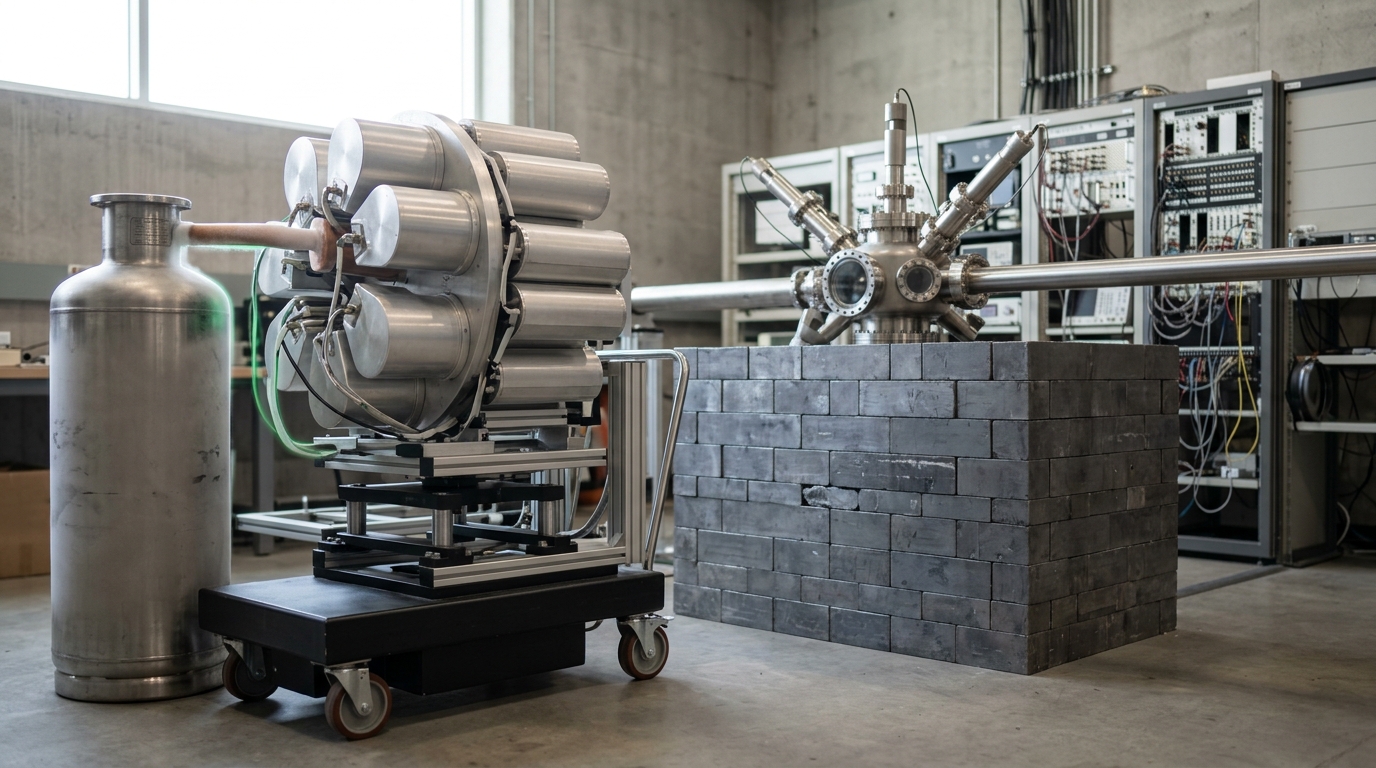
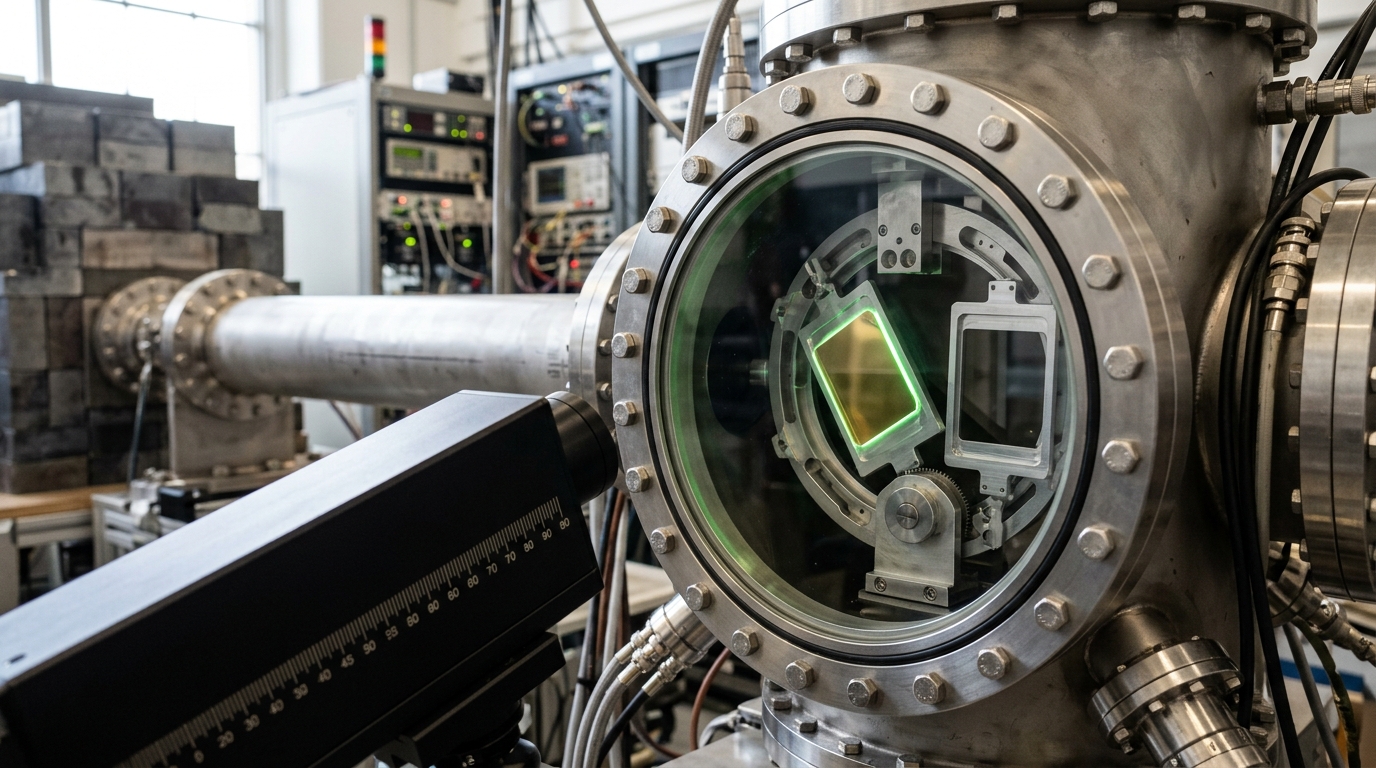
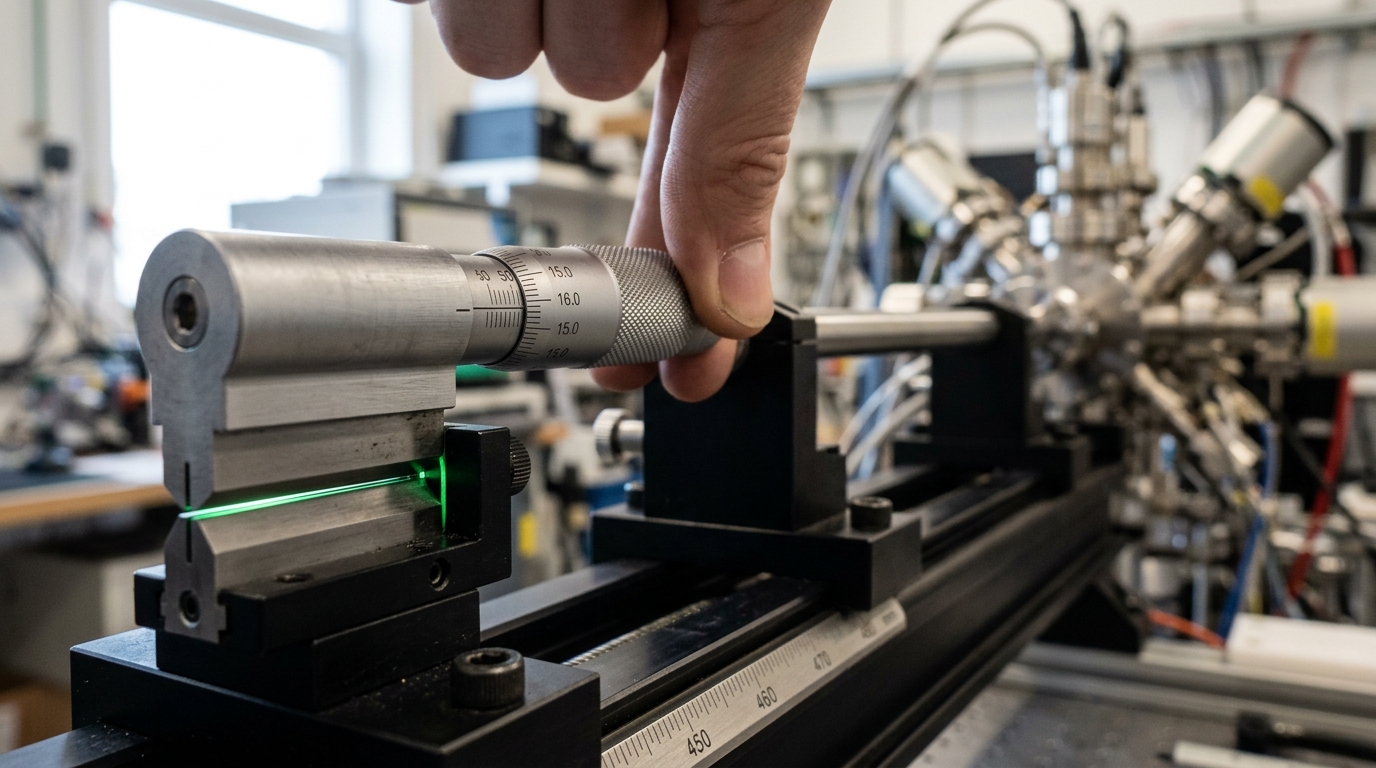
Structure aside, the number every stellar-nucleosynthesis code actually needs is narrower and, as of the last five years, disputed. Once the Hoyle state forms, it almost always breaks straight back apart into three alpha particles; only a small fraction decays electromagnetically down to the carbon-12 ground state, and it is specifically that electromagnetic, or radiative, branch that determines the net rate at which the triple-alpha process actually produces stable carbon rather than merely cycling alpha particles through a transient excited state. For decades the accepted radiative branching ratio, built from measurements dating largely to the 1960s and 1970s, carried a weighted average of (4.03 ± 0.10) × 10⁻⁴ [5]. In 2020, a gamma-ray spectroscopy measurement using the cascading 3.21 MeV and 4.44 MeV electric-quadrupole transitions from the Hoyle state reported a radiative width of 5.1(6) × 10⁻³ eV, described in the paper itself as about 34% higher than the value then in use [12] — a shift large enough, if correct, to matter for the carbon-production rate itself. Two independent measurements published in 2024 came back the other way: a charged-particle and magnetic-spectrometer measurement of the same decay reported a radiative branching ratio of (4.0 ± 0.3) × 10⁻⁴, stated as consistent with the original adopted value and as excluding the 2020 result [13], and a separate measurement combining two techniques reported a radiative width of 3.75(40) × 10⁻³ eV, explicitly described as not in agreement with the 2020 increase but consistent with the older adopted value [14]. As of this writing the disagreement stands unresolved among peer-reviewed, independently conducted measurements; this article does not adjudicate it and does not need to. The relevant fact is structural: a number that enters directly into how much carbon a star manufactures is, right now, the subject of live, mutually contradicting measurements, conducted in rooms built exactly like the one this article’s figures were shot in.

Sensitivity calculations turn the resonance into a landscape with a ridge, not a single peak
Livio, Hollowell, Weiss and Truran asked, in 1989, a quantitative version of a question implicit since Hoyle’s original argument: how much could the Hoyle-state energy be displaced from its measured position before stellar carbon and oxygen production would be seriously disrupted, worked through using stellar-evolution models rather than nuclear theory alone [9]. That calculation could only be pushed onto more fundamental ground once nuclear binding energies could be computed from an underlying theory of the strong interaction rather than fitted to reproduce known results — precisely what the lattice effective field theory calculations of the following decades made possible.
Epelbaum, Krebs, Lähde, Lee and Meißner’s 2013 follow-up to their original ab initio calculation did exactly this. They define a single combined parameter, denoted ε, equal to the Hoyle-state energy above the fundamental three-alpha breakup threshold — measured, in their paper, at 379.47(18) keV — and use their lattice framework to compute how ε itself shifts as the underlying light-quark mass, or the strength of the electromagnetic interaction, is varied [8]. Their result: sufficient stellar production of both carbon and oxygen survives across roughly a ±100 keV excursion in ε, which corresponds to light-quark-mass shifts of about 2 to 3% or an electromagnetic-coupling shift of roughly 2.5%, the latter broadly consistent with an independently reported bound of about 4% from earlier work the paper cites for comparison [8]. That tolerance is meaningfully larger than an earlier, more dramatic claim in the literature of a roughly 0.5% window on the strength of the nuclear force, a comparison the 2013 paper draws explicitly against its own, less restrictive result [8].
The underlying reaction-rate dependence that ties the Hoyle-state’s radiative width directly to the resonance’s position above threshold is the same relation used throughout the modern literature on this reaction, of the schematic resonant form
where
Framed in the coined vocabulary, and graded carefully rather than asserted: viability here is not a single narrow peak in constant-space, it is a broad plateau crossed by a ridge, because shifting ε in one direction favors carbon production at oxygen’s expense and shifting it the other way reverses the trade — eliminating both requires a substantially larger displacement than merely changing their ratio [8]. A landscape with a ridge rather than a single peak, where improving one output trades against another, is exactly the shape population biology calls a trade-off surface or antagonistic pleiotropy; the term transfers cleanly here because the underlying object — a scalar outcome evaluated across a parameter space, non-monotonic along more than one axis — is the same mathematical structure in both fields, not a borrowed figure of speech standing in for something else. Fred Adams’s 2019 Physics Reports survey, working across a considerably wider swath of fundamental-constant space than the strong-interaction-focused calculations above, arrives at a similarly tempered picture: viable stellar production, including via the triple-alpha reaction specifically, holds across a broader range of constant-space than the more dramatic popular framing of fine-tuning suggests, without thereby denying that genuine, sharply localized sensitivities — this resonance prominent among them — are real [11]. The two results sit together comfortably: this particular resonance is genuinely, measurably sensitive, and the overall picture of stellar viability is more forgiving than that one sharp case might suggest in isolation.
Selection of chemistries is a conditioning statement, not a Darwinian mechanism
The method behind every number in the previous section has a name, and the name deserves to be stated plainly: counterfactual-physics reasoning holds a theory’s structure fixed, varies one or a small number of its input constants, recomputes the same physical process under the new values, and reads off the result. It is what Öpik and Salpeter’s original rate equations did implicitly by asking what reaction rate a given resonance structure would produce, and it is exactly what Epelbaum and collaborators did explicitly by re-running their lattice calculation at shifted quark masses [8]. As a method it is sound and, in this specific case, unusually well controlled, because the calculation is genuinely ab initio rather than fitted. It is also a method with two disciplined limits, both named carefully in Luke Barnes’s 2012 methodological review of fine-tuning arguments generally [10].
The first is what Barnes calls the measure problem: a sensitivity calculation like the one above produces a tolerance interval — here, roughly ±100 keV in ε, or 2 to 3% in the light-quark mass — but that interval says nothing by itself about how probable or improbable a universe with a given constant actually is, unless one first commits to a measure, a prior probability distribution, over the space of possible values that constant could have taken. Physics supplies no privileged, non-arbitrary choice of such a measure over quark masses or coupling constants, and treating a narrow tolerance interval as automatically improbable quietly assumes one anyway [10]. The second is what might be called the single-variation fallacy: holding every constant but one fixed and testing tolerance along that single axis, as the Epelbaum calculations largely do and say so honestly, tends to overstate rather than understate how easy a chemistry-permitting configuration is to reach, because the actually viable region of the full parameter space is the intersection of many such constraints explored one at a time in the literature, and the intersection of several individually wide bands can still be a narrow region [10]. Both limits apply directly to the figures in the previous section: they are honestly reported single-axis tolerances, and neither this article nor, on its own terms, the paper that produced them claims to have computed the joint, multi-constant viable region.

This is also the point at which the coined vocabulary’s central borrowed word needs to be handled with some care, because it is the one most likely to mislead if taken at face value. What actually licenses describing any of this as a “selection of chemistries” is a narrow and specific statistical correction: any observer’s reasoning about which physical constants are typical is automatically conditioned on that observer existing at all, in the same way a study of hospitalized patients cannot estimate general population health without correcting for the fact that entering the sample already required being sick enough to be admitted. Correcting for that conditioning is a legitimate, purely statistical move, and it is the entire content of the anthropic reasoning properly used in cases like this one. It is not, and this article does not treat it as, evidence for a mechanism. Darwinian selection is a mechanism — differential survival and reproduction of heritable variants within an actual population, iterated over generations, producing adaptation as a causal consequence. Anthropic reasoning, used correctly, describes no process that acted on anything; it names a bias in which evidence an observer is positioned to collect, not a force that shaped which universe, or which nuclear resonance, came to exist. Whether an actual population of universes exists at all, over which any literal process — selective or otherwise — could even in principle operate, is exactly the multiverse question, and it is a different question from the one this article answers: this piece’s claim is confined to the nuclear case worked through above and does not extend past it into cosmology it has not argued for.
One further piece of the borrowed vocabulary is worth naming precisely because it does not transfer, and saying so is as much a part of using the coined term honestly as the parts that do. Genetic drift describes stochastic, generation-by-generation change in trait frequencies within a population, operating independently of and often against selection. Nothing in this article’s physics has a working counterpart: the Hoyle-state energy is not a quantity that varies across trials, generations, or samples within our universe — it is a fixed fact about the one set of physical laws this universe happens to have. The “landscape” explored in the previous section is a landscape across different possible universes’ fixed constants, evaluated once each, not a population within a single universe changing stochastically over time. Where the analogy holds, it holds because the same mathematics is doing the same work in both fields; here it simply does not apply, and forcing it to would misdescribe the physics rather than illuminate it.
One energy level, in rooms like this one, is where the whole argument actually lives
Put the pieces back together in order. No stable nuclide exists at mass 5 or mass 8, so three helium nuclei can only build carbon by passing through a transient, barely-bound beryllium-8 intermediate — a bottleneck in the exact structural sense the term carries in population genetics, with no heredity attached to license anything more than that structural claim. Hoyle argued, from measured cosmic abundances rather than from any premise about his own existence, that a specific resonance had to sit near a specific energy for that two-step reaction to run fast enough, and an experimental search he prompted at Caltech found a matching state before his own fuller paper was even in print — a genuinely striking episode of nuclear-astrophysical reasoning, correctly described, that later retelling dressed up as something more anthropically dramatic than the historical record supports. The state that resonance turned out to be remains, seven decades on, only partly understood: an extended, “bent-arm” cluster arrangement rather than a compact nucleus, possibly host to an additional breathing-mode excitation still being argued from data, and carrying a radiative width that three independent measurements published between 2020 and 2024 do not agree on. Ab initio calculations that can move the underlying quark mass by a couple of percent find the resonance’s position can drift by roughly a hundred kilo-electron-volts before carbon and oxygen production genuinely fails, revealing a landscape shaped more like a ridge than a single peak — real sensitivity, but not a knife-edge, and one that a broader deflationary survey of stellar viability finds is more the exception than the rule.
None of that is a philosophical abstraction. It is 7.653 ± 0.008 MeV, by one historical measurement [5], sitting 379.47(18) keV above the threshold that matters, by one modern one [8] — a single, specific, keV-precision number, sitting between a universe with stellar chemistry and a universe with almost none, presently being re-measured, disputed, and re-measured again, in rooms built like the one photographed for this article. That is the sharpest form the coined lens’ central claim can take: not that evolutionary vocabulary discovers something new about carbon-12, but that stating exactly where a bottleneck is real, where a landscape has a ridge instead of a peak, and where “selection” stops being a mechanism and becomes only a correction for who is doing the observing, is itself a way of being honest about what a single measured nuclear level can and cannot be asked to explain.