Owen catalogued the pattern and stopped at an archetype, not an ancestor
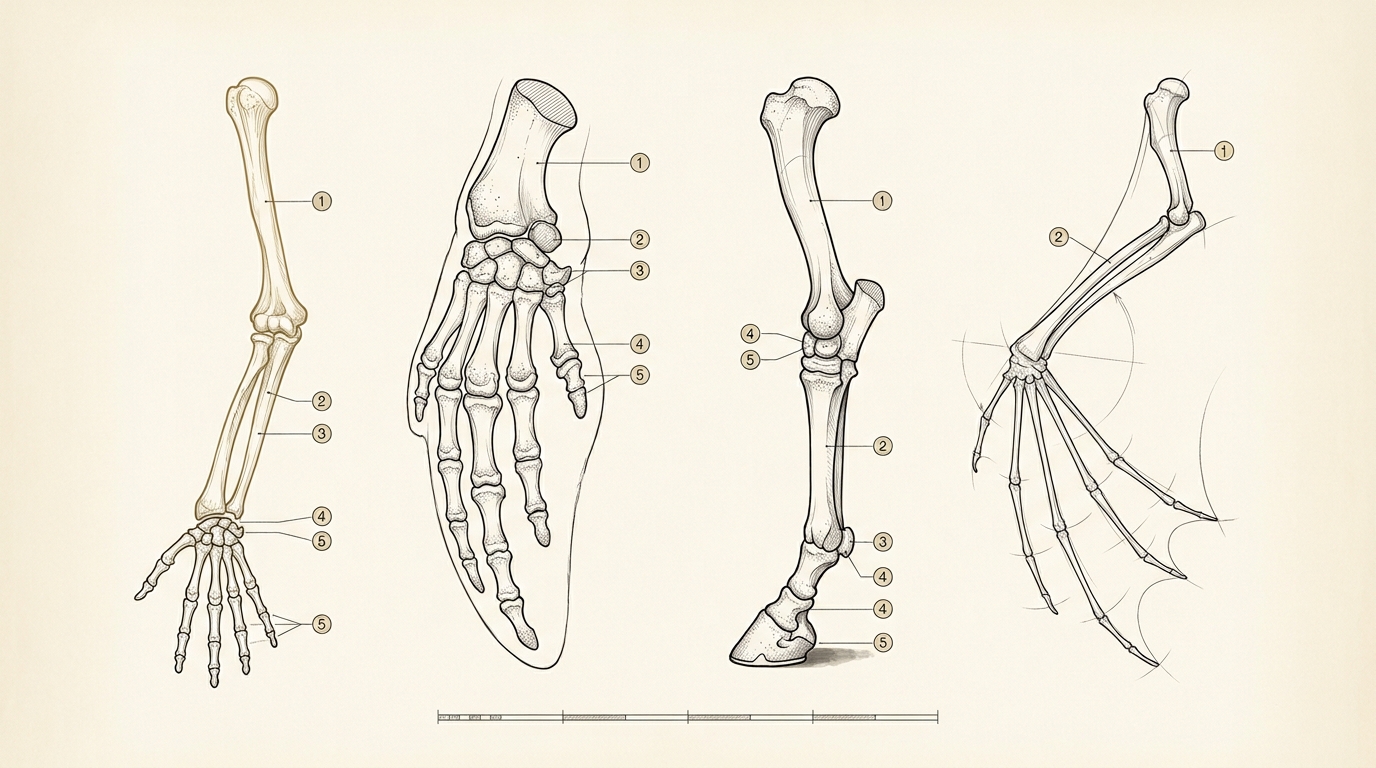
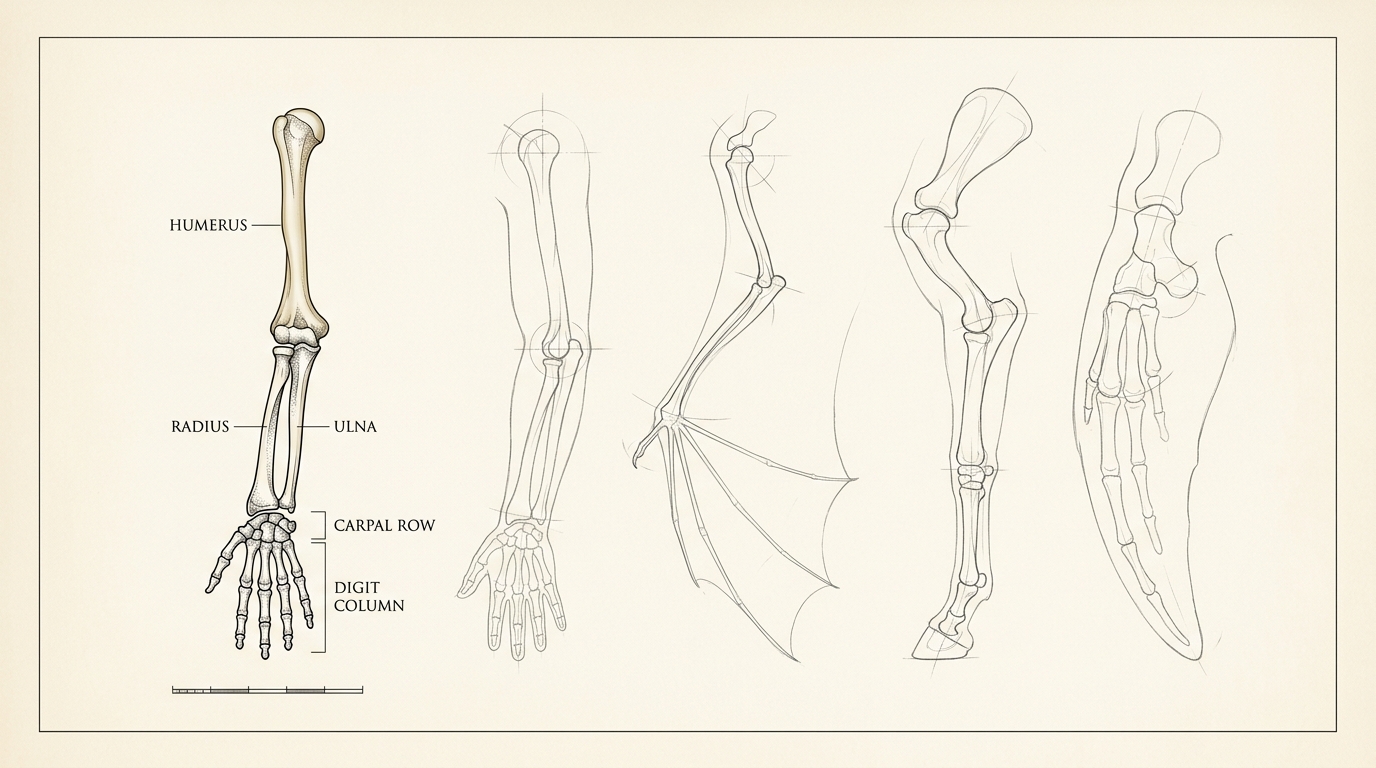
In February 1849, Richard Owen stood before the Royal Institution and delivered a discourse that would eventually flatter Darwin’s argument more than its own author intended. “On the Nature of Limbs” set out, bone by bone, a claim Owen had spent a decade assembling: that the arm of a man, the leg of a horse, the wing of a bat and the flipper of a whale are not merely similar in the loose sense two objects can resemble each other. They share the same parts, in the same order, at the same joints. Owen’s own summary of the relation reads: “the arm of the Man is the fore-leg of the Beast, the wing of the Bird, and the pectoral fin of the Fish…their relation to the vertebrate Archetype” [1]. He had coined the term “homologue” for exactly this years earlier, and by 1849 he could point to specific bones. Comparing a bat’s wing to a human arm, he wrote that “the essential similarity of its composition to that of the human arm…is greater, the difference depending more on the proportion than on the change or suppression of parts” [1]. Of the whale’s flipper, sealed inside skin and used for nothing resembling grasping, he wrote that “every segment and almost every bone which is present in the human hand and arm should exist in the fin of the whale” [1].
This was not casual analogy. Owen had dissected across the vertebrate classes and abstracted from hundreds of specimens a single idealized skeleton, the archetype, from which he argued that every actual vertebra, limb and skull could be derived by exaggeration, suppression or fusion of one fixed set of elements. Treated purely as description, it holds up: the parts list Owen wrote down in 1849 for the tetrapod forelimb is the same parts list a modern developmental biologist would write down today, humerus, radius, ulna, carpals, metacarpals, phalanges, occurring in the same proximal-to-distal order in every case he checked.
The archetype was never limited to limbs. Owen had already proposed, as the wider project this discourse drew on, that every vertebra in every vertebrate resolves into the same handful of elements, a centrum below and paired neural, pleural and haemal arches around it, repeated and modified from skull to tail [1]. “On the Nature of Limbs” extended that same logic outward from the backbone into the paired appendages, which is why Owen treated the fin, wing, leg and arm as one further instance of a pattern he had already generalized across the whole skeleton, rather than as a special case needing its own separate account.
What Owen refused to do with that list is the part that matters for everything that follows. Asked, in effect, why one plan recurs through animals as different as bats and whales, his answer reached for an “archetypal exemplar on which it has pleased the Creator to frame certain of his living creatures” [1] — an ideal template, instantiated by design, not a physical ancestor modified by inheritance. Historian of science Ron Amundson’s close reading of Owen’s career complicates the simplest version of that story: Owen, at various points, “associated Unity of Type and the Vertebrate Archetype with a naturalistic cause of the origin of species,” gesturing toward some law-governed process of derivation rather than static, once-and-for-all creation [3]. That gesture is real and worth crediting. It is also not a genealogy. Nowhere in the 1849 discourse does Owen propose that the bat and the whale carry the same bones because they share a physical common ancestor whose limb happened to look a certain way. He catalogued the pattern completely and left its cause an open, and explicitly non-hereditary, question.
Darwin renamed Owen’s archetype an ancestor, and the pattern became evidence
Ten years later, Darwin took Owen’s catalogue and supplied the missing mechanism, using Owen’s own vocabulary to do it. In the Origin’s chapter on morphology, Darwin restated the observation in terms close enough to Owen’s that the debt is unmistakable: “What can be more curious than that the hand of a man, formed for grasping, that of a mole for digging, the leg of the horse, the paddle of the porpoise, and the wing of the bat, should all be constructed on the same pattern, and should include the same bones, in the same relative positions?” [2]. He then supplied the sentence Owen’s discourse had no room for. “Nothing can be more hopeless than to attempt to explain this similarity of pattern in members of the same class, by utility or by the doctrine of final causes,” Darwin wrote, and then: “The explanation is manifest on the theory of the natural selection of successive slight modifications,—each modification being profitable in some way to the modified form, but often affecting by correlation of growth other parts of the organisation” [2].
Darwin then reached directly for Owen’s term and repurposed it. “If we suppose that the ancient progenitor, the archetype as it may be called, of all mammals, had its limbs constructed on the existing general pattern, for whatever purpose they served, we can at once perceive the plain signification of the homologous construction of the limbs throughout the whole class” [2]. The archetype stopped being an idea and became an animal: a real, physical ancestor whose limb plan every descendant inherited and then locally modified. A few pages earlier Darwin had already staked out the general claim classification itself would need: that “propinquity of descent…is the bond, hidden as it is by various degrees of modification, which is partially revealed to us by our classifications” [2]. Notice, too, the phrase Darwin reached for to describe how one modification can ripple outward: “correlation of growth,” his term for the fact that a change favoured in one part of a developing body can drag unrelated parts along with it, whether or not those other parts are independently useful. That is a nineteenth-century name for exactly the kind of developmental entanglement a modern account of shared regulatory genes would later make precise.
It is worth being precise about what changed in that decade and what did not, because the rest of this article depends on the distinction. Owen’s data survived the transition intact; Darwin corrected none of the anatomy. What changed was the causal claim sitting underneath the same parts list: from a pattern imposed once, externally, to a pattern inherited from a single physical ancestor and then reworked, generation after generation, by selection acting on whatever variation happened to be available at the time. That distinction generates a prediction Owen’s archetype cannot make and Darwin’s descent can. A shared ancestor should leave the same inherited parts behind even in places where a fresh design would not have chosen them, and the signature should be sharpest exactly where those inherited parts are worst suited to their new assignment. Everything that follows tests that prediction against real anatomy rather than merely restating it.
One parts list runs a wing, a sealed paddle, a load-bearing leg and a hand
Put the four cases Owen already named side by side and the range of jobs one parts list is asked to do becomes concrete rather than rhetorical. A bat’s forelimb spreads a flight membrane across four enormously elongated fingers, using the same bones a human hand uses to hold a cup, stretched to a different proportion and webbed in skin. A whale’s flipper encases the identical set of bones, often with extra duplicated joints added within existing digits, inside a rigid, immobile paddle used for steering underwater, with no single bone free to move independently of the others. A horse’s leg fuses the forearm bones and reduces four of the five ancestral digits to non-functional splints, so that the animal runs its entire body weight on a single grossly enlarged third digit, standing, in effect, on one fingernail. A human arm keeps the full ancestral count of mobile, independently articulated digits for fine manipulation.
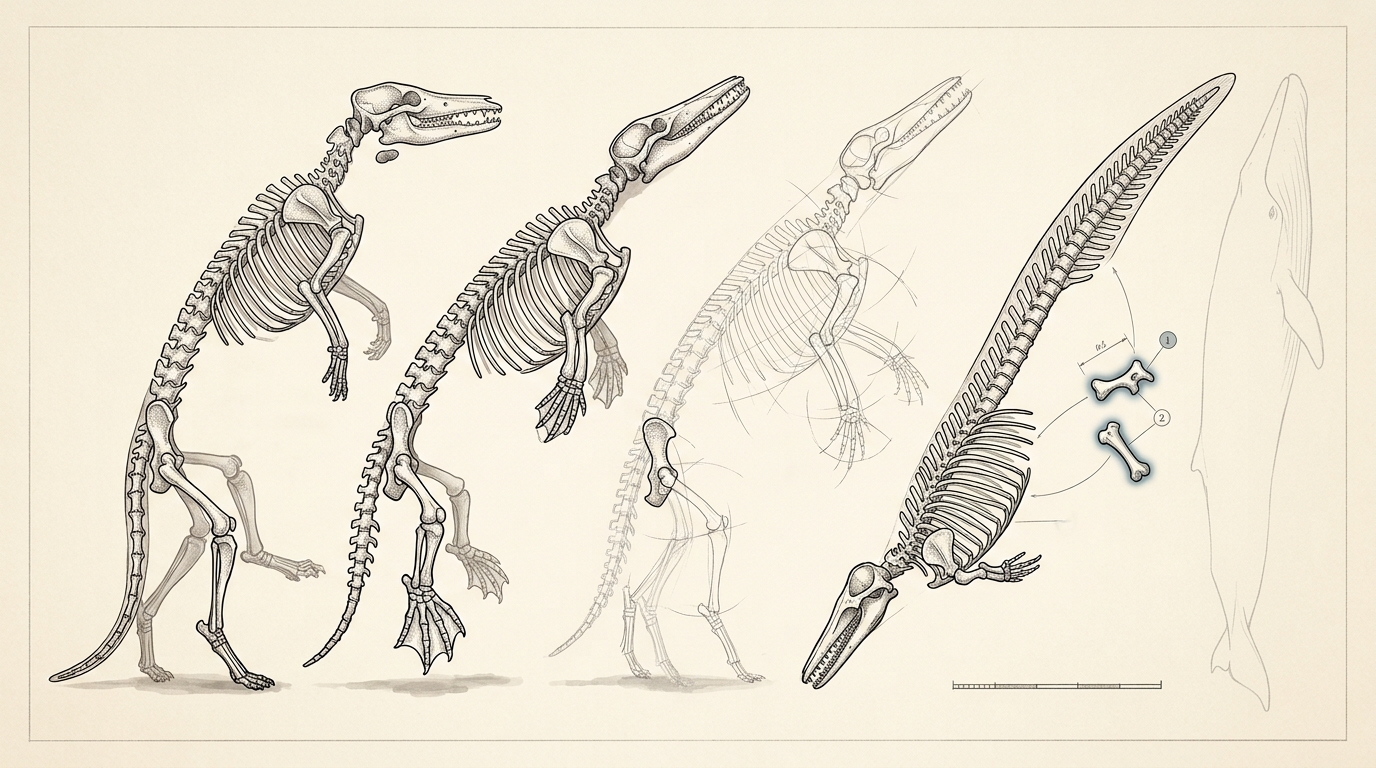
The whale case goes further than simple retention. Several digits in a cetacean flipper carry more phalangeal joints than any land-mammal ancestor possessed, a condition called hyperphalangy, so the inherited parts list was not just repackaged inside the paddle but locally over-built within the same skeletal envelope. The horse case runs in the opposite direction: of the five ancestral digits, only the third remains functional, carrying the animal’s full weight as the cannon bone, while the second and fourth persist as slender, functionless splint bones fused along its shaft rather than being lost outright, a pair of parts doing no work that a fresh brief for a single-toed runner would never have included in the first place [1].
No engineering brief written from scratch, for any one of those four jobs, would start by specifying a five-fingered hand and then modify it. A wing built to specification looks like an insect’s, cuticle stretched over structural veins with no internal skeleton to drag along; a sealed underwater paddle built to specification does not need a wrist; a single load-bearing limb built to specification does not carry four vestigial extra toes doing nothing. What “design for function” cannot explain is precisely the thing common descent predicts without strain: that whatever the target function, the raw material available to build it was always the same inherited forelimb skeleton, because that is what every mammalian lineage in this comparison actually had on hand. Function shaped how the parts were stretched, fused or discarded. It did not choose the parts.
Digit number is a dosage effect on an inherited system, not a fresh decision
The reason the same list keeps showing up is not mysterious anymore; it is regulatory. Shubin, Tabin and Carroll’s synthesis of what they term “deep homology” makes the underlying claim explicit: structures that look independently invented, including tetrapod limbs, arose instead by the modification of pre-existing genetic regulatory circuits that were already in place in much earlier common ancestors, so that the conservation runs deeper than gross anatomy, down into the actual developmental toolkit doing the building [4]. Zakany and Duboule’s review of Hox gene function in the developing limb makes the mechanical version of the same point: the genes that pattern the limb bud along its different axes cannot be examined as separate, independently tunable systems, because Hox expression integrates growth and positional identity together across the whole limb at once [12]. Shubin, Tabin and Carroll extend the same argument well past limbs: animal eyes and giant beetle horns, structures that look like they were invented independently in wildly different lineages, arose in each documented case by modification of regulatory circuits already established in much earlier common ancestors, not by assembling a fresh genetic program from nothing [4]. The tetrapod limb is one instance of a much more general rule: novelty in evolution is disproportionately old circuitry redeployed, rarely circuitry invented to order.
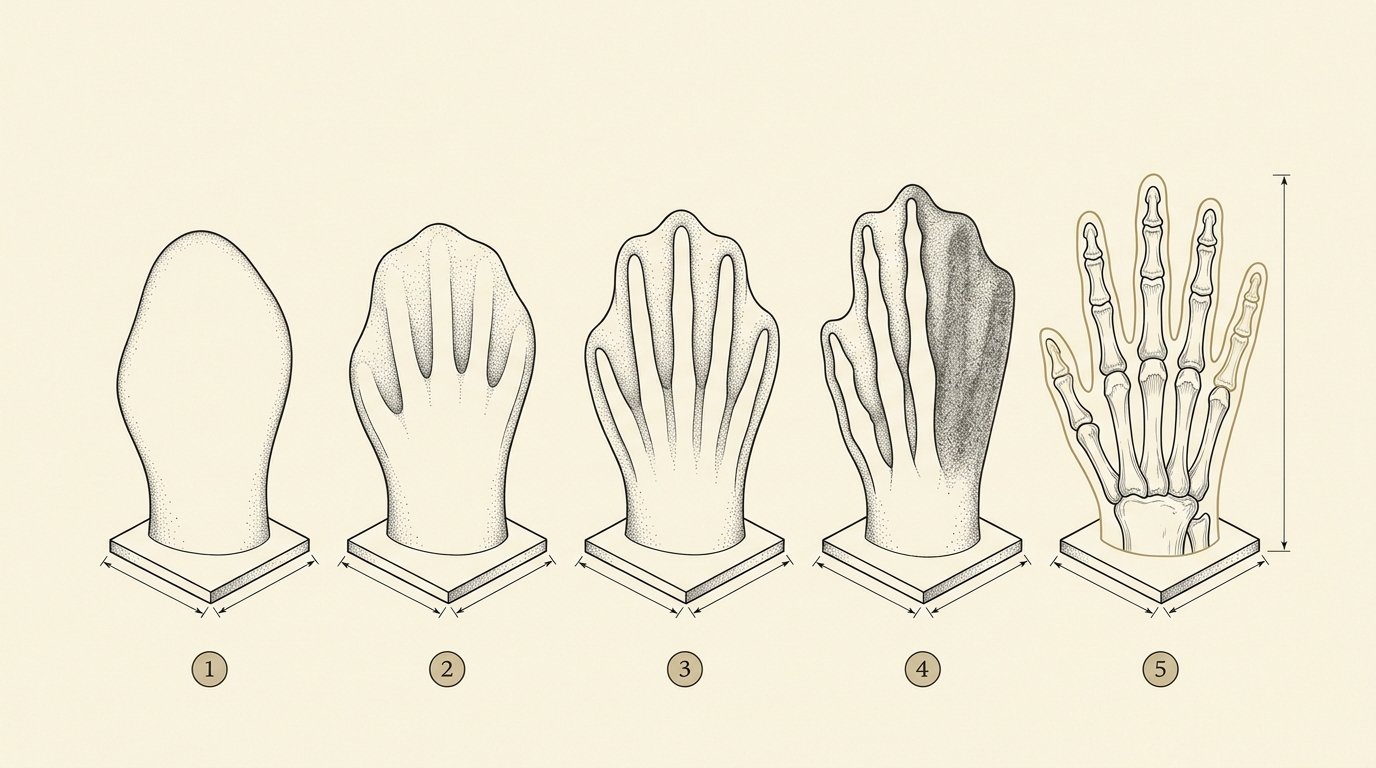
The clearest demonstration of what that integration actually buys, and costs, comes from a direct experimental dial-down of the system. Sheth and colleagues progressively removed copies of the distal Hox genes that pattern the mouse limb bud and watched what happened to digit number. The hand did not lose structure or gain some entirely new kind of part. Instead, animals with fewer functional Hox gene copies developed “progressively more severe polydactyly, displaying thinner and densely packed digits” [5], with digits “thinner and narrower gaps between them, while remaining regularly spaced” [5]. The authors interpret this as evidence for a Turing-type reaction-diffusion mechanism in which Hox gene dosage sets the spacing, or wavelength, of a self-organizing pattern, rather than each digit being separately specified by its own dedicated instruction. Reduce the dosage and the wavelength shortens; more, narrower rays fit into the same paddle. This is the mechanistic reason the four forelimbs above never diverge into arbitrarily different numbers or kinds of digits no matter how different their jobs: the system available to build a digit is one tunable pattern-generator, inherited whole, and evolution’s only lever on it is dosage, not a blank sheet of paper.
Gould’s panda thumb is real; the dissection found a whole joint doing the work
The giant panda cannot grow a sixth finger. Its digits, like every other bear’s, are already committed by the same Hox-regulated system just described to five, fully assigned to weight-bearing and locomotion, with no developmental slot free to add an opposable grasping digit even though one would plainly help an animal that spends most of its day stripping leaves off bamboo stems one at a time. Stephen Jay Gould’s essay on exactly this animal made the case for constraint into one of the most widely read arguments in popular evolutionary biology: rather than a new finger, the panda’s lineage enlarged an existing wrist bone, the radial sesamoid, into a thumb-like opposable digit, because a spare, nearby, structurally available part was what selection had to work with [8].
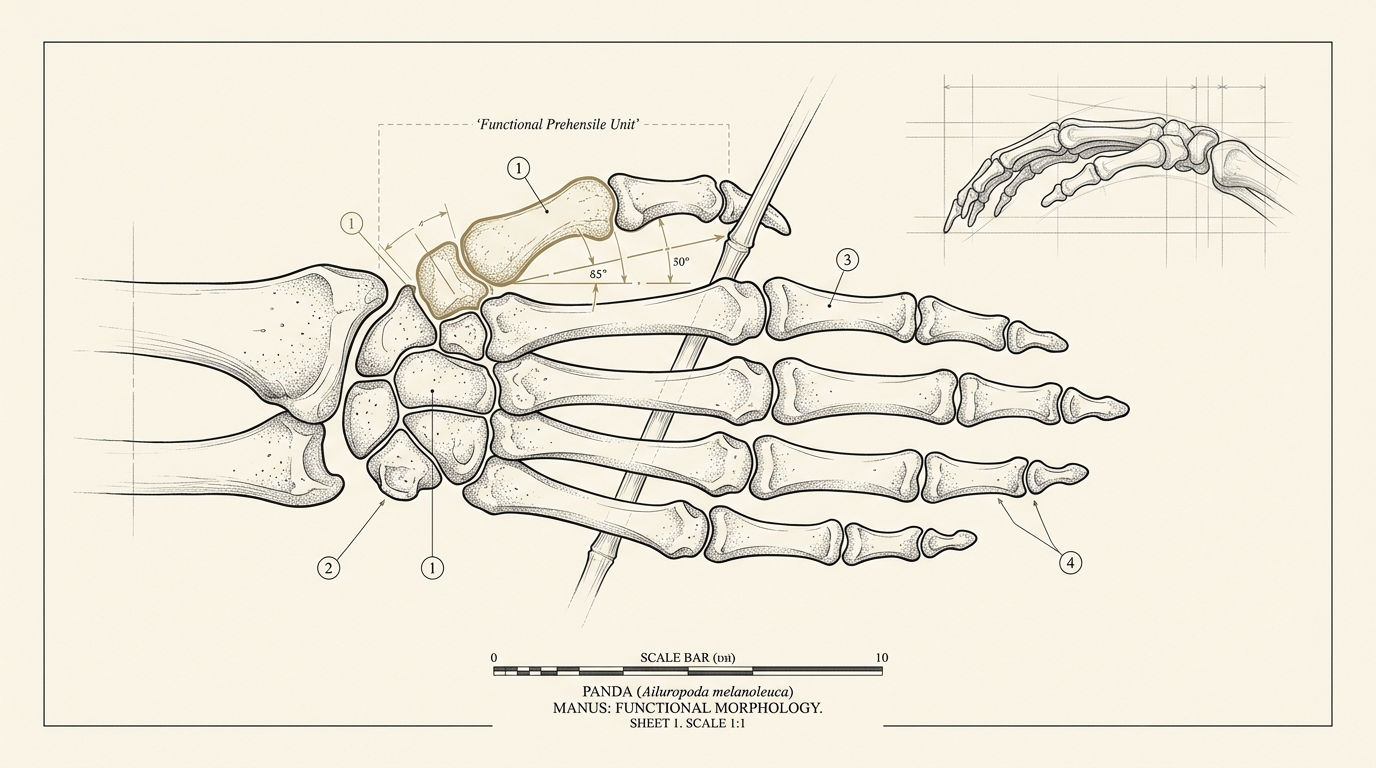
Endo and colleagues’ anatomical study of the actual mechanism, using computed tomography and MRI, found something more specific than one bone standing in for a thumb. The radial sesamoid does not move independently of the bones around it. Instead it forms one functional unit together with the radial carpal and the first metacarpal, described in the group’s follow-up study of the joint’s mechanics as the R–R–M complex, which is opposed during a grip by a second complex formed from the accessory carpal and the ulnar carpal [6]. Grasping happens when “the R–R–M complex strongly flexes at the wrist joint,” swinging the radial sesamoid into a position roughly parallel to the accessory carpal, while “well-developed opponens pollicis and abductor pollicis brevis muscles envelop and fix objects between the R–R–M complex and the phalanges” [7]. In other words, the grip is not one repurposed bone; it is an entire pre-existing wrist joint, its two carpal complexes and the muscles that already flexed that wrist for other purposes, all recruited together into a double-pincer arrangement. Gould’s moral survives this correction intact and arguably strengthens: a design brief given a free hand would add a sixth digit rather than dragooning a whole wrist joint into service, and the more integrated the actual retrofit turns out to be, the harder it is to read as anything other than history working with whatever joint happened to be sitting nearby.
The laryngeal nerve is committed before the neck exists to make its loop absurd
Every tetrapod’s vagus nerve sends a branch to the larynx by a route that first goes the wrong way, and the reason is fixed early in development rather than negotiated case by case. The recurrent laryngeal nerve is laid down caudal to the embryonic aortic arches, alongside the vessel derived from the sixth arch, before the neck exists to separate throat from heart [9]. As development proceeds and the heart descends into the thorax, dragging that vessel with it, the nerve has no way to detach: it is snagged beneath the vessel and must loop caudal to it before climbing back up the neck to reach a larynx sitting only centimetres from the brainstem that sent the nerve down in the first place. Every extant tetrapod checked, amphibian, reptile, bird and mammal, retains this looped route; a genuinely direct, nonrecurrent laryngeal nerve occurs in fewer than one percent of humans, and only ever as a side effect of an unrelated developmental abnormality in the arteries of the right forelimb, never as an independent alternative wiring plan on its own [9]. Owen himself is part of this thread: Wedel credits an 1841 paper of Owen’s on the anatomy of the Nubian giraffe as the first demonstration that the animal’s nerves and great vessels keep the same topological relationships found in humans, decades before anyone asked what a fourteen-metre neck would do to the same fixed arrangement [9].
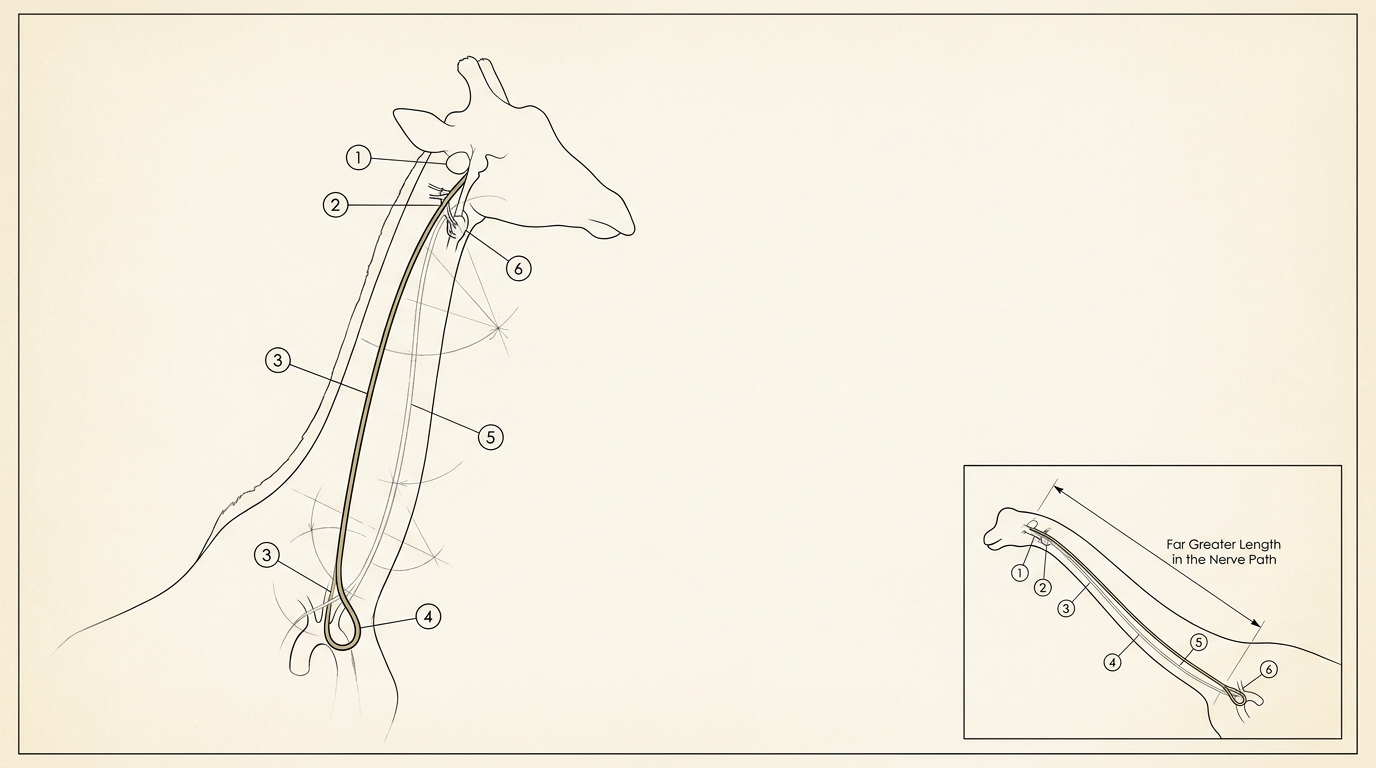
The lengths involved make the constraint impossible to dismiss as trivial. The tallest giraffes have necks up to 2.4 metres long, and because the nerve fibre length is roughly double the neck length, the total path from brainstem to larynx along the descending vagus and ascending recurrent nerve “approaches 5 m in the largest individuals,” to cover a direct distance of a few centimetres [9]. Extend the identical embryological sequence, unmodified because it is a fixed developmental step rather than a routing choice made fresh in each lineage, to an animal with a fourteen-metre neck, and Wedel’s estimate for Supersaurus, a sauropod whose single longest recorded vertebra measures 138 centimetres, is that the neurons making up its recurrent laryngeal nerve “were at least 28 meters long,” with the very longest-necked sauropods hypothesized to have carried the same nerve at “40–50 meters long, probably the longest cells in the history of life” [9].
No engineer given a free brief routes a signal wire the long way around a fixed pulley to save a few centimetres at one end and lose tens of metres at the other. What holds the loop in place is not that the route works well; it is that the nerve is committed to a position caudal to the sixth-arch vessel before the anatomy that will later make the loop absurd, a long neck, even exists, and there is no accessible intermediate step between “committed early, looped for life” and “detached and running direct” that does not pass through a nonfunctional larynx along the way. Selection has not left the arrangement completely untouched, though. Wedel notes that the giraffe’s overlong nerve compensates in part with “larger, more heavily myelinated nerve fibers, which allow faster conduction velocities” than the same fibre count would otherwise achieve, citing histological comparison of nerve fibre size in humans and giraffes [9]. The route itself never gets shorter. Only some of what the extra length costs gets paid back down.
Not all of it. Wedel also notes that some fibres within even the giraffe’s recurrent laryngeal nerve remain unmyelinated, conducting at speeds as low as roughly half a metre per second, and extrapolates that equivalent unmyelinated fibres running the sauropod-scale version of the same nerve would have taken close to a full minute to relay a slow pain signal from larynx to brainstem, absent some additional adaptation this fossil record cannot show us directly [9]. Myelination buys back speed where it evolves. It does not buy back distance, and it plainly does not reach every fibre in the bundle.
The vertebrate retina faces the wrong way, and a glial cell partly compensates
The vertebrate eye has the same structure of argument built into its wiring. Photoreceptor cells sit at the back of the retina, facing away from incoming light, behind several layers of nerve cells, their processes, and blood vessels that light must first pass through before it reaches a rod or a cone. Franze and colleagues describe the resulting optical situation plainly: it is “the equivalent of placing a thin diffusing screen directly over the film in your camera” [10]. Cephalopods, whose camera eyes converged on a similar overall shape from a completely separate evolutionary origin, wired the same job the other way around: their photoreceptors face the incoming light directly. Ogura, Ikeo and Gojobori’s comparison of gene expression in the octopus and human eye, explicitly framed around the fact that “the eyes of humans and octopuses have been described as a typical example of convergent evolution,” nonetheless records “differences in direction of visual cells” as one of the basic structural facts distinguishing the two designs even where the underlying genetic toolkit converges [11]. Of the two working solutions to the same optical problem, the vertebrate one is the arrangement a fresh review would reject: a photodetector should not have its sensing surface wired away from the light source.
The same comparison finds that convergence and divergence are answering different questions at once. Of 1,052 non-redundant genes the study examined from the octopus eye, 729, or 69.3 percent, were also expressed in the human eye [11], a level of shared genetic program the authors read as underwriting the two eyes’ independent arrival at a broadly similar camera design. That shared toolkit did not extend to which way the photoreceptors ended up facing. Genetic convergence and architectural convergence are separable outcomes, each settled by its own lineage’s history rather than by the demands of the optical problem alone, and the direction the vertebrate retina happened to face is exactly the kind of detail history, not present function, was left to decide.
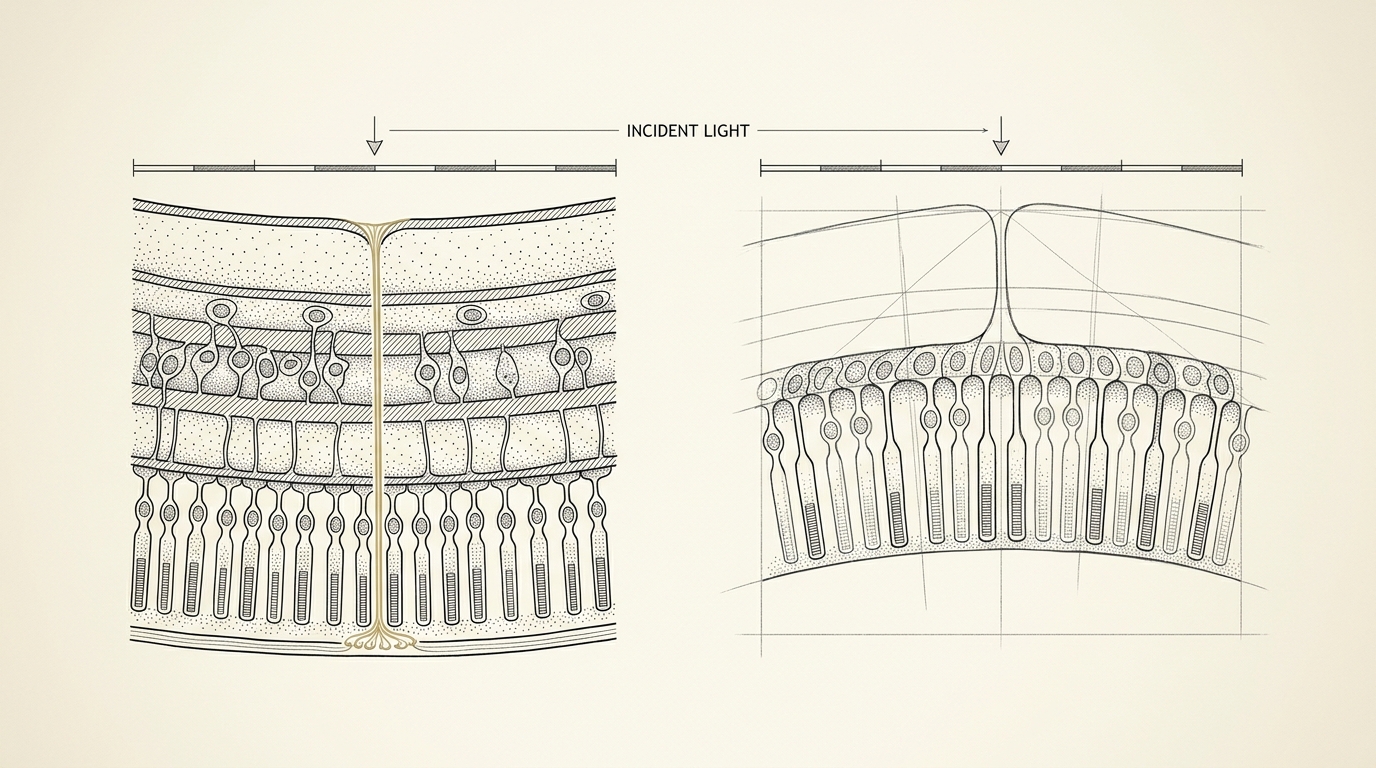
The vertebrate retina’s layering is not a decision made toward a photographic goal; it follows from developing as an outgrowth of the brain rather than as a simple inward fold of the surface layer the way an eye built the other direction can. Once that layering was fixed, deep in vertebrate ancestry and long before any light-guiding solution existed to select for, any later mutation that reduced how much the intervening layers scattered incoming light had something to act on, and Franze and colleagues found exactly such a trait already doing that job. Müller glial cells, spanning the full thickness of the retina, function as living optical fibres: their processes measure a distinctly raised refractive index, 1.380 ± 0.021, against the surrounding retinal tissue’s 1.358 ± 0.005 [10], with funnel-shaped endings at the inner retinal surface that collect light and a calculated waveguide parameter of 2.6 to 2.9 at 700 nanometres consistent with efficient, low-loss guiding along the length of each cell [10]. Spaced roughly five to six micrometres apart in a dense, regular array, these cells deliver an image to the photoreceptor layer below with substantially less blurring than the inverted arrangement would otherwise produce [10].
Read correctly, that finding does not soften the constraint argument; it completes it. A retina designed correctly the first time would not need an internal fibre-optic layer bolted in afterward to correct for its own backward wiring, and a constraint that had never mattered to survival would never have had anything to select for. What the Müller cell result records is the signature a constraint under ongoing selection leaves behind: the original commitment stays exactly where a shared developmental history put it, while whatever partial mitigation was mutationally available gets retained because it measurably helps. Mitigation after the fact, without removal of the fault it mitigates, is not what deliberate design looks like. It is what history looks like from the inside.
Constraint is legible without anyone intending it
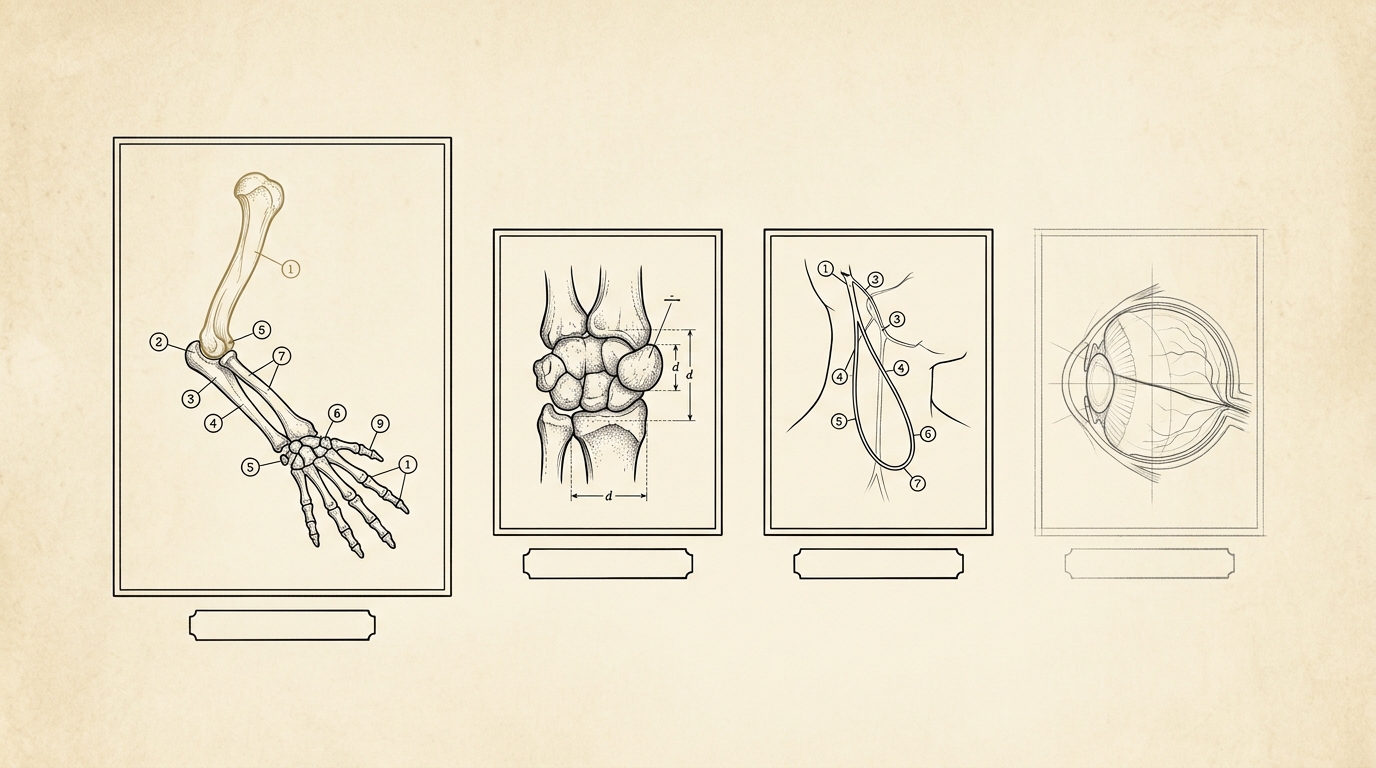
None of the four cases above is presented here as evidence that evolution is clumsy in some general, deflationary sense, and none of them should be read that way. The claim is narrower and more falsifiable than that: common descent specifically predicts that unrelated functional demands will be met by modifying whatever parts a lineage already happens to carry, rather than by re-deriving a part list from first principles each time, and that prediction is confirmed most sharply exactly where the inherited parts are a poor fit for their new assignment. A panda’s wrist joint recruited whole into a grip, a laryngeal nerve looped around a vessel it has no functional need to follow, and photoreceptors wired backward and only partially corrected by a glial fibre are not three unrelated curiosities. They are the same signature read off three different tissues: the tetrapod forelimb toolkit, the tetrapod branchial-arch nervous wiring, and the vertebrate optic vesicle, each fixed early enough in a shared ancestry that no amount of subsequent selective pressure could unwind the initial commitment, only work around it.
This is where the argument has to stay disciplined about intention, because the same facts support a stronger and a weaker reading, and only the weaker one is warranted. Natural selection does not anticipate a future long neck when it fails to shorten a laryngeal nerve’s route in a short-necked ancestor, and it does not “choose” to reuse a wrist bone rather than grow a new digit; each case above is the retention, generation after generation, of whatever variant happened to function marginally better than its neighbors within the limits a prior developmental commitment allowed, with no step in the process directed toward an outcome. That is precisely why the pattern is such strong evidence for descent rather than for good or bad design as such. An independent designer, solving the same problem twice, is free to converge on a similarly good solution without inheriting anything at all, which is exactly what the octopus and vertebrate eye show when they arrive at comparable camera eyes by unrelated routes. What no independent designer has a reason to do is inherit the same specific, sometimes actively counterproductive, parts and routes across lineages that share nothing but ancestry.
That is also what would disconfirm this reading, and it is worth stating plainly rather than leaving the argument unfalsifiable by omission. If a laryngeal nerve routed the long way around a great vessel turned out, on independent physiological grounds, to be the actual optimum for controlling a long neck’s swallowing reflex, the giraffe and the sauropod estimate would stop being evidence of constraint and become evidence of convergent good design instead. If a backward-facing retina turned out to outperform a forward-facing one once every relevant optical trade-off is priced in, the vertebrate eye would stop being a workaround and become simply another correct answer. Neither claim has support: nothing in Wedel’s account proposes a functional benefit to the loop itself, only a partial fix for its cost, and nothing in Franze’s account proposes that the inverted layering out-performs the cephalopod arrangement it is compensating for, only that a glial cell reduces how much the inversion costs. Owen counted the bones in 1849 and had no way to explain why a bad routing decision should recur alongside all the good ones. Darwin’s answer to that question, argued from an archetype turned into an ancestor, is still the only explanation that predicts both the elegant cases and the clumsy ones from the same single cause.