A Patch Written to Stop Time
On 8 February 1917, Albert Einstein read a short paper to the Prussian Academy of Sciences that did something odd for a man who had just spent a decade dismantling the idea of absolute space. “Kosmologische Betrachtungen zur allgemeinen Relativitätstheorie” applied general relativity to the universe as a whole, and it did so by first assuming, as a starting condition rather than a derived result, that matter’s average motion across the cosmos is negligible — “the relative velocities of the stars are very small as compared with the velocity of light,” he wrote, and reasoned from that observation toward a universe at rest [1]. The trouble was mathematical: his own field equations, applied to a static, uniform mass distribution, would not hold still. Gravity pulled everything together; nothing in the 1915 equations pushed back. So Einstein added a term — a new constant, later called Lambda, multiplying the metric itself — whose entire job was to supply a repulsion exactly strong enough to balance gravitational attraction at cosmic scale [1]. It was not derived from any observation. It was inserted because the alternative was a universe that could not stay put, and Einstein wanted one that could.
This is the detail worth sitting with before the anecdotes arrive: the cosmological constant was not a mistake of over-generality that happened to enable a static solution. It was purpose-built for exactly one job, stopping the universe from changing, by a physicist whose entire prior achievement had been to show that space and time were not fixed backdrops after all. The man who ended Newton’s absolute stage insisted that the stage’s contents stay still.
Friedmann Found the Instability Einstein Had Missed
Five years later, a St. Petersburg mathematician named Alexander Friedmann took Einstein’s own field equations, without adding anything, and asked what solutions they actually permitted for a homogeneous, isotropic universe. The answer, published in 1922 as “Über die Krümmung des Raumes” in Zeitschrift für Physik, was that Einstein’s static model was one razor’s-edge case among a family of solutions that mostly expand or contract [2]. A second 1922 paper extended the analysis to negatively curved space, and Friedmann’s short popular book that same year, The World as Space and Time, laid out an evolving cosmos in plain language for a general readership [3].
Einstein’s first response was not engagement; it was dismissal on a technicality. He submitted a brief note to the same journal claiming Friedmann’s result rested on a calculational error and that the field equations, correctly applied, still forced a static universe [3]. The note ran without independent review. It was wrong. Friedmann wrote to Einstein directly to explain the mistake, got no reply, and it took a personal intervention — his friend Yuri Krutkov, then abroad and close to Paul Ehrenfest, secured a meeting with Einstein in Petrograd’s absence and walked him through the calculation in May 1923 — before Einstein conceded in print. His second communication to Zeitschrift für Physik, received by the editors on 31 May 1923, retracted the objection outright: “my criticism… was based on an error in calculations. I consider the results of Friedmann correct and clarifying” [3]. Retraction was not endorsement, though. Correcting the arithmetic and accepting that non-static solutions were mathematically permitted is not the same as believing the universe was actually one of them, and for the rest of the 1920s Einstein continued to treat his own static model as the physical description of the cosmos, the mathematics of expansion filed away as a curiosity rather than a candidate [3].

Lemaître Reached the Same Answer and Got a Harsher Verdict
Georges Lemaître, a Belgian priest and physicist working independently of Friedmann’s largely unread papers, arrived at an equivalent expanding solution in 1927, publishing “Un Univers homogène de masse constante et de rayon croissant…” in the Annales de la Société Scientifique de Bruxelles [4]. Lemaître went further than Friedmann had: he combined the theoretical expansion with Vesto Slipher’s published radial velocities for spiral nebulae and produced an estimated coefficient relating velocity to distance, a proto-Hubble constant, two years before Hubble’s own paper [5]. Published in a journal with limited international circulation, the paper was largely ignored on release.
It did reach Einstein. At the fifth Solvay Congress in Brussels that October, Lemaître, uninvited but only twenty kilometres from home, caught Einstein during a break and the two walked together in the Parc Léopold. By the historian Simon Mitton’s account, Einstein complimented Lemaître’s mathematics and then rejected the physical reality of an expanding universe as an “abomination” [5]. The line that circulates today in the more quotable form — “your calculations are correct, but your physics is abominable” — comes down to us through a later retelling by Lemaître’s student André Deprit rather than a transcript of the conversation itself [5]; Lemaître’s own recollection, decades afterward, was simply that Einstein found the physical picture abominable. Both versions agree on the substance and disagree only on phrasing, which is itself the right level of confidence to hold: something dismissive was said in Brussels in 1927, its exact wording preserved only by memory passed through an intermediary. It is worth noting, too, that it was Einstein who pointed Lemaître to Friedmann’s earlier, unknown-to-him work in that same conversation — he rejected the physics while directing its independent discoverer toward its independent discoverer.
The paper’s own path into general circulation carried a second, quieter act of editing. When the Royal Astronomical Society sought Lemaître’s permission in 1931 to publish an English translation in Monthly Notices, its secretary specified that only the paper’s first seventy-two paragraphs be rendered; paragraph 73, containing Lemaître’s numerical estimate of the velocity-distance coefficient, was left out of the version that reached English-speaking astronomers [5]. Lemaître, who translated the paper himself, complied without recorded objection, on the stated grounds that the 1927 distance data had since been superseded. Whatever the intent, the effect was that the paper most likely to have pre-empted Hubble’s 1929 priority on the velocity-distance relation reached its widest audience with that exact result quietly removed.
Hubble Supplied the Evidence Neither Objection Could Survive
The turn came from Mount Wilson, not from theory. In a paper communicated to the National Academy of Sciences on 17 January 1929 and published that March, Edwin Hubble combined radial velocities, mostly measured spectroscopically by Slipher and others, with distance estimates for 46 extragalactic nebulae, 24 of which had individually determined distances, and reported that “the data… indicate a linear correlation between distances and velocities” [6]. His fitted value, on the order of 500 kilometres per second per megaparsec, was crude by later standards and, as it later turned out, badly overestimated because of systematic errors in the underlying distance scale. But the shape of the relation, not its exact slope, was the finding that mattered: galaxies further away were receding faster, in direct proportion, exactly the signature a Friedmann-Lemaître expanding model predicted and a static Einstein model could not produce at all [6].
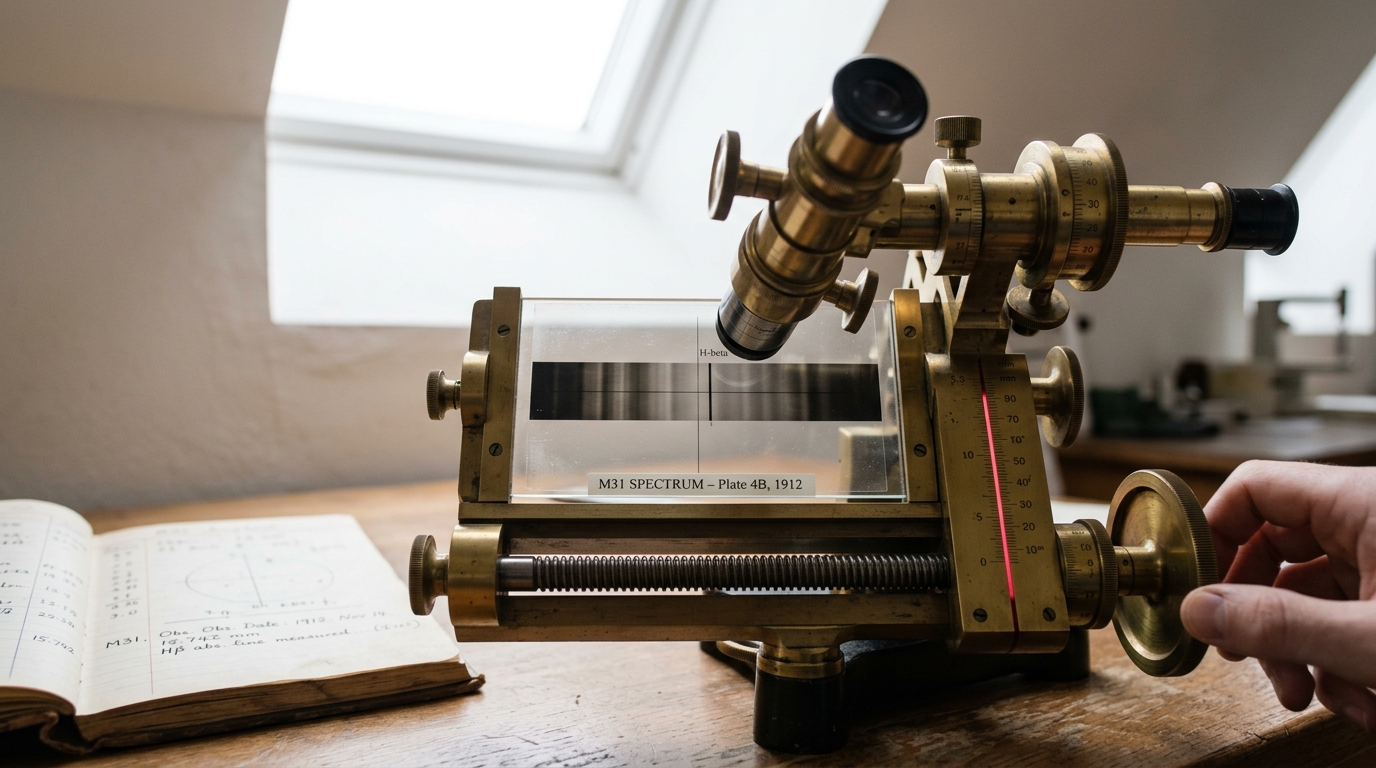
Einstein went to see the evidence himself. In January 1931, on his first extended visit to Caltech, he traveled to Mount Wilson Observatory with Hubble and the observatory’s director, Walter Adams, and was photographed there examining the 100-inch Hooker telescope he had come to discuss with the astronomers who had produced the redshift data [7]. Later that year he published “Zum kosmologischen Problem der allgemeinen Relativitätstheorie,” a paper analyzed in detail by the historians Cormac O’Raifeartaigh and Brendan McCann, who translated it into English for the first time in 2014. It set the cosmological constant to zero and proposed instead a relativistic model that expands from a point and later recontracts, an idea distinct from both his 1917 static universe and the monotonically expanding Einstein-de Sitter model he would help formulate the following year [8]. O’Raifeartaigh and McCann also found a numerical error in Einstein’s own matter-density calculation in that paper, one independently corroborated by surviving blackboard notes from a lecture Einstein gave at Oxford in May 1931 [8]. Even the paper that formally abandoned the static universe still carried an arithmetic slip in the same territory that had tripped him up with Friedmann nine years earlier.
The “Biggest Blunder” Line Is a Historical Claim, Not a Transcript
The story usually ends here with a punchline: Einstein supposedly called the cosmological constant “the biggest blunder of my life.” That line deserves the same scrutiny this piece has applied to everything before it, because unlike the 1917 paper or the 1923 retraction, it does not exist in Einstein’s own published writing at all. Its earliest print appearance is a 1956 Scientific American article by the physicist George Gamow, who wrote that “Einstein remarked to me many years ago that the cosmic repulsion idea was the biggest blunder he had made in his entire life,” a claim Gamow repeated with slightly different wording in his 1970 autobiography, My World Line [9]. No draft, letter, or recorded interview in Einstein’s own hand says this. For decades that absence has left historians uneasy about repeating the line as fact.
In 2018, O’Raifeartaigh and Mitton investigated the claim’s provenance directly, examining Gamow’s reliability, his documented relationship with Einstein, and whether any independent testimony corroborated the remark [9]. They found two: the physicist John Archibald Wheeler recounted hearing Einstein tell Gamow, while walking into the Institute for Advanced Study, “That was my biggest blunder of my life,” and Ralph Alpher, Gamow’s own collaborator, separately recalled Einstein describing his introduction of the constant as “a blunder” in a different conversation at Princeton [9]. Neither account is a primary document either; both are recollections, recorded years after the fact, of the same class of evidence the “biggest blunder” claim itself rests on. The authors’ conclusion is appropriately hedged rather than triumphant: it is very plausible Einstein said something like this on at least one occasion, and near-certain that he had come to regard the term as a serious error by the 1930s, but “it may never be known for certain if Einstein used those exact words” [9]. That is the honest state of the evidence, and it is a more useful lesson than the quote itself: a scientific legend can be well-supported and still not verifiable as a transcript, and the two things are not the same claim.

The Discarded Term Became the Explanation for Acceleration
The last irony is the one the historical record settles cleanly, because it happened inside living memory and under modern peer review. In 1998, two independent teams, the High-Z Supernova Search led in publication by Adam Riess and the Supernova Cosmology Project led by Saul Perlmutter, measured the brightness and redshift of distant Type Ia supernovae to trace the universe’s expansion history. Riess and nineteen co-authors reported that their high-redshift supernovae appeared systematically fainter, and therefore farther away, than a matter-only decelerating universe predicted, evidence for cosmic acceleration and a positive cosmological constant [10]. Perlmutter’s team, analyzing 42 high-redshift supernovae the following year, reported a non-zero, positive value for the Lambda term at high statistical confidence, essentially the mirror image of the “suspicious” verdict Einstein had once passed on Friedmann [11].
The term Einstein inserted in 1917 to keep the universe from evolving, then set to zero in 1931 because it was no longer needed to explain a universe that plainly was evolving, turned out in 1998 to be exactly the tool needed to explain how that evolution was itself accelerating. Lambda did not vanish from cosmology when Einstein discarded it; it went dormant in the equations for sixty-seven years, waiting for a measurement precise enough to require it again, this time for the opposite reason it was invented. O’Raifeartaigh and Mitton note the same irony in closing their own investigation of the blunder legend: by some readings, Einstein’s real error was not writing the term into his equations in 1917 but banishing it from them in 1931, since a small positive value is now standard cosmology’s own best account of the universe’s largest-scale behavior [9]. A single constant, in other words, has now been credited with holding the universe still, blamed for nothing when it was dropped, and rehabilitated as the reason the universe is speeding up — three verdicts on the same three characters in the equation, seventy years apart.
None of this makes Einstein’s resistance a simple error to smile at from the present. His 1917 assumption of a static universe was the mainstream astronomical judgment of its decade too; the very idea that “nebulae” might be entire external galaxies, rather than clouds within the Milky Way, was still unsettled when he wrote the paper. What the record shows instead is something narrower and more useful: the theorist who had just proven that simultaneity, length, and time itself were not absolute held out longest against the one implication of his own equations that made the universe, as a whole, into a historical object — a thing with a past different from its present, discovered the same way any evolving system is discovered, by comparing one measurement against an earlier one and refusing to explain away the difference. Friedmann’s math, Lemaître’s synthesis, and Hubble’s plates did the discovering. Einstein, for fourteen years, did the resisting, and the historical record of exactly how he resisted, edited and retracted and revisited under new evidence, is a better case study than any tidy quotation about a blunder.