The claim this briefing tests
“AI demand is causing a memory shortage” is the headline version of the 2026 HBM story. This briefing goes one level deeper: it quantifies the pricing escalation, identifies the specific manufacturing step that actually constrains supply, and traces the arithmetic that connects an HBM stack on an Nvidia accelerator to a $200 price increase on an unrelated consumer laptop.
Pricing across three generations
Per-stack HBM pricing has escalated sharply and consistently across generations: HBM3 at roughly $200/stack, HBM3E at roughly $300/stack, HBM4 at roughly $500/stack [1]. That is a 150% price increase across three generations, in a market where volumes are simultaneously growing — pricing power and volume growth moving in the same direction at once, which is the clearest possible signal of a genuine, not merely reported, shortage.
Why the constraint is not wafer capacity
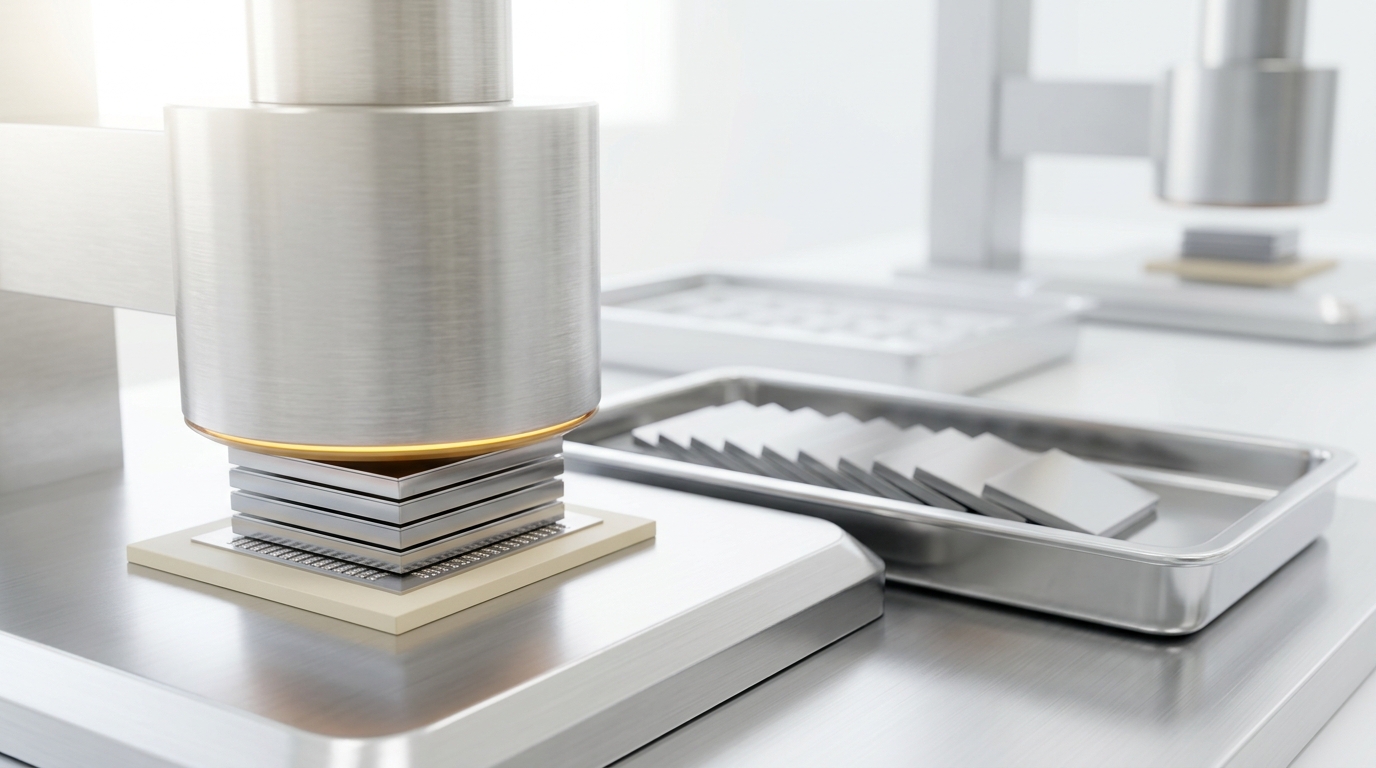
The single most important, least-appreciated fact in this story: the HBM shortage is not a silicon wafer shortage. It is a back-end assembly constraint, specifically: through-silicon via (TSV) throughput, hybrid-bonding line capacity, thermal-compression (TC) bonder availability, and known-good-stack-die yield [2]. Each of these is a distinct manufacturing step unique to building a tall, multi-die vertical stack rather than an ordinary flat DRAM chip, and each scales on a different, slower capital-equipment cycle than wafer fabrication does. A reader who assumes “just build more DRAM fabs” solves this problem is missing the actual bottleneck entirely.
The displacement ratio
One widely cited estimate quantifies the trade-off directly: every AI-grade HBM chip produced displaces the capacity to make roughly three ordinary consumer/PC-grade DRAM chips at the same fab [2]. That ratio is the mechanism — not a metaphor — connecting HBM demand to consumer electronics pricing. It is why a memory-fab operator choosing to allocate a production line toward HBM is, by the same decision, choosing not to produce roughly three units of ordinary DRAM, tightening that market simultaneously.
The consumer spillover, quantified
By Q4 2025, DRAM spot prices were reported at nearly triple their level from a year earlier. DDR5 contract prices rose 30-50% per quarter through the second half of 2025. Samsung raised overall memory prices by up to 60% since September 2025, then raised DRAM contract prices a further ~60-70% in Q1 2026, followed by another ~30% quarter-on-quarter increase in Q2 2026 [2] [6].
That chart compounds the reported percentage increases into a single index for illustration; the underlying quarterly percentages are the sourced figures, and the compounded index should be read as directional rather than as an official published price series.
| Segment | 2026 shortage evidence |
|---|---|
| HBM supply | Sold out for all of 2026, multi-year agreements [1] |
| DRAM spot price | ~3x year-over-year by Q4 2025 [2] |
| Consumer DRAM/NAND | Direct pass-through into PC, phone, SSD pricing [7] |
| Overall semiconductor revenue | Memory ≈24.6% of $1.3T projected 2026 total [8] |
The disagreement worth naming explicitly
Sources in this space disagree with each other, and the disagreement should be reported rather than resolved by picking a side. Sell-side analysis and multiple industry trackers describe the shortage persisting through 2028 [4]. SK hynix’s own public commentary goes further, warning the shortage “may last past 2030” [5] — though as a supplier with an obvious interest in high, stable pricing, that specific claim deserves reading with proportionate skepticism. Set against both: some overseas and Korean-media reporting suggests an HBM price correction is possible after 2026, as competition intensifies and capacity additions from all three producers begin landing simultaneously [3].
What would resolve the disagreement
The two views are not actually contradictory forecasts about the same variable — they differ on how fast hybrid-bonding and TC-bonding capacity, the specific bottlenecked step identified above, can be added across all three producers at once. A reader can track this directly: capital expenditure disclosures specifically earmarked for back-end HBM assembly capacity, not headline DRAM capex totals, are the leading indicator that would resolve which forecast proves closer to correct, likely visible in reported figures well before the 2027-2028 window itself arrives.